
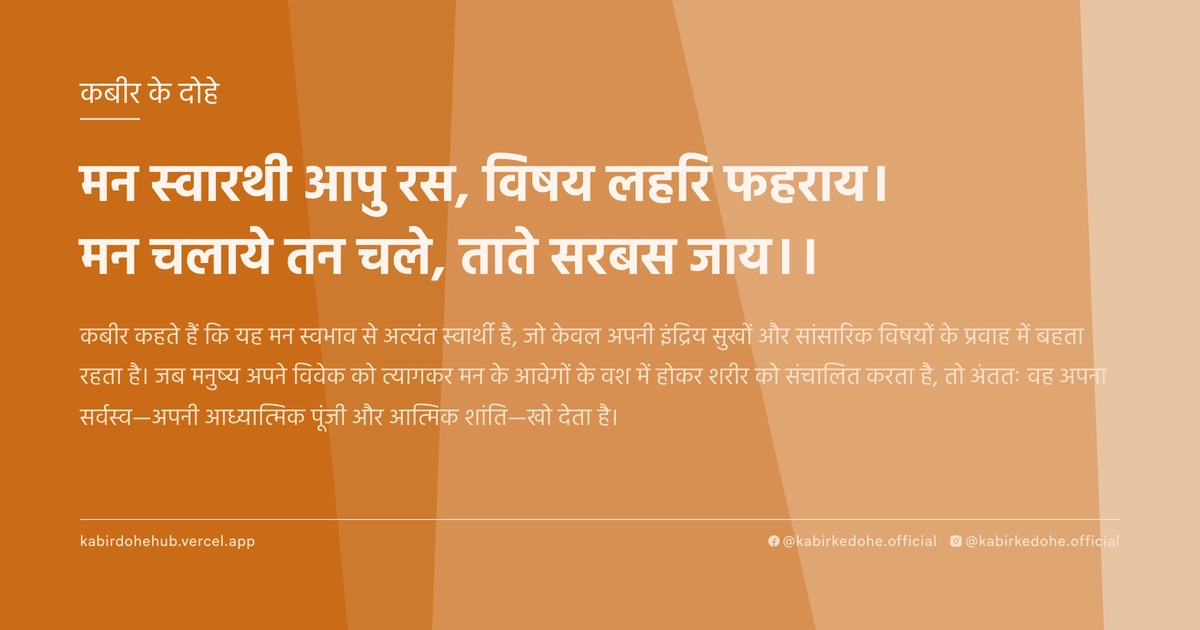
मन स्वारथी आपु रस, विषय लहरि फहराय।
मन चलाये तन चले, ताते सरबस जाय।।
Man swarthi aapu ras, vishay lahari phahray. Man chalaye tan chale, taate sarbas jaaye.
इस पृष्ठ पर इस कबीर दोहे का अर्थ (meaning), हिंदी व्याख्या और अंग्रेज़ी अनुवाद, दार्शनिक विश्लेषण और व्यावहारिक जीवन सीख दी गई है। यह दोहा मन नियंत्रण (Mind Control) विषय से जुड़ा है — Kabir doha meaning and explanation in Hindi and English.
अर्थ (Meaning):
कबीर कहते हैं कि यह मन स्वभाव से अत्यंत स्वार्थी है, जो केवल अपनी इंद्रिय सुखों और सांसारिक विषयों के प्रवाह में बहता रहता है। जब मनुष्य अपने विवेक को त्यागकर मन के आवेगों के वश में होकर शरीर को संचालित करता है, तो अंततः वह अपना सर्वस्व—अपनी आध्यात्मिक पूंजी और आत्मिक शांति—खो देता है।
Kabir explains that the mind is inherently selfish, forever drifting in the undulating waves of sensory pleasures and worldly desires. When a person allows the impulsive mind to drive the physical body, bypassing the higher intellect and spirit, they eventually lose everything—not just material wealth, but their very spiritual essence and inner peace.
व्याख्या (Interpretation):
इस दोहे का शाब्दिक अर्थ है कि मन अपनी तृप्ति के लिए विषयों की लहरों पर झूमता है। गहरे स्तर पर, यह 'माया' के प्रभाव का वर्णन है जहाँ जीव स्वयं को शरीर और मन के साथ एकाकार मान लेता है। यह द्वैतवाद की स्थिति है जहाँ 'मैं' और 'मेरा' का अहंकार सत्य को ढक लेता है। कबीर यहाँ निरगुण भक्ति के मार्ग पर जोर देते हैं, जहाँ मन को वश में करना ही वास्तविक साधना है। जब मन शरीर का सारथी बन जाता है, तो वह आत्मा को विस्मृत कर देता है। यह एक आध्यात्मिक विरोधाभास है: हम जिसे सुख समझते हैं, वही वास्तव में हमारे विनाश का कारण बनता है। अंततः, यह अद्वैत वेदांत के उस सत्य की ओर संकेत करता है जहाँ मन का विसर्जन ही ब्रह्म से मिलन का एकमात्र मार्ग है।
Literally, the verse describes the mind dancing upon the waves of sensory gratification. Metaphorically, this is a profound critique of 'Maya' (illusion), where the individual mistakenly identifies the eternal Atman with the transient mind and body. This state of duality, driven by the ego, obscures the realization of the formless Divine (Nirgun Brahman). Kabir highlights the central paradox of human existence: the pursuit of fleeting pleasure is the very mechanism that ensures spiritual bankruptcy. By allowing the impulsive mind to steer the physical vessel, the seeker drifts further from the shore of liberation. The 'loss of everything' refers to the erosion of consciousness and the forgetting of one's divine nature. True liberation occurs only when the mind ceases to be the master and becomes a transparent medium for the universal consciousness.
दार्शनिक विश्लेषण (Philosophical Analysis):
कबीर का यह दोहा उनके युग के धार्मिक पाखंड और बाहरी कर्मकांडों के विरुद्ध एक सशक्त प्रहार है। वे बताते हैं कि तीर्थयात्रा या माला जपना तब तक व्यर्थ है जब तक मन की स्वार्थपरता जीवित है। यह विश्लेषण सूफी मत के 'नफ्स' (अहंकार/इच्छा) के विचार से मेल खाता है, जहाँ नफ्स को मारकर ही खुदा को पाया जा सकता है।
अद्वैत वेदांत के परिप्रेक्ष्य में, मन वह पर्दा है जो जीव और ईश्वर के बीच खड़ा है। कबीर यहाँ 'मन' को एक ऐसे चंचल तत्व के रूप में देखते हैं जो निरंतर बाहरी दुनिया में सुख खोजता है, जबकि वास्तविक आनंद 'अंतर्मुखी' होने में है। वे जाति और धर्म के भेदों को नकारते हुए यह समझाते हैं कि अहंकार किसी विशेष वर्ग का नहीं, बल्कि मानवीय स्वभाव का दोष है।
मनोवैज्ञानिक स्तर पर, यह दोहा 'इच्छा' और 'विवेक' के बीच के संघर्ष को दर्शाता है। जब वासनाएं (विषय लहरि) हावी होती हैं, तो मनुष्य की निर्णय क्षमता समाप्त हो जाती है। कबीर का दर्शन यहाँ केवल नैतिक उपदेश नहीं, बल्कि एक मानसिक सर्जरी है जो मनुष्य को उसकी आसक्ति से मुक्त करने का प्रयास करती है।
भक्ति आंदोलन के संदर्भ में, कबीर की निरगुण उपासना यह सिखाती है कि ईश्वर किसी मंदिर या मस्जिद में नहीं, बल्कि उस शुद्ध चेतना में है जो मन के शोर के शांत होने पर प्रकट होती है। वे चेतावनी देते हैं कि जो व्यक्ति अपनी इंद्रियों का दास है, वह कभी भी सत्य का साक्षात्कार नहीं कर सकता।
अंततः, 'सरबस जाय' का अर्थ केवल भौतिक हानि नहीं है, बल्कि यह उस आध्यात्मिक पतन की ओर संकेत है जहाँ मनुष्य अपनी मानवता और दैवीय अंश को खो देता है। यह पूर्ण समर्पण (Surrender) की मांग करता है, जहाँ 'मैं' का विलोपन ही 'वह' की प्राप्ति है।
Kabir's verse serves as a surgical strike against the ritualistic hypocrisy of his era. He posits that external piety—be it pilgrimages or repetitive chanting—is meaningless if the internal machinery of the mind remains driven by selfishness. This aligns closely with the Sufi concept of 'Nafs' (the lower self/ego), which must be annihilated to achieve union with the Beloved.
From the lens of Advaita Vedanta, the mind is the primary veil (Maya) that separates the individual soul from the Absolute Brahman. Kabir identifies the mind as a restless entity that perpetually seeks validation and pleasure in the external world, whereas the ultimate truth is found in 'Antarmukhi' (inward-turning) consciousness. By rejecting caste and creed, he universalizes the struggle against the ego, framing it as a human condition rather than a social one.
Psychologically, the poem explores the tension between the limbic system's desires and the prefrontal cortex's discernment. When the 'waves of subjects' (sensory impulses) overwhelm the intellect, the individual loses the capacity for conscious choice, becoming a mere puppet of their biological urges. Kabir's approach is not merely moralistic but transformative, aiming for a complete cognitive shift.
Within the Bhakti movement, Kabir's Nirgun path emphasizes that the Divine is not a localized entity in a temple or mosque, but a pervasive consciousness that emerges only when the noise of the mind is silenced. He warns that slavery to the senses is the greatest barrier to spiritual enlightenment.
Ultimately, the phrase 'sarbas jaay' (everything is lost) refers to spiritual bankruptcy. It is the loss of the 'Sadhana' (spiritual practice) and the forgetting of one's divine origin. The only remedy is the total dissolution of the ego, where the 'I' vanishes to make room for the Universal Truth.
मूल संदेश (Core Message):
- मन की वासनाएँ सत्य के मार्ग में सबसे बड़ी बाधा हैं।
- इंद्रियों का दास होना आध्यात्मिक दासता है।
- विवेक द्वारा मन का नियंत्रण ही वास्तविक स्वतंत्रता है।
- बाहरी समृद्धि आंतरिक रिक्तता को कभी नहीं भर सकती।
- जब 'मैं' मिटता है, तभी 'परम सत्य' प्रकट होता है।
- The cravings of the mind are the primary obstacles to Truth.
- Slavery to the senses is the ultimate spiritual bondage.
- Mastering the mind through discernment is true liberation.
- External abundance can never fill an internal void.
- Only when the 'I' dissolves does the 'Universal Truth' emerge.
व्यावहारिक उदाहरण (Practical Example):
एक समय की बात है, वाराणसी के घाटों पर रामदीन नाम का एक वृद्ध बुनकर रहता था। वह अपने कपड़ों की बुनाई में इतना निपुण था कि लोग दूर-दूर से उसके पास आते थे। लेकिन रामदीन के भीतर एक गहरी लालसा थी—वह शहर का सबसे अमीर व्यापारी बनना चाहता था।
उसका मन हमेशा इस बात में लगा रहता कि कैसे वह अपनी कला का उपयोग करके अधिक धन कमा सके। उसने धीरे-धीरे गुणवत्ता की उपेक्षा करना शुरू कर दिया और सस्ते धागों का उपयोग करने लगा ताकि मुनाफा बढ़ सके।
उसका मन उसे फुसलाता था, "थोड़ा समझौता कर लो, कोई नहीं जानेगा।" वह विषय-लहरों में बह गया और केवल अपने स्वार्थ को देखने लगा।
उसने अपने पुराने ईमानदार ग्राहकों को धोखा देना शुरू किया। वह अब केवल सोने के सिक्कों की खनक सुनता था, जबकि उसकी आत्मा धीरे-धीरे सूख रही थी।
एक दिन, उसके जीवन में एक फकीर आया जिसने उसकी आँखों में देखा और कहा, "रामदीन, तूने रेशम के धागों से धन तो बुन लिया, लेकिन अपने चरित्र का धागा तोड़ दिया।"
रामदीन को पहले तो गुस्सा आया, लेकिन उस रात उसे नींद नहीं आई। उसने महसूस किया कि वह अब पहले जैसा खुश नहीं था। उसके पास धन तो था, लेकिन शांति गायब थी।
उसने देखा कि उसके बच्चे अब केवल पैसों की बात करते थे और उसके पुराने मित्र उससे दूर हो चुके थे। वह वास्तव में सब कुछ खो चुका था—सम्मान, प्रेम और अपनी आंतरिक शांति।
तभी उसे कबीर का यह दोहा याद आया कि जब मन शरीर को चलाता है, तो सब कुछ नष्ट हो जाता है। उसने महसूस किया कि उसका 'स्वार्थी मन' ही उसका असली शत्रु था।
रामदीन ने उसी क्षण निर्णय लिया कि वह अपनी सारी अतिरिक्त संपत्ति गरीबों में बाँट देगा और पुनः ईमानदारी से बुनाई करेगा।
उसने अपने मन को अपना स्वामी बनाने के बजाय, उसे अपना सेवक बनाना सीखा। धीरे-धीरे उसकी खोई हुई शांति और सम्मान वापस लौट आए, और वह वास्तव में समृद्ध हो गया।
Once, on the ghats of Varanasi, lived an elderly weaver named Ramdeen. He was a master of his craft, and people traveled from afar for his exquisite fabrics. However, within Ramdeen grew a seed of insatiable greed—he desired to become the wealthiest merchant in the city.
His mind became obsessed with maximizing profit. He began to neglect the quality of his work, substituting fine silk with cheaper, inferior threads to increase his margins.
His mind whispered, "Just a small compromise; no one will notice." He surrendered to these waves of desire, allowing his selfishness to dictate his actions.
He started deceiving his long-time, loyal customers. While the clinking of gold coins filled his ears, his spirit began to wither in silence.
One day, a wandering ascetic visited him. Looking deeply into Ramdeen's eyes, the ascetic remarked, "Ramdeen, you have woven wealth with your silk, but you have snapped the thread of your character."
Ramdeen was initially offended, but that night, sleep evaded him. He realized that despite his riches, the joy he once felt in his craft had vanished.
He noticed that his children now spoke only of money, and his old friends had drifted away. He had indeed lost everything—respect, genuine love, and inner tranquility.
In that moment of clarity, Kabir's words echoed in his mind: when the mind drives the body, all is lost. He realized that his 'selfish mind' had been his true master and his greatest enemy.
Ramdeen decided to distribute his excess wealth among the needy and return to the path of honest craftsmanship.
He learned to treat his mind as a servant rather than a master. Gradually, his peace and respect returned, and he discovered a wealth that gold could never buy.
अभ्यास मार्गदर्शन (Practice Guidance):
- प्रतिदिन 20 मिनट 'साक्षी भाव' (Witness Consciousness) का अभ्यास करें, जहाँ आप अपने मन के विचारों को बिना किसी निर्णय के केवल देखें।
- एक 'इच्छा डायरी' बनाएँ। जब भी कोई तीव्र इच्छा जागे, उसे लिखें और स्वयं से पूछें: "क्या यह मेरी आत्मा की आवश्यकता है या केवल मन का स्वार्थ?"
- सचेत उपभोग (Conscious Consumption) का अभ्यास करें। कुछ भी खरीदने या करने से पहले 5 मिनट रुकें और विचार करें कि क्या यह क्रिया आपके अहंकार को बढ़ा रही है।
- निदान चेकलिस्ट: यदि आप छोटी बातों पर अत्यधिक क्रोधित हो रहे हैं, दूसरों की सफलता से ईर्ष्या कर रहे हैं, या केवल भौतिक लाभ के लिए निर्णय ले रहे हैं, तो समझ लें कि आपका 'मन' शरीर को चला रहा है।
- Practice 'Sakshi Bhav' (Witness Consciousness) for 20 minutes daily, observing your thoughts as a detached observer without judgment.
- Maintain a 'Desire Journal'. Whenever a strong impulse arises, write it down and ask: "Is this a need of my soul, or merely the selfishness of the mind?"
- Practice Conscious Consumption. Before any purchase or action, pause for 5 minutes and analyze whether this act is feeding your ego or your essence.
- Diagnostic Checklist: If you find yourself reacting with disproportionate anger, feeling envy toward others' success, or making decisions based solely on material gain, recognize that the 'mind' has taken the driver's seat.
चिंतन प्रश्न (Reflection Questions):
- मेरे जीवन के वे कौन से निर्णय थे जो केवल मेरे अहंकार को संतुष्ट करने के लिए लिए गए थे?
- क्या मेरी डिजिटल पहचान (सोशल मीडिया) मेरे वास्तविक स्वरूप को ढक रही है?
- जब मैं दूसरों की मदद करता हूँ, तो क्या उसके पीछे कोई सूक्ष्म स्वार्थ छिपा होता है?
- यदि आज मेरा सारा भौतिक वैभव छीन लिया जाए, तो मेरे पास 'मैं' के रूप में क्या बचेगा?
- मैं अपने जीवन में 'शांति' की तलाश कर रहा हूँ या 'उत्तेजना' की?
- मेरे भीतर का कौन सा 'विषय' (लहर) मुझे बार-बार मेरे केंद्र से दूर ले जाता है?
- Which decisions in my life were made solely to feed my ego's hunger for validation?
- Is my digital persona creating a mask that hides my authentic spiritual self?
- When I perform acts of kindness, is there a hidden motive for social approval?
- If all my material possessions were stripped away today, what would remain of 'Me'?
- Am I truly seeking 'Peace' or am I merely addicted to 'Excitement'?
- Which specific 'wave' of desire repeatedly pulls me away from my inner center?