
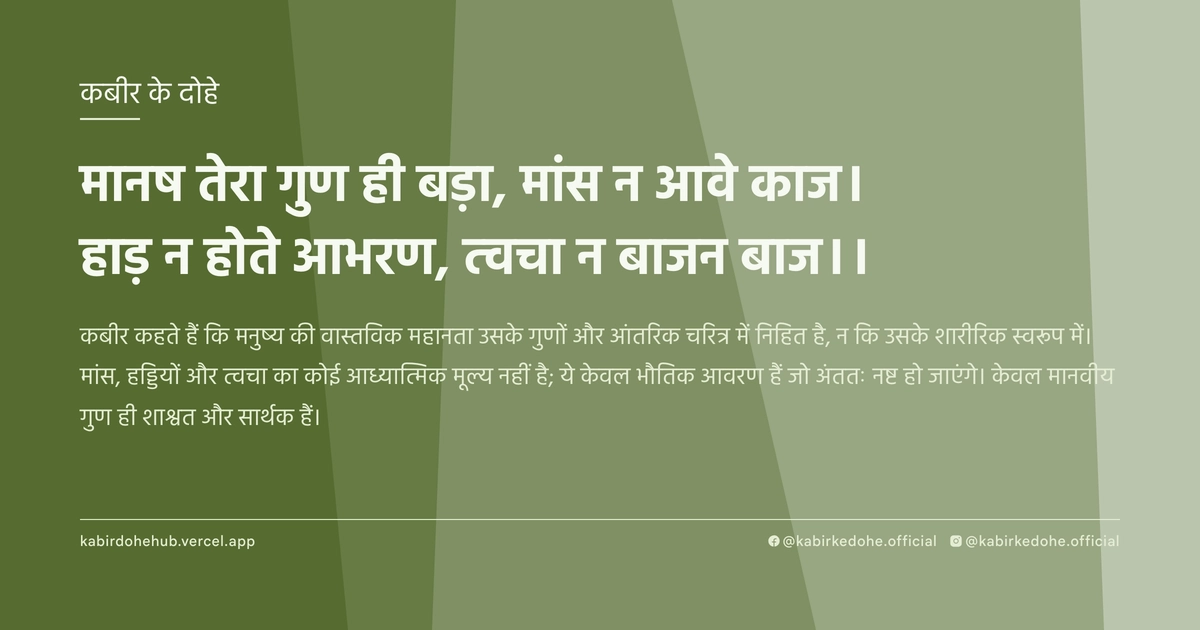
मानष तेरा गुण ही बड़ा, मांस न आवे काज।
हाड़ न होते आभरण, त्वचा न बाजन बाज।।
Maanash tera gun hi bada, maans na aave kaaj. Haad na hote aabharan, tvacha na baajan baaj.
इस पृष्ठ पर इस कबीर दोहे का अर्थ (meaning), हिंदी व्याख्या और अंग्रेज़ी अनुवाद, दार्शनिक विश्लेषण और व्यावहारिक जीवन सीख दी गई है। यह दोहा आत्मा और शरीर (Soul and Body) विषय से जुड़ा है — Kabir doha meaning and explanation in Hindi and English.
अर्थ (Meaning):
कबीर कहते हैं कि मनुष्य की वास्तविक महानता उसके गुणों और आंतरिक चरित्र में निहित है, न कि उसके शारीरिक स्वरूप में। मांस, हड्डियों और त्वचा का कोई आध्यात्मिक मूल्य नहीं है; ये केवल भौतिक आवरण हैं जो अंततः नष्ट हो जाएंगे। केवल मानवीय गुण ही शाश्वत और सार्थक हैं।
Kabir asserts that a human's true greatness lies solely in their virtues and inner character, not in their physical appearance. Flesh, bones, and skin hold no spiritual value; they are merely material coverings destined for decay. Only the inherent qualities of the soul are eternal and meaningful.
व्याख्या (Interpretation):
यह दोहा शरीर की नश्वरता और आत्मा की अमरता के बीच के विरोधाभास को दर्शाता है। कबीर पहले भौतिक शरीर के घटकों—मांस, हड्डी और त्वचा—का वर्णन करते हैं, यह बताते हुए कि ये किसी भी आध्यात्मिक कार्य में सहायक नहीं हैं। यहाँ 'गुण' शब्द का प्रयोग केवल नैतिक गुणों के लिए नहीं, बल्कि उस दैवीय चेतना के लिए किया गया है जो शरीर के भीतर निवास करती है। यह निर्गुण भक्ति का सार है, जहाँ ईश्वर को किसी रूप या आकार में नहीं, बल्कि शुद्ध गुणों और सत्य में खोजा जाता है। माया हमें यह विश्वास दिलाती है कि सुंदरता या शारीरिक शक्ति महत्वपूर्ण है, जबकि वास्तव में ये केवल 'आभरण' या बाहरी सजावट हैं। जब अहंकार इस भौतिकता से हटकर आंतरिक गुणों की ओर मुड़ता है, तब व्यक्ति अपनी वास्तविक पहचान, यानी आत्मा-ब्रह्म की एकता को पहचान पाता है।
This couplet highlights the paradox between the perishability of the body and the immortality of the soul. Kabir first describes the physical components—flesh, bone, and skin—explaining that they contribute nothing to spiritual liberation. The term 'gun' (virtue/quality) refers not just to morality, but to the divine consciousness residing within. This is the essence of Nirgun Bhakti, where the Divine is sought not in forms or images, but in pure attributes and Truth. Maya deceives us into believing that physical beauty or strength is paramount, whereas these are merely 'aabharan' or external ornaments. When the ego shifts its focus from the material to the internal virtues, the individual realizes their true identity: the non-duality of Atman and Brahman.
दार्शनिक विश्लेषण (Philosophical Analysis):
कबीर का यह दृष्टिकोण उनके युग के कट्टरपंथी सामाजिक और धार्मिक ढांचे के विरुद्ध एक सशक्त प्रहार था। उस समय समाज जाति, वर्ण और शारीरिक लक्षणों के आधार पर श्रेष्ठता तय करता था। कबीर ने इस बाहरी विभाजन को पूरी तरह नकार दिया और घोषणा की कि मनुष्य की पहचान उसके जन्म या शरीर से नहीं, बल्कि उसके कर्मों और गुणों से होती है। यह विचार सीधे तौर पर अद्वैत वेदांत से जुड़ता है, जहाँ शरीर को केवल एक 'कोश' या आवरण माना गया है, जबकि वास्तविक तत्व शुद्ध चेतना है।
सूफीवाद के प्रभाव में, कबीर 'फना' (अहंकार का विनाश) की बात करते हैं। जब मनुष्य यह समझ लेता है कि उसकी त्वचा और हड्डियाँ केवल मिट्टी हैं, तो वह उस अहंकार से मुक्त हो जाता है जो उसे दूसरों से श्रेष्ठ दिखाता है। यह मनोवैज्ञानिक रूपांतरण है जहाँ व्यक्ति 'मैं' (शरीर) से 'वह' (परमात्मा) की ओर बढ़ता है।
कबीर ritualism (कर्मकांड) का विरोध करते हैं क्योंकि बाहरी दिखावा अक्सर आंतरिक शून्यता को छिपाने का प्रयास होता है। वे तर्क देते हैं कि मंदिर, मस्जिद या शारीरिक पवित्रता का कोई अर्थ नहीं है यदि हृदय में करुणा और सत्य जैसे गुण नहीं हैं।
दार्शनिक स्तर पर, यह दोहा द्वैतवाद (Dualism) को चुनौती देता है। यह सिखाता है कि शरीर और आत्मा अलग नहीं हैं, बल्कि शरीर वह माध्यम है जिसके द्वारा आत्मा अपने गुणों को अभिव्यक्त करती है। हालांकि, जब व्यक्ति शरीर को ही अपनी पहचान मान लेता है, तो वह भ्रम (Maya) में फंस जाता है।
अंततः, कबीर का संदेश यह है कि मृत्यु के बाद केवल 'गुण' ही शेष रहते हैं। यह विश्लेषण हमें यह समझने के लिए प्रेरित करता है कि भौतिक सौंदर्य और सामाजिक प्रतिष्ठा क्षणभंगुर हैं, जबकि आध्यात्मिक जागृति ही एकमात्र स्थायी उपलब्धि है।
Kabir's perspective was a powerful strike against the rigid social and religious frameworks of his era. At that time, society determined superiority based on caste, varna, and physical attributes. Kabir completely rejected this external division, declaring that a human's identity is defined not by birth or body, but by their deeds and virtues. This idea aligns directly with Advaita Vedanta, where the body is viewed merely as a 'kosha' or sheath, while the true essence is pure consciousness.
Influenced by Sufism, Kabir speaks of 'Fana' (the annihilation of the ego). When a person realizes that their skin and bones are merely earth, they are liberated from the ego that makes them feel superior to others. This is a psychological transformation where the individual moves from the 'I' (the body) toward the 'That' (the Divine).
Kabir opposed ritualism because external displays are often attempts to hide internal emptiness. He argues that temples, mosques, or physical purity are meaningless if the heart lacks virtues like compassion and truth.
On a philosophical level, this couplet challenges dualism. It teaches that the body and soul are not separate, but the body is the medium through which the soul expresses its qualities. However, when a person mistakes the body for their identity, they fall into the trap of Maya (illusion).
Ultimately, Kabir's message is that only 'virtues' remain after death. This analysis urges us to understand that physical beauty and social prestige are ephemeral, while spiritual awakening is the only lasting achievement.
मूल संदेश (Core Message):
- शरीर केवल एक मिट्टी का पुतला है, इसे अपनी पहचान न बनाएं।
- बाहरी सुंदरता क्षणभंगुर है, आंतरिक गुण शाश्वत हैं।
- अहंकार का अंत ही वास्तविक आध्यात्मिक यात्रा की शुरुआत है।
- सच्ची मानवता मांस और हड्डियों में नहीं, करुणा में बसती है।
- आत्मा का प्रकाश शरीर के अंधकार को मिटा देता है।
- The body is but a puppet of clay; do not make it your identity.
- External beauty is ephemeral; internal virtues are eternal.
- The end of ego is the true beginning of the spiritual journey.
- True humanity resides in compassion, not in flesh and bone.
- The light of the soul dissolves the darkness of the physical form.
व्यावहारिक उदाहरण (Practical Example):
वाराणसी के एक पुराने घाट पर, रामदीन नाम का एक वृद्ध बुनकर रहता था। वह अपनी कला में निपुण था, लेकिन उसका शरीर समय के साथ जर्जर हो गया था। उसकी कमर झुक गई थी, हाथ कांपते थे और त्वचा झुर्रियों से भर गई थी। शहर के अमीर लोग और नए युवा कलाकार उसे देखकर उपहास करते थे, क्योंकि वे केवल उसकी बाहरी कमजोरी और ढलती उम्र को देखते थे।
रामदीन को इस बात का दुख नहीं था, क्योंकि उसने अपना पूरा जीवन सत्य और निस्वार्थ सेवा में बिताया था। वह चुपचाप अपने करघे पर काम करता और आने वाले हर राहगीर को बिना किसी भेदभाव के प्रेम और ज्ञान बांटता था।
एक दिन, शहर का एक अहंकारी युवा मूर्तिकार, जो अपनी शारीरिक सुंदरता और मांसपेशियों पर बहुत गर्व करता था, रामदीन के पास आया। वह रामदीन की शारीरिक स्थिति का मजाक उड़ाते हुए बोला, "बाबा, आप इस टूटे हुए शरीर के साथ क्या ही कर पाएंगे? देखिए मुझे, मैं शक्तिशाली हूँ, मेरी त्वचा चमकती है, मैं दुनिया जीत सकता हूँ।"
रामदीन मुस्कुराया और उसने अपनी एक पुरानी, फटी हुई चादर उठाई। उसने कहा, "बेटा, इस चादर को देखो। यह बाहर से मैली और फटी हुई है, लेकिन इसके भीतर जो सूत है, वह सोने जैसा शुद्ध है। यदि मैं इस चादर को जला दूँ, तो क्या उसकी सुंदरता बचेगी? नहीं। लेकिन जो गुण इस चादर को बुनने वाले ने इसमें डाले हैं, वे याद रखे जाएंगे।"
युवा मूर्तिकार को लगा कि यह केवल एक साधारण बात है। लेकिन उसी रात, उस युवा को एक गंभीर दुर्घटना का सामना करना पड़ा जिससे उसकी शारीरिक सुंदरता पूरी तरह नष्ट हो गई। वह बिस्तर पर पड़ गया और उसकी वह 'चमकती त्वचा' अब किसी काम की नहीं रही।
अकेलेपन और दर्द में, वह युवा मूर्तिकार रामदीन के पास गया। उसने देखा कि रामदीन, जो शारीरिक रूप से कमजोर था, उसके चेहरे पर एक ऐसी शांति और तेज था जो उस युवा की सुंदरता में कभी नहीं था। रामदीन ने उसे सहारा दिया और बिना किसी अहंकार के उसकी सेवा की।
उस क्षण युवा को कबीर के शब्दों का बोध हुआ। उसने महसूस किया कि उसने अब तक केवल 'मांस और हड्डी' की पूजा की थी, जबकि असली शक्ति उस 'गुण' में थी जो रामदीन के भीतर था।
उसने अपनी पूरी जीवनशैली बदल ली। उसने बाहरी दिखावे को त्याग कर आंतरिक करुणा और सेवा को अपना लिया। वह समझ गया कि शरीर केवल एक वस्त्र है, और असली मनुष्य वह है जिसके गुण दूसरों के जीवन में प्रकाश भर सकें।
On an old ghat in Varanasi lived an elderly weaver named Ramdeen. He was a master of his craft, but his body had grown frail with time. His back was bent, his hands trembled, and his skin was covered in wrinkles. The wealthy people of the city and young artists would often mock him, seeing only his physical weakness and aging frame.
Ramdeen was not saddened by this, for he had spent his entire life in truth and selfless service. He quietly worked at his loom, sharing love and wisdom with every passerby without discrimination.
One day, an arrogant young sculptor, who took immense pride in his physical beauty and muscles, approached Ramdeen. Mocking his condition, the youth said, "Baba, what can you possibly achieve with this broken body? Look at me—I am powerful, my skin glows, I can conquer the world."
Ramdeen smiled and picked up an old, torn shawl. He said, "Son, look at this cloth. It is dirty and torn on the outside, but the thread within it is as pure as gold. If I burn this shawl, will its beauty remain? No. But the virtues the weaver wove into it will be remembered."
The young sculptor thought this was merely a simple platitude. However, that very night, the youth met with a severe accident that completely destroyed his physical beauty. He became bedridden, and his 'glowing skin' was now of no use.
In his loneliness and pain, the young sculptor went to Ramdeen. He noticed that Ramdeen, despite his physical frailty, possessed a peace and radiance on his face that the youth's beauty had never held.
In that moment, the youth realized the truth of Kabir's words. He understood that he had spent his life worshipping 'flesh and bone,' while the real power lay in the 'virtues' residing within Ramdeen.
He completely transformed his lifestyle. He abandoned external vanity and embraced internal compassion and service. He understood that the body is merely a garment, and a true human is one whose virtues bring light into the lives of others.
अभ्यास मार्गदर्शन (Practice Guidance):
- प्रतिदिन 15 मिनट मौन ध्यान करें, जहाँ आप अपना ध्यान शरीर की संवेदनाओं से हटाकर अपने आंतरिक गुणों (जैसे प्रेम, क्षमा, धैर्य) पर केंद्रित करें।
- एक 'अहंकार डायरी' लिखें: दिन भर में उन क्षणों को नोट करें जब आपने किसी को उसके बाहरी रूप, रंग या स्थिति के आधार पर आंका, और फिर उसे सुधारने का प्रयास करें।
- सेवा अभ्यास: सप्ताह में एक बार किसी ऐसे व्यक्ति की मदद करें जिसे समाज 'कमजोर' या 'अदृश्य' मानता है, ताकि आप शरीर से परे मानवीय गुणों को देख सकें।
- निदान चेकलिस्ट: क्या मैं दर्पण में अपना चेहरा देखकर अधिक समय बिताता हूँ या अपने चरित्र पर विचार करने में? क्या मैं दूसरों की प्रशंसा उनके पद/रूप के लिए करता हूँ या उनके व्यवहार के लिए? यदि उत्तर बाहरी है, तो आप अभी भी माया के प्रभाव में हैं।
- Practice 15 minutes of silent meditation daily, shifting your focus from bodily sensations to your internal virtues (such as love, forgiveness, and patience).
- Keep an 'Ego Diary': Note moments throughout the day when you judged someone based on their appearance, color, or status, and then consciously work to correct that perception.
- Service Practice: Once a week, help someone whom society considers 'weak' or 'invisible,' allowing you to see human virtues beyond the physical form.
- Diagnostic Checklist: Do I spend more time looking at my face in the mirror or reflecting on my character? Do I praise others for their status/looks or for their behavior? If the answer is external, you are still under the influence of Maya.
चिंतन प्रश्न (Reflection Questions):
- यदि आज मेरा पूरा शारीरिक स्वरूप बदल जाए, तो मेरे व्यक्तित्व में ऐसा क्या बचेगा जिसे दुनिया 'मैं' कह सके?
- मैं अपनी डिजिटल पहचान (सोशल मीडिया) को संवारने में जितना समय लगाता हूँ, क्या उसका दसवां हिस्सा भी मैं अपने चरित्र निर्माण में लगाता हूँ?
- क्या मेरी करुणा केवल उन लोगों के लिए है जो सुंदर या प्रभावशाली दिखते हैं?
- जब मैं किसी की 'खामियों' को देखता हूँ, तो क्या मैं वास्तव में उन्हें देख रहा होता हूँ या अपनी अपनी धारणाओं के प्रतिबिंब को?
- मृत्यु के क्षण में, मेरी कौन सी उपलब्धि मुझे सुकून देगी—मेरा बैंक बैलेंस, मेरा रूप, या मेरी निस्वार्थता?
- If my entire physical appearance changed today, what would remain of my personality that the world could still call 'I'?
- Do I spend even a tenth of the time I use to curate my digital identity (social media) on building my actual character?
- Is my compassion reserved only for those who appear beautiful or influential?
- When I perceive 'flaws' in others, am I seeing them, or am I seeing a reflection of my own biases?
- At the moment of death, which achievement will bring me peace—my bank balance, my looks, or my selflessness?