
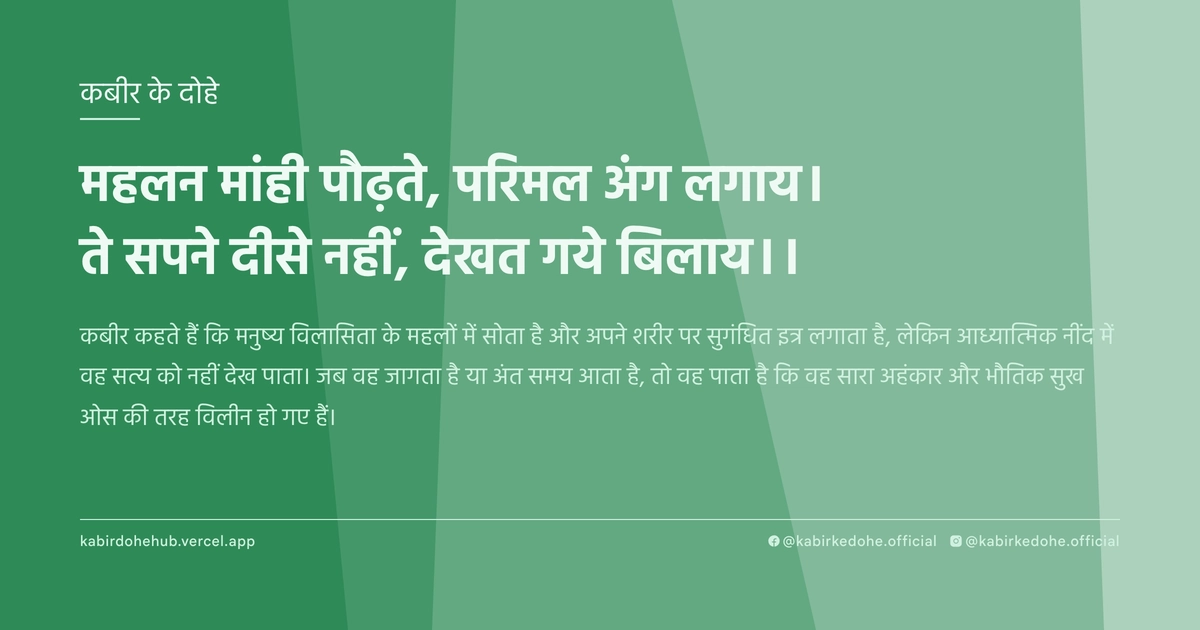
महलन मांही पौढ़ते, परिमल अंग लगाय।
ते सपने दीसे नहीं, देखत गये बिलाय।।
Mahlan maahi paudhate, parimal ang lagay. Te sapne deese nahin, dekhat gaye bilay.
इस पृष्ठ पर इस कबीर दोहे का अर्थ (meaning), हिंदी व्याख्या और अंग्रेज़ी अनुवाद, दार्शनिक विश्लेषण और व्यावहारिक जीवन सीख दी गई है। यह दोहा अनित्य (Impermanence) विषय से जुड़ा है — Kabir doha meaning and explanation in Hindi and English.
अर्थ (Meaning):
कबीर कहते हैं कि मनुष्य विलासिता के महलों में सोता है और अपने शरीर पर सुगंधित इत्र लगाता है, लेकिन आध्यात्मिक नींद में वह सत्य को नहीं देख पाता। जब वह जागता है या अंत समय आता है, तो वह पाता है कि वह सारा अहंकार और भौतिक सुख ओस की तरह विलीन हो गए हैं।
Kabir observes that man sleeps in luxurious palaces, adorning his body with fragrant perfumes, yet in this state of spiritual slumber, he fails to perceive the Ultimate Truth. When the moment of awakening or death arrives, he discovers that all his ego-driven pleasures have vanished like a fleeting dream.
व्याख्या (Interpretation):
यह दोहा भौतिकवाद और आध्यात्मिक अज्ञानता के बीच के विरोधाभास को दर्शाता है। 'महल' केवल ईंट-पत्थर का घर नहीं, बल्कि अहंकार और सामाजिक प्रतिष्ठा का प्रतीक है। 'परिमल' या सुगंध बाहरी दिखावे और इंद्रिय सुखों को इंगित करती है। कबीर यहाँ 'निर्गुण भक्ति' के परिप्रेक्ष्य से समझाते हैं कि जब तक आत्मा माया के आवरण में लिपटी रहती है, वह ब्रह्म के साथ अपने अद्वैत संबंध को नहीं पहचान पाती। यह एक गहरी विडंबना है कि मनुष्य बाहरी सौंदर्य को संवारने में पूरा जीवन व्यतीत कर देता है, जबकि आंतरिक आत्मा धूल धूसरित रहती है। अंततः, यह भौतिक अस्तित्व एक स्वप्न के समान है जो सत्य के प्रकाश के सामने विलीन हो जाता है।
This couplet illustrates the paradox between materialism and spiritual ignorance. The 'palace' is not merely a physical structure but a symbol of the ego and social prestige. 'Parimal' or fragrance signifies external adornments and sensory gratifications. From the perspective of Nirgun Bhakti, Kabir explains that as long as the soul is shrouded in the veil of Maya, it cannot recognize its non-dual relationship with Brahman. It is a profound irony that man spends his entire life grooming the external shell while the internal soul remains neglected. Ultimately, this material existence is akin to a dream that dissolves instantly upon the dawn of spiritual awakening.
दार्शनिक विश्लेषण (Philosophical Analysis):
कबीर का यह प्रहार उनके युग के उस सामाजिक ढांचे पर है जहाँ धर्म और ईश्वर को बाहरी कर्मकांडों और वैभव से जोड़ा गया था। वे स्पष्ट करते हैं कि मोक्ष महलों में नहीं, बल्कि मन के समर्पण में है। यहाँ अद्वैत वेदांत का प्रभाव दिखता है, जहाँ संसार को 'मिथ्या' या एक भ्रम माना गया है। कबीर का तर्क है कि जो व्यक्ति अपनी पहचान को अपने पद, धन या शरीर से जोड़ता है, वह वास्तव में एक गहरी निद्रा में है।
सूफी मत के 'फना' (अहंकार का विनाश) के सिद्धांत की तरह, कबीर यहाँ यह बता रहे हैं कि जब तक 'मैं' (अहंकार) जीवित है, तब तक 'वह' (परमात्मा) अदृश्य है। सुगंधित इत्र लगाना इस बात का प्रतीक है कि मनुष्य अपनी कमियों को ढकने के लिए बाहरी दिखावे का सहारा लेता है, लेकिन मृत्यु और समय के सामने यह दिखावा निरर्थक है।
वे जाति और वर्ग के भेदों को नकारते हुए कहते हैं कि मृत्यु सबको समान बनाती है। एक राजा का महल और एक फकीर की झोपड़ी, अंत में दोनों ही शून्य में विलीन हो जाते हैं। यह विश्लेषण हमें सिखाता है कि वास्तविक संपत्ति वह नहीं जो संचित की जाए, बल्कि वह है जो अनुभव की जाए।
मनोवैज्ञानिक स्तर पर, यह दोहा 'संज्ञानात्मक विसंगति' (cognitive dissonance) को दर्शाता है—जहाँ मनुष्य जानता है कि सब कुछ नश्वर है, फिर भी वह नश्वरता को संजोने में लगा रहता है। कबीर इस विसंगति को तोड़कर व्यक्ति को आत्म-साक्षात्कार की ओर धकेलते हैं।
अंततः, यह संदेश है कि बाहरी चमक-धमक केवल एक पर्दा है। जब यह पर्दा गिरता है, तो केवल सत्य बचता है। कबीर का मार्ग वह मार्ग है जो हमें 'होने' के भ्रम से निकालकर 'सत्य' के अनुभव तक ले जाता है।
Kabir's critique targets the social fabric of his era, where divinity was often conflated with external rituals and opulence. He asserts that liberation is found not in palaces, but in the surrender of the mind. The influence of Advaita Vedanta is evident here, as the material world is characterized as 'Mithya' or an illusion.
Mirroring the Sufi concept of 'Fana' (the annihilation of the ego), Kabir suggests that as long as the 'I' (ego) persists, the 'He' (Divine) remains hidden. The act of applying fragrant perfumes symbolizes the human tendency to mask internal voids with external pretenses, which prove futile in the face of time and mortality.
By rejecting caste and class distinctions, he emphasizes that death is the great equalizer. The palace of a king and the hut of a mystic both dissolve into the void. This analysis posits that true wealth is not that which is accumulated, but that which is realized within.
Psychologically, this doha highlights a state of cognitive dissonance—where humans are aware of the impermanence of life yet remain obsessively attached to the ephemeral. Kabir seeks to shatter this delusion to propel the individual toward self-realization.
Ultimately, the message is that external splendor is merely a veil. When this veil is lifted, only the Truth remains. Kabir's path is one that transitions the seeker from the illusion of 'being' something to the experience of 'Truth' itself.
मूल संदेश (Core Message):
- बाहरी विलासिता आध्यात्मिक अंधापन पैदा करती है।
- अहंकार का महल सत्य के मार्ग में सबसे बड़ी बाधा है।
- दिखावे की सुगंध आत्मा की दुर्गंध को नहीं छिपा सकती।
- संसार एक स्वप्न है; जागरण ही एकमात्र मुक्ति है।
- शून्य होना ही पूर्ण होने का एकमात्र तरीका है।
- आंतरिक सादगी ही वास्तविक दिव्यता का द्वार है।
- External luxury breeds spiritual blindness.
- The palace of ego is the greatest barrier to Truth.
- The fragrance of pretense cannot mask the soul's decay.
- The world is a dream; awakening is the only liberation.
- Becoming nothing is the only way to become everything.
- Inner simplicity is the only gateway to true divinity.
व्यावहारिक उदाहरण (Practical Example):
वाराणसी के घाटों पर रहने वाली एक वृद्ध विधवा, जानकी, का जीवन इसी दोहे का जीवंत उदाहरण था। जानकी के पास कभी बहुत धन था और वह शहर के सबसे प्रतिष्ठित घरों में से एक की मालकिन थी। उसने अपना पूरा जीवन अपने घर की सजावट, रेशमी साड़ियों और समाज में अपनी उच्च स्थिति को बनाए रखने में लगा दिया। वह मानती थी कि उसकी प्रतिष्ठा ही उसकी पहचान है।
समय बीता, और धीरे-धीरे उसके परिवार के सदस्य उसे छोड़कर चले गए। उसकी संपत्ति कानूनी विवादों में फंस गई और वह एक छोटी सी कुटिया में रहने को मजबूर हो गई। अब उसके पास न तो रेशमी साड़ियाँ थीं और न ही वह सुगंधित इत्र, जिसे वह कभी अपनी पहचान मानती थी।
एक दिन, वह घाट पर बैठी एक युवा सन्यासी को देख रही थी, जिसके पास कुछ नहीं था, फिर भी उसके चेहरे पर एक असीम शांति थी। जानकी को अचानक कबीर का यह दोहा याद आया। उसे अहसास हुआ कि वह वर्षों तक जिस 'महल' में सो रही थी, वह वास्तव में एक मानसिक कारागार था।
उसने महसूस किया कि उसने अपनी पूरी ऊर्जा बाहरी दुनिया को प्रभावित करने में लगा दी, जबकि उसके भीतर का खालीपन बढ़ता गया। वह सुगंध, जिसे वह लगाती थी, वास्तव में उसकी आत्मा की पुकार को दबाने का एक तरीका था।
इस बोध ने जानकी के भीतर एक क्रांति पैदा की। उसने अब अपनी शेष आयु दूसरों की सेवा में लगाने का निर्णय लिया। उसने घाट पर आने वाले असहाय लोगों को भोजन कराना शुरू किया।
उसने पाया कि जब उसने अपने अहंकार के 'महल' को ढहा दिया, तब उसे वह शांति मिली जो उसे सोने के बिस्तरों पर कभी नहीं मिली थी। उसकी बाहरी गरीबी उसकी आंतरिक समृद्धि का कारण बन गई।
उसका व्यवहार बदल गया; अब वह किसी की सामाजिक स्थिति को नहीं देखती थी, बल्कि केवल मनुष्य की पीड़ा को देखती थी। वह अब 'परिमल' की तलाश नहीं करती थी, क्योंकि उसकी आत्मा की सादगी ही अब उसकी सुगंध बन गई थी।
अंत में, जानकी ने समझा कि असली जागरण तब होता है जब हम यह जान लेते हैं कि हम वह नहीं हैं जो दुनिया हमें बताती है, बल्कि वह हैं जो इस पूरे खेल को देख रहा है।
Janaki, an elderly widow living on the ghats of Varanasi, embodied the essence of this doha. In her youth, Janaki possessed immense wealth and was the matriarch of one of the city's most prestigious households. She spent her entire life decorating her home, wearing fine silks, and meticulously maintaining her high social standing, believing her prestige was her identity.
As time passed, her family drifted away, and her assets were consumed by legal disputes. She eventually found herself living in a tiny, dilapidated hut. The silk sarees and fragrant perfumes she once cherished were gone, replaced by a coarse cotton wrap.
One afternoon, while sitting by the river, she observed a young monk. He possessed nothing, yet his face radiated an unbound peace. In that moment, Kabir's words resonated within her. She realized that the 'palace' she had slept in for decades was actually a mental prison.
She understood that she had exhausted her life's energy trying to impress the external world, while the void within her only grew deeper. The fragrances she applied were merely attempts to mask the silent screams of her neglected soul.
This realization triggered a profound transformation. Janaki decided to dedicate her remaining years to the service of others. She began providing simple meals to the destitute who gathered at the ghats.
She discovered that once she demolished the 'palace' of her ego, she found a tranquility that the gold-threaded beds of her past could never provide. Her external poverty became the catalyst for her internal abundance.
Her behavior shifted; she no longer judged people by their social status, seeing only the shared human suffering. She stopped seeking external 'perfumes,' as the simplicity of her spirit became her new fragrance.
Ultimately, Janaki understood that true awakening occurs when we realize we are not the identity the world assigns to us, but the silent witness observing the entire play.
अभ्यास मार्गदर्शन (Practice Guidance):
- प्रतिदिन 20 मिनट मौन ध्यान करें, जहाँ आप अपने विचारों को केवल एक दर्शक की तरह देखें, बिना उनसे जुड़े।
- एक 'अहंकार डायरी' बनाएँ: दिन भर में उन क्षणों को लिखें जब आपने अपनी प्रतिष्ठा या बाहरी दिखावे के लिए झूठ बोला या गर्व महसूस किया।
- सप्ताह में एक बार 'सादगी का व्रत' रखें—बिना किसी इत्र, मेकअप या महंगे कपड़ों के समय बिताएं और अपनी आंतरिक स्थिति का अवलोकन करें।
- निदानात्मक चेकलिस्ट: क्या मैं अपनी खुशी के लिए दूसरों की प्रशंसा पर निर्भर हूँ? क्या मैं अपनी उपलब्धियों को अपनी पहचान मानता हूँ? यदि हाँ, तो आप अभी भी 'महल' में सो रहे हैं।
- Practice 20 minutes of silent meditation daily, observing your thoughts as a detached witness without identifying with them.
- Maintain an 'Ego Journal': Record moments throughout the day when you acted out of a desire for prestige or used external adornments to mask insecurity.
- Observe a weekly 'Vow of Simplicity'—spend a day without perfumes, makeup, or luxury clothing, focusing entirely on your internal state.
- Diagnostic Checklist: Do I rely on external validation for my happiness? Do I equate my achievements with my identity? If yes, you are still slumbering in the 'palace'.
चिंतन प्रश्न (Reflection Questions):
- यदि आज आपकी सारी सामाजिक प्रतिष्ठा और संपत्ति छीन ली जाए, तो आपके पास 'स्वयं' के रूप में क्या बचेगा?
- आप अपनी छवि को बेहतर बनाने के लिए किन 'सुगंधित इत्रों' (झूठों या मुखौटों) का उपयोग कर रहे हैं?
- क्या आपकी डिजिटल पहचान (सोशल मीडिया) आपका आधुनिक 'महल' बन गया है जहाँ आप सो रहे हैं?
- आप किस डर से अपनी आंतरिक रिक्तता को बाहरी शोर और विलासिता से भरते हैं?
- क्या आप वास्तव में जाग रहे हैं, या केवल एक सपने से दूसरे सपने में जा रहे हैं?
- वह कौन सा सत्य है जिसे आप अपने सुखद भ्रमों के कारण अनदेखा कर रहे हैं?
- If all your social prestige and assets were stripped away today, what would remain of 'you'?
- What 'fragrant perfumes' (lies or masks) are you using to curate your public image?
- Has your digital identity become the modern 'palace' where you are currently slumbering?
- What fear drives you to fill your internal void with external noise and luxury?
- Are you truly awake, or are you simply transitioning from one dream to another?
- What truth are you consciously ignoring to maintain your comfortable delusions?