
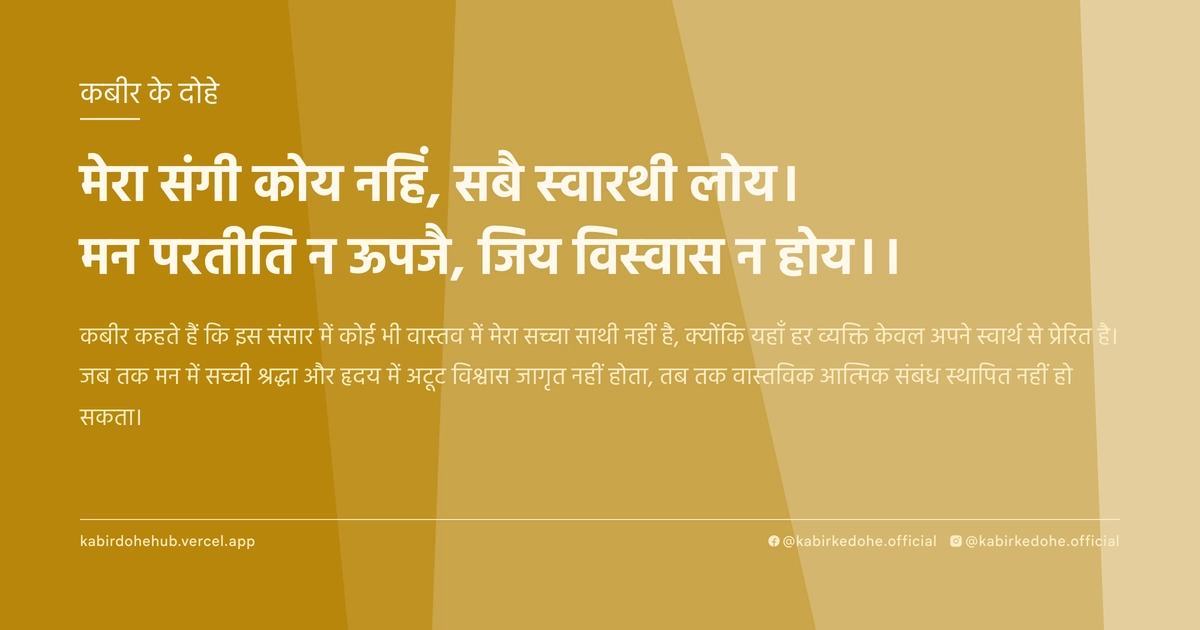
मेरा संगी कोय नहिं, सबै स्वारथी लोय।
मन परतीति न ऊपजै, जिय विस्वास न होय।।
Mera sangi koy nahin, sabai swarthi loy. Man partit na upjai, jiya vishwas na hoye.
इस पृष्ठ पर इस कबीर दोहे का अर्थ (meaning), हिंदी व्याख्या और अंग्रेज़ी अनुवाद, दार्शनिक विश्लेषण और व्यावहारिक जीवन सीख दी गई है। यह दोहा आत्मनिरीक्षण (Self-introspection) विषय से जुड़ा है — Kabir doha meaning and explanation in Hindi and English.
अर्थ (Meaning):
कबीर कहते हैं कि इस संसार में कोई भी वास्तव में मेरा सच्चा साथी नहीं है, क्योंकि यहाँ हर व्यक्ति केवल अपने स्वार्थ से प्रेरित है। जब तक मन में सच्ची श्रद्धा और हृदय में अटूट विश्वास जागृत नहीं होता, तब तक वास्तविक आत्मिक संबंध स्थापित नहीं हो सकता।
Kabir asserts that in this transient world, there is no true companion, as every individual is driven by their own self-interest. Until genuine faith awakens in the mind and unwavering trust takes root in the heart, a real spiritual connection remains unattainable.
व्याख्या (Interpretation):
शाब्दिक अर्थ यह है कि बाहरी दुनिया में विश्वासघात और स्वार्थ व्याप्त है। आध्यात्मिक स्तर पर, 'संगी' का अर्थ केवल मनुष्य नहीं, बल्कि उन मानसिक प्रवृत्तियों से है जो हमें भ्रमित करती हैं। यह दोहा 'माया' के प्रभाव को दर्शाता है जहाँ व्यक्ति स्वयं को दूसरों से अलग मानता है। जब तक अहंकार (I-ness) जीवित है, तब तक 'परतीति' या वास्तविक बोध संभव नहीं है। यह अद्वैत वेदांत के उस सत्य की ओर संकेत करता है जहाँ बाहरी संबंधों की शून्यता साधक को अंतर्मुखी होने और केवल निराकार ब्रह्म (Nirgun) में विश्वास खोजने के लिए प्रेरित करती है। यहाँ विश्वास का अर्थ किसी व्यक्ति पर नहीं, बल्कि उस सार्वभौमिक सत्य पर है जो सबके भीतर समान है।
Literally, the verse speaks of the pervasive nature of betrayal and selfishness in the external world. Spiritually, the 'companion' refers not just to people, but to the mental tendencies that mislead the soul. This doha illustrates the grip of 'Maya,' where the individual perceives themselves as separate from others. As long as the ego (Ahamkara) persists, 'Pratiti' or true realization cannot arise. It points toward the Advaita Vedanta truth where the void of external relationships compels the seeker to turn inward and find trust only in the Formless Absolute (Nirgun Brahman). Here, faith is not placed in a human entity, but in the universal truth that resides equally within all beings, transcending the paradox of loneliness.
दार्शनिक विश्लेषण (Philosophical Analysis):
कबीर का यह कथन उनके युग के सामाजिक और धार्मिक पाखंडों के प्रति एक तीखी प्रतिक्रिया है। उन्होंने देखा कि कैसे धर्म और जाति के नाम पर लोग एक-दूसरे का उपयोग करते थे। यह दर्शन सूफीवाद के 'फना' (अहंकार का विनाश) और अद्वैत के 'अहं ब्रह्मास्मि' के बीच का सेतु है। कबीर यह स्पष्ट करते हैं कि जब तक हम बाहरी दुनिया में 'संगी' या सहारे की तलाश करते हैं, हम वास्तव में अपनी ही अज्ञानता को पोषित कर रहे होते हैं।
ritualism (कर्मकांड) का विरोध करते हुए, कबीर तर्क देते हैं कि मंदिर या मस्जिद जाने से विश्वास नहीं आता, बल्कि वह आंतरिक शुद्धि से आता है। स्वार्थ केवल व्यक्तिगत लाभ नहीं है, बल्कि यह वह पर्दा है जो आत्मा को परमात्मा से अलग करता है। यह मनोवैज्ञानिक रूपांतरण की मांग करता है जहाँ व्यक्ति यह स्वीकार करे कि वह इस संसार में अकेला है, ताकि वह उस परम साथी (ब्रह्म) को पा सके जो कभी अलग नहीं था।
ऐतिहासिक रूप से, कबीर एक बुनकर थे जिन्होंने समाज के सबसे निचले स्तर के संघर्षों को देखा। उनका 'स्वार्थी लोय' का विश्लेषण केवल निराशा नहीं, बल्कि एक आह्वान है। वे कहते हैं कि जब बाहरी सहारे टूट जाते हैं, तभी मनुष्य की वास्तविक आध्यात्मिक यात्रा शुरू होती है। यह 'शून्य' की स्थिति है जहाँ से सत्य का उदय होता है।
अद्वैत वेदांत के अनुसार, यह अलगाव एक भ्रम है। लेकिन इस भ्रम को तोड़ने के लिए पहले इस कड़वे सच को स्वीकार करना होगा कि संसार की कोई भी वस्तु या व्यक्ति स्थायी सहारा नहीं दे सकता। यह बोध साधक को 'साक्षी भाव' में ले जाता है।
अंततः, यह दोहा हमें सिखाता है कि विश्वास (Vishwas) कोई बाहरी वस्तु नहीं जिसे प्राप्त किया जाए, बल्कि यह एक आंतरिक अवस्था है जो तब प्रकट होती है जब हम बाहरी अपेक्षाओं का पूरी तरह त्याग कर देते हैं। यह अहंकार के विसर्जन और शुद्ध चेतना के उदय की प्रक्रिया है।
Kabir's assertion is a sharp reaction to the social and religious hypocrisies of his era. He witnessed how people exploited one another in the name of religion and caste. This philosophy serves as a bridge between the Sufi concept of 'Fana' (annihilation of the ego) and the Advaita principle of 'Aham Brahmasmi' (I am Brahman). Kabir clarifies that as long as we seek a 'companion' or support in the external world, we are merely nourishing our own ignorance.
Opposing ritualism, Kabir argues that faith does not arise from visiting temples or mosques, but from internal purification. Selfishness is not merely a desire for personal gain; it is the veil that separates the Atman from the Paramatman. This requires a psychological transformation where the individual accepts their existential loneliness to finally encounter the Supreme Companion who was never truly absent.
Historically, as a weaver, Kabir experienced the struggles of the marginalized. His analysis of the 'selfish world' is not an expression of pessimism, but a spiritual call to action. He suggests that only when external supports crumble does the authentic spiritual journey begin. This is the state of 'Shunya' (void), from which the ultimate truth emerges.
According to Advaita Vedanta, this perceived separation is an illusion (Maya). However, to shatter this illusion, one must first accept the bitter reality that no worldly object or person can provide permanent refuge. This realization leads the seeker into the state of the 'Witness' (Sakshi).
Ultimately, this doha teaches that faith (Vishwas) is not an external acquisition but an internal state that manifests only when all external expectations are completely relinquished. It is the process of dissolving the ego to allow pure consciousness to arise.
मूल संदेश (Core Message):
- बाहरी सहारे एक मृगतृष्णा हैं, जो केवल प्यास बढ़ाते हैं।
- अकेलापन वास्तव में परमात्मा से मिलने का एकमात्र द्वार है।
- स्वार्थ दुनिया का स्वभाव है; इसे स्वीकार करना ही मुक्ति है।
- सच्चा विश्वास वह है जो किसी व्यक्ति पर नहीं, सत्य पर हो।
- जब 'मैं' मिटता है, तब 'वह' (ब्रह्म) ही एकमात्र साथी बचता है।
- External supports are a mirage that only increases the thirst.
- Solitude is actually the only gateway to encountering the Divine.
- Selfishness is the nature of the world; accepting it is liberation.
- True faith is not placed in a person, but in the Absolute Truth.
- When the 'I' vanishes, 'He' (Brahman) remains the only companion.
व्यावहारिक उदाहरण (Practical Example):
वाराणसी के घाटों पर रहने वाली एक वृद्ध विधवा, जानकी, का जीवन अत्यंत एकाकी था। उनके अपने बच्चे शहर चले गए थे और केवल त्योहारों पर पैसे भेजते थे, लेकिन कभी हाल पूछने नहीं आते थे। जानकी ने अपना पूरा जीवन दूसरों की सेवा में लगा दिया था, लेकिन अंत समय में उन्होंने पाया कि जिस समाज और परिवार को उन्होंने अपना 'संगी' माना, वे सब केवल अपनी जरूरतों के समय उनके पास आते थे।
एक दिन, जानकी ने महसूस किया कि उनकी उदासी का कारण यह नहीं था कि लोग स्वार्थी थे, बल्कि यह था कि उन्होंने अपनी खुशी की चाबी दूसरों के हाथों में दे रखी थी। उन्होंने कबीर के इस दोहे को सुना और गहराई से विचार किया। उन्होंने महसूस किया कि वे जिस 'विश्वास' की तलाश बाहर कर रही थीं, वह वास्तव में उनके भीतर की शांति थी जिसे उन्होंने कभी खोजा ही नहीं था।
उन्होंने धीरे-धीरे बाहरी दुनिया से अपनी अपेक्षाएं कम करना शुरू किया। उन्होंने घाट पर आने वाले अनाम यात्रियों को बिना किसी उम्मीद के भोजन कराना शुरू किया। अब वे यह नहीं सोचती थीं कि कोई उन्हें धन्यवाद देगा या नहीं। उन्होंने पाया कि जब उन्होंने 'संगी' की तलाश छोड़ दी, तो वे स्वयं के साथ सबसे अच्छी मित्र बन गईं।
उनकी आंतरिक शांति देखकर अब लोग उनकी ओर आकर्षित होने लगे, लेकिन अब जानकी को उनकी जरूरत नहीं थी। वे अब किसी के व्यवहार से विचलित नहीं होती थीं क्योंकि उनका 'विश्वास' अब इंसानों पर नहीं, बल्कि उस निराकार शक्ति पर था जो हर जीव में वास करती है।
एक बार उनके बेटे वापस आए और उनकी संपत्ति पर अधिकार जमाना चाहते थे। पुराने समय में जानकी टूट जातीं, लेकिन अब वे शांत थीं। उन्होंने मुस्कुराकर सब कुछ दे दिया, क्योंकि उन्हें समझ आ गया था कि असली संपत्ति वह शांति है जिसे कोई छीन नहीं सकता।
उनके जीवन में यह 'कबीर ट्विस्ट' तब आया जब उन्होंने यह जाना कि अकेलापन एक अभिशाप नहीं, बल्कि एक अवसर है। इस अकेलेपन ने उन्हें उस परमात्मा से जोड़ दिया जो कभी उनका साथ नहीं छोड़ता।
उनकी आँखों में अब शिकायत नहीं, बल्कि एक गहरी करुणा थी। उन्होंने सीखा कि जब हम दूसरों से उम्मीद करना बंद कर देते हैं, तभी हम वास्तव में स्वतंत्र होते हैं।
अंततः, जानकी ने यह अनुभव किया कि संसार का स्वार्थ ही वह धक्का था जिसने उन्हें ईश्वर की ओर धकेला। यदि लोग उनके प्रति दयालु होते, तो शायद वे कभी अपनी आत्मा की गहराई में नहीं उतरतीं।
Janaki, an elderly widow living on the ghats of Varanasi, led an existence of profound loneliness. Her children had moved to the city, sending money only during festivals, but never visiting to inquire about her well-being. Janaki had spent her entire life serving others, only to realize in her twilight years that the society and family she deemed her 'companions' appeared only when they had needs of their own.
One day, Janaki realized that her sorrow stemmed not from the selfishness of others, but from the fact that she had handed the key to her happiness to other people. She encountered Kabir's doha and contemplated it deeply. She understood that the 'faith' she sought externally was actually an internal peace she had never attempted to cultivate.
Slowly, she began to diminish her expectations from the external world. She started feeding nameless travelers on the ghats without any hope of return. She no longer cared whether she received a word of thanks. She discovered that by ceasing the search for a 'companion,' she became her own best friend.
Seeing her inner tranquility, people began to be drawn to her, but Janaki no longer needed them. She was no longer disturbed by the behavior of others because her 'faith' was no longer anchored in humans, but in the Formless Power that resides in every living being.
Once, her sons returned, intending to claim her property. In the past, Janaki would have been devastated, but now she remained serene. She smiled and gave everything away, knowing that the only true wealth is the peace that cannot be stolen.
This 'Kabir Twist' occurred when she realized that loneliness is not a curse, but an opportunity. This solitude connected her to the Divine, who never abandons the soul.
There was no longer resentment in her eyes, only a deep, radiating compassion. She learned that only when we stop expecting from others do we truly become free.
Ultimately, Janaki experienced that the selfishness of the world was the very catalyst that pushed her toward God. Had people been kind, she might never have descended into the depths of her own soul.
अभ्यास मार्गदर्शन (Practice Guidance):
- प्रतिदिन 20 मिनट मौन साधना करें, जहाँ आप केवल अपने श्वास और आंतरिक रिक्तता का अवलोकन करें, बिना किसी बाहरी सहारे की इच्छा के।
- एक 'अपेक्षा डायरी' लिखें: उन क्षणों को दर्ज करें जब आपको किसी के व्यवहार से दुख हुआ, और फिर विश्लेषण करें कि आपकी कौन सी आंतरिक उम्मीद उस दुख का कारण थी।
- निस्वार्थ सेवा का अभ्यास: सप्ताह में एक बार ऐसा कार्य करें जिसके लिए आपको कोई पहचान या धन्यवाद न मिले, ताकि अहंकार का विसर्जन हो सके।
- डायग्नोस्टिक चेकलिस्ट: क्या मैं दूसरों की प्रशंसा पर निर्भर हूँ? क्या किसी के विश्वासघात से मेरी मानसिक शांति भंग होती है? यदि हाँ, तो आप अभी भी बाहरी 'संगी' की तलाश में हैं।
- Practice 20 minutes of daily silent meditation, observing only your breath and the internal void, without desiring any external support.
- Maintain an 'Expectation Journal': Record moments when someone's behavior caused you pain, then analyze which internal expectation triggered that suffering.
- Practice selfless service: Once a week, perform an act of kindness for which you receive no recognition or thanks, to facilitate the dissolution of the ego.
- Diagnostic Checklist: Am I dependent on the praise of others? Does a betrayal shatter my mental peace? If yes, you are still searching for an external 'companion'.
चिंतन प्रश्न (Reflection Questions):
- यदि आज आपके जीवन से वे सभी लोग चले जाएँ जो आपको प्यार करते हैं, तो क्या आपके पास कोई ऐसा आंतरिक आधार बचेगा जो आपको स्थिर रख सके?
- आपकी 'डिजिटल पहचान' (सोशल मीडिया) पर जो प्रशंसा आप खोजते हैं, क्या वह आपके भीतर के अकेलेपन को भरने का एक असफल प्रयास है?
- क्या आप वास्तव में दूसरों की मदद करते हैं, या अनजाने में आप अपनी 'अच्छे इंसान' होने की छवि को पुष्ट कर रहे होते हैं?
- आपके जीवन का वह कौन सा डर है जो आपको अकेले रहने से रोकता है और आपको जहरीले रिश्तों से बांधे रखता है?
- क्या आप उस मौन को सहन कर सकते हैं जहाँ कोई आपसे बात करने वाला न हो, या आप शोर में अपनी पहचान खोजते हैं?
- If everyone who loves you vanished today, would you have an internal foundation strong enough to keep you stable?
- Is the validation you seek through your 'digital identity' (social media) an unsuccessful attempt to fill an inner void?
- Do you truly help others, or are you unconsciously reinforcing an image of yourself as a 'good person'?
- What is the specific fear in your life that prevents you from being alone and keeps you tethered to toxic relationships?
- Can you endure the silence where there is no one to speak to, or do you seek your identity within the noise?