
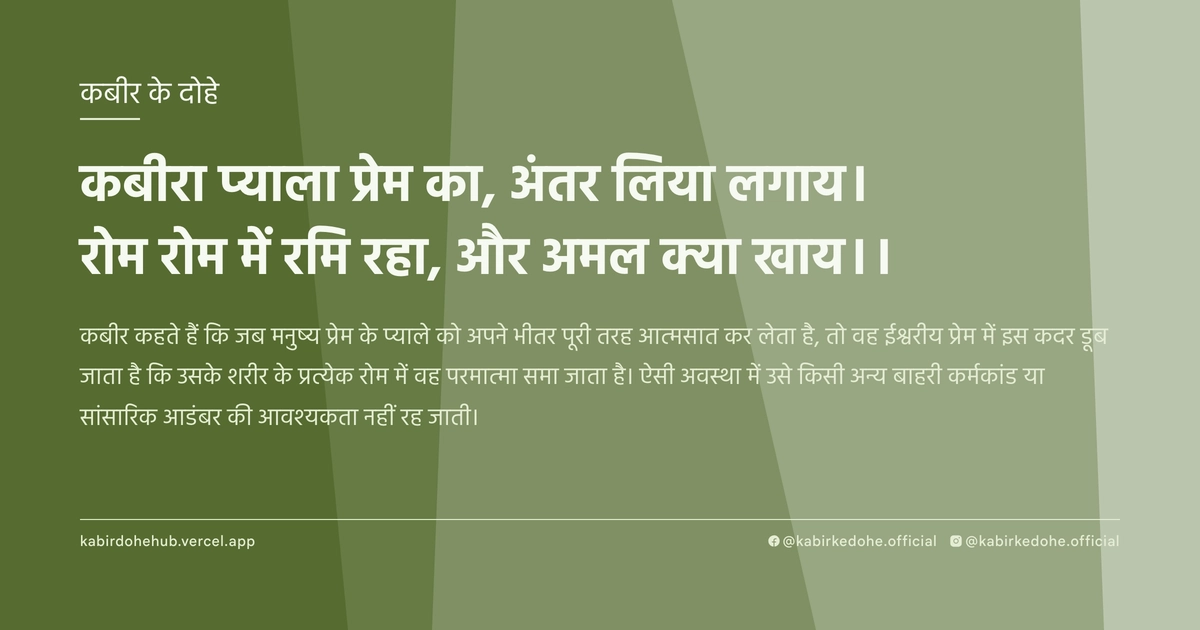
कबीरा प्याला प्रेम का, अंतर लिया लगाय।
रोम रोम में रमि रहा, और अमल क्या खाय।।
Kabira pyala prem ka, antar liya lagay. Rom rom mein rami raha, aur amal kya khaye.
इस पृष्ठ पर इस कबीर दोहे का अर्थ (meaning), हिंदी व्याख्या और अंग्रेज़ी अनुवाद, दार्शनिक विश्लेषण और व्यावहारिक जीवन सीख दी गई है। यह दोहा भक्ति (Bhakti) विषय से जुड़ा है — Kabir doha meaning and explanation in Hindi and English.
अर्थ (Meaning):
कबीर कहते हैं कि जब मनुष्य प्रेम के प्याले को अपने भीतर पूरी तरह आत्मसात कर लेता है, तो वह ईश्वरीय प्रेम में इस कदर डूब जाता है कि उसके शरीर के प्रत्येक रोम में वह परमात्मा समा जाता है। ऐसी अवस्था में उसे किसी अन्य बाहरी कर्मकांड या सांसारिक आडंबर की आवश्यकता नहीं रह जाती।
Kabir proclaims that once a seeker drinks the cup of divine love and internalizes it completely, the essence of that love permeates every single pore of their being. In this state of total immersion, the need for external rituals or worldly pursuits vanishes, as the soul is saturated with the Absolute.
व्याख्या (Interpretation):
शाब्दिक रूप से, यह दोहा प्रेम के एक प्रतीकात्मक प्याले को पीने की बात करता है। आध्यात्मिक स्तर पर, यह 'प्रेम' मानवीय आसक्ति नहीं, बल्कि 'ईश्वरीय अनुराग' है। जब यह प्रेम अंतरात्मा में उतरता है, तो यह द्वैत को समाप्त कर देता है। यह निरगुण भक्ति का सार है जहाँ भक्त और भगवान एक हो जाते हैं। माया का पर्दा हट जाता है और आत्मा को अपनी वास्तविक पहचान ब्रह्म के रूप में मिलती है। यहाँ 'अमल' का अर्थ केवल कर्म नहीं, बल्कि उन व्यर्थ के कर्मकांडों से है जो अहंकार को पुष्ट करते हैं। यह स्थिति अद्वैत वेदांत की उस अवस्था के समान है जहाँ केवल शुद्ध चेतना शेष रहती है।
Literally, the verse speaks of drinking a symbolic cup of love. Spiritually, this 'love' is not mundane affection but 'Divine Longing.' When this love descends into the inner core, it annihilates duality. This is the essence of Nirgun Bhakti, where the devotee and the Divine merge into one. The veil of Maya is lifted, and the Atman recognizes its identity as Brahman. The term 'amal' refers not just to actions, but to the futile rituals that nourish the ego. This state mirrors the Advaita Vedanta realization where only pure consciousness remains, rendering the separation between the observer and the observed obsolete.
दार्शनिक विश्लेषण (Philosophical Analysis):
कबीर का यह दोहा उस युग की उपज है जहाँ धर्म बाहरी दिखावे और जातिगत भेदभाव में जकड़ा हुआ था। कबीर ने मंदिर-मस्जिद के विवादों से ऊपर उठकर 'प्रेम' को ही एकमात्र धर्म घोषित किया। यह दृष्टिकोण सूफी मत के 'इश्क-ए-हकीकी' (ईश्वरीय प्रेम) से गहराई से मेल खाता है, जहाँ प्रेमी अपने अस्तित्व को मिटाकर प्रियतम (ईश्वर) में विलीन हो जाता है।
दार्शनिक रूप से, यहाँ 'प्याला' अहंकार के विसर्जन का प्रतीक है। जब तक व्यक्ति 'मैं' के प्याले से भरा है, वह ईश्वर के प्रेम को ग्रहण नहीं कर सकता। जैसे ही अहंकार शून्य होता है, वह शून्य ईश्वरीय ऊर्जा से भर जाता है। यह मनोवैज्ञानिक रूपांतरण है जहाँ व्यक्ति अपनी सीमित पहचान को त्यागकर सार्वभौमिक पहचान अपनाता है।
कबीर यहाँ कर्मकांडीय धर्म (Ritualism) पर प्रहार करते हैं। वे तर्क देते हैं कि यदि परमात्मा रोम-रोम में व्याप्त है, तो उसे खोजने के लिए तीर्थयात्रा या कठिन तपस्या की आवश्यकता नहीं है। यह आंतरिक यात्रा का मार्ग है, न कि बाहरी गंतव्य का।
अद्वैत वेदांत के परिप्रेक्ष्य में, यह 'अहं ब्रह्मास्मि' की अनुभूति है। जब प्रेम की पराकाष्ठा होती है, तो ज्ञाता, ज्ञान और ज्ञेय का भेद समाप्त हो जाता है। यह केवल एक भावना नहीं, बल्कि एक उच्चतर चेतना की स्थिति है।
अंततः, कबीर यह समझाते हैं कि वास्तविक भक्ति वह नहीं है जो दुनिया को दिखाई दे, बल्कि वह है जो व्यक्ति के अस्तित्व के सूक्ष्मतम कणों में रची-बसी हो। यह 'अमल' या बाहरी कर्मों की तुलना में 'भाव' की श्रेष्ठता को स्थापित करता है।
This couplet emerges from an era where religion was shackled by external displays and caste hierarchies. Kabir transcends the temple-mosque conflict, declaring 'Love' as the only true religion. This perspective aligns deeply with the Sufi concept of 'Ishq-e-Haqiqi' (Divine Love), where the lover annihilates their existence to merge with the Beloved.
Philosophically, the 'cup' symbolizes the dissolution of the ego. As long as a person is filled with the cup of 'I-ness,' they cannot receive divine love. Once the ego becomes a void, that void is filled with universal energy. This is a psychological metamorphosis where the individual sheds a limited identity for a cosmic one.
Kabir strikes a blow against ritualism. He argues that if the Divine permeates every pore of existence, there is no need for pilgrimages or rigorous austerities to find Him. It is a journey inward, not a destination outward.
From the lens of Advaita Vedanta, this is the realization of 'Aham Brahmasmi' (I am Brahman). At the peak of love, the distinction between the knower, the known, and the knowledge vanishes. This is not merely an emotion but a state of heightened consciousness.
Ultimately, Kabir explains that true devotion is not what is visible to the world, but what is woven into the subtlest particles of one's being. He establishes the supremacy of 'Bhava' (inner disposition) over 'Amal' (external ritualistic deeds).
मूल संदेश (Core Message):
- बाहरी कर्मकांड केवल अहंकार की तुष्टि करते हैं।
- प्रेम ही वह एकमात्र सेतु है जो आत्मा को परमात्मा से जोड़ता है।
- जब प्रेम आंतरिक होता है, तो पूरा अस्तित्व मंदिर बन जाता है।
- अहंकार का विसर्जन ही ईश्वरीय ऊर्जा के प्रवेश का द्वार है।
- सच्ची भक्ति प्रदर्शन में नहीं, बल्कि रोम-रोम के अनुभव में है।
- External rituals only serve to nourish the ego.
- Love is the sole bridge connecting the soul to the Absolute.
- When love is internalized, the entire existence becomes a temple.
- The dissolution of ego is the only gateway for divine energy to enter.
- True devotion lies not in display, but in the cellular experience of being.
व्यावहारिक उदाहरण (Practical Example):
एक समय की बात है, वाराणसी के घाटों पर माधव नाम का एक वृद्ध बुनकर रहता था। माधव अपनी कला में निपुण था, लेकिन उसका मन हमेशा इस बात से अशांत रहता था कि वह पर्याप्त पुण्य नहीं कमा पा रहा है। वह घंटों मंदिर में बिताता, कठिन व्रत रखता और दान-पुण्य के नाम पर अपनी सारी जमापूंजी लुटा देता, फिर भी उसके भीतर एक खालीपन था।
एक दिन उसकी मुलाकात एक फकीर से हुई जिसने उसे कबीर का यह दोहा सुनाया। फकीर ने उससे पूछा, 'माधव, तुम धागों को इतनी बारीकी से बुनते हो, क्या तुमने कभी अपने भीतर के प्रेम को बुना है?' माधव हैरान था। उसने पूछा कि प्रेम बुनना क्या होता है?
फकीर ने कहा, 'तुम मंदिर जाते हो ताकि ईश्वर तुम्हें देखे, लेकिन क्या तुम ईश्वर को अपने भीतर देखते हो? जब तुम कपड़े बुनते हो, तो क्या तुम केवल पैसे के लिए बुनते हो या उस कपड़े को पहनने वाले की खुशी के लिए?'
माधव ने गहराई से सोचा। उसने महसूस किया कि उसकी सारी भक्ति 'डर' और 'पुरस्कार' की इच्छा से प्रेरित थी, प्रेम से नहीं। उसने तय किया कि अब वह अपने हर काम को एक प्रार्थना बना देगा।
अगले दिन से, जब वह करघे पर बैठता, तो वह यह नहीं सोचता कि उसे कितने पैसे मिलेंगे। वह यह सोचता कि यह कपड़ा किसी गरीब को गर्माहट देगा या किसी बच्चे की मुस्कान बनेगा। उसने अपने काम में प्रेम का प्याला घोल दिया।
धीरे-धीरे, माधव का व्यवहार बदलने लगा। वह अब केवल मंदिर में नहीं, बल्कि सड़क पर गिरे हुए घायल पक्षी की सेवा में भी ईश्वर को देखने लगा। उसके चेहरे पर एक ऐसी शांति आ गई जो पहले कठिन व्रतों से नहीं आई थी।
एक दिन एक अमीर सेठ उसके पास आया और उसने माधव की शांति का रहस्य पूछा। माधव ने मुस्कुराते हुए कहा, 'सेठ जी, मैं अब पुण्य कमाने की कोशिश नहीं करता, मैं बस प्रेम में रमता हूँ। जब प्रेम रोम-रोम में बस जाता है, तो बाहरी दिखावे की भूख मिट जाती है।'
सेठ ने देखा कि माधव के साधारण से घर में वह सुकून था जो उसके आलीशान महल में नहीं था। माधव ने अपनी कला को भक्ति बना लिया था।
वह अब किसी विशेष दिन या समय का इंतजार नहीं करता था। उसका हर सांस, हर धागा और हर मुस्कान उसी 'प्रेम के प्याले' का हिस्सा बन गई थी।
माधव की कहानी हमें सिखाती है कि ईश्वर किसी विशेष स्थान पर नहीं, बल्कि हमारे कर्मों के प्रति हमारे दृष्टिकोण में बसता है। जब कर्म प्रेम बन जाता है, तो वह स्वतः ही मोक्ष बन जाता है।
Once, on the ghats of Varanasi, lived an elderly weaver named Madhav. Madhav was a master of his craft, yet his mind was perpetually restless, fearing he wasn't earning enough spiritual merit. He spent hours in temples, observed rigorous fasts, and gave away his savings in the name of charity, yet a void remained within him.
One day, he met a wandering dervish who recited this doha of Kabir. The dervish asked him, 'Madhav, you weave threads with such precision, but have you ever woven love within yourself?' Madhav was bewildered and asked what 'weaving love' meant.
The dervish replied, 'You go to the temple so that God may see you, but do you see God within yourself? When you weave, do you do it for the money, or for the joy of the person who will wear the cloth?'
Madhav reflected deeply. He realized his entire spiritual practice was driven by 'fear' and a 'desire for reward,' not by love. He decided to turn every action into a prayer.
From the next day, as he sat at his loom, he stopped thinking about the profit. Instead, he imagined the warmth the cloth would provide to a poor soul or the smile it would bring to a child. He dissolved the cup of love into his labor.
Gradually, Madhav's behavior transformed. He no longer sought God only in the temple but saw Him in the service of a wounded bird on the street. A serenity descended upon his face that no rigorous fast had ever provided.
One day, a wealthy merchant came to him, curious about the secret of his peace. Madhav smiled and said, 'Sir, I no longer strive to earn merit; I simply dwell in love. When love permeates every pore, the hunger for external validation vanishes.'
The merchant noticed that Madhav's humble hut possessed a tranquility absent from his own opulent palace. Madhav had turned his art into devotion.
He no longer waited for a specific day or time to be spiritual. Every breath, every thread, and every smile became a part of that 'cup of love.'
Madhav's story teaches us that the Divine does not reside in a specific location, but in the intention behind our actions. When action becomes love, it automatically becomes liberation.
अभ्यास मार्गदर्शन (Practice Guidance):
- दैनिक ध्यान: प्रतिदिन 20 मिनट मौन बैठें और कल्पना करें कि एक सुनहरा प्रकाश (प्रेम) आपके हृदय से शुरू होकर शरीर के प्रत्येक रोम और कोशिका में फैल रहा है।
- आत्म-पूछताछ जर्नल: प्रतिदिन एक ऐसी घटना लिखें जहाँ आपने 'पुरस्कार' या 'डर' के कारण कार्य किया, और फिर विचार करें कि यदि वही कार्य 'शुद्ध प्रेम' से किया जाता, तो परिणाम और अनुभव कैसे भिन्न होते।
- व्यवहार परिवर्तन: दिन में कम से कम तीन ऐसे कार्य करें जिनका कोई व्यक्तिगत लाभ न हो, और उन्हें पूरी तन्मयता और प्रेम के साथ करें।
- निदान चेकलिस्ट: क्या मैं अभी भी दूसरों से प्रशंसा की उम्मीद कर रहा हूँ? क्या मेरा धर्म केवल नियमों का पालन है या हृदय का विस्तार? क्या मैं दूसरों में वही ईश्वर देख पा रहा हूँ जो मैं मंदिर में खोजता हूँ?
- Daily Meditation: Sit in silence for 20 minutes daily, visualizing a golden light (Love) expanding from your heart to permeate every pore and cell of your body.
- Self-Inquiry Journal: Record one daily instance where you acted out of 'reward' or 'fear,' then reflect on how the experience would differ if the same act were done out of 'pure love.'
- Behavioral Shift: Perform at least three selfless acts daily with total mindfulness and affection, seeking no personal gain.
- Diagnostic Checklist: Am I still craving external validation? Is my spirituality merely a set of rules or an expansion of the heart? Do I see the same Divine in others that I seek in the temple?
चिंतन प्रश्न (Reflection Questions):
- क्या मेरा 'आध्यात्मिक व्यक्तित्व' मेरे वास्तविक आंतरिक स्वभाव से अलग है?
- मैं किन सामाजिक मुखौटों के पीछे अपनी वास्तविक करुणा को छुपाता हूँ?
- यदि मेरे जीवन से सभी धार्मिक पहचान (जाति, धर्म, संप्रदाय) हटा दी जाएं, तो क्या केवल प्रेम शेष रहेगा?
- क्या मेरी प्रार्थनाएं ईश्वर को पाने के लिए हैं, या केवल अपनी इच्छाओं की पूर्ति के लिए?
- मैं अपनी डिजिटल पहचान (Social Media Ego) को आध्यात्मिक विनम्रता के साथ कैसे संतुलित करता हूँ?
- Is my 'spiritual persona' distinct from my actual internal nature?
- Behind which social masks do I hide my authentic compassion?
- If all religious identities (caste, creed, sect) were stripped away, would only love remain?
- Are my prayers intended to reach the Divine, or merely to fulfill my own desires?
- How do I balance my digital identity (Social Media Ego) with genuine spiritual humility?