
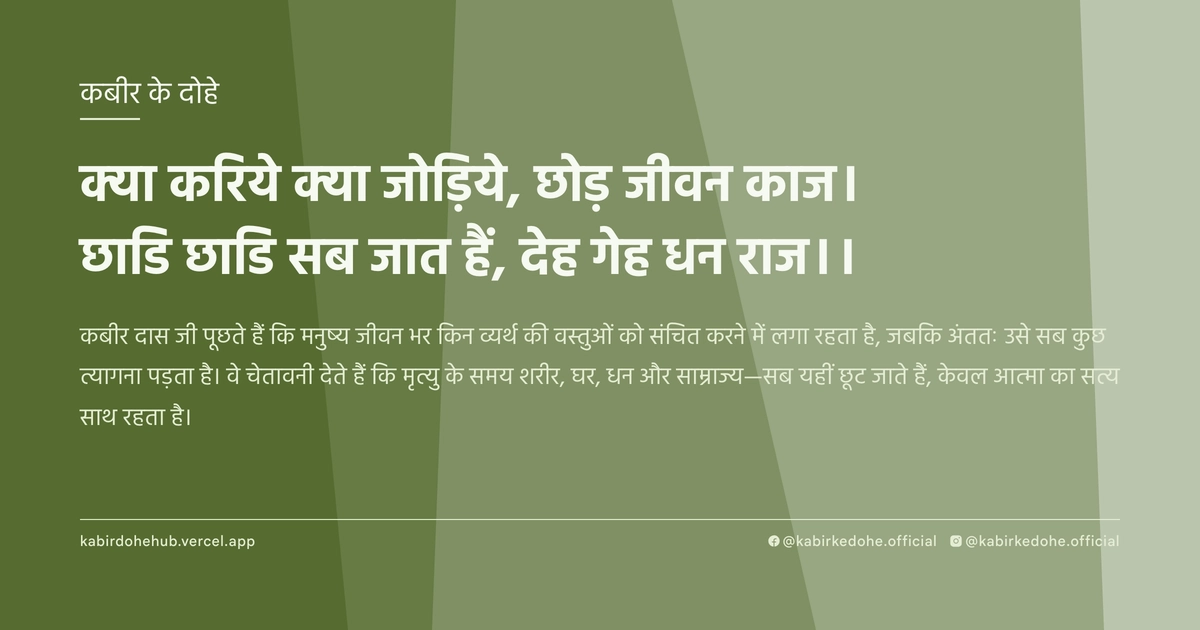
क्या करिये क्या जोड़िये, छोड़ जीवन काज।
छाडि छाडि सब जात हैं, देह गेह धन राज।।
Kya kariye kya jodiye, chhod jeevan kaaj. Chhadi chhadi sab jaat hain, deh geh dhan raaj.
इस पृष्ठ पर इस कबीर दोहे का अर्थ (meaning), हिंदी व्याख्या और अंग्रेज़ी अनुवाद, दार्शनिक विश्लेषण और व्यावहारिक जीवन सीख दी गई है। यह दोहा मृतुक्यता (Mortality) विषय से जुड़ा है — Kabir doha meaning and explanation in Hindi and English.
अर्थ (Meaning):
कबीर दास जी पूछते हैं कि मनुष्य जीवन भर किन व्यर्थ की वस्तुओं को संचित करने में लगा रहता है, जबकि अंततः उसे सब कुछ त्यागना पड़ता है। वे चेतावनी देते हैं कि मृत्यु के समय शरीर, घर, धन और साम्राज्य—सब यहीं छूट जाते हैं, केवल आत्मा का सत्य साथ रहता है।
Kabir questions the futility of human accumulation and the endless pursuit of material security. He reminds us that at the inevitable moment of departure, everything we have spent our lives gathering—our physical body, our homes, our wealth, and our social status—is left behind, proving the transience of worldly attachments.
व्याख्या (Interpretation):
यह दोहा भौतिक संसार की नश्वरता पर प्रहार करता है। 'क्या जोड़िये' शब्द उस मानसिक संचय की प्रवृत्ति को दर्शाता है जिसे हम सुरक्षा समझते हैं, परंतु वास्तव में वह माया का जाल है। कबीर यहाँ देह (शरीर), गेह (घर) और राज (सत्ता) को तीन स्तरों के मोह के रूप में प्रस्तुत करते हैं। यह निर्गुण भक्ति का सार है, जहाँ साधक को यह बोध होता है कि आत्मा अजर-अमर है और यह भौतिक खोल केवल एक अस्थायी पड़ाव है। जब व्यक्ति यह समझता है कि 'मैं' शरीर नहीं हूँ, तब वह द्वैत से अद्वैत की ओर बढ़ता है, जहाँ केवल शुद्ध चेतना शेष रहती है।
This couplet strikes at the heart of material impermanence. The phrase 'what to accumulate' highlights the psychological tendency to seek security in the tangible, which Kabir identifies as the veil of Maya. He categorizes attachments into three levels: the physical body (deh), the domestic sphere (geh), and worldly power (raaj). This aligns with Nirgun Bhakti, where the seeker realizes the soul is eternal while the physical shell is a transient vessel. By dismantling the illusion of 'I am this body,' the practitioner moves from duality to Advaita (non-duality), recognizing that only pure consciousness persists beyond the physical collapse.
दार्शनिक विश्लेषण (Philosophical Analysis):
कबीर का यह दृष्टिकोण उनके समय के कर्मकांडीय और सामाजिक ढांचे के विरुद्ध एक विद्रोह था। उन्होंने देखा कि लोग जाति, कुल और संपत्ति के अहंकार में इतने डूबे थे कि वे जीवन के वास्तविक उद्देश्य—आत्म-साक्षात्कार—को भूल गए थे। यह दर्शन अद्वैत वेदांत के 'नेति नेति' (यह नहीं, वह नहीं) के सिद्धांत से मिलता-जुलता है, जहाँ सत्य तक पहुँचने के लिए पहले असत्य का त्याग करना आवश्यक है।
सूफीवाद के 'फना' (अहंकार का विनाश) के विचार की तरह, कबीर यहाँ 'छोड़' शब्द पर जोर देते हैं। उनके लिए त्याग केवल भौतिक वस्तुओं का नहीं, बल्कि उस 'मैं' का है जो इन वस्तुओं के साथ अपनी पहचान जोड़ता है। जब तक मनुष्य स्वयं को अपने धन या पद से जोड़ता है, वह बंधन में रहता है।
ऐतिहासिक रूप से, कबीर ने बुनकर समुदाय से होते हुए समाज के सबसे निचले और ऊपरी दोनों स्तरों को देखा। उन्होंने पाया कि चाहे वह राजा हो या रंक, मृत्यु सबको समान कर देती है। यह समानता ही उनके सामाजिक न्याय का आधार थी।
मनोवैज्ञानिक स्तर पर, यह दोहा 'लॉस एवर्जन' (हानि का डर) की मानवीय प्रवृत्ति को संबोधित करता है। हम इसलिए जोड़ते हैं क्योंकि हमें डर है कि हम कम पड़ जाएंगे। कबीर इस डर को आध्यात्मिक शून्यता में बदलकर मुक्ति का मार्ग दिखाते हैं।
अंततः, यह विश्लेषण स्पष्ट करता है कि कबीर संन्यास का उपदेश नहीं दे रहे, बल्कि 'अनासक्ति' (Detachment) की बात कर रहे हैं। संसार में रहो, लेकिन संसार को अपने भीतर मत बसने दो। यही वह बिंदु है जहाँ भक्ति और ज्ञान का मिलन होता है।
Kabir's perspective was a direct rebellion against the ritualistic and hierarchical social structures of his era. He observed people deeply entrenched in the ego of caste, lineage, and property, causing them to overlook the true purpose of existence: self-realization. This philosophy mirrors the Advaita Vedanta principle of 'Neti Neti' (not this, not that), suggesting that to reach the Truth, one must first discard all falsehoods.
Similar to the Sufi concept of 'Fana' (the annihilation of the ego), Kabir emphasizes the act of 'leaving' or 'letting go.' For him, renunciation is not merely about discarding physical objects but about erasing the 'I' that identifies itself with these possessions. As long as a human ties their identity to wealth or status, they remain in bondage.
Historically, emerging from the weaver community, Kabir witnessed the extremes of both poverty and power. He realized that death is the ultimate equalizer, stripping the king and the beggar of their distinctions. This realization formed the bedrock of his call for social equality and the rejection of caste.
Psychologically, this doha addresses the human instinct of 'loss aversion.' We accumulate because we fear scarcity. Kabir transforms this fear into spiritual emptiness, showing that true abundance comes from realizing we possess nothing and are, therefore, free from the fear of loss.
Ultimately, this analysis clarifies that Kabir is not advocating for monasticism or fleeing from society, but for 'Vairagya' or detachment. He suggests living in the world without allowing the world to reside within the soul. This is the precise intersection where devotion (Bhakti) and knowledge (Gyan) converge.
मूल संदेश (Core Message):
- संग्रह का मोह ही सबसे बड़ा बंधन है।
- शरीर और संपत्ति केवल अस्थायी किराए के घर हैं।
- सच्ची संपत्ति केवल आंतरिक जागृति और प्रेम है।
- मृत्यु हर भौतिक अहंकार का अंत करती है।
- त्याग ही वह द्वार है जिससे मुक्ति संभव है।
- अद्वैत का अनुभव तब होता है जब 'मेरा' समाप्त होता है।
- The craving for accumulation is the primary chain of bondage.
- The body and wealth are merely temporary rented dwellings.
- True wealth resides only in inner awakening and compassion.
- Death is the ultimate eraser of all material ego.
- Renunciation is the only gateway to genuine liberation.
- Non-duality is experienced only when the concept of 'mine' vanishes.
व्यावहारिक उदाहरण (Practical Example):
वाराणसी के घाटों पर रहने वाले एक वृद्ध विधवा, जानकी, का जीवन इस दोहे का जीवंत उदाहरण है। जानकी ने अपना पूरा जीवन अपने पति और पुत्रों की सेवा में बिताया, और उनके जाने के बाद वह अपने पुराने गहनों और संदूकों को अपनी पहचान मानकर उनसे चिपकी रही। वह अक्सर उन चीजों की सफाई करती और उन्हें निहारती, जैसे वे उसकी सुरक्षा कवच हों।
एक दिन उसने देखा कि पास के घाट पर एक युवा साधु अपनी सारी संपत्ति गंगा में प्रवाहित कर रहा था, बिना किसी दुख के। जानकी ने उससे पूछा कि वह ऐसा क्यों कर रहा है। साधु ने मुस्कुराकर कहा, 'माँ, मैं वह बोझ उतार रहा हूँ जिसे मैं अगले सफर में नहीं ले जा सकता।'
यह बात जानकी के हृदय में गहरे तक उतर गई। उसने महसूस किया कि वह जिन गहनों को पकड़कर बैठी थी, वे वास्तव में उसे अतीत की यादों और दुख के पिंजरे में कैद किए हुए थे। उसने महसूस किया कि उसका असली 'घर' उसके भीतर की शांति है, न कि वह पुराना कमरा।
धीरे-धीरे जानकी ने अपने गहनों को उन गरीब लड़कियों की शिक्षा के लिए दान करना शुरू किया जो मंदिर के बाहर बैठती थीं। जैसे-जैसे वह भौतिक वस्तुओं को छोड़ती गई, उसका मन हल्का होता गया।
शुरुआत में उसे डर लगा कि वह 'अकेली' और 'खाली' हो जाएगी, लेकिन जल्द ही उसने पाया कि खालीपन ही वह स्थान है जहाँ ईश्वर का वास होता है।
उसने अपने दैनिक जीवन में एक नया नियम बनाया: हर दिन एक ऐसी चीज का त्याग करना जो उसे अहंकार या मोह से जोड़ती थी।
उसका व्यवहार बदल गया; वह अब दूसरों की मदद करने में अधिक समय बिताती थी और मृत्यु के विचार से डरने के बजाय उसका स्वागत करने लगी।
अंततः, जानकी ने पाया कि जब उसने सब कुछ 'छोड़' दिया, तब उसके पास वह सब कुछ आ गया जिसे वह जीवन भर खोज रही थी—परम शांति और आत्म-संतोष।
Janaki, an elderly widow living on the ghats of Varanasi, embodies the essence of this doha. Janaki spent her entire life serving her husband and sons, and after their passing, she clung to her old jewelry and chests of heirlooms as if they were her identity and security.
She spent hours polishing these items, believing that these material remnants were the only things keeping her connected to her loved ones and her social standing.
One day, she witnessed a young seeker on the riverbank casting his few remaining possessions into the Ganges with a look of profound liberation. Intrigued, Janaki asked him why he was throwing away his wealth.
The seeker smiled and replied, 'Mother, I am simply unloading the baggage that I cannot carry into the next journey.'
These words pierced Janaki's heart. She realized that the jewelry she guarded so fiercely was actually a cage of memories and grief, preventing her from experiencing the present moment.
She began to understand that her true 'home' was the silence within her, not the physical walls of her ancestral room.
Slowly, Janaki started donating her jewelry to support the education of impoverished girls who sat outside the temple. As she let go of the gold, her spirit felt lighter.
Initially, she feared she would become 'empty' or 'invisible,' but she soon discovered that emptiness is the only space where the Divine can truly reside.
She adopted a daily practice of relinquishing one attachment—be it a grudge, a prized possession, or a rigid belief—that tied her to her ego.
Her behavior shifted from hoarding to helping, and she stopped fearing death, viewing it instead as a natural transition. In the end, by letting go of everything, Janaki found the only thing that truly mattered: eternal peace and self-contentment.
अभ्यास मार्गदर्शन (Practice Guidance):
- दैनिक चिंतन: प्रतिदिन 15 मिनट मौन बैठें और विचार करें कि आपके पास ऐसी कौन सी वस्तुएं या विचार हैं जिन्हें आप 'अपना' मानते हैं, और फिर कल्पना करें कि वे आपसे छिन गई हैं।
- आत्म-पूछताछ जर्नल: लिखें कि 'यदि आज मेरा अंतिम दिन हो, तो मेरी कौन सी उपलब्धियां वास्तव में मायने रखेंगी और कौन सी व्यर्थ होंगी?'
- व्यवहारिक परिवर्तन: सप्ताह में एक बार किसी ऐसी वस्तु का दान करें जिससे आप भावनात्मक रूप से जुड़े हों, ताकि अनासक्ति का अभ्यास हो सके।
- निदान चेकलिस्ट: क्या मैं अपनी पहचान अपने पद, धन या शरीर से जोड़ रहा हूँ? क्या मैं खोने के डर से चीजों को पकड़ कर बैठा हूँ? यदि हाँ, तो मैं अभी भी माया के प्रभाव में हूँ।
- Daily Contemplation: Sit in silence for 15 minutes and identify the things or ideas you call 'mine,' then visualize a life where they are completely gone.
- Self-Inquiry Journaling: Write a response to the prompt: 'If today were my final day, which of my achievements would truly matter and which would be utterly irrelevant?'
- Behavioral Shift: Once a week, donate an item you are emotionally attached to, practicing the art of conscious detachment.
- Diagnostic Checklist: Am I defining my identity through my title, wealth, or appearance? Am I hoarding out of a fear of loss? If yes, I am still operating under the illusion of Maya.
चिंतन प्रश्न (Reflection Questions):
- यदि आपकी सारी सामाजिक प्रतिष्ठा और धन आज छीन लिए जाएं, तो आपके व्यक्तित्व का क्या बचेगा?
- आप अपनी डिजिटल पहचान (सोशल मीडिया) को संवारने में कितना समय बिताते हैं, जबकि वह भी एक 'देह गेह' की तरह अस्थायी है?
- क्या आपका दान वास्तव में त्याग है, या यह केवल आपकी छवि को बेहतर बनाने का एक तरीका है?
- आप किस डर से अपनी पुरानी यादों और वस्तुओं को पकड़ कर बैठे हैं?
- क्या आप वास्तव में स्वतंत्र हैं, या आप अपनी सुख-सुविधाओं के गुलाम बन चुके हैं?
- If all your social prestige and wealth were stripped away today, what would remain of your personality?
- How much effort do you invest in curating your digital identity, knowing it is as transient as a physical body?
- Is your act of giving a true renunciation, or is it merely a tool to enhance your public image?
- What specific fear keeps you tethered to your past memories and material possessions?
- Are you truly free, or have you become a slave to the very comforts you worked so hard to acquire?