
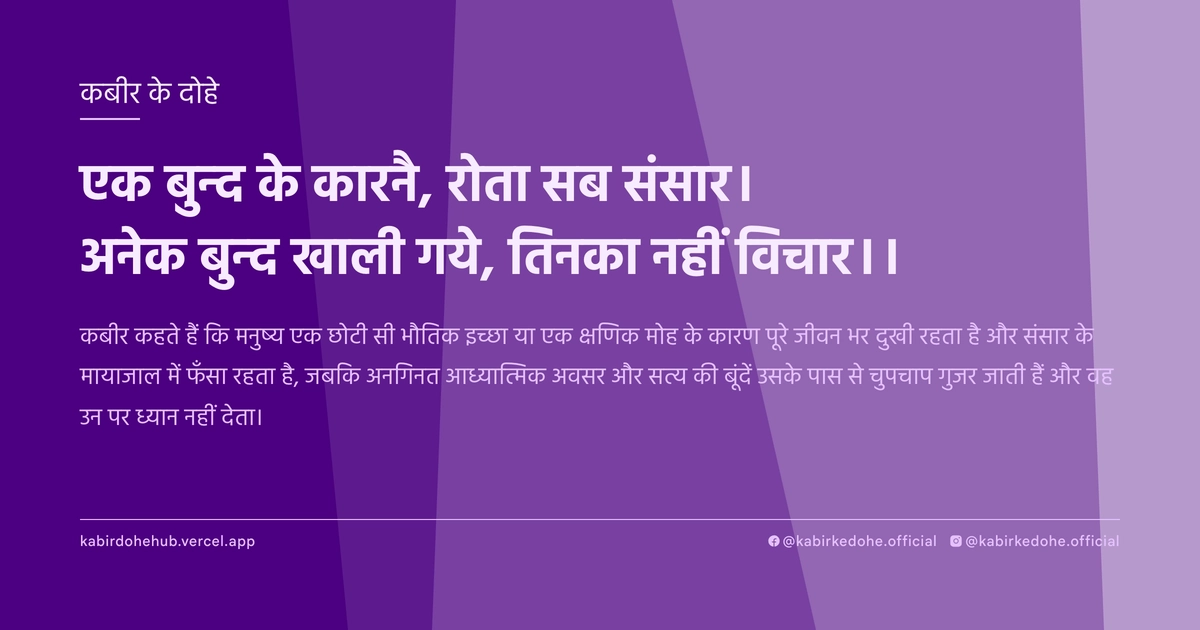
एक बुन्द के कारनै, रोता सब संसार।
अनेक बुन्द खाली गये, तिनका नहीं विचार।।
Ek bund ke karane, rota sab sansar. Aneka bund khali gaye, tinka nahi vichar.
इस पृष्ठ पर इस कबीर दोहे का अर्थ (meaning), हिंदी व्याख्या और अंग्रेज़ी अनुवाद, दार्शनिक विश्लेषण और व्यावहारिक जीवन सीख दी गई है। यह दोहा मोह (Attachment) विषय से जुड़ा है — Kabir doha meaning and explanation in Hindi and English.
अर्थ (Meaning):
कबीर कहते हैं कि मनुष्य एक छोटी सी भौतिक इच्छा या एक क्षणिक मोह के कारण पूरे जीवन भर दुखी रहता है और संसार के मायाजाल में फँसा रहता है, जबकि अनगिनत आध्यात्मिक अवसर और सत्य की बूंदें उसके पास से चुपचाप गुजर जाती हैं और वह उन पर ध्यान नहीं देता।
Kabir observes that humanity weeps and suffers for the sake of a single drop—a tiny, fleeting worldly desire or attachment—while countless other drops of divine truth and spiritual liberation pass by unnoticed and unvalued, leaving the soul in a state of perpetual longing and ignorance.
व्याख्या (Interpretation):
शाब्दिक अर्थ में यह वर्षा की बूंदों की बात है, लेकिन रूपक के स्तर पर 'एक बूंद' उस अहंकार और सांसारिक आसक्ति को दर्शाती है जिसे हम अपना सर्वस्व मान लेते हैं। यह विडंबना है कि मनुष्य उस एक चीज के लिए विलाप करता है जो नश्वर है, जबकि 'अनेक बूंदें' उस अनंत ब्रह्म या निर्गुण परमात्मा के संकेतों को दर्शाती हैं जो हर क्षण हमारे चारों ओर मौजूद हैं। यहाँ कबीर अद्वैत वेदांत के उस सत्य को उजागर करते हैं जहाँ जीव अपनी सीमित पहचान (माया) में इतना उलझा है कि वह अपनी वास्तविक पहचान (आत्मा) को भूल गया है। यह विरोधाभास है कि हम तुच्छ को पाने के लिए विराट को खो देते हैं। यह दोहा हमें चेतावनी देता है कि हमारी दृष्टि केवल उस पर है जो हमें बांधता है, न कि उस पर जो हमें मुक्त करता है।
Literally, the verse speaks of raindrops, but metaphorically, the 'single drop' represents the ego and the minuscule worldly attachments that we mistake for our entire existence. It is a profound irony that humans grieve over a transient loss while 'countless drops'—the omnipresent signals of the Nirgun Brahman and spiritual awakening—flow past them unnoticed. Kabir links this to the Advaita Vedanta concept of Maya, where the soul is so mesmerized by the illusion of duality and limitation that it forgets its non-dual nature with the Absolute. The central paradox highlighted here is the human tendency to prioritize the finite over the infinite. We weep for the drop of desire while ignoring the ocean of consciousness, effectively choosing bondage over liberation through a distorted perception of value.
दार्शनिक विश्लेषण (Philosophical Analysis):
कबीर का यह दोहा उनके युग के उस सामाजिक और धार्मिक पाखंड पर प्रहार है जहाँ लोग बाहरी कर्मकांडों की 'एक बूंद' (जैसे तीर्थयात्रा या माला जपना) को ही मोक्ष का एकमात्र मार्ग मान लेते थे। वे यहाँ 'निर्गुण भक्ति' का समर्थन करते हैं, जहाँ ईश्वर किसी मूर्ति या मंदिर में नहीं, बल्कि स्वयं के भीतर और सृष्टि के कण-कण में व्याप्त है। कबीर का दर्शन सूफीवाद के 'फना' (अहंकार का विनाश) के करीब है, जहाँ साधक को यह समझना होता है कि उसकी व्यक्तिगत इच्छाएं केवल भ्रम हैं।
दार्शनिक रूप से, यह दोहा 'अविद्या' (अज्ञानता) की व्याख्या करता है। जब मनुष्य अपनी पहचान को शरीर और उसकी इच्छाओं से जोड़ लेता है, तो वह उस 'एक बूंद' का बंदी बन जाता है। यह मानसिक संकीर्णता है जो उसे विराट सत्य से दूर रखती है। कबीर तर्क देते हैं कि दुःख का कारण वस्तु नहीं, बल्कि उस वस्तु के प्रति हमारा मोह है।
वे जाति और धर्म के भेदों को भी इसी 'एक बूंद' के मोह के रूप में देखते हैं। लोग अपनी जातिगत श्रेष्ठता की एक छोटी सी बूंद को पकड़े रहते हैं और मानवता के विशाल समुद्र को अनदेखा कर देते हैं। यह सामाजिक विभाजन वास्तव में आध्यात्मिक अंधता का परिणाम है।
मनोवैज्ञानिक स्तर पर, यह 'लॉस एवर्जन' (हानि से बचने की प्रवृत्ति) का आध्यात्मिक विश्लेषण है। हम खोई हुई छोटी चीजों पर इतना ध्यान केंद्रित करते हैं कि हम उपलब्ध अनंत संभावनाओं को नहीं देख पाते। कबीर हमें अपनी चेतना के केंद्र को स्थानांतरित करने का आह्वान करते हैं।
अंततः, यह दोहा अद्वैत की उस स्थिति की ओर ले जाता है जहाँ 'बूंद' और 'सागर' का भेद मिट जाता है। जब तक हम स्वयं को एक अलग बूंद मानते हैं, हम रोएंगे; जिस दिन हम स्वयं को सागर के रूप में पहचानेंगे, विलाप समाप्त हो जाएगा। यह केवल ज्ञान की बात नहीं, बल्कि अनुभव की बात है।
This Doha is a sharp critique of the ritualistic blindness prevalent during Kabir's era, where people clung to the 'single drop' of outward piety—such as pilgrimage or rote chanting—believing it to be the sole path to salvation. Kabir champions 'Nirgun Bhakti,' asserting that the Divine is not confined to an idol or a temple but is an all-pervasive, formless reality. His philosophy mirrors the Sufi concept of 'Fana' (the annihilation of the ego), where the seeker must realize that personal desires are mere mirages.
Philosophically, the verse dissects 'Avidya' (spiritual ignorance). When a human identifies solely with the physical body and its cravings, they become prisoners of that 'single drop.' This cognitive narrowing prevents them from perceiving the vastness of the Absolute. Kabir argues that suffering is not caused by the object of desire, but by the attachment to it, which creates a false sense of separation from the Whole.
He extends this critique to the caste system and religious sectarianism. People cling to the 'single drop' of caste superiority or religious identity, ignoring the vast ocean of shared humanity. Such social divisions are, in Kabir's view, symptoms of a deeper spiritual blindness where the ego seeks validation in labels rather than in Truth.
Psychologically, this is an analysis of 'loss aversion' applied to spirituality. We obsess over the tiny fragments of life we have lost or crave, rendering us blind to the infinite grace available in the present moment. Kabir calls for a radical shift in consciousness, moving from the periphery of desire to the center of Being.
Ultimately, the poem points toward the Advaita realization where the distinction between the 'drop' and the 'ocean' vanishes. As long as we perceive ourselves as a separate, fragile drop, we will suffer; the moment we realize we are the ocean, the weeping ceases. This is not a theoretical exercise but a call for an experiential shift in identity.
मूल संदेश (Core Message):
- मोह एक सूक्ष्म बंधन है जो विराट को ओझल कर देता है।
- दुःख वस्तु में नहीं, बल्कि उसके प्रति हमारी आसक्ति में है।
- अहंकार की एक बूंद पूरे सत्य के सागर को ढक लेती है।
- वर्तमान की अनंत संभावनाओं को पहचानना ही वास्तविक जागृति है।
- जब 'मैं' मिटता है, तब 'सब कुछ' प्रकट होता है।
- Attachment is a subtle bond that obscures the Infinite.
- Suffering resides not in the object, but in our clinging to it.
- A single drop of ego can veil the entire ocean of Truth.
- True awakening is recognizing the infinite possibilities of the Now.
- When the 'I' vanishes, the 'All' is revealed.
व्यावहारिक उदाहरण (Practical Example):
वाराणसी के एक पुराने घाट पर रामदीन नाम का एक वृद्ध नाविक रहता था। रामदीन का पूरा जीवन एक छोटी सी नाव और उसके पुराने मालिक द्वारा दिए गए एक छोटे से कर्ज को चुकाने की चिंता में बीता। वह कर्ज बहुत मामूली था, लेकिन रामदीन के मन में वह 'एक बूंद' बन गया था। वह हर दिन उस कर्ज के बारे में सोचकर दुखी रहता, अपनी वर्तमान खुशियों को नजरअंदाज करता और खुद को एक असफल व्यक्ति मानता रहा।
वह गंगा की लहरों को देखता, लेकिन उसमें छिपे संगीत को नहीं सुन पाता था। वह घाट पर आने वाले संतों की बातें सुनता, लेकिन उसका मन हमेशा उस पुराने हिसाब-किताब में उलझा रहता। उसके पास प्रकृति का सौंदर्य, परिवार का प्रेम और ईश्वर की उपस्थिति जैसे 'अनेक बूंदें' थीं, लेकिन उसने केवल उस एक कर्ज की बूंद को पकड़ा हुआ था।
एक दिन, एक फकीर ने उसे देखा और पूछा, "रामदीन, तू इस सुंदर शाम में इतना उदास क्यों है?" रामदीन ने अपना दुख सुनाया। फकीर मुस्कुराया और बोला, "तूने एक छोटी सी बूंद के लिए पूरे समुद्र को भुला दिया। जिस कर्ज की तू चिंता कर रहा है, वह उस मालिक के परिवार द्वारा सालों पहले माफ किया जा चुका है, बस तुझे कभी बताया नहीं गया।"
रामदीन स्तब्ध रह गया। उसे एहसास हुआ कि उसने अपने जीवन के तीस साल एक ऐसी चिंता में बिता दिए जो वास्तव में अस्तित्व में ही नहीं थी। उसने उस 'एक बूंद' के मोह में उन हजारों खुशियों को खो दिया जो उसके सामने थीं।
इस 'कबीर ट्विस्ट' ने रामदीन की पूरी दृष्टि बदल दी। उसने महसूस किया कि हम अक्सर अपनी जिंदगी के छोटे-छोटे दुखों, पुरानी शिकायतों या असफलताओं को पकड़ कर बैठ जाते हैं, जबकि जीवन हमें हर पल नई संभावनाएं देता है।
रामदीन ने उस दिन से कर्ज की चिंता छोड़ दी और अपनी नाव को केवल सवारी ढोने का साधन नहीं, बल्कि शांति का माध्यम बना लिया। वह अब लहरों के साथ बहना सीख गया था।
उसने देखा कि जब वह उस एक मानसिक बोझ से मुक्त हुआ, तो उसे अचानक अपने आस-पास की दुनिया अधिक रंगीन और जीवंत लगने लगी।
उसकी मुस्कान अब बनावटी नहीं थी, क्योंकि उसने जान लिया था कि असली दुख बाहरी अभाव में नहीं, बल्कि आंतरिक आसक्ति में होता है।
अंत में, रामदीन ने अपनी नाव का नाम 'शून्य' रख दिया, ताकि वह हर दिन याद रख सके कि जब हम सब कुछ छोड़ देते हैं, तभी हम वास्तव में सब कुछ पा लेते हैं।
On an ancient ghat in Varanasi lived an elderly boatman named Ramdin. Ramdin's entire life was consumed by the anxiety of repaying a small debt owed to his former employer. Though the amount was negligible, in Ramdin's mind, it became that 'single drop' of obsession. He spent every day grieving over this debt, ignoring his current joys and viewing himself as a failure.
He looked at the waves of the Ganges but failed to hear the music within them. He listened to the saints on the ghats, but his mind remained entangled in old accounts. He was surrounded by 'countless drops' of grace—the beauty of nature, the love of his family, and the presence of the Divine—yet he clung only to that one drop of financial guilt.
One day, a wandering dervish noticed him and asked, "Ramdin, why are you so sorrowful on such a beautiful evening?" Ramdin shared his burden. The dervish smiled and replied, "You have forgotten the entire ocean for the sake of one tiny drop. The debt you worry about was forgiven by the owner's family years ago; you were simply never told."
Ramdin was stunned. He realized he had spent thirty years of his life in agony over a worry that didn't even exist. In his obsession with that 'single drop,' he had ignored the thousands of blessings flowing right past him.
This 'Kabir Twist' fundamentally altered Ramdin's perception. He understood that humans often cling to small sorrows, old grudges, or past failures, while life offers endless new possibilities every single moment.
From that day on, Ramdin let go of the mental debt and transformed his boat from a mere tool of labor into a vessel of peace. He learned to flow with the current rather than fight it.
He noticed that once he released that one mental burden, the world around him suddenly appeared more colorful and vibrant.
His smile became genuine because he finally understood that true suffering lies not in external lack, but in internal attachment.
Eventually, Ramdin renamed his boat 'Shunya' (Void), as a daily reminder that only when we let go of everything do we truly possess everything.
अभ्यास मार्गदर्शन (Practice Guidance):
- प्रतिदिन 15 मिनट 'साक्षी भाव' का अभ्यास करें: अपने मन में उठने वाली इच्छाओं को केवल देखें, उन्हें पकड़े नहीं।
- स्व-पूछताछ जर्नल: लिखें कि वर्तमान में वह 'एक बूंद' (चिंता या मोह) क्या है जिसने आपको मानसिक रूप से बंदी बना रखा है।
- कृतज्ञता अभ्यास: दिन भर में उन 5 'अनेक बूंदों' (छोटी खुशियों या ईश्वरीय संकेतों) की सूची बनाएं जिन्हें आपने अक्सर अनदेखा कर दिया।
- डायग्नोस्टिक चेकलिस्ट: यदि आप किसी पुरानी गलती पर बार-बार विचार कर रहे हैं या भविष्य की एक छोटी उपलब्धि के लिए वर्तमान शांति का त्याग कर रहे हैं, तो समझें कि आप 'एक बूंद' के मोह में हैं।
- Practice 'Witness Consciousness' for 15 minutes daily: Observe the desires arising in your mind without clinging to them.
- Self-Inquiry Journaling: Identify and write down the 'single drop' (the specific anxiety or attachment) that is currently keeping you mentally imprisoned.
- Gratitude Mapping: List 5 'countless drops' (small joys or divine synchronicities) from your day that you usually overlook.
- Diagnostic Checklist: If you find yourself ruminating on a past mistake or sacrificing present peace for a small future gain, recognize that you are trapped in the 'single drop' illusion.
चिंतन प्रश्न (Reflection Questions):
- वह कौन सी एक छोटी सी बात या शिकायत है जिसे पकड़कर मैं अपनी पूरी मानसिक शांति नष्ट कर रहा हूँ?
- क्या मेरी पहचान मेरी उपलब्धियों (बूंदों) से है, या मैं उस चेतना (सागर) को महसूस कर पाता हूँ जिससे वे उपजी हैं?
- मैं डिजिटल दुनिया की 'लाइक' और 'अटेंशन' की बूंदों के लिए अपनी वास्तविक उपस्थिति को कितना खो रहा हूँ?
- यदि आज मेरा सबसे प्रिय भौतिक लगाव मुझसे छिन जाए, तो क्या मैं उस शून्य में भी पूर्ण रह पाऊंगा?
- क्या मैं धर्म के नाम पर केवल कर्मकांड की बूंदों को इकट्ठा कर रहा हूँ, जबकि प्रेम का सागर मेरे पास से गुजर रहा है?
- What is the one small grudge or complaint I am clinging to that is destroying my overall mental peace?
- Is my identity defined by my achievements (drops), or can I feel the consciousness (ocean) from which they emerge?
- How much of my authentic presence am I sacrificing for the 'drops' of likes and attention in the digital world?
- If my most cherished physical attachment were taken away today, could I remain whole in that void?
- Am I merely collecting drops of ritualism in the name of religion while the ocean of love flows past me?