
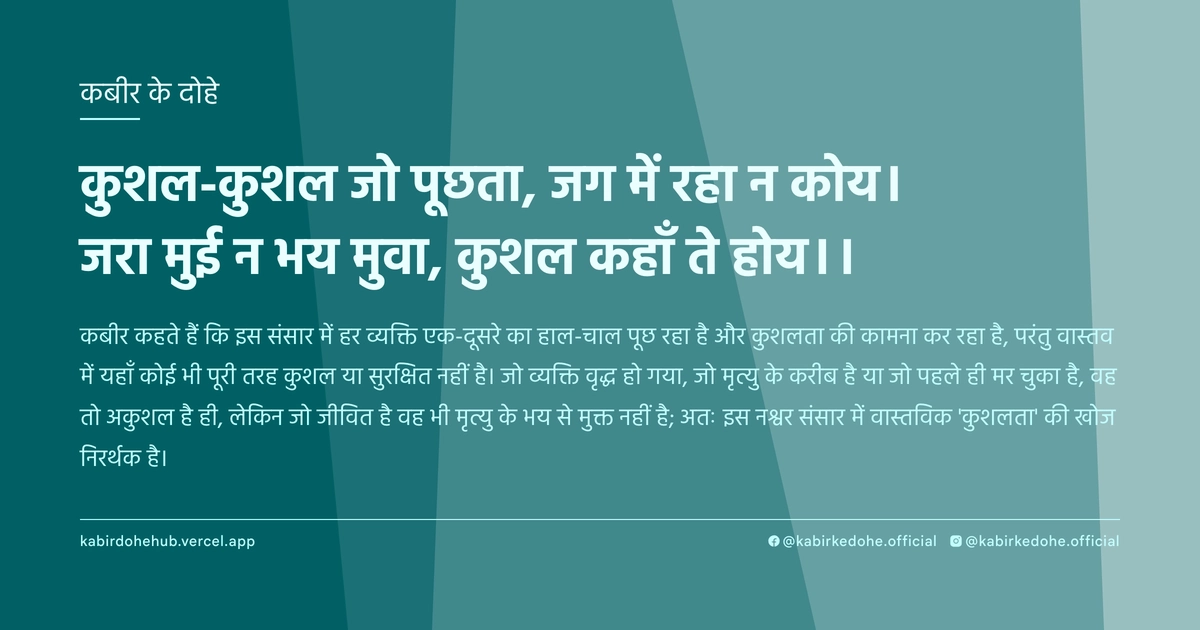
कुशल-कुशल जो पूछता, जग में रहा न कोय।
जरा मुई न भय मुवा, कुशल कहाँ ते होय।।
Kushal-kushal jo poochhta, jag me raha na koy. Jara mui na bhay muva, kushal kahan te hoye.
इस पृष्ठ पर इस कबीर दोहे का अर्थ (meaning), हिंदी व्याख्या और अंग्रेज़ी अनुवाद, दार्शनिक विश्लेषण और व्यावहारिक जीवन सीख दी गई है। यह दोहा मृतुक्यता (Mortality) विषय से जुड़ा है — Kabir doha meaning and explanation in Hindi and English.
अर्थ (Meaning):
कबीर कहते हैं कि इस संसार में हर व्यक्ति एक-दूसरे का हाल-चाल पूछ रहा है और कुशलता की कामना कर रहा है, परंतु वास्तव में यहाँ कोई भी पूरी तरह कुशल या सुरक्षित नहीं है। जो व्यक्ति वृद्ध हो गया, जो मृत्यु के करीब है या जो पहले ही मर चुका है, वह तो अकुशल है ही, लेकिन जो जीवित है वह भी मृत्यु के भय से मुक्त नहीं है; अतः इस नश्वर संसार में वास्तविक 'कुशलता' की खोज निरर्थक है।
Kabir observes that while people in this world constantly inquire about each other's well-being and seek security, in reality, no one is truly safe or 'well.' Those who have aged, those who are dying, and those who have already passed are obviously not well, but even the living are haunted by the inevitability of death; therefore, seeking absolute wellness or permanent security in this transient world is a futile pursuit.
व्याख्या (Interpretation):
यह दोहा भौतिक अस्तित्व की क्षणभंगुरता और मानवीय अज्ञानता के बीच के विरोधाभास को दर्शाता है। 'कुशल' शब्द यहाँ केवल शारीरिक स्वास्थ्य नहीं, बल्कि उस मानसिक सुरक्षा और स्थिरता का प्रतीक है जिसे मनुष्य माया के प्रभाव में खोजता है। कबीर तर्क देते हैं कि जब शरीर का अंत निश्चित है, तो सांसारिक सुखों में कुशलता खोजना एक भ्रम है। यह निर्गुण भक्ति का आह्वान है, जहाँ साधक को यह समझना होता है कि आत्मा (Atman) अविनाशी है, जबकि शरीर नश्वर है। जब तक हम स्वयं को शरीर मानते हैं, हम मृत्यु के भय और अकुशलता के चक्र में फंसे रहेंगे। यह अद्वैत वेदांत के उस सत्य की ओर संकेत करता है जहाँ व्यक्ति अपनी पहचान सीमित अहंकार से हटाकर अनंत ब्रह्म से जोड़ता है। इस प्रकार, वास्तविक कुशलता केवल उस सत्य के साक्षात्कार में है जो जन्म और मृत्यु के पार है।
This couplet highlights the paradox between the fragility of physical existence and human ignorance. The word 'Kushal' (well-being) here represents not just physical health, but the psychological security and stability that humans seek under the influence of Maya (illusion). Kabir argues that since the dissolution of the body is certain, seeking permanent wellness in worldly pleasures is a delusion. This is a call toward Nirgun Bhakti, where the seeker must realize that while the body is perishable, the Atman (Soul) is immortal. As long as we identify with the physical form, we remain trapped in the cycle of fear and instability. It points toward the truth of Advaita Vedanta, where one shifts identity from the limited ego to the infinite Brahman. Thus, true well-being is found only in the realization of the Truth that transcends birth and death.
दार्शनिक विश्लेषण (Philosophical Analysis):
कबीर का यह दोहा उस सामाजिक और धार्मिक पाखंड पर प्रहार करता है जहाँ लोग बाहरी कर्मकांडों और सामाजिक शिष्टाचार के माध्यम से अपनी नश्वरता को छिपाने का प्रयास करते हैं। उनके समय में, धर्म का अर्थ अक्सर केवल पूजा-पाठ और बाहरी दिखावा था, जिसे कबीर ने सिरे से नकार दिया। वे बताते हैं कि 'कुशलता' पूछना एक सामाजिक मुखौटा है, जबकि आंतरिक सत्य यह है कि हर सांस हमें अंत की ओर ले जा रही है।
दार्शनिक स्तर पर, यह सूफी मत के 'फना' (अहंकार का विनाश) और अद्वैत वेदांत के 'माया' सिद्धांत का संगम है। कबीर यह समझा रहे हैं कि जब तक मनुष्य अपनी पहचान 'मैं' और 'मेरा' (अहंकार) से जोड़ता है, वह हमेशा असुरक्षित महसूस करेगा। यह असुरक्षा ही उसे सांसारिक मोह-माया में बांधे रखती है।
यहाँ 'जरा' (बुढ़ापा) और 'मुवा' (मृत्यु) केवल शारीरिक अवस्थाएं नहीं हैं, बल्कि वे समय की उस अपरिवर्तनीय शक्ति के प्रतीक हैं जो हर भौतिक संरचना को नष्ट कर देती है। कबीर का उद्देश्य डराना नहीं, बल्कि जागृत करना है। वे चाहते हैं कि मनुष्य इस सत्य को स्वीकार करे ताकि वह मृत्यु के भय से मुक्त होकर उस 'अविनाशी' तत्व की खोज करे जो कभी नहीं मरता।
यह विश्लेषण हमें यह सिखाता है कि मनोवैज्ञानिक रूपांतरण तब शुरू होता है जब हम अपनी नश्वरता को स्वीकार कर लेते हैं। जब हम यह जान लेते हैं कि इस संसार में कुछ भी स्थायी नहीं है, तब हमारा मोह कम होने लगता है और हम वास्तविक शांति की ओर बढ़ते हैं।
अंततः, कबीर यह स्पष्ट करते हैं कि वास्तविक कुशलता किसी बाहरी स्थिति या स्वास्थ्य में नहीं, बल्कि आत्म-साक्षात्कार में है। जो व्यक्ति स्वयं को ब्रह्म का अंश मान लेता है, उसके लिए जन्म और मृत्यु केवल वस्त्र बदलने जैसी प्रक्रिया बन जाती है, और वहीं वह वास्तविक 'कुशल' हो जाता है।
Kabir's couplet attacks the social and religious hypocrisy where people attempt to mask their mortality through external rituals and social etiquettes. In his era, religion was often reduced to mere performance and outward display, which Kabir vehemently rejected. He posits that inquiring about 'well-being' is a social mask, while the internal truth is that every breath leads us closer to the end.
Philosophically, this is a convergence of the Sufi concept of 'Fana' (annihilation of the ego) and the Advaita Vedanta principle of 'Maya'. Kabir explains that as long as a human ties their identity to 'I' and 'Mine' (the ego), they will perpetually feel insecure. This insecurity is precisely what binds them to worldly attachments.
Here, 'Jara' (old age) and 'Muva' (death) are not merely physical states but symbols of the irreversible power of time that destroys every material structure. Kabir's intent is not to instill fear, but to awaken the consciousness. He urges the individual to accept this truth to liberate themselves from the fear of death and seek the 'Indestructible' element that never perishes.
This analysis teaches us that psychological transformation begins with the acceptance of our own mortality. Once we realize that nothing in this material world is permanent, our attachments diminish, and we move toward genuine peace.
Ultimately, Kabir clarifies that true well-being is not found in an external condition or physical health, but in self-realization. For the one who recognizes themselves as a part of the Brahman, birth and death become as simple as changing clothes, and only then do they become truly 'Kushal'.
मूल संदेश (Core Message):
- सांसारिक सुरक्षा एक सुंदर लेकिन घातक भ्रम है।
- मृत्यु का भय केवल शरीर से जुड़ाव के कारण है।
- वास्तविक कुशलता आत्मा के अविनाशी स्वरूप को जानने में है।
- अहंकार का विसर्जन ही परम शांति का एकमात्र मार्ग है।
- नश्वरता को स्वीकार करना ही वास्तविक स्वतंत्रता की शुरुआत है।
- Worldly security is a beautiful yet lethal illusion.
- The fear of death exists only due to identification with the body.
- True well-being lies in realizing the immortal nature of the soul.
- The dissolution of the ego is the only path to ultimate peace.
- Accepting impermanence is the beginning of true liberation.
व्यावहारिक उदाहरण (Practical Example):
वाराणसी के एक पुराने घाट पर रहने वाले एक वृद्ध बुनकर थे, जिनका नाम माधव था। माधव अपनी पूरी जिंदगी बेहतरीन रेशमी साड़ियाँ बुनने में बिता चुके थे। वे शहर के सबसे कुशल बुनकर माने जाते थे और लोग अक्सर उनसे उनकी कुशलता और स्वास्थ्य के बारे में पूछते थे।
माधव का अहंकार उनकी इस 'कुशलता' में बसा था। उन्हें लगता था कि उनकी कला उन्हें अमर बना देगी। वे अपने शिष्यों को सिखाते थे कि कैसे धागों को मजबूती से बांधा जाए ताकि कपड़ा कभी न फटे।
एक दिन माधव को एक गंभीर बीमारी ने घेर लिया। उनके हाथ कांपने लगे और वे अब एक इंच धागा भी सही से नहीं जोड़ पा रहे थे। उनके पास आने वाले लोग अब भी औपचारिक रूप से पूछते, 'माधव काका, अब आपकी कुशलता कैसी है?'
माधव को महसूस हुआ कि जिस 'कुशलता' पर उन्होंने अपना पूरा जीवन टिकाया था, वह कितनी खोखली थी। उनकी कला, उनका सम्मान और उनका शरीर—सब समय की मार से टूट रहे थे।
तभी उनकी मुलाकात एक घुमक्कड़ साधु से हुई, जिसने माधव की आंखों में छिपी हताशा को देखा। साधु ने मुस्कुराते हुए कहा, 'माधव, तुम उस धागे की कुशलता खोज रहे हो जो एक दिन टूटना ही है। असली कुशलता उस बुनकर को खोजने में है जिसने इस पूरे ब्रह्मांड को बुना है।'
इस बात ने माधव के भीतर एक बिजली सी कौंधा। उन्होंने महसूस किया कि वे अब तक केवल 'कपड़े' की कुशलता में उलझे थे, जबकि 'जीवन' की कुशलता को पूरी तरह अनदेखा कर दिया था।
माधव ने अपने बचे हुए दिन शिकायत करने में नहीं, बल्कि समर्पण में बिताए। उन्होंने अपनी सारी संपत्ति गरीबों में बांट दी और केवल ध्यान में लीन रहने लगे।
अब जब लोग उनसे पूछते कि वे कैसे हैं, तो वे शांति से मुस्कुराते और कहते, 'मैं अब उस कुशलता में हूँ जहाँ न कुछ खोने का डर है और न कुछ पाने की चाह।'
माधव का रूपांतरण यह दिखाता है कि जब हम भौतिक सुरक्षा के भ्रम को छोड़ देते हैं, तभी हम वास्तविक मानसिक शांति प्राप्त करते हैं।
उनकी मृत्यु के समय उनके चेहरे पर एक ऐसी शांति थी जो उनके जीवन की सबसे बेहतरीन रेशमी साड़ी से भी अधिक सुंदर और मूल्यवान थी।
On an old ghat in Varanasi lived an elderly weaver named Madhav. Madhav had spent his entire life weaving the finest silk sarees. He was considered the most skilled weaver in the city, and people often inquired about his well-being and the 'skill' of his craft.
Madhav's ego was rooted in this 'skill.' He believed his artistry would make him immortal. He taught his disciples how to tie threads so tightly that the fabric would never tear.
One day, a severe illness struck Madhav. His hands began to tremble, and he could no longer join even an inch of thread correctly. People visiting him would still formally ask, 'Madhav Kaka, how is your well-being now?'
Madhav realized that the 'wellness' and 'skill' upon which he had anchored his entire life were utterly hollow. His art, his reputation, and his body—all were crumbling under the weight of time.
Then he met a wandering monk who saw the desperation hidden in Madhav's eyes. The monk smiled and said, 'Madhav, you are seeking the skill of a thread that is destined to break. True skill lies in finding the Weaver who wove this entire universe.'
These words struck Madhav like a bolt of lightning. He realized he had been obsessed with the skill of the 'cloth' while completely ignoring the skill of 'living.'
Madhav spent his remaining days not in complaint, but in surrender. He distributed his wealth among the poor and immersed himself in meditation.
Now, when people asked how he was, he would smile peacefully and say, 'I am now in that state of well-being where there is neither fear of losing nor desire for gaining.'
Madhav's transformation demonstrates that only when we abandon the illusion of material security do we attain genuine mental peace.
At the time of his death, there was a serenity on his face that was more beautiful and valuable than the finest silk saree he had ever woven.
अभ्यास मार्गदर्शन (Practice Guidance):
- प्रतिदिन 20 मिनट 'मरणोपरांत चिंतन' (Death Contemplation) करें: यह सोचें कि यदि आज अंतिम दिन हो, तो आपकी कौन सी उपलब्धियां वास्तव में मायने रखेंगी।
- स्व-पूछताछ जर्नल: लिखें कि आप अपनी 'कुशलता' या 'सफलता' को किन बाहरी चीजों (पद, पैसा, स्वास्थ्य) से जोड़ रहे हैं और यह जुड़ाव आपको कितना असुरक्षित बनाता है।
- व्यवहारिक परिवर्तन: जब कोई आपसे 'कैसे हो?' पूछे, तो केवल औपचारिक उत्तर देने के बजाय, एक क्षण के लिए अपनी नश्वरता और वर्तमान क्षण की अनमोलता को महसूस करें।
- निदान चेकलिस्ट: यदि आप छोटी सी बीमारी या आर्थिक नुकसान पर अत्यधिक घबरा जाते हैं, तो इसका अर्थ है कि आप अभी भी 'माया' की कुशलता में फंसे हैं। यदि आप उतार-चढ़ाव में भी स्थिर हैं, तो आप सत्य की ओर बढ़ रहे हैं।
- Daily Death Contemplation: Spend 20 minutes reflecting on the impermanence of life. Ask yourself: 'If today were my last day, which of my achievements would truly matter?'
- Self-Inquiry Journaling: List the external factors (status, money, health) you associate with your 'well-being' and analyze how this attachment creates a sense of insecurity.
- Behavioral Shift: When someone asks 'How are you?', instead of giving a robotic formal answer, take a moment to feel the fragility of existence and the preciousness of the present moment.
- Diagnostic Checklist: If you experience extreme panic over a minor illness or financial loss, you are still trapped in the illusion of material wellness. If you remain equanimous amidst fluctuations, you are aligning with the Truth.
चिंतन प्रश्न (Reflection Questions):
- आप अपनी सामाजिक छवि (Public Identity) को बनाए रखने के लिए अपनी आंतरिक शांति का कितना बलिदान करते हैं?
- यदि आपका स्वास्थ्य और पद आज छिन जाए, तो आपके व्यक्तित्व का कौन सा हिस्सा बचेगा जिसे आप 'मैं' कह सकें?
- क्या आपकी 'कुशलता' दूसरों से बेहतर दिखने की होड़ है, या वास्तव में आंतरिक संतोष?
- आप मृत्यु के विचार से भागते हैं या उसे एक रूपांतरण के रूप में देखते हैं?
- डिजिटल युग में, आपकी 'प्रोफाइल' की कुशलता आपके वास्तविक जीवन की रिक्तता को कितना ढक रही है?
- How much of your inner peace do you sacrifice to maintain your public identity?
- If your health and status were stripped away today, what part of your personality would remain that you could call 'I'?
- Is your sense of 'well-being' a competition to appear better than others, or is it genuine inner contentment?
- Do you flee from the thought of death, or do you perceive it as a transformation?
- In the digital age, how much does the 'wellness' of your online profile mask the emptiness of your actual life?