
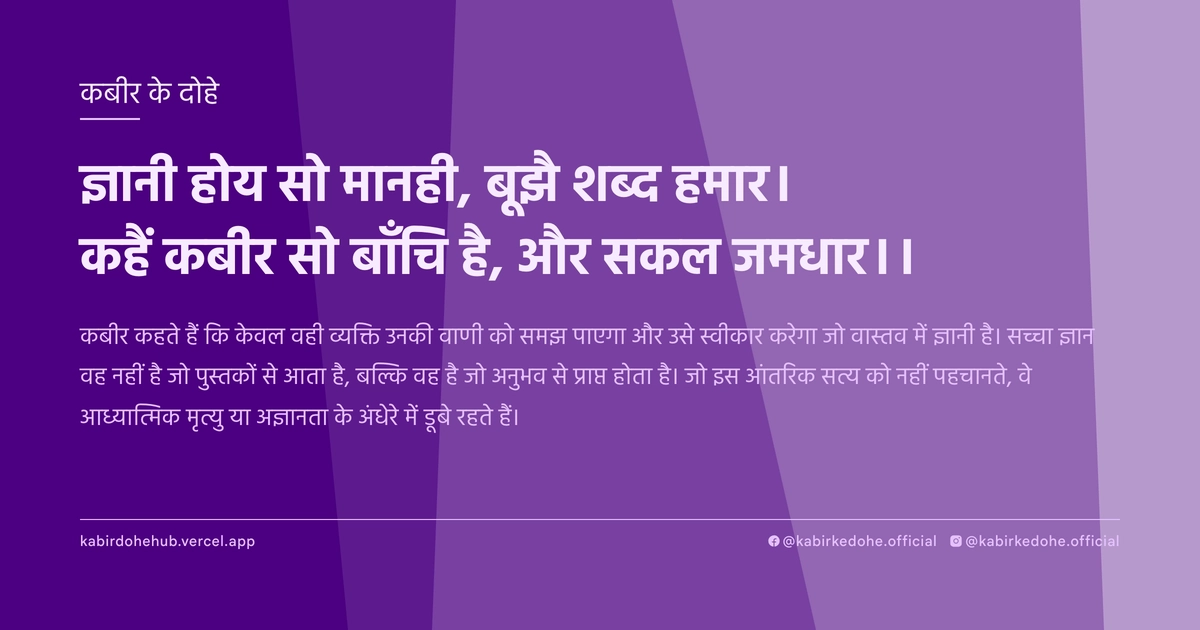
ज्ञानी होय सो मानही, बूझै शब्द हमार।
कहैं कबीर सो बाँचि है, और सकल जमधार।।
Gyaani hoye so maanhi, boojhai shabd hamar. Kahain kabir so baanchi hai, aur sakal jamdhaar.
इस पृष्ठ पर इस कबीर दोहे का अर्थ (meaning), हिंदी व्याख्या और अंग्रेज़ी अनुवाद, दार्शनिक विश्लेषण और व्यावहारिक जीवन सीख दी गई है। यह दोहा आत्मनिरीक्षण (Self-introspection) विषय से जुड़ा है — Kabir doha meaning and explanation in Hindi and English.
अर्थ (Meaning):
कबीर कहते हैं कि केवल वही व्यक्ति उनकी वाणी को समझ पाएगा और उसे स्वीकार करेगा जो वास्तव में ज्ञानी है। सच्चा ज्ञान वह नहीं है जो पुस्तकों से आता है, बल्कि वह है जो अनुभव से प्राप्त होता है। जो इस आंतरिक सत्य को नहीं पहचानते, वे आध्यात्मिक मृत्यु या अज्ञानता के अंधेरे में डूबे रहते हैं।
Kabir asserts that only a truly enlightened soul, possessing genuine wisdom, can comprehend and embrace his words. True knowledge is not a product of scholarly study but of direct experiential realization. Those who fail to recognize this inner truth remain trapped in the spiritual oblivion and darkness of ignorance.
व्याख्या (Interpretation):
इस दोहे का शाब्दिक अर्थ है कि केवल ज्ञानी ही कबीर के शब्दों का मूल्य समझेगा। यहाँ 'ज्ञानी' का तात्पर्य डिग्रीधारी विद्वान से नहीं, बल्कि उस व्यक्ति से है जिसने अपनी अहंकार की परतों को हटा दिया है। कबीर 'शब्द' को एक बीज के रूप में देखते हैं जो केवल उपजाऊ मन में ही अंकुरित होता है। यह निरगुण भक्ति का सार है, जहाँ ईश्वर किसी मूर्ति में नहीं बल्कि स्वयं के भीतर के बोध में है। 'जमधार' शब्द यहाँ मृत्यु के देवता यमराज का प्रतीक है, जो वास्तव में अज्ञानता और माया के बंधन को दर्शाता है। यह द्वैतवाद के अंत और अद्वैत वेदांत की ओर संकेत करता है, जहाँ ज्ञाता और ज्ञात एक हो जाते हैं। अंततः, यह दोहा मनुष्य की उस त्रासदी को दर्शाता है जहाँ वह सत्य के सामने खड़ा होकर भी उसे पहचान नहीं पाता क्योंकि उसका अहंकार उसे ढके हुए है।
Literally, the verse suggests that only the wise will honor Kabir's words. However, 'wisdom' here does not refer to academic erudition but to the experiential realization of the self. Kabir views the 'Shabd' (Word) as a seed that can only germinate in a mind stripped of ego. This aligns with Nirgun Bhakti, where the Divine is not a sculpted idol but a formless presence realized within. The term 'Jamdhar' (the lord of death) symbolizes the spiritual inertia and the veil of Maya that keeps the soul in bondage. It points toward the non-duality of Advaita Vedanta, where the distinction between the seeker and the sought dissolves. The central paradox presented is the human condition: standing in the presence of absolute truth yet remaining blind to it due to the cataracts of intellectual pride.
दार्शनिक विश्लेषण (Philosophical Analysis):
कबीर का यह दोहा उस समय के सामाजिक और धार्मिक वातावरण पर एक तीखा प्रहार है, जहाँ ज्ञान को केवल संस्कृत के ग्रंथों और उच्च जातियों के एकाधिकार के रूप में देखा जाता था। कबीर ने इस 'किताबी ज्ञान' को खारिज करते हुए 'सहज ज्ञान' या अनुभवजन्य सत्य पर बल दिया। उनका दर्शन सूफी मत के 'मारिफत' (दिव्य ज्ञान) और वेदांत के 'आत्म-साक्षात्कार' का एक अनूठा संगम है।
यहाँ ritualism (कर्मकांड) का विरोध स्पष्ट है। कबीर का मानना था कि बाहरी आडंबर, जैसे माला जपना या तीर्थ यात्रा करना, यदि आंतरिक रूपांतरण के बिना हो, तो वे केवल अहंकार को बढ़ाते हैं। सच्चा ज्ञान वह है जो मनुष्य को उसके 'स्व' से मिलाए और उसे जाति, धर्म और वर्ग के कृत्रिम विभाजनों से मुक्त करे।
मनोवैज्ञानिक स्तर पर, कबीर 'अहंकार के विलोपन' की बात कर रहे हैं। जब तक व्यक्ति यह मानता है कि वह 'जानता' है, वह वास्तव में सीखने के लिए तैयार नहीं होता। यह 'अज्ञान की चेतना' ही है जो उसे जमधार (मृत्यु/अंधकार) की ओर ले जाती है। ज्ञान यहाँ सूचना नहीं, बल्कि एक रूपांतरण है।
सूफीवाद के प्रभाव में, कबीर 'शब्द' को एक आध्यात्मिक सेतु मानते हैं। यह शब्द केवल ध्वनि नहीं है, बल्कि वह कंपन है जो आत्मा को परमात्मा से जोड़ता है। जो इस कंपन को महसूस नहीं कर पाता, वह केवल शब्दों के बाहरी ढांचे में उलझा रहता है।
अंततः, कबीर यह स्थापित करते हैं कि सत्य सार्वभौमिक है, लेकिन उसकी पात्रता केवल उन्हीं को प्राप्त है जिन्होंने अपनी वासनाओं और मानसिक जड़ता को त्याग दिया है। यह संदेश आज भी प्रासंगिक है, जहाँ सूचना की अधिकता है लेकिन विवेक का अभाव है।
This Doha is a piercing critique of the socio-religious climate of Kabir's era, where knowledge was viewed as the exclusive domain of Sanskrit scholars and high castes. Kabir rejects this 'bookish knowledge' in favor of 'Sahaj Gyan' or experiential truth. His philosophy is a unique synthesis of the Sufi concept of 'Ma'rifat' (divine gnosis) and the Vedantic pursuit of 'Atma-Sakshatkar' (self-realization).
The rejection of ritualism is explicit here. Kabir argues that external pieties—such as chanting beads or pilgrimages—only inflate the ego if they are not accompanied by internal transformation. True wisdom is that which reconnects the individual with their essence, liberating them from the artificial constructs of caste, creed, and class.
Psychologically, Kabir addresses the 'annihilation of the ego'. As long as a person believes they 'know', they are fundamentally closed to learning. This 'consciousness of ignorance' is what leads them toward 'Jamdhar'—the spiritual death caused by mental inertia and attachment to the illusory self.
Influenced by Sufism, Kabir treats the 'Shabd' (Word) as a spiritual bridge. The Word is not merely a linguistic unit but a cosmic vibration that aligns the soul with the Universal Truth. Those who cannot perceive this vibration remain trapped in the superficial structure of language.
Ultimately, Kabir establishes that while Truth is universal, the capacity to receive it is reserved for those who have transcended their desires and cognitive rigidity. This remains profoundly relevant in the modern age, where we are overwhelmed by information but starved for wisdom.
मूल संदेश (Core Message):
- सूचना ज्ञान नहीं है; अनुभव ही वास्तविक बोध है।
- अहंकार वह पर्दा है जो सत्य को ओझल कर देता है।
- बाहरी विद्वत्ता अक्सर आंतरिक अंधकार को छिपाने का मुखौटा होती है।
- सत्य को पढ़ने की नहीं, बल्कि उसे जीने की आवश्यकता है।
- जब 'मैं' मिटता है, तभी 'वह' (परमात्मा) प्रकट होता है।
- Information is not wisdom; only experience is true realization.
- The ego is the veil that obscures the Absolute Truth.
- External erudition is often a mask hiding internal darkness.
- Truth is not to be read, but to be lived and embodied.
- Only when the 'I' dissolves does the 'Divine' manifest.
व्यावहारिक उदाहरण (Practical Example):
वाराणसी के एक पुराने घाट पर माधव नाम का एक वृद्ध व्यक्ति रहता था, जो स्वयं को धर्मशास्त्रों का महान ज्ञाता मानता था। वह दिन भर राहगीरों को यह बताता कि मोक्ष कैसे प्राप्त किया जाए और कौन से मंत्र सबसे शक्तिशाली हैं। उसकी आवाज़ में अधिकार था, लेकिन उसकी आँखों में एक अजीब सी बेचैनी थी।
उसी घाट के पास एक साधारण सा जुलाहा रहता था, जो चुपचाप अपना काम करता और कभी-कभी कबीर के दोहे गुनगुनाता। माधव अक्सर उस जुलाहे का मज़ाक उड़ाता और कहता, 'तुम अनपढ़ लोग क्या जानो ज्ञान के बारे में? मैंने हज़ारों ग्रंथ पढ़े हैं, जबकि तुम केवल धागे बुनते हो।'
एक दिन शहर में एक महान संत आए। माधव उनके चरणों में गिर गया और अपनी विद्वत्ता का प्रदर्शन करने लगा। उसने कठिन श्लोकों का पाठ किया और संत से पूछा कि क्या वह उसकी विद्वत्ता से प्रभावित हैं। संत ने मुस्कुराते हुए माधव की ओर देखा और कहा, 'तुम्हारे शब्दों में ज्ञान तो है, लेकिन तुम्हारे हृदय में शांति नहीं है। तुम ग्रंथों को जानते हो, पर स्वयं को नहीं।'
संत ने फिर उस चुपचाप बैठे जुलाहे की ओर इशारा किया और कहा, 'यह व्यक्ति भले ही अक्षर नहीं जानता, लेकिन इसने अपने भीतर के शोर को शांत कर लिया है। यह कबीर के शब्दों को जीता है, जबकि तुम उन्हें केवल पढ़ते हो।'
माधव को पहली बार महसूस हुआ कि उसकी सारी पढ़ाई केवल एक मानसिक बोझ थी। उसने महसूस किया कि वह अब तक केवल 'सूचनाओं' का संग्रह कर रहा था, 'बोध' का नहीं। उसका अहंकार, जिसे वह ज्ञान समझ रहा था, वास्तव में उसे सत्य से दूर रख रहा था।
उस रात माधव सो नहीं सका। उसे कबीर का वह दोहा याद आया कि केवल ज्ञानी ही शब्दों को समझेगा। उसने महसूस किया कि वह अब तक 'जमधार' के प्रभाव में था—एक ऐसी मानसिक मृत्यु जहाँ वह जीवित तो था, पर जागृत नहीं था।
अगली सुबह, माधव ने अपनी सारी पोथियाँ एक तरफ रख दीं। उसने जुलाहे के पास जाकर उससे पूछा, 'भाई, मुझे वह शांति कैसे मिलेगी जो तुम्हारे चेहरे पर है?' जुलाहे ने बस इतना कहा, 'अपनी विद्वत्ता का चोला उतार कर फेंक दो, फिर देखो सत्य कैसे सामने आता है।'
माधव ने धीरे-धीरे अपनी पहचान एक 'विद्वान' के रूप में त्याग दी और एक साधारण जिज्ञासु बन गया। उसने सीखा कि मौन में जो सुनाई देता है, वह किसी ग्रंथ में नहीं लिखा होता। उसका जीवन अब प्रदर्शन से हटकर अनुभव की ओर मुड़ गया था।
On an ancient ghat in Varanasi lived an elderly man named Madhav, who considered himself a master of the scriptures. He spent his days instructing passersby on the path to salvation and the potency of specific mantras. His voice carried authority, but his eyes betrayed a restless anxiety.
Nearby lived a humble weaver who worked in silence, occasionally humming the couplets of Kabir. Madhav often mocked him, saying, 'You illiterate folk know nothing of wisdom. I have studied thousands of texts, while you merely weave threads.'
One day, a renowned saint visited the city. Madhav fell at his feet and began showcasing his erudition, reciting complex shlokas and asking if the saint was impressed. The saint smiled and replied, 'Your words contain knowledge, but your heart lacks peace. You know the texts, but you do not know yourself.'
The saint then pointed to the silent weaver and said, 'This man may not know the alphabet, but he has silenced the noise within. He lives the words of Kabir, while you merely read them.'
For the first time, Madhav realized that his scholarship was merely a mental burden. He saw that he had been collecting 'information' rather than attaining 'realization'. His ego, which he had mistaken for wisdom, was actually the veil separating him from the Truth.
That night, Madhav could not sleep. He recalled Kabir's verse stating that only the truly wise can comprehend the Word. He realized he had been under the spell of 'Jamdhar'—a state of spiritual death where he was biologically alive but consciously dormant.
The next morning, Madhav set aside his heavy volumes of scriptures. He approached the weaver and asked, 'Brother, how do I find the peace that radiates from your face?' The weaver simply replied, 'Shed the cloak of your scholarship, and watch how the Truth reveals itself.'
Slowly, Madhav relinquished his identity as a 'scholar' and became a simple seeker. He learned that what is heard in silence is never written in any book. His life shifted from a performance of knowledge to a practice of experience.
अभ्यास मार्गदर्शन (Practice Guidance):
- दैनिक आत्म-निरीक्षण: प्रतिदिन 20 मिनट मौन बैठें और विचार करें कि आपके कौन से विचार 'अहंकार' से प्रेरित हैं और कौन से 'सत्य' से।
- लेखन अभ्यास: एक डायरी लिखें जिसमें आप उन क्षणों को दर्ज करें जब आपकी बौद्धिक श्रेष्ठता ने आपको दूसरों से या सत्य से दूर किया।
- व्यवहार परिवर्तन: जब भी आप किसी को कुछ 'सिखाने' की कोशिश करें, तो पहले यह पूछें कि क्या आप सुनने के लिए तैयार हैं।
- निदान चेकलिस्ट: क्या आप दूसरों की राय से विचलित होते हैं? क्या आप अपनी पहचान अपनी उपलब्धियों से जोड़ते हैं? यदि हाँ, तो आप अभी भी 'जमधार' (अज्ञान) के प्रभाव में हैं।
- Daily Self-Inquiry: Sit in silence for 20 minutes daily and observe which of your thoughts are driven by 'ego' and which by 'truth'.
- Journaling Practice: Maintain a journal recording moments where your intellectual pride distanced you from others or from the present reality.
- Behavioral Shift: Whenever you feel the urge to 'instruct' someone, first ask yourself if you are truly open to listening to them.
- Diagnostic Checklist: Do you feel agitated by opposing views? Do you tie your identity to your achievements? If yes, you are still under the influence of 'Jamdhar' (ignorance).
चिंतन प्रश्न (Reflection Questions):
- क्या मेरी विद्वत्ता मुझे दूसरों के करीब लाती है या मुझे उनसे श्रेष्ठ महसूस कराकर अलग करती है?
- यदि मेरी सभी डिग्रियाँ और उपलब्धियाँ छीन ली जाएँ, तो मेरी वास्तविक पहचान क्या रह जाएगी?
- मैं किन पूर्वाग्रहों के कारण सत्य को सुनने में असमर्थ हूँ?
- क्या मैं वास्तव में सत्य की खोज कर रहा हूँ, या केवल अपनी मान्यताओं की पुष्टि करना चाहता हूँ?
- मेरे जीवन का कौन सा हिस्सा अभी भी 'जमधार' (अज्ञानता के अंधेरे) में जी रहा है?
- Does my knowledge bring me closer to others, or does it isolate me by fueling a sense of superiority?
- If all my degrees and accolades were stripped away, what would remain of my true identity?
- Which deep-seated biases prevent me from hearing the truth when it is spoken by someone 'inferior'?
- Am I genuinely seeking the Truth, or am I merely seeking confirmation of my existing beliefs?
- Which part of my life is still residing in the darkness of 'Jamdhar' (spiritual ignorance)?