
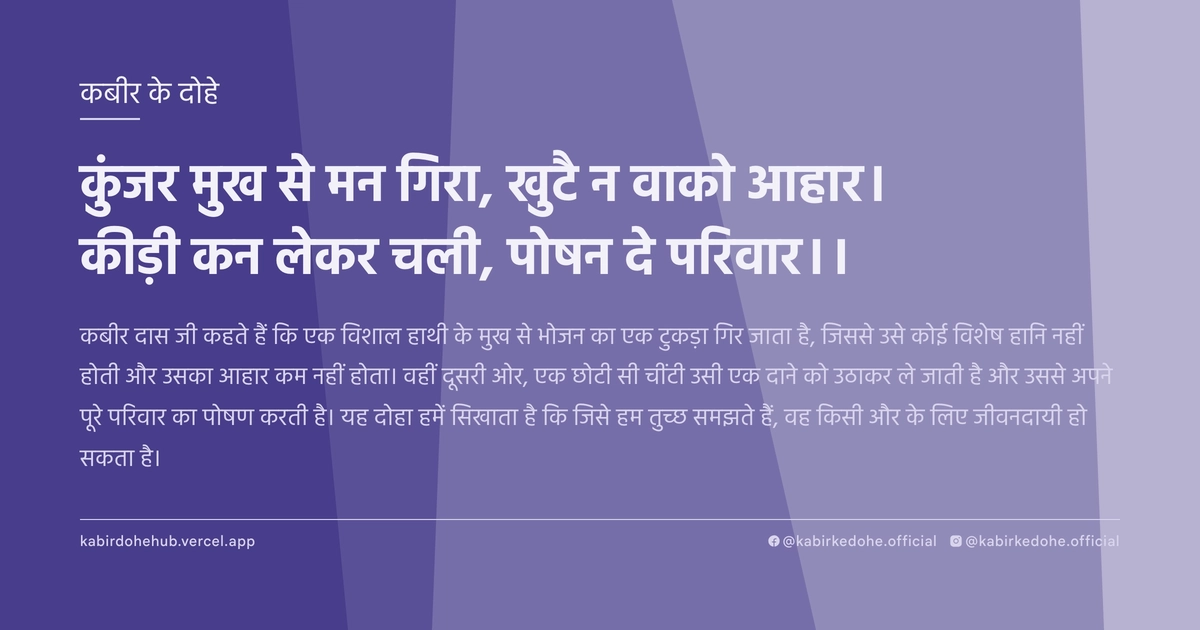
कुंजर मुख से मन गिरा, खुटै न वाको आहार।
कीड़ी कन लेकर चली, पोषन दे परिवार।।
Kunjar mukh se man gira, khutai na vaako aahaar. Keedi kan lekar chali, poshan de parivaar.
इस पृष्ठ पर इस कबीर दोहे का अर्थ (meaning), हिंदी व्याख्या और अंग्रेज़ी अनुवाद, दार्शनिक विश्लेषण और व्यावहारिक जीवन सीख दी गई है। यह दोहा संतोष (Contentment) विषय से जुड़ा है — Kabir doha meaning and explanation in Hindi and English.
अर्थ (Meaning):
कबीर दास जी कहते हैं कि एक विशाल हाथी के मुख से भोजन का एक टुकड़ा गिर जाता है, जिससे उसे कोई विशेष हानि नहीं होती और उसका आहार कम नहीं होता। वहीं दूसरी ओर, एक छोटी सी चींटी उसी एक दाने को उठाकर ले जाती है और उससे अपने पूरे परिवार का पोषण करती है। यह दोहा हमें सिखाता है कि जिसे हम तुच्छ समझते हैं, वह किसी और के लिए जीवनदायी हो सकता है।
Kabir observes that when a morsel of food falls from the mouth of a mighty elephant, it is a negligible loss that does not diminish the elephant's sustenance. However, a tiny ant finds that same grain and carries it back to nourish her entire colony. This verse teaches that what seems insignificant to the powerful can be a lifeline for the humble, emphasizing the relativity of value and the virtue of compassion.
व्याख्या (Interpretation):
यहाँ हाथी 'अहंकार' और 'विशालता' का प्रतीक है, जबकि चींटी 'विनम्रता' और 'परिश्रम' की। हाथी का भोजन गिरना इस बात का संकेत है कि अहंकार में डूबा व्यक्ति अक्सर अपनी प्रचुरता के कारण छोटी चीजों की कद्र नहीं करता। चींटी का उस दाने को उठाना 'साधना' और 'कृतज्ञता' को दर्शाता है। यह निरगुण भक्ति के उस सिद्धांत से जुड़ा है जहाँ ईश्वर किसी बाहरी आडंबर में नहीं, बल्कि सूक्ष्म सेवा और संतोष में मिलता है। माया हमें यह विश्वास दिलाती है कि केवल बड़ी उपलब्धियाँ मायने रखती हैं, जबकि सत्य सूक्ष्मता में छिपा है। आत्मा का परमात्मा से मिलन भी इसी सूक्ष्म जागरूकता के माध्यम से संभव है, जहाँ व्यक्ति अपनी लघुता को स्वीकार कर विराटता में विलीन हो जाता है।
In this metaphor, the elephant symbolizes the 'Ego' and the illusion of grandeur, while the ant represents 'Humility' and 'Diligence'. The falling of food from the elephant's mouth signifies how those blinded by pride often overlook the value of small things due to their perceived abundance. The ant's effort to carry the grain reflects 'Sadhana' (spiritual discipline) and 'Gratitude'. This aligns with Nirgun Bhakti, suggesting that the Divine is found not in grand rituals, but in subtle acts of service and contentment. Maya creates the illusion that only massive achievements hold value, whereas Truth resides in the infinitesimal. The union of Atman and Brahman is achieved through this subtle awareness, where one accepts their smallness to merge with the Infinite.
दार्शनिक विश्लेषण (Philosophical Analysis):
कबीर का यह दोहा तत्कालीन सामाजिक संरचना पर एक गहरा प्रहार है, जहाँ ऊँच-नीच और जातिगत भेदभाव चरम पर था। हाथी यहाँ उस सत्ता या वर्ग का प्रतिनिधित्व करता है जो संसाधनों पर एकाधिकार रखता है और जिसकी दृष्टि में 'तुच्छ' लोग अदृश्य होते हैं। कबीर यहाँ 'अद्वैत वेदांत' के उस पहलू को छूते हैं जहाँ सब कुछ एक ही चेतना का हिस्सा है, फिर भी अहंकार हमें विभाजित करता है।
सूफीवाद के 'फना' (अहंकार का विनाश) के सिद्धांत के अनुसार, जब तक मनुष्य खुद को हाथी की तरह विशाल और दूसरों से ऊपर समझता है, वह सत्य को नहीं देख पाता। चींटी की मेहनत यह दर्शाती है कि आध्यात्मिक प्रगति के लिए बाहरी संसाधनों की नहीं, बल्कि आंतरिक लगन की आवश्यकता होती है।
कबीर कर्मकांडों का विरोध करते हुए यह समझाते हैं कि ईश्वर को पाने के लिए बड़े मंदिरों या तीर्थों की आवश्यकता नहीं है। जिस प्रकार एक छोटा सा दाना चींटी के परिवार के लिए पर्याप्त है, उसी प्रकार एक छोटा सा सच्चा विचार या निस्वार्थ कार्य मनुष्य के आध्यात्मिक जीवन को पूर्ण कर सकता है।
मनोवैज्ञानिक स्तर पर, यह दोहा 'सापेक्षता' (Relativity) की बात करता है। हमारी समस्या यह नहीं है कि हमारे पास क्या नहीं है, बल्कि यह है कि हम अपनी प्रचुरता के कारण उस मूल्य को भूल जाते हैं जो दूसरों के लिए अनिवार्य है। यह अहंकार के विसर्जन और करुणा के उदय की प्रक्रिया है।
अंततः, कबीर यह संदेश देते हैं कि ब्रह्मांड में कुछ भी व्यर्थ नहीं है। जो एक के लिए कचरा है, वह दूसरे के लिए अमृत हो सकता है। यह बोध ही मनुष्य को संकीर्णता से मुक्त कर उसे सार्वभौमिक प्रेम और एकता के मार्ग पर ले जाता है।
Kabir’s verse is a profound critique of the social hierarchies of his era, where caste and class distinctions were rigid. The elephant represents the ruling class or the egoistic individual who holds a monopoly over resources and views the 'insignificant' as invisible. Here, Kabir touches upon the Advaita Vedanta principle that while all is one consciousness, the ego creates a false sense of separation.
According to the Sufi concept of 'Fana' (annihilation of the self), as long as a person perceives themselves as the elephant—superior and towering—they remain blind to the Truth. The ant’s struggle illustrates that spiritual evolution requires not external abundance, but internal persistence and devotion.
Rejecting ritualism, Kabir argues that reaching the Divine does not require grand temples or pilgrimages. Just as a single grain sustains an ant's colony, a single sincere thought or selfless act can complete a human's spiritual journey. The focus shifts from the quantity of ritual to the quality of intent.
Psychologically, the poem addresses the concept of relativity. Our suffering often stems not from a lack of resources, but from a lack of perspective. We forget the value of what we possess because we compare ourselves to those who have more, or we ignore those who have less. This is a call for the dissolution of the ego and the awakening of empathy.
Ultimately, Kabir asserts that nothing in the universe is waste. What is discarded by the powerful may be the very sustenance required by the weak. This realization liberates the seeker from narrow-mindedness and leads them toward universal love and the non-dual reality of existence.
मूल संदेश (Core Message):
- अहंकार की विशालता अक्सर सत्य की सूक्ष्मता को अनदेखा कर देती है।
- सच्ची सेवा वह है जो दूसरे की छोटी से छोटी जरूरत को समझे।
- जीवन का मूल्य मात्रा में नहीं, बल्कि प्रभाव और उपयोगिता में है।
- विनम्रता ही वह द्वार है जिससे विराट सत्य का अनुभव होता है।
- ब्रह्मांड में कुछ भी व्यर्थ नहीं है; हर कण में पोषण छिपा है।
- The grandeur of ego often blinds us to the subtlety of Truth.
- True service is the ability to perceive the smallest need of another.
- The value of life lies not in quantity, but in impact and utility.
- Humility is the only gateway to experiencing the Infinite Reality.
- Nothing in the universe is waste; every grain holds the seed of sustenance.
व्यावहारिक उदाहरण (Practical Example):
वाराणसी के एक पुराने घाट पर रामदीन नाम का एक वृद्ध नाविक रहता था। वह जीवन भर नाव चलाकर बहुत कम कमा पाया था, लेकिन उसका हृदय बहुत उदार था। उसी घाट पर एक बहुत बड़ा सेठ आता था, जो दान-पुण्य का ढिंढोरा पीटता था और हज़ारों रुपये गरीबों में बाँटता था, पर उसके मन में अहंकार था कि वह सबको 'पाल' रहा है।
एक दिन सेठ के हाथ से एक छोटा सा रेशमी रुमाल गिर गया, जिसे उसने तुच्छ समझकर अनदेखा कर दिया। रामदीन ने वह रुमाल उठाया और उसे धोकर एक गरीब बीमार बच्चे के सिर पर पट्टी बाँधने के काम में ले आया।
सेठ के लिए वह रुमाल एक मामूली कपड़ा था, लेकिन उस बच्चे के लिए वह दर्द से राहत पाने का एकमात्र साधन बन गया। रामदीन ने जब यह देखा, तो उसे कबीर का वह दोहा याद आया।
रामदीन ने महसूस किया कि सेठ का दान केवल उसकी अपनी छवि चमकाने के लिए था, जबकि वास्तविक सेवा वह है जो दूसरे की तात्कालिक और सूक्ष्म आवश्यकता को समझे।
सेठ को जब यह पता चला, तो उसे अपनी विशालता पर गर्व था, लेकिन रामदीन की इस छोटी सी क्रिया ने उसे अंदर तक झकझोर दिया।
उसने देखा कि उसकी 'बड़ी' दानशीलता में वह करुणा भूल गया था, जबकि रामदीन की 'छोटी' मदद में पूरा ब्रह्मांड समाया था।
सेठ का अहंकार टूटने लगा। उसने महसूस किया कि वह अब तक केवल 'हाथी' बनकर दाने गिरा रहा था, लेकिन वह कभी 'चींटी' की तरह दूसरों के दुख को महसूस नहीं कर पाया था।
उस दिन से सेठ ने दिखावे का दान छोड़कर, लोगों की सूक्ष्म जरूरतों को समझना शुरू किया।
उसने सीखा कि महानता इस बात में नहीं है कि आप कितना देते हैं, बल्कि इस बात में है कि आपका दिया हुआ दूसरे के जीवन में कितना मूल्य रखता है।
रामदीन की सादगी ने एक अहंकारी व्यक्ति को मानवता का पाठ पढ़ा दिया, और यही कबीर का वास्तविक 'ट्विस्ट' था।
On an ancient ghat in Varanasi lived Ramdeen, an elderly boatman. He had earned very little throughout his life, but his heart was immense. On the same ghat visited a wealthy merchant who boasted of his charity, distributing thousands of rupees to the poor, yet he harbored the ego that he was the 'provider' for all.
One day, a small silk handkerchief fell from the merchant's hand; he ignored it, considering it a trivial piece of cloth. Ramdeen picked it up, washed it, and used it to tie a bandage around the head of a sick, impoverished child.
To the merchant, the cloth was insignificant, but for the child, it became the only source of relief from pain. Witnessing this, Ramdeen recalled Kabir's verse about the elephant and the ant.
Ramdeen realized that the merchant's charity was merely a tool for self-glorification, whereas true service is that which recognizes the immediate and subtle needs of another.
When the merchant learned of this, he was initially proud of his wealth, but the simplicity of Ramdeen's act shook him to his core.
He realized that in his 'grand' generosity, he had forgotten compassion, while in Ramdeen's 'small' act, the entire universe of love was contained.
The merchant's ego began to crumble. He realized he had been like the elephant, dropping grains without thought, never having felt the struggle of the ant.
From that day forward, the merchant abandoned performative charity and began to observe the subtle, unspoken needs of the people around him.
He learned that greatness is not measured by the volume of the gift, but by the value that gift holds in the life of the receiver.
Ramdeen's simplicity taught an arrogant man the essence of humanity, creating the 'Kabir Twist' of spiritual transformation.
अभ्यास मार्गदर्शन (Practice Guidance):
- दैनिक चिंतन: प्रतिदिन एक ऐसी छोटी चीज़ या व्यक्ति की पहचान करें जिसे आप 'नगण्य' समझते हैं, और उसमें छिपी दिव्यता को खोजने का प्रयास करें।
- आत्म-पूछताछ जर्नल: लिखें कि जीवन में ऐसी कौन सी छोटी घटनाएँ थीं जिन्होंने आपके जीवन को बदल दिया, जबकि वे दूसरों के लिए मामूली थीं।
- व्यवहार परिवर्तन: किसी की मदद करते समय यह सुनिश्चित करें कि आप अपनी श्रेष्ठता का अहसास न कराएं; मदद को 'दान' नहीं, बल्कि 'साझाकरण' समझें।
- निदान चेकलिस्ट: क्या आप दूसरों की छोटी गलतियों पर बहुत क्रोधित होते हैं? क्या आप केवल बड़ी उपलब्धियों को ही सफलता मानते हैं? यदि हाँ, तो आपका अहंकार 'हाथी' की तरह बढ़ रहा है।
- Daily Contemplation: Identify one small object or person you typically overlook as 'insignificant' and consciously seek the divinity within them.
- Self-Inquiry Journaling: Document small, seemingly trivial events that fundamentally changed your life, acknowledging the power of the 'small'.
- Behavioral Shift: When helping others, ensure you do not project superiority; view the act not as 'charity' but as 'sharing' between equals.
- Diagnostic Checklist: Do you react with disproportionate anger to small mistakes? Do you only value massive achievements? If yes, your ego is expanding like the elephant.
चिंतन प्रश्न (Reflection Questions):
- मेरे जीवन में वह कौन सा 'छोटा दाना' है जिसे मैं अपनी प्रचुरता के कारण अनदेखा कर रहा हूँ?
- क्या मेरी उदारता वास्तव में करुणा है, या यह केवल मेरे अहंकार को संतुष्ट करने का एक तरीका है?
- मैं अपनी सार्वजनिक छवि (हाथी) को बनाए रखने के लिए अपने आंतरिक सत्य (चींटी) की कितनी उपेक्षा करता हूँ?
- यदि आज मेरे पास मेरी सारी उपलब्धियाँ न रहें, तो क्या मेरे भीतर वह विनम्रता बचेगी जो मुझे दूसरों से जोड़ सके?
- क्या मैं दूसरों की मदद इसलिए करता हूँ क्योंकि मुझे उनकी जरूरत दिखती है, या इसलिए क्योंकि मुझे 'दाता' कहलाना पसंद है?
- What is the 'small grain' in my life that I am ignoring due to my perceived abundance?
- Is my generosity truly rooted in compassion, or is it merely a mechanism to feed my ego?
- How much do I neglect my internal truth (the ant) to maintain my public persona (the elephant)?
- If all my achievements were stripped away today, would I possess the humility required to connect with others?
- Do I help others because I see their need, or because I enjoy the identity of being a 'provider'?