
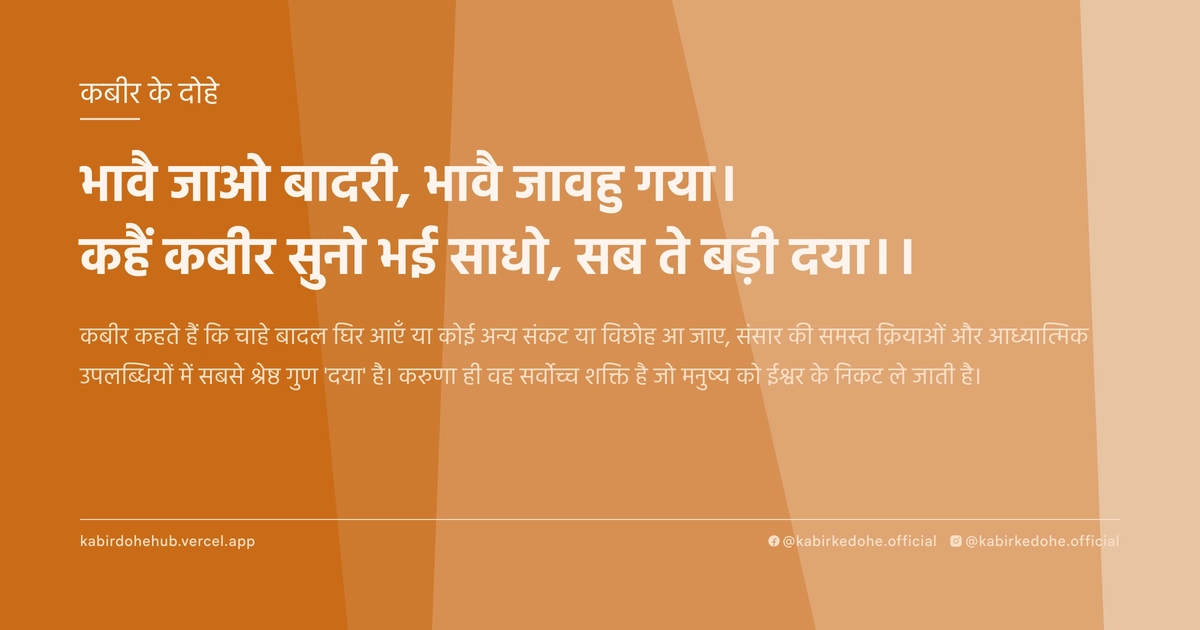
भावै जाओ बादरी, भावै जावहु गया।
कहैं कबीर सुनो भई साधो, सब ते बड़ी दया।।
Bhaavai jaao baadari, bhaavai jaavahu gaya. Kahain Kabir suno bhai sadho, sab te badi daya.
इस पृष्ठ पर इस कबीर दोहे का अर्थ (meaning), हिंदी व्याख्या और अंग्रेज़ी अनुवाद, दार्शनिक विश्लेषण और व्यावहारिक जीवन सीख दी गई है। यह दोहा करुणा (Compassion) विषय से जुड़ा है — Kabir doha meaning and explanation in Hindi and English.
अर्थ (Meaning):
कबीर कहते हैं कि चाहे बादल घिर आएँ या कोई अन्य संकट या विछोह आ जाए, संसार की समस्त क्रियाओं और आध्यात्मिक उपलब्धियों में सबसे श्रेष्ठ गुण 'दया' है। करुणा ही वह सर्वोच्च शक्ति है जो मनुष्य को ईश्वर के निकट ले जाती है।
Kabir asserts that regardless of the storms that gather or the losses one endures, the quality of compassion (Daya) stands supreme above all other virtues. True spiritual realization is found not in rituals, but in the profound act of mercy toward all living beings.
व्याख्या (Interpretation):
इस दोहे का शाब्दिक अर्थ है कि चाहे परिस्थितियाँ कितनी भी प्रतिकूल हों, दया का महत्व सर्वोपरि है। रूपक के तौर पर 'बादरी' (बादल) मन के भ्रम और माया के अंधकार को दर्शाता है। निर्गुण भक्ति के परिप्रेक्ष्य में, दया केवल एक भावना नहीं बल्कि आत्मा का परमात्मा के साथ एकात्म होने की अवस्था है। जब साधक अपने भीतर के 'अहं' को मिटाकर समस्त सृष्टि को अपना स्वरूप मानता है, तब दया स्वाभाविक रूप से प्रस्फुटित होती है। यह अद्वैत वेदांत के उस सत्य को पुष्ट करता है जहाँ 'स्व' और 'पर' का भेद समाप्त हो जाता है। दया ही वह सेतु है जो माया के बंधन को काटकर जीव को ब्रह्म के करीब ले जाती है।
Literally, the verse suggests that despite any external turmoil, compassion remains the highest virtue. Metaphorically, 'Badari' (clouds) represents the veil of Maya and the turbulence of the human ego. In the context of Nirgun Bhakti, compassion is not merely an emotion but a state of ontological unity where the practitioner recognizes the Divine in every entity. This aligns with Advaita Vedanta, where the distinction between the self and the other is revealed as an illusion. The paradox lies in the fact that while the world seeks power and knowledge, the ultimate liberation is found in the surrender of the ego through selfless mercy. Compassion is the catalyst that dissolves the duality of the observer and the observed.
दार्शनिक विश्लेषण (Philosophical Analysis):
कबीर का यह दर्शन उस युग की प्रतिक्रिया है जहाँ धर्म कर्मकांडों, जातिगत श्रेष्ठता और बाहरी आडंबरों में सिमट गया था। उन्होंने स्पष्ट किया कि मंदिर, मस्जिद या कठिन तपस्या से अधिक मूल्यवान एक दयालु हृदय है। यह दृष्टिकोण सूफी मत के 'इश्क-ए-हकीकी' (ईश्वरीय प्रेम) से मेल खाता है, जहाँ खुदा की प्राप्ति केवल उसकी रचनाओं से प्रेम करने में निहित है।
दार्शनिक स्तर पर, कबीर यहाँ 'अहंकार' के विसर्जन की बात कर रहे हैं। जब मनुष्य यह समझ जाता है कि वह और दूसरा अलग नहीं हैं, तो दया एक नैतिक कर्तव्य न रहकर एक स्वाभाविक स्वभाव बन जाती है। यह अद्वैतवाद का व्यावहारिक अनुप्रयोग है।
कबीर ने उस समय की सामाजिक स्तरीकरण व्यवस्था को चुनौती दी। उनके लिए दया का अर्थ था—बिना किसी भेदभाव के हर जीव के प्रति करुणा। यह सामाजिक न्याय का आध्यात्मिक आधार था।
मनोवैज्ञानिक रूप से, दया व्यक्ति को उसके संकुचित 'मैं' से मुक्त करती है। जब हम दूसरों के दुख को अपना मानते हैं, तो हमारा मानसिक क्षितिज विस्तृत होता है और हम भय एवं ईर्ष्या से मुक्त हो जाते हैं।
अंततः, यह दोहा यह स्थापित करता है कि आध्यात्मिक पूर्णता का पैमाना ज्ञान की मात्रा नहीं, बल्कि हृदय की कोमलता है। जो व्यक्ति दयालु है, वही वास्तव में 'साधु' या जागृत आत्मा है, चाहे उसने कोई शास्त्र न पढ़ा हो।
Kabir’s philosophy emerged as a radical critique of an era dominated by rigid ritualism, caste hierarchies, and external displays of piety. He posits that a compassionate heart is far more sacred than the most elaborate temple or mosque. This resonates deeply with the Sufi concept of 'Ishq-e-Haqiqi' (Divine Love), which suggests that the path to the Creator is paved with love for His creation.
Philosophically, Kabir is addressing the annihilation of the ego. When the practitioner realizes the non-duality of existence—that the 'I' and the 'Other' are one—compassion ceases to be a moral obligation and becomes a natural state of being. This is the practical application of Advaita Vedanta, moving from theoretical oneness to lived experience.
By elevating compassion above all, Kabir challenged the social stratification of his time. He argued that spiritual merit is not inherited by birth or caste but earned through the quality of one's interactions with other sentient beings. This provided a spiritual foundation for social equality.
Psychologically, the act of compassion liberates the individual from the prison of the 'small self.' By empathizing with the suffering of others, the practitioner expands their consciousness, effectively neutralizing fear, greed, and envy.
Ultimately, this verse establishes that the metric of spiritual attainment is not the volume of one's scriptural knowledge, but the depth of one's empathy. The true 'Sadhu' is not the one who renounces the world, but the one who embraces it with an unconditional heart.
मूल संदेश (Core Message):
- बाहरी तूफानों से अधिक आंतरिक करुणा महत्वपूर्ण है।
- अहंकार का अंत ही वास्तविक दया का आरंभ है।
- सेवा ही सबसे बड़ा और सच्चा धर्म है।
- सृष्टि के हर कण में उसी एक चेतना का वास है।
- दयालु हृदय ही ईश्वर का वास्तविक निवास स्थान है।
- Inner compassion outweighs any external storm of life.
- The death of the ego is the birth of true mercy.
- Selfless service is the highest form of spiritual practice.
- The same consciousness resides in every atom of existence.
- A compassionate heart is the only true temple of God.
व्यावहारिक उदाहरण (Practical Example):
एक समय की बात है, वाराणसी के घाटों पर रहने वाली एक वृद्ध विधवा, जानकी, का जीवन अत्यंत कठिन था। वह दूसरों के घरों में छोटे-मोटे काम करके अपना गुजारा करती थी। समाज उसे 'अशुभ' मानकर उससे दूरी बनाकर रखता था। जानकी के पास न तो धन था और न ही कोई अपना, लेकिन उसके हृदय में सबके लिए असीम करुणा थी।
एक दिन, घाट की सीढ़ियों पर एक विदेशी यात्री बेहोश पड़ा मिला। वह गंभीर रूप से बीमार था और उसके पास कोई मददगार नहीं था। शहर के कई संपन्न लोग और तथाकथित 'पंडित' वहाँ से गुजरे, लेकिन किसी ने उसकी मदद नहीं की क्योंकि वह एक बाहरी व्यक्ति था और उसकी भाषा कोई नहीं समझता था।
जानकी ने जब उस व्यक्ति को देखा, तो उसे अपना दुख याद नहीं आया, बल्कि उस अजनबी का दर्द महसूस हुआ। उसने अपनी सीमित जमापूंजी से दवाइयाँ खरीदीं और कई दिनों तक उसकी सेवा की। वह उसे अपने छोटे से कमरे में ले गई और उसे तब तक खिलाया-पिलाया जब तक वह स्वस्थ नहीं हो गया।
जब वह यात्री ठीक हुआ, तो उसने जानकी से पूछा कि उसने उसकी मदद क्यों की, जबकि दुनिया ने उसे अनदेखा कर दिया। जानकी ने बस मुस्कुराकर कहा, 'बेटा, भूख और दर्द की कोई भाषा या देश नहीं होता, बस एक आत्मा होती है जो पुकारती है।'
उस यात्री ने देखा कि जानकी के चेहरे पर जो शांति थी, वह उन बड़े महलों में रहने वालों के पास नहीं थी। जानकी ने कभी कोई मंत्र नहीं पढ़ा था, लेकिन उसकी दया ने उसे एक जीवित संत बना दिया था।
इस घटना ने घाट के अन्य लोगों को भी सोचने पर मजबूर कर दिया। उन्होंने महसूस किया कि जिस महिला को वे तुच्छ समझते थे, वही वास्तव में ईश्वर के सबसे करीब थी।
जानकी का यह सरल व्यवहार एक 'कबीर ट्विस्ट' की तरह था, जिसने लोगों के अहंकार को तोड़ दिया। उन्होंने सीखा कि धर्म केवल पूजा-पाठ में नहीं, बल्कि एक पीड़ित की सेवा में है।
धीरे-धीरे, उस बस्ती के लोग अपनी जातिगत श्रेष्ठता का मोह छोड़कर एक-दूसरे की मदद करने लगे। जानकी की निस्वार्थ दया ने पूरे समुदाय के हृदय को बदल दिया, जिससे वहाँ प्रेम और सद्भाव का संचार हुआ।
यह कहानी सिद्ध करती है कि दया वह सर्वोच्च शक्ति है जो सबसे गहरे सामाजिक और मानसिक विभाजनों को मिटा सकती है।
In the ancient lanes of Varanasi, there lived an elderly widow named Janaki. Her life was a testament to hardship; she survived by doing menial chores in others' homes. Due to the rigid social norms of the time, many viewed her as 'inauspicious' and kept their distance.
One scorching afternoon, a foreign traveler collapsed on the stone steps of the ghats. He was severely ill and delirious. Many wealthy merchants and self-proclaimed scholars passed by, but none stopped to help, as he was a stranger from a distant land whose language they did not speak.
When Janaki saw him, she didn't see a foreigner or a stranger; she saw a suffering soul. Forgetting her own poverty and the insults she endured daily, she felt a surge of profound empathy. She used her meager savings to buy basic medicines and tended to him with unwavering care.
She brought him into her tiny, damp hut, feeding him porridge and wiping his brow for days. She asked for nothing in return, treating him as if he were her own kin.
Upon recovering, the traveler asked Janaki why she had risked so much for someone who could give her nothing. Janaki simply smiled and replied, 'Child, hunger and pain have no language or nationality; there is only the soul that cries out.'
The traveler realized that the serenity radiating from Janaki's face was absent in the opulent mansions of the city. Though she had never read a scripture, her compassion had rendered her a living saint.
This act served as a 'Kabir Twist' for the local community. Those who had looked down upon Janaki began to feel a deep sense of shame. They realized that the woman they deemed lowest in the social order was actually the highest in spiritual stature.
Slowly, the people of the ghats began to shed their caste-based arrogance. They started helping one another, inspired by Janaki's selfless act of mercy.
Janaki's life became a mirror in which the community saw their own ugliness and the possibility of beauty. Her simple act of kindness transformed the social fabric of the neighborhood.
This story illustrates that compassion is the ultimate power, capable of dissolving the deepest social and psychological divides, proving that the heart is the only true temple.
अभ्यास मार्गदर्शन (Practice Guidance):
- दैनिक करुणा अभ्यास: प्रतिदिन कम से कम एक ऐसा कार्य करें जिससे किसी अन्य जीव (पशु, पक्षी या मनुष्य) को बिना किसी स्वार्थ के लाभ मिले।
- आत्म-पूछताछ जर्नल: हर रात लिखें कि आज आपने कहाँ अपने अहंकार को दया पर प्राथमिकता दी और उस समय आपकी मानसिक स्थिति क्या थी।
- मौन अवलोकन: भीड़भाड़ वाली जगहों पर लोगों के चेहरों को देखें और उनके भीतर छिपे दुख को महसूस करने का प्रयास करें, यह सोचकर कि 'यह मैं ही हूँ'।
- निदान चेकलिस्ट: यदि आप किसी की मदद करते समय श्रेष्ठता महसूस कर रहे हैं, तो आप 'दया' नहीं बल्कि 'अहंकार' का पोषण कर रहे हैं। वास्तविक दया में 'दाता' और 'ग्राही' का भाव मिट जाता है।
- Daily Compassion Practice: Perform at least one act of selfless service daily for any sentient being (human, animal, or bird) without expecting any recognition.
- Self-Inquiry Journaling: Each night, record instances where your ego took precedence over compassion and analyze the psychological trigger behind it.
- Silent Observation: In crowded places, look at people's faces and try to feel their hidden sorrows, meditating on the thought, 'This is another version of myself.'
- Diagnostic Checklist: If you feel a sense of superiority while helping someone, you are nourishing the ego, not compassion. True mercy exists only when the distinction between the giver and the receiver vanishes.
चिंतन प्रश्न (Reflection Questions):
- क्या मेरी दया वास्तव में निस्वार्थ है, या मैं इसे अपनी छवि सुधारने के लिए एक उपकरण के रूप में उपयोग करता हूँ?
- जब मैं किसी ऐसे व्यक्ति की मदद करता हूँ जिसे मैं नापसंद करता हूँ, तो मेरे भीतर कौन से प्रतिरोध उत्पन्न होते हैं?
- क्या मैं अपनी डिजिटल पहचान (सोशल मीडिया) पर करुणा का प्रदर्शन करता हूँ जबकि वास्तविक जीवन में उदासीन रहता हूँ?
- मेरे जीवन का वह कौन सा हिस्सा है जहाँ मैं अभी भी 'श्रेष्ठता' का भाव रखता हूँ?
- यदि मैं पूरी तरह से अपनी पहचान खो दूँ, तो क्या तब भी मैं दूसरों के प्रति दयालु रहूँगा?
- Is my compassion truly selfless, or do I use it as a tool to polish my public image?
- What internal resistances arise when I am called to help someone I fundamentally dislike?
- Do I perform 'compassion' for my digital persona while remaining indifferent in my physical reality?
- In which areas of my life am I still clinging to a sense of superiority or entitlement?
- If I were to lose every shred of my identity, would the impulse to be merciful still remain?