
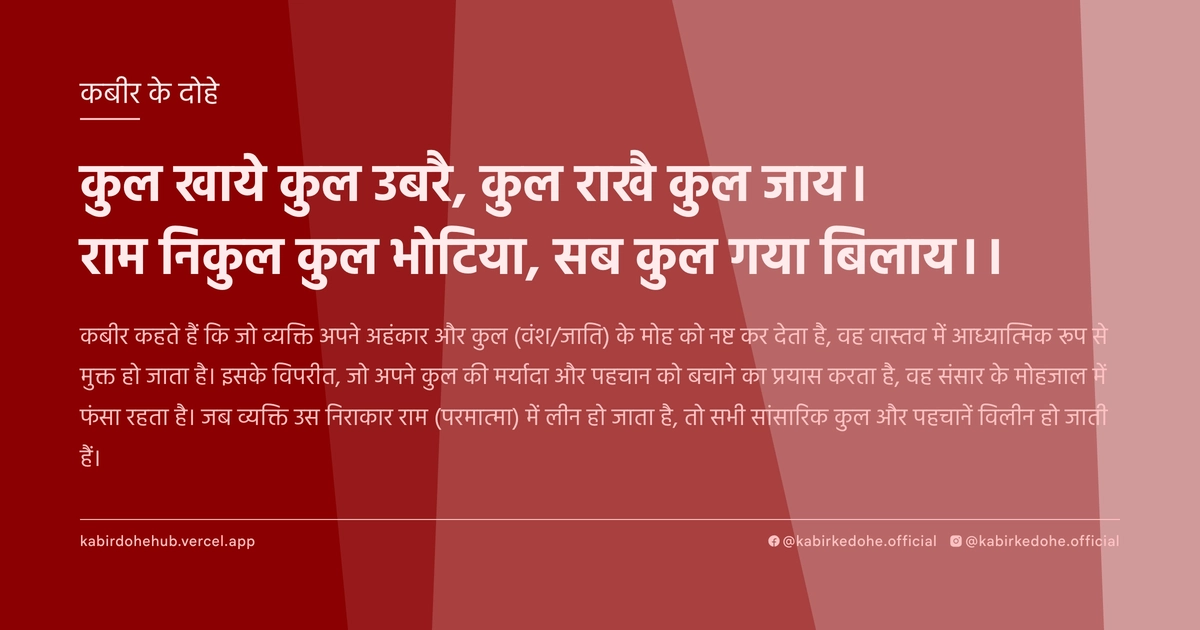
कुल खाये कुल उबरै, कुल राखै कुल जाय।
राम निकुल कुल भोटिया, सब कुल गया बिलाय।।
Kul khaaye kul ubray, kul raakhai kul jaaye. Ram nikul kul bhotiya, sab kul gaya bilaay.
इस पृष्ठ पर इस कबीर दोहे का अर्थ (meaning), हिंदी व्याख्या और अंग्रेज़ी अनुवाद, दार्शनिक विश्लेषण और व्यावहारिक जीवन सीख दी गई है। यह दोहा अनित्य (Impermanence) विषय से जुड़ा है — Kabir doha meaning and explanation in Hindi and English.
अर्थ (Meaning):
कबीर कहते हैं कि जो व्यक्ति अपने अहंकार और कुल (वंश/जाति) के मोह को नष्ट कर देता है, वह वास्तव में आध्यात्मिक रूप से मुक्त हो जाता है। इसके विपरीत, जो अपने कुल की मर्यादा और पहचान को बचाने का प्रयास करता है, वह संसार के मोहजाल में फंसा रहता है। जब व्यक्ति उस निराकार राम (परमात्मा) में लीन हो जाता है, तो सभी सांसारिक कुल और पहचानें विलीन हो जाती हैं।
Kabir asserts that one who consumes or annihilates the ego associated with lineage and caste is spiritually liberated. Conversely, those who strive to preserve and protect their ancestral identity remain trapped in the cycle of worldly attachment. When the seeker merges into the formless Ram (the Universal Consciousness), all distinctions of clan and social identity dissolve into the absolute oneness.
व्याख्या (Interpretation):
इस दोहे का शाब्दिक अर्थ कुल या वंश के त्याग से है, लेकिन गहरा अर्थ 'अहंकार' के विसर्जन से है। यहाँ 'कुल' केवल परिवार नहीं, बल्कि वह सामाजिक पहचान है जिसे मनुष्य अपनी उपलब्धि मानता है। यह निरगुण भक्ति का सार है जहाँ आत्मा को यह समझना होता है कि वह किसी जाति या कुल का हिस्सा नहीं, बल्कि ब्रह्म का अंश है। माया हमें यह विश्वास दिलाती है कि हमारी पहचान हमारे पूर्वजों या सामाजिक स्थिति से है, जो एक भ्रम है। जब यह द्वैत मिटता है, तब आत्मा और परमात्मा का अद्वैत (non-duality) स्थापित होता है। यह विरोधाभास है कि जिसे हम 'बचाने' की कोशिश करते हैं, वही हमें बंधन में डालता है, और जिसे हम 'नष्ट' करते हैं, वही हमें मुक्त करता है।
Literally, the verse speaks of the destruction of lineage, but metaphorically, it addresses the annihilation of the 'ego-identity.' Here, 'Kul' represents not just family, but the entire social construct and prestige that a human clings to as their primary identity. This is the essence of Nirgun Bhakti, where the soul realizes it is not a product of caste or clan, but a spark of the formless Brahman. Maya creates the illusion that our worth is derived from ancestral heritage, which is a spiritual shackle. When this duality vanishes, the non-duality of Atman and Brahman is realized. The central paradox is that the identity we strive to preserve is the very wall that prevents our liberation, and only by 'losing' this identity do we truly find our universal self.
दार्शनिक विश्लेषण (Philosophical Analysis):
कबीर का यह दोहा उस युग की प्रतिक्रिया है जहाँ जाति व्यवस्था और कुल की शुद्धता को मोक्ष का आधार माना जाता था। कबीर ने इस सामाजिक पदानुक्रम को पूरी तरह खारिज कर दिया। उनका दर्शन अद्वैत वेदांत से मेल खाता है, जहाँ केवल एक ही चेतना है और बाकी सब माया है। वे कहते हैं कि जब तक आप खुद को 'क्षत्रिय', 'ब्राह्मण' या 'शूद्र' मानते रहेंगे, आप उस अनंत राम तक नहीं पहुँच सकते क्योंकि ये लेबल सीमित हैं।
सूफीवाद के 'फना' (Fana) के सिद्धांत की तरह, कबीर यहाँ स्वयं के अस्तित्व को मिटाने की बात कर रहे हैं। जब 'मैं' (अहंकार) मिट जाता है, तभी 'वह' (परमात्मा) प्रकट होता है। यह केवल सामाजिक विद्रोह नहीं था, बल्कि एक मनोवैज्ञानिक रूपांतरण था। कबीर का तर्क है कि कुल का मोह वास्तव में एक मानसिक कारागार है जो व्यक्ति को उसकी वास्तविक क्षमता से रोकता है।
अनुष्ठानों और बाहरी दिखावे के प्रति उनकी घृणा इस बात से स्पष्ट है कि वे कुल की रक्षा को 'पतन' (कुल जाय) मानते हैं। उनके लिए वास्तविक 'उबरना' (उद्धार) तब होता है जब व्यक्ति अपनी पहचान को सार्वभौमिक प्रेम में विलीन कर देता है। यह दृष्टिकोण उस समय के रूढ़िवादी समाज के लिए एक बड़ा आघात था, क्योंकि यह जन्म आधारित श्रेष्ठता को शून्य घोषित कर रहा था।
दार्शनिक रूप से, 'राम' यहाँ अयोध्या के राजा नहीं, बल्कि वह सर्वव्यापी ऊर्जा हैं जो हर कण में व्याप्त है। जब कबीर कहते हैं कि 'सब कुल गया बिलाय', तो वे उस स्थिति का वर्णन कर रहे हैं जहाँ ज्ञाता और ज्ञेय का भेद समाप्त हो जाता है। यह पूर्ण समर्पण की अवस्था है जहाँ व्यक्ति अपनी छोटी पहचान को त्यागकर विराट पहचान को अपनाता है।
अंततः, यह विश्लेषण हमें सिखाता है कि आध्यात्मिक प्रगति के लिए सबसे बड़ी बाधा बाहरी शत्रु नहीं, बल्कि आंतरिक 'पहचान का मोह' है। जब तक हम अपनी विशिष्टता के अहंकार में रहेंगे, हम उस एकता का अनुभव नहीं कर पाएंगे जो समस्त सृष्टि का आधार है।
This Doha is a visceral reaction to an era where caste purity and lineage were considered the primary gateways to salvation. Kabir systematically dismantles this social hierarchy. His philosophy aligns with Advaita Vedanta, asserting that only one consciousness exists, and all perceived distinctions are mere Maya. He argues that as long as one identifies as a 'Kshatriya,' 'Brahmin,' or 'Shudra,' they cannot reach the Infinite Ram because these labels are inherently limiting.
Parallel to the Sufi concept of 'Fana' (annihilation of the self), Kabir advocates for the total erasure of the individual ego. Only when the 'I' vanishes does the 'He' (the Divine) manifest. This was not merely a social rebellion but a profound psychological transformation. Kabir posits that the attachment to lineage is a mental prison that obstructs the soul's realization of its own divinity.
His disdain for rituals and outward displays is evident in his claim that attempting to preserve one's lineage leads to spiritual decay ('kul jaay'). For Kabir, true 'salvation' (ubrai) occurs only when the individual dissolves their narrow identity into universal love. This perspective was a radical challenge to the orthodox society of his time, as it rendered birth-based superiority obsolete.
Philosophically, 'Ram' here is not the historical king of Ayodhya, but the omnipresent energy pervading every atom. When Kabir states that 'all lineages have dissolved,' he describes the state of Samadhi where the distinction between the knower and the known disappears. This is the state of total surrender, where the small self is traded for the cosmic self.
Ultimately, this analysis reveals that the greatest obstacle to spiritual growth is not an external enemy, but the internal attachment to identity. As long as we cling to the ego of our uniqueness or superiority, we remain blind to the unity that constitutes the foundation of all existence.
मूल संदेश (Core Message):
- पहचान का मोह ही आत्मा की सबसे बड़ी बेड़ी है।
- श्रेष्ठता का अहंकार सत्य के मार्ग में सबसे बड़ा अवरोध है।
- जब 'मैं' मिटता है, तभी 'परमात्मा' का अनुभव होता है।
- वास्तविक मुक्ति सामाजिक प्रतिष्ठा के त्याग में निहित है।
- हम सब एक ही सार्वभौमिक चेतना के विभिन्न रूप हैं।
- अद्वैत का अनुभव केवल अहंकार के विसर्जन से संभव है।
- Attachment to identity is the soul's heaviest shackle.
- The ego of superiority is the primary obstacle to Truth.
- Only when the 'I' vanishes does the Divine manifest.
- True liberation lies in the renunciation of social prestige.
- We are all diverse expressions of a single universal consciousness.
- The experience of non-duality is possible only through the dissolution of ego.
व्यावहारिक उदाहरण (Practical Example):
वाराणसी के घाटों पर रहने वाले एक वृद्ध बुनकर, माधव, की कहानी है। माधव अपने परिवार में सबसे कुशल बुनकर थे और उन्हें अपने पूर्वजों की 'शाही बुनकरी' की विरासत पर बहुत गर्व था। वे अक्सर नए बुनकरों को नीचा दिखाते थे क्योंकि वे उनके कुल की पारंपरिक विधि का पालन नहीं करते थे।
माधव का पूरा जीवन इस बात की रक्षा करने में बीता कि उनकी 'कुल की कला' शुद्ध रहे। उन्होंने अपने बेटों को भी यही सिखाया कि वे किसी अन्य जाति या समुदाय के साथ कला साझा न करें। इस अहंकार ने उन्हें समाज से अलग कर दिया और उनके मन में निरंतर क्रोध और असुरक्षा बनी रही।
एक दिन, एक अनाम साधु उनके पास आए। उन्होंने माधव के बेहतरीन कपड़े देखे और मुस्कुराते हुए कहा, 'यह कपड़ा सुंदर है, लेकिन क्या यह पहनने वाले को शांति देता है? या यह केवल तुम्हारी श्रेष्ठता का विज्ञापन है?'
माधव को यह बात चुभी। उन्होंने तर्क दिया कि यह उनके कुल की महानता है। साधु ने शांति से उत्तर दिया, 'जिस दिन तुम यह भूल जाओगे कि तुम एक 'शाही बुनकर' हो और केवल एक 'बुनकर' बन जाओगे, उस दिन तुम्हारी कला में ईश्वर उतरेगा।'
माधव ने कई दिनों तक इस बात पर विचार किया। उन्होंने महसूस किया कि उनका 'कुल गौरव' वास्तव में एक बोझ था जिसने उन्हें अन्य कलाकारों से सीखने और प्रेम करने से रोक दिया था।
एक रात, उन्होंने अपनी सबसे महंगी और पुरानी पारिवारिक पद्धति की किताब को किनारे रख दिया और एक साधारण गरीब बुनकर के साथ बैठकर उसकी तकनीक सीखने लगे, जिसे वे पहले तुच्छ समझते थे।
जैसे ही उन्होंने अपने 'कुल' के अहंकार को नष्ट किया, उनके काम में एक नई तरलता और प्रेम आ गया। अब वे कपड़े केवल बेचने के लिए नहीं, बल्कि सेवा के लिए बनाने लगे।
उन्होंने अपनी कार्यशाला के दरवाजे सभी के लिए खोल दिए, चाहे उनकी जाति या कुल कुछ भी हो। उन्होंने महसूस किया कि जब वे अपनी पहचान को मिटाते हैं, तो वे वास्तव में पूरी दुनिया से जुड़ जाते हैं।
माधव का जीवन अब तनावमुक्त था। वे अब 'कुल के रक्षक' नहीं, बल्कि 'प्रेम के सेवक' बन चुके थे। उनकी कला अब और भी निखर गई थी क्योंकि उसमें अब अहंकार नहीं, बल्कि समर्पण था।
यह 'कबीर ट्विस्ट' था—अपनी पहचान को खोकर उन्होंने अपनी वास्तविक आत्मा को पा लिया।
Consider the story of Madhav, an elderly weaver living on the ghats of Varanasi. Madhav was the most skilled weaver in his community and took immense pride in the 'royal weaving' heritage of his ancestors. He often belittled newer weavers because they did not follow the traditional methods of his lineage.
Madhav spent his entire life protecting the 'purity' of his clan's art. He taught his sons to never share their techniques with anyone from other castes or communities. This ego isolated him from society and left him in a state of constant anger and insecurity.
One day, an anonymous monk visited him. After seeing Madhav's exquisite fabrics, the monk smiled and asked, 'This cloth is beautiful, but does it bring peace to the wearer? Or is it merely an advertisement of your superiority?'
Madhav felt insulted. He argued that this was the greatness of his lineage. The monk replied calmly, 'The day you forget that you are a "royal weaver" and become simply a "weaver," the Divine will enter your art.'
Madhav pondered this for many days. He realized that his 'clan pride' was actually a burden that prevented him from learning from and loving other artists.
One night, he set aside the expensive, ancient manual of his family's secret methods and sat down with a poor, simple weaver—someone he had previously dismissed as inferior—to learn his technique.
As he annihilated the ego of his 'Kul,' a new fluidity and love entered his work. He no longer created fabrics just for profit, but as an act of service.
He opened the doors of his workshop to everyone, regardless of their caste or background. He discovered that by erasing his specific identity, he was actually connecting with the entire world.
Madhav's life became stress-free. He was no longer the 'protector of the lineage' but a 'servant of love.' His art flourished even more because it was now driven by surrender rather than ego.
This was the 'Kabir Twist'—by losing his identity, he finally found his true soul.
अभ्यास मार्गदर्शन (Practice Guidance):
- दैनिक चिंतन: प्रतिदिन 15 मिनट मौन बैठें और विचार करें कि आपकी कौन सी पहचान (पद, जाति, पारिवारिक प्रतिष्ठा) आपको दूसरों से अलग या श्रेष्ठ महसूस कराती है। उस विचार को धीरे-धीरे विलीन करें।
- आत्म-पूछताछ जर्नल: लिखें कि 'यदि मेरी सारी सामाजिक पहचानें छीन ली जाएं, तो मैं वास्तव में कौन हूँ?' इस प्रश्न के उत्तर को गहराई तक ले जाएं।
- व्यवहार परिवर्तन: सप्ताह में एक बार ऐसे व्यक्ति की मदद करें या उनके साथ समय बिताएं जिसे समाज आपके 'कुल' या 'स्तर' से नीचे मानता है, और यह महसूस करें कि आप दोनों के भीतर एक ही चेतना है।
- डायग्नोस्टिक चेकलिस्ट: क्या मैं किसी की प्रशंसा उसकी जाति/कुल के आधार पर करता हूँ? क्या मैं अपनी उपलब्धियों का श्रेय अपने वंश को देता हूँ? क्या मुझे अपनी पहचान खोने का डर है? (यदि हाँ, तो आप अभी भी 'कुल' के बंधन में हैं)।
- Daily Contemplation: Spend 15 minutes in silence daily, identifying which labels (position, caste, family prestige) make you feel separate or superior. Gently visualize these labels dissolving into light.
- Self-Inquiry Journal: Write a response to the prompt: 'If all my social identities were stripped away, who would I truly be?' Push the answer beyond the physical and psychological self.
- Behavioral Shift: Once a week, consciously serve or spend time with someone whom society deems 'lower' than your status, focusing entirely on the shared consciousness between you.
- Diagnostic Checklist: Do I praise people based on their lineage? Do I attribute my success to my ancestry? Do I fear losing my social status? (If yes, you are still bound by the 'Kul' ego).
चिंतन प्रश्न (Reflection Questions):
- आपकी वह कौन सी 'गुप्त पहचान' है जिसे आप दुनिया के सामने बनाए रखने के लिए संघर्ष करते हैं?
- क्या आपकी नैतिकता आपके 'कुल' की मर्यादा से प्रेरित है या वास्तविक करुणा से?
- यदि आप एक ऐसे समाज में पैदा होते जहाँ आपकी वर्तमान जाति/कुल सबसे निम्न होती, तो क्या आपका व्यक्तित्व वैसा ही रहता?
- आपकी डिजिटल पहचान (सोशल मीडिया) आपके वास्तविक आंतरिक स्वरूप को कितना ढक रही है?
- क्या आप वास्तव में दूसरों को समान मानते हैं, या आप केवल अपनी उदारता के अहंकार में उन्हें 'समान' कह रहे हैं?
- वह कौन सा डर है जो आपको अपनी सामाजिक पहचान को पूरी तरह छोड़ने से रोकता है?
- What is that 'hidden identity' you struggle to maintain in the eyes of the world?
- Is your morality driven by the prestige of your 'lineage' or by genuine compassion?
- If you were born into a society where your current caste/clan was the lowest, would your personality remain the same?
- To what extent does your digital identity (social media) mask your true internal state?
- Do you truly view others as equals, or are you merely calling them 'equal' from a position of egoic generosity?
- What is the specific fear that prevents you from completely letting go of your social identity?