
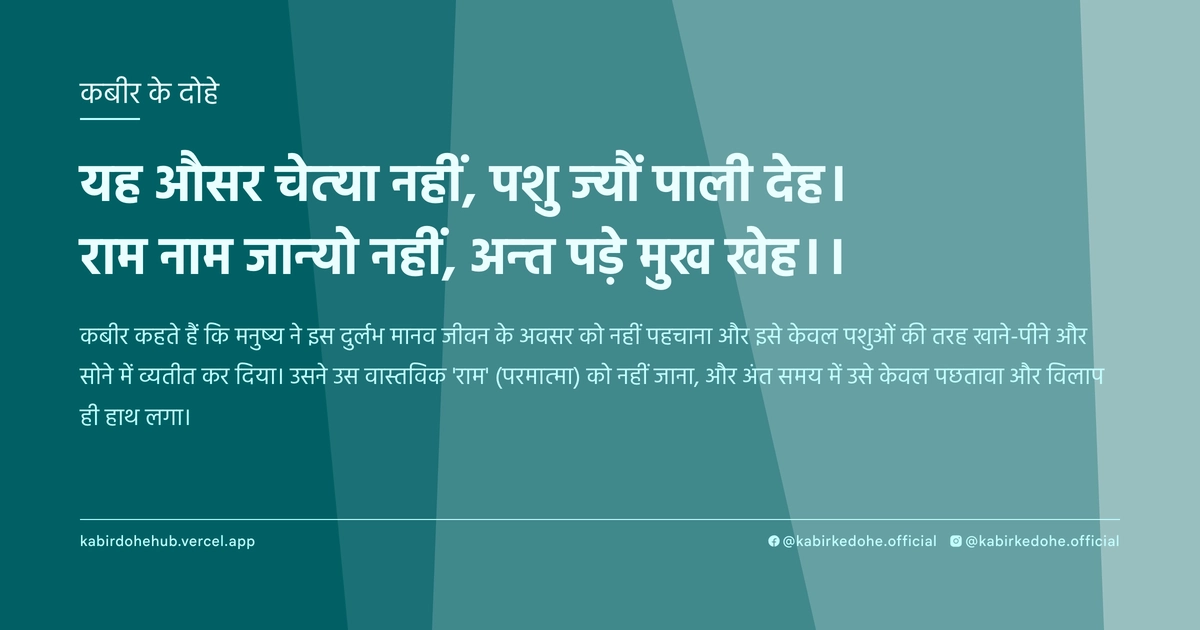
यह औसर चेत्या नहीं, पशु ज्यौं पाली देह।
राम नाम जान्यो नहीं, अन्त पड़े मुख खेह।।
Yeh ausar chetya nahi, pashu jyaun paali deh. Ram naam janyo nahi, ant pade mukh kheh.
इस पृष्ठ पर इस कबीर दोहे का अर्थ (meaning), हिंदी व्याख्या और अंग्रेज़ी अनुवाद, दार्शनिक विश्लेषण और व्यावहारिक जीवन सीख दी गई है। यह दोहा जागृति (The Wake-up Call) विषय से जुड़ा है — Kabir doha meaning and explanation in Hindi and English.
अर्थ (Meaning):
कबीर कहते हैं कि मनुष्य ने इस दुर्लभ मानव जीवन के अवसर को नहीं पहचाना और इसे केवल पशुओं की तरह खाने-पीने और सोने में व्यतीत कर दिया। उसने उस वास्तविक 'राम' (परमात्मा) को नहीं जाना, और अंत समय में उसे केवल पछतावा और विलाप ही हाथ लगा।
Kabir asserts that the human being has failed to recognize the rare opportunity of this earthly existence, spending it merely on physical sustenance and sensory gratification like an animal. By ignoring the realization of the True Name (the Divine Presence), one is left with nothing but regret and sorrow at the moment of death.
व्याख्या (Interpretation):
यह दोहा मानव अस्तित्व की त्रासदी का वर्णन करता है। 'पशु ज्यों पाली देह' का अर्थ है कि जब मनुष्य केवल शारीरिक आवश्यकताओं (भोजन, निद्रा, भय, मैथुन) तक सीमित रहता है, तो वह अपनी चेतना को पशु स्तर पर ही रखता है। यहाँ 'राम नाम' किसी व्यक्ति विशेष की पूजा नहीं, बल्कि उस निर्गुण ब्रह्म का बोध है जो हर कण में व्याप्त है। यह अद्वैत वेदांत के उस सिद्धांत को दर्शाता है जहाँ अज्ञान (माया) के कारण जीव स्वयं को शरीर मानता है। जब तक यह भ्रम नहीं टूटता, मनुष्य संसार के चक्र में फँसा रहता है। अंत में 'मुख खेह' उस गहन शोक का प्रतीक है जो तब उत्पन्न होता है जब आत्मा को आभास होता है कि उसने अनंतता के अवसर को क्षणभंगुर इच्छाओं के लिए त्याग दिया।
This couplet describes the tragedy of human existence. The phrase 'pashu jyaun paali deh' implies that when a human remains confined to basic biological needs—eating, sleeping, fear, and procreation—they maintain their consciousness at an animalistic level. Here, 'Ram Naam' does not refer to the worship of a specific deity, but to the realization of the Nirgun Brahman (the Formless Absolute) that permeates every atom. It aligns with Advaita Vedanta, where due to Maya (illusion), the soul mistakenly identifies with the physical body. Until this delusion is shattered, the individual remains trapped in the cycle of Samsara. The 'mukh kheh' (sorrow at the end) symbolizes the profound grief that arises when the soul realizes it traded the opportunity for infinity for fleeting, transient desires.
दार्शनिक विश्लेषण (Philosophical Analysis):
कबीर का यह दृष्टिकोण उनके समय के कर्मकांडीय धर्म और अंधविश्वास पर एक कड़ा प्रहार है। वे तर्क देते हैं कि केवल धार्मिक अनुष्ठान करना या तीर्थयात्रा करना पर्याप्त नहीं है यदि आंतरिक चेतना का जागरण नहीं हुआ। यह सूफी मत के 'फना' (अहंकार का विनाश) और भक्ति मार्ग के 'आत्म-साक्षात्कार' का संगम है। कबीर के अनुसार, मानव शरीर एक साधन है, साध्य नहीं। यदि इस साधन का उपयोग सत्य की खोज के लिए नहीं किया गया, तो यह जीवन व्यर्थ है।
दार्शनिक स्तर पर, यह दोहा 'चेतना के स्तर' की बात करता है। पशु चेतना केवल उत्तरजीविता (survival) पर केंद्रित होती है, जबकि मानव चेतना में आत्म-निरीक्षण की क्षमता होती है। जब मनुष्य अपनी इस क्षमता का उपयोग नहीं करता, तो वह 'मानव' होते हुए भी 'पशु' ही रहता है। यह स्थिति अविद्या (ignorance) की पराकाष्ठा है।
कबीर यहाँ जाति और वर्ग के भेदों को नकारते हुए यह स्पष्ट करते हैं कि आध्यात्मिक पतन किसी एक वर्ग तक सीमित नहीं है; यह हर उस व्यक्ति की स्थिति है जो बाहरी आडंबरों में उलझा है। वे हमें चेतावनी देते हैं कि समय सीमित है और मृत्यु अटल है।
अद्वैत वेदांत के संदर्भ में, 'राम नाम' वह सत्य है जो ज्ञाता, ज्ञान और ज्ञेय के भेद को मिटा देता है। जब तक मनुष्य 'मैं' और 'मेरा' के अहंकार में जीता है, वह वास्तव में सो रहा है। जागृति का अर्थ है यह पहचानना कि शरीर नश्वर है और आत्मा अविनाशी है।
अंततः, यह विश्लेषण हमें मनोवैज्ञानिक रूपांतरण की ओर ले जाता है। यह केवल मृत्यु का भय नहीं है, बल्कि जीवन की सार्थकता की पुकार है। कबीर चाहते हैं कि हम अपनी जैविक प्रवृत्तियों से ऊपर उठकर आध्यात्मिक चेतना को अपनाएं, ताकि जीवन का अंत विलाप में नहीं, बल्कि आनंदमय विलीनीकरण में हो।
Kabir's perspective is a sharp critique of the ritualistic religion and superstitions of his era. He argues that performing religious rites or visiting pilgrimages is insufficient if there is no awakening of internal consciousness. This is a convergence of the Sufi concept of 'Fana' (annihilation of the ego) and the Bhakti path of 'Self-Realization.' According to Kabir, the human body is a means, not the end. If this instrument is not used for the quest for Truth, the life is wasted.
On a philosophical level, this couplet discusses 'levels of consciousness.' Animal consciousness is focused solely on survival, whereas human consciousness possesses the capacity for introspection. When a human fails to utilize this capacity, they remain an 'animal' despite their human form. This state represents the peak of Avidya (spiritual ignorance).
By rejecting caste and class distinctions, Kabir clarifies that spiritual downfall is not limited to any specific group; it is the condition of anyone entangled in external pomposity. He warns that time is finite and death is inevitable.
In the context of Advaita Vedanta, 'Ram Naam' is the Truth that erases the distinction between the knower, the known, and the knowledge. As long as a human lives within the ego of 'I' and 'Mine,' they are effectively asleep. Awakening means recognizing that the body is perishable while the Atman is eternal.
Ultimately, this analysis leads us toward psychological transformation. It is not merely a fear of death, but a call for the meaningfulness of life. Kabir urges us to rise above biological instincts and embrace spiritual consciousness, so that the end of life is not a lamentation, but a blissful merging into the Absolute.
मूल संदेश (Core Message):
- मानव जीवन एक दुर्लभ अवसर है, इसे व्यर्थ न गँवाएँ।
- केवल शारीरिक संतुष्टि पशुता है; आत्म-बोध ही मानवता है।
- बाहरी कर्मकांड आंतरिक सत्य का विकल्प नहीं हो सकते।
- अहंकार का त्याग ही परमात्मा से मिलन का एकमात्र मार्ग है।
- जागरूकता के बिना जीवन केवल समय की बर्बादी है।
- सत्य की खोज को कल पर टालना सबसे बड़ी भूल है।
- Human life is a rare opportunity; do not squander it.
- Mere physical satisfaction is animality; self-realization is humanity.
- External rituals cannot substitute for internal truth.
- The surrender of ego is the only path to union with the Divine.
- Life without awareness is nothing but a waste of time.
- Postponing the quest for Truth is the greatest mistake.
व्यावहारिक उदाहरण (Practical Example):
वाराणसी के घाटों पर रहने वाले एक वृद्ध विधवा, जानकी, का जीवन केवल परंपराओं और नियमों के पालन में बीत रहा था। वह सुबह उठकर घंटों स्नान करती, मंत्र पढ़ती और दूसरों को यह दिखाने का प्रयास करती कि वह कितनी पवित्र है। उसका पूरा दिन केवल इस बात पर केंद्रित था कि समाज उसे एक 'आदर्श सती' के रूप में देखे। वह अपनी आंतरिक शांति की खोज को पूरी तरह भूल चुकी थी और केवल बाहरी दिखावे की गुलाम बन गई थी।
एक दिन उसकी मुलाकात एक घुमंतू साधु से हुई, जिसने उसे देखा और मुस्कुराते हुए कहा, 'माँ, तुम शरीर को तो धो रही हो, लेकिन क्या मन की मैल साफ हुई? तुम मंदिर की सीढ़ियों पर तो बैठी हो, लेकिन क्या तुमने अपने भीतर के मंदिर में प्रवेश किया?'
जानकी को पहले तो यह बात चुभी, लेकिन फिर उसने गहराई से सोचा। उसे एहसास हुआ कि उसने अपना पूरा जीवन केवल 'दिखने' में बिता दिया। वह वास्तव में एक पशु की तरह केवल अपनी सामाजिक प्रतिष्ठा की भूख को मिटा रही थी, जबकि उसकी आत्मा प्यासी थी।
उस रात जानकी सो नहीं सकी। उसे कबीर की यह बात याद आई कि यदि इस अवसर को नहीं पहचाना, तो अंत में केवल पछतावा बचेगा। उसने महसूस किया कि उसकी सारी पूजा केवल एक मानसिक व्यायाम थी, जिसमें प्रेम और सत्य का अभाव था।
अगले दिन से जानकी ने अपनी दिनचर्या बदली। उसने दिखावे के लिए मंत्र पढ़ना बंद किया और मौन का अभ्यास शुरू किया। उसने अपने भीतर के क्रोध और अहंकार को देखना शुरू किया, जो वह अक्सर दूसरों की आलोचना करके शांत करती थी।
उसने पाया कि जब वह दूसरों की मदद बिना किसी उम्मीद के करती है, तो उसे वह शांति मिलती है जो घंटों के जाप से नहीं मिली थी। उसने अपनी पहचान एक 'पवित्र विधवा' से बदलकर एक 'जिज्ञासु साधक' के रूप में की।
धीरे-धीरे उसके चेहरे की कड़वाहट गायब हो गई और एक सहज मुस्कान ने उसकी जगह ले ली। वह अब केवल नियमों का पालन नहीं कर रही थी, बल्कि वह जीवन के प्रवाह को महसूस कर रही थी।
जब अंततः उसका समय आया, तो उसके चेहरे पर कोई भय या पछतावा नहीं था। उसने अपनी आँखें बंद कीं और एक गहरी शांति के साथ विदा हुई, क्योंकि उसने अपने जीवन के अंतिम वर्षों में 'राम नाम' यानी उस आंतरिक सत्य को जान लिया था।
Janaki, an elderly widow living on the ghats of Varanasi, spent her entire life adhering strictly to traditions and rules. She would bathe for hours every morning, chant mantras, and strive to show the world how pious she was. Her entire day was centered on ensuring society viewed her as an 'ideal ascetic.' She had completely forgotten the quest for internal peace and had become a slave to external appearances.
One day, she met a wandering monk who looked at her and smiled, saying, 'Mother, you are washing the body, but has the filth of the mind been cleansed? You sit on the steps of the temple, but have you entered the temple within yourself?'
Initially, Janaki felt offended, but then she thought deeply. She realized she had spent her whole life merely 'appearing' pious. She was, in essence, like an animal, merely feeding her hunger for social prestige while her soul remained thirsty.
That night, Janaki could not sleep. She remembered the essence of Kabir's teaching: if this opportunity is not recognized, only regret remains at the end. She felt that all her prayers were merely mental exercises, devoid of love and truth.
From the next day, Janaki changed her routine. She stopped chanting for show and began practicing silence. She started observing the anger and ego within her, which she often vented by criticizing others.
She discovered that when she helped others without expectation, she found a peace that hours of chanting had never provided. She shifted her identity from a 'pious widow' to a 'curious seeker.'
Gradually, the bitterness on her face vanished, replaced by a natural, serene smile. She was no longer just following rules; she was experiencing the flow of life.
When her time finally came, there was no fear or regret on her face. She closed her eyes and departed with deep peace, for in the final years of her life, she had come to know 'Ram Naam'—the internal Truth.
अभ्यास मार्गदर्शन (Practice Guidance):
- दैनिक आत्म-निरीक्षण: प्रतिदिन 20 मिनट मौन बैठें और स्वयं से पूछें, 'क्या मैं आज केवल जैविक आवश्यकताओं के लिए जिया, या मैंने अपनी चेतना को ऊपर उठाया?'
- अहंकार का विसर्जन: दिन में कम से कम एक ऐसा कार्य करें जिसमें आपका कोई व्यक्तिगत लाभ न हो और जिसे आप किसी को बता न सकें।
- साक्षी भाव का अभ्यास: अपनी इच्छाओं और आवेगों को एक तीसरे व्यक्ति की तरह देखें। जब क्रोध या लोभ आए, तो कहें, 'यह मेरा स्वभाव है, मैं यह स्वभाव नहीं हूँ।'
- निदान चेकलिस्ट: क्या मैं अभी भी दूसरों की राय से अपनी खुशी तय कर रहा हूँ? क्या मेरा ध्यान केवल भौतिक सुखों पर है? यदि हाँ, तो आप 'पशु चेतना' में हैं। यदि आप आंतरिक शांति और सत्य की खोज में हैं, तो आप जागृत हो रहे हैं।
- Daily Self-Inquiry: Sit in silence for 20 minutes daily and ask yourself, 'Did I live today only for biological needs, or did I elevate my consciousness?'
- Dissolution of Ego: Perform at least one act of service daily that offers no personal gain and remains completely anonymous.
- Practice of Witness Consciousness: Observe your desires and impulses as a third party. When anger or greed arises, tell yourself, 'This is a trait of the mind; I am not this trait.'
- Diagnostic Checklist: Am I still determining my happiness based on others' opinions? Is my focus solely on material comforts? If yes, you are in 'animal consciousness.' If you are seeking internal peace and Truth, you are awakening.
चिंतन प्रश्न (Reflection Questions):
- यदि आज मेरा अंतिम दिन हो, तो क्या मैं अपने जीवन को 'सार्थक' कह सकूँगा या केवल 'व्यतीत किया हुआ'?
- मेरे जीवन के कौन से हिस्से केवल सामाजिक मुखौटों को बनाए रखने के लिए हैं?
- क्या मेरी आध्यात्मिक साधना वास्तव में मुझे बदल रही है, या यह केवल मेरे अहंकार को 'धार्मिक' होने का संतोष दे रही है?
- मैं किन भौतिक सुखों के प्रति इतना आसक्त हूँ कि वे मेरी आध्यात्मिक दृष्टि को धुंधला कर रहे हैं?
- क्या मैं वास्तव में स्वतंत्र हूँ, या मैं अपनी आदतों और वासनाओं का एक प्रशिक्षित पशु हूँ?
- मेरे भीतर का 'राम' (सत्य) किस शोर के नीचे दबा हुआ है?
- If today were my last day, would I call my life 'meaningful' or merely 'spent'?
- Which parts of my life exist solely to maintain social masks?
- Is my spiritual practice actually transforming me, or is it merely giving my ego the satisfaction of being 'religious'?
- To which material comforts am I so attached that they blur my spiritual vision?
- Am I truly free, or am I a trained animal of my own habits and cravings?
- Under what noise is the 'Ram' (Truth) within me buried?