
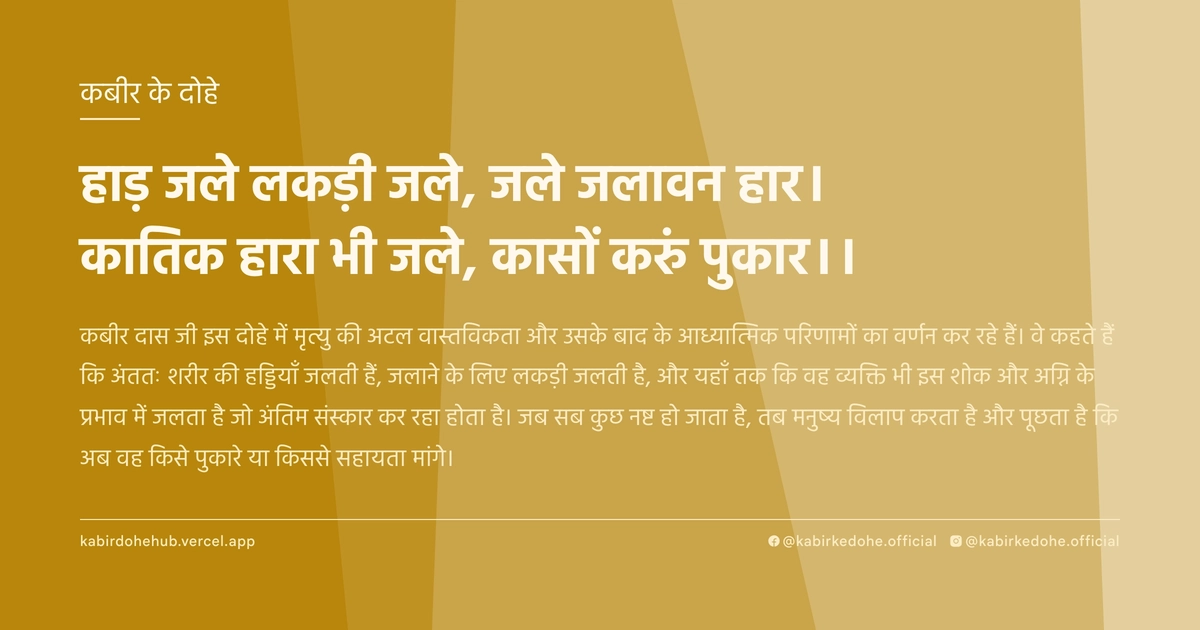
हाड़ जले लकड़ी जले, जले जलावन हार।
कातिक हारा भी जले, कासों करुं पुकार।।
Haad jale lakdi jale, jale jalavan haar. Kaatik haara bhi jale, kaason karun pukaar.
इस पृष्ठ पर इस कबीर दोहे का अर्थ (meaning), हिंदी व्याख्या और अंग्रेज़ी अनुवाद, दार्शनिक विश्लेषण और व्यावहारिक जीवन सीख दी गई है। यह दोहा मृतुक्यता (Mortality) विषय से जुड़ा है — Kabir doha meaning and explanation in Hindi and English.
अर्थ (Meaning):
कबीर दास जी इस दोहे में मृत्यु की अटल वास्तविकता और उसके बाद के आध्यात्मिक परिणामों का वर्णन कर रहे हैं। वे कहते हैं कि अंततः शरीर की हड्डियाँ जलती हैं, जलाने के लिए लकड़ी जलती है, और यहाँ तक कि वह व्यक्ति भी इस शोक और अग्नि के प्रभाव में जलता है जो अंतिम संस्कार कर रहा होता है। जब सब कुछ नष्ट हो जाता है, तब मनुष्य विलाप करता है और पूछता है कि अब वह किसे पुकारे या किससे सहायता मांगे।
Kabir describes the inevitable reality of death and its spiritual aftermath. He observes that in the end, the bones of the deceased burn, the wood used for the pyre burns, and even the one performing the last rites is consumed by the fire of grief and the realization of mortality. When everything is reduced to ash, the soul cries out in desperation, wondering whom to call upon or where to seek refuge now that all earthly ties are severed.
व्याख्या (Interpretation):
यह दोहा केवल श्मशान की अग्नि का वर्णन नहीं है, बल्कि यह 'माया' के विनाश और अहंकार के दहन का प्रतीक है। 'हाड़' और 'लकड़ी' भौतिक शरीर और सांसारिक आसक्तियों को दर्शाते हैं। 'जलावन हार' वह मोह है जो हमें अपनों से बांधे रखता है, जो अंततः दुख की अग्नि में जलता है। यहाँ कबीर निरगुण भक्ति का संकेत दे रहे हैं, जहाँ वे बताते हैं कि जब तक व्यक्ति इस नश्वर शरीर को ही अपनी पहचान मानता है, वह इस अग्नि से नहीं बच सकता। यह अद्वैत वेदांत के उस सत्य की ओर ले जाता है जहाँ केवल शुद्ध चेतना (ब्रह्म) ही शेष रहती है। विरोधाभास यह है कि मनुष्य जीवन भर जिसे संचित करता है, अंत में वही उसे जलाने के काम आता है। यह पुकार वास्तव में उस आत्मा की तड़प है जो अब बोध कर चुकी है कि संसार शून्य था।
This couplet is not merely a description of the cremation fire but a metaphor for the incineration of the ego and the dissolution of Maya. The 'bones' and 'wood' represent the physical body and worldly attachments. The 'one who burns' symbolizes the clinging affection that binds us to others, which eventually burns in the fire of grief. Kabir alludes to Nirgun Bhakti, suggesting that as long as one identifies with the perishable body, they cannot escape this fire. This leads to the Advaita Vedanta truth where only pure consciousness (Brahman) remains. The central paradox is that everything a human accumulates in life eventually serves as fuel for their own end. The final 'cry' is the awakening of the soul realizing that the material world was a void, leading to a desperate search for the Eternal.
दार्शनिक विश्लेषण (Philosophical Analysis):
कबीर का यह दोहा उनके युग की सामाजिक और धार्मिक जड़ता पर एक प्रहार है। उस समय लोग कर्मकांडों और बाहरी अनुष्ठानों में विश्वास करते थे, यह सोचकर कि वे मृत्यु के बाद के कष्टों से बच जाएंगे। कबीर इस भ्रम को तोड़ते हुए कहते हैं कि अग्नि सबको समान रूप से जलाती है, चाहे वह पंडित हो या चांडाल। यह उनके जाति-विरोधी और कर्मकांड-विरोधी दृष्टिकोण का प्रमाण है।
दार्शनिक स्तर पर, यह सूफीवाद के 'फना' (अहंकार का विनाश) के विचार से मिलता-जुलता है। जिस प्रकार लकड़ी जलकर राख हो जाती है, उसी प्रकार मनुष्य के 'मैं' का विलीनीकरण आवश्यक है ताकि वह परमात्मा में समा सके। कबीर यहाँ चेतावनी दे रहे हैं कि यदि आपने जीवित रहते हुए अपने अहंकार को नहीं जलाया, तो मृत्यु की अग्नि आपको अत्यंत पीड़ा देगी क्योंकि आप अभी भी मोह से बंधे होंगे।
अद्वैत वेदांत के परिप्रेक्ष्य में, यह शरीर एक वस्त्र की तरह है। जब वस्त्र जल जाता है, तो केवल वह तत्व बचता है जो अविनाशी है। कबीर का तर्क है कि अधिकांश लोग केवल 'वस्त्र' (शरीर) की चिंता करते हैं और 'धागे' (आत्मा) को भूल जाते हैं। यह विश्लेषण हमें यह समझने पर मजबूर करता है कि भौतिक संचय व्यर्थ है।
मनोवैज्ञानिक रूप से, यह दोहा मृत्यु-चिंतन (Memento Mori) के माध्यम से वर्तमान क्षण में जागृति लाने का प्रयास है। जब हम यह स्वीकार कर लेते हैं कि अंत निश्चित है, तो हम दूसरों के प्रति द्वेष और ईर्ष्या छोड़ देते हैं। यह अहंकार के विसर्जन की प्रक्रिया है, जहाँ व्यक्ति अपनी पहचान को सामाजिक पद या शारीरिक सुंदरता से हटाकर आंतरिक सत्य पर केंद्रित करता है।
अंततः, कबीर यह स्पष्ट करते हैं कि 'पुकार' तब नहीं करनी चाहिए जब शरीर जल रहा हो, बल्कि तब करनी चाहिए जब आप जीवित हों। जीवित रहते हुए उस निरगुण राम को खोजना ही एकमात्र उपाय है। यह दोहा हमें भौतिकता के मोह से निकालकर आध्यात्मिक स्वतंत्रता की ओर प्रेरित करता है, जहाँ भय और शोक का कोई स्थान नहीं रहता।
Kabir's couplet is a direct assault on the social and religious inertia of his era. During his time, people clung to elaborate rituals, believing such external acts could mitigate the sufferings of death. Kabir shatters this illusion, asserting that the fire consumes everyone equally, regardless of whether they are a high priest or an outcast. This is a testament to his fierce rejection of caste and ritualism.
On a philosophical level, this aligns with the Sufi concept of 'Fana' (the annihilation of the self). Just as wood is reduced to ash, the human 'I' must be dissolved to merge with the Divine. Kabir warns that if one does not incinerate their ego while living, the fire of death will be agonizing because the soul remains tethered to worldly attachments.
From the perspective of Advaita Vedanta, the body is likened to a garment. When the garment burns, only the indestructible element—the Atman—remains. Kabir argues that most people obsess over the 'garment' (the body) and forget the 'thread' (the soul). This analysis forces us to realize that material accumulation is an exercise in futility.
Psychologically, this verse employs 'Memento Mori' (remember that you will die) to trigger mindfulness in the present. By accepting the certainty of the end, one naturally sheds malice, jealousy, and greed. It is a process of ego-dissolution, shifting identity from social status or physical beauty to internal truth.
Ultimately, Kabir clarifies that the 'cry' for help should not happen while the body is burning, but while one is still alive. Seeking the Nirgun Ram during one's lifetime is the only salvation. The verse urges a transition from material attachment to spiritual liberation, where fear and grief no longer hold power.
मूल संदेश (Core Message):
- शरीर नश्वर है, केवल आत्मा शाश्वत है।
- भौतिक संचय अंततः राख में बदल जाता है।
- अहंकार का दहन ही वास्तविक मुक्ति का मार्ग है।
- मृत्यु का भय केवल मोह के कारण होता है।
- सत्य की खोज जीवन के रहते ही अनिवार्य है।
- The body is transient; only the soul is eternal.
- Material accumulation eventually turns to ash.
- The incineration of ego is the only path to liberation.
- Fear of death is merely a byproduct of attachment.
- The search for Truth is urgent while life remains.
व्यावहारिक उदाहरण (Practical Example):
वाराणसी के एक पुराने घाट पर रहने वाले रामदीन नाम के एक वृद्ध बुनकर थे। उनका पूरा जीवन रेशमी कपड़ों की बारीकियों और व्यापारिक लाभ को बढ़ाने में बीता। उन्होंने अपने जीवन में बहुत धन संचित किया और अपने परिवार को शहर के सबसे बड़े घर में बसाया। रामदीन को अपनी संपत्ति और अपनी सामाजिक प्रतिष्ठा पर बहुत गर्व था।
एक दिन उनके सबसे छोटे बेटे की अचानक मृत्यु हो गई। रामदीन ने अपनी पूरी संपत्ति लगा दी ताकि अंतिम संस्कार भव्य हो, सबसे महंगी लकड़ियाँ मंगवाई गईं और बड़े पंडितों को बुलाया गया। लेकिन जब उन्होंने अपने बेटे के शरीर को अग्नि को समर्पित होते देखा, तो उन्हें एक गहरा झटका लगा।
उन्होंने देखा कि वह महंगी लकड़ी, जिसे उन्होंने अपनी प्रतिष्ठा के लिए खरीदा था, बस कुछ ही मिनटों में राख हो रही थी। उनके बेटे का वह शरीर, जिसे उन्होंने दुनिया का सबसे अच्छा भोजन और वस्त्र दिए थे, वह भी धुएँ में बदल रहा था।
उस क्षण रामदीन को कबीर का यह दोहा याद आया। उन्हें एहसास हुआ कि जिस 'प्रतिष्ठा' और 'संपत्ति' के पीछे वे जीवन भर भागते रहे, वह वास्तव में उस लकड़ी की तरह थी जो केवल अंत में जलने के लिए थी।
उन्होंने देखा कि उनके आस-पास खड़े लोग भी शोक में जल रहे थे, ठीक उसी तरह जैसे चिता की लकड़ी जल रही थी। उन्हें महसूस हुआ कि वे अब तक केवल बाहरी आवरण को सजा रहे थे, जबकि भीतर की आत्मा खाली थी।
रामदीन ने महसूस किया कि उन्होंने अपने बेटे को भौतिक सुख तो दिए, लेकिन उसे यह नहीं सिखाया कि इस नश्वर संसार से ऊपर कैसे उठा जाए। यह बोध उनके लिए एक मानसिक अग्नि की तरह था जिसने उनके अहंकार को जला दिया।
अगले ही दिन, रामदीन ने अपनी संपत्ति का एक बड़ा हिस्सा उन लोगों के लिए समर्पित कर दिया जो शिक्षा और आध्यात्मिकता की तलाश में थे। उन्होंने रेशम के महंगे कपड़ों के बजाय सादे सूती वस्त्र पहनना शुरू कर दिया।
अब वे घाट पर बैठकर केवल व्यापार की बातें नहीं करते थे, बल्कि युवाओं को जीवन की क्षणभंगुरता और आंतरिक शांति के महत्व के बारे में बताते थे।
उनका व्यवहार बदल गया; अब वे क्रोध और अहंकार के बजाय करुणा और विनम्रता से बात करते थे। उन्होंने जान लिया था कि असली 'पुकार' मृत्यु के बाद नहीं, बल्कि जीवन के रहते ही सत्य की खोज में होनी चाहिए।
रामदीन का जीवन अब एक प्रदर्शन नहीं, बल्कि एक साधना बन गया था, जहाँ उन्होंने अंततः उस शांति को पा लिया जो किसी भी रेशमी कपड़े या सोने के सिक्के से नहीं खरीदी जा सकती थी।
In the ancient ghats of Varanasi lived an elderly weaver named Ramdeen. His entire life was spent mastering the intricacies of silk weaving and maximizing business profits. He accumulated vast wealth and settled his family in the largest house in the neighborhood. Ramdeen took immense pride in his riches and social standing.
One day, his youngest son passed away suddenly. Ramdeen spent a fortune to ensure the funeral was grand, ordering the most expensive woods and hiring the most renowned priests. However, as he watched his son's body being committed to the flames, a profound shock struck him.
He observed that the expensive wood, bought to maintain his prestige, was turning to ash in mere minutes. The body of his son, which he had provided with the finest food and clothing in the world, was vanishing into smoke.
In that moment, Kabir's couplet echoed in his mind. He realized that the 'prestige' and 'wealth' he had chased all his life were actually like that wood—only meant to be burned in the end.
He noticed that the people standing around him were also burning in the fire of grief, just as the pyre's wood was burning. He felt that he had spent his life decorating the outer shell while the inner soul remained empty.
Ramdeen realized he had given his son every material luxury but had failed to teach him how to rise above this ephemeral world. This realization acted as a mental fire, incinerating his long-held ego.
The very next day, Ramdeen dedicated a significant portion of his wealth to those seeking education and spiritual growth. He stopped wearing expensive silks and switched to simple cotton clothes.
He no longer spent his days on the ghats discussing trade; instead, he spoke to the youth about the transience of life and the importance of inner peace.
His behavior transformed; he spoke with compassion and humility instead of anger and pride. He understood that the true 'cry' should not happen after death, but during life, in the pursuit of Truth.
Ramdeen's life ceased to be a performance and became a spiritual practice, where he finally found a peace that no silk fabric or gold coin could ever purchase.
अभ्यास मार्गदर्शन (Practice Guidance):
- दैनिक मृत्यु-चिंतन: प्रतिदिन 10 मिनट शांत बैठकर यह विचार करें कि यह शरीर नश्वर है। यह अभ्यास भय को कम करता है और कृतज्ञता बढ़ाता है।
- अहंकार का विसर्जन (Journaling): एक डायरी में उन तीन चीजों की सूची बनाएं जिन पर आपको सबसे अधिक गर्व है, और फिर लिखें कि मृत्यु के समय वे चीजें कितनी निरर्थक होंगी।
- सादा जीवन, उच्च विचार: अपनी भौतिक इच्छाओं को कम करें। सप्ताह में एक दिन ऐसा रखें जब आप न्यूनतम संसाधनों के साथ रहें ताकि आप भौतिकता पर अपनी निर्भरता को पहचान सकें।
- निदान चेकलिस्ट: यदि आप छोटी बातों पर क्रोधित हो रहे हैं या अपनी संपत्ति/पद के खोने के डर में जी रहे हैं, तो समझ लें कि आपका 'अहंकार' अभी जलना बाकी है।
- Daily Contemplation on Mortality: Spend 10 minutes each day reflecting on the impermanence of the body. This practice reduces fear and increases gratitude for the present.
- Ego Dissolution (Journaling): List three things you are most proud of in a journal, then write about how irrelevant those things will be at the moment of death.
- Simple Living, High Thinking: Intentionally reduce material desires. Dedicate one day a week to live with minimal resources to recognize your dependence on materiality.
- Diagnostic Checklist: If you find yourself reacting with anger over trivial matters or living in fear of losing status/wealth, recognize that your 'ego' has yet to be incinerated.
चिंतन प्रश्न (Reflection Questions):
- यदि आज मेरा अंतिम दिन हो, तो मेरी कौन सी उपलब्धियां वास्तव में मायने रखेंगी?
- मैं अपनी पहचान को अपने पद, धन या शरीर से कितना जोड़ता हूँ?
- क्या मेरा 'डिजिटल अहंकार' (सोशल मीडिया इमेज) मुझे वास्तविक आत्म-बोध से दूर कर रहा है?
- मैं दूसरों के दुख में जो सहानुभूति दिखाता हूँ, क्या वह वास्तविक है या केवल मेरी अपनी मृत्यु का एक सूक्ष्म भय है?
- मेरे जीवन का वह कौन सा 'अटैचमेंट' है जिसे मैं कभी नहीं छोड़ना चाहता, और वह मुझे कैसे बांध रहा है?
- क्या मैं वास्तव में 'मैं' हूँ, या मैं केवल समाज द्वारा दी गई परिभाषाओं का एक संग्रह हूँ?
- If today were my final day, which of my achievements would actually hold meaning?
- To what extent do I tie my identity to my position, wealth, or physical body?
- Is my 'digital ego' (social media image) distancing me from authentic self-realization?
- Is the empathy I show for others' suffering genuine, or is it a subtle fear of my own mortality?
- What is the one 'attachment' in my life I refuse to let go of, and how is it binding me?
- Am I truly 'I', or am I merely a collection of definitions provided by society?