
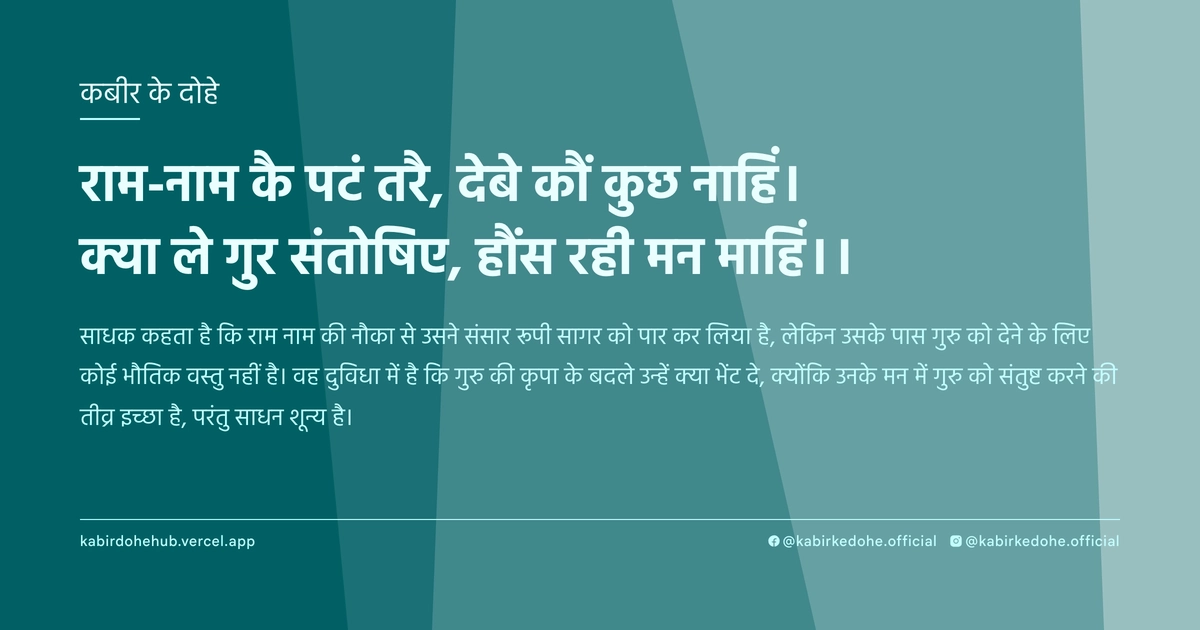
राम-नाम कै पटं तरै, देबे कौं कुछ नाहिं।
क्या ले गुर संतोषिए, हौंस रही मन माहिं।।
Ram-naam kai patan tarai, debe kaun kuch naahin. Kya le gur santoshiye, hauns rahi man maahin.
इस पृष्ठ पर इस कबीर दोहे का अर्थ (meaning), हिंदी व्याख्या और अंग्रेज़ी अनुवाद, दार्शनिक विश्लेषण और व्यावहारिक जीवन सीख दी गई है। यह दोहा गुरु महत्व (The Guru's Importance) विषय से जुड़ा है — Kabir doha meaning and explanation in Hindi and English.
अर्थ (Meaning):
साधक कहता है कि राम नाम की नौका से उसने संसार रूपी सागर को पार कर लिया है, लेकिन उसके पास गुरु को देने के लिए कोई भौतिक वस्तु नहीं है। वह दुविधा में है कि गुरु की कृपा के बदले उन्हें क्या भेंट दे, क्योंकि उनके मन में गुरु को संतुष्ट करने की तीव्र इच्छा है, परंतु साधन शून्य है।
The seeker acknowledges that they have crossed the ocean of worldly existence using the raft of the Divine Name (Ram-naam), yet they possess nothing material to offer the Guru in return. There is a profound inner longing to gratify the teacher's generosity, but the seeker finds themselves devoid of any worldly possession to present as a token of gratitude.
व्याख्या (Interpretation):
यह दोहा गुरु-शिष्य परंपरा के उस उच्चतम बिंदु को दर्शाता है जहाँ भौतिकता पूरी तरह समाप्त हो जाती है। 'राम-नाम' यहाँ केवल एक शब्द नहीं, बल्कि वह निराकार चेतना (Nirgun) है जो माया के बंधनों को काटती है। साधक का यह कहना कि 'देबे कौं कुछ नाहिं' वास्तव में उसकी आध्यात्मिक पूर्णता का संकेत है, क्योंकि जब अहंकार मिट जाता है, तब 'देने वाला' और 'लेने वाला' दोनों समाप्त हो जाते हैं। यह अद्वैत वेदांत के उस सत्य को उजागर करता है जहाँ आत्मा और परमात्मा एक हो जाते हैं। यहाँ 'हौंस' या इच्छा वास्तव में गुरु के प्रति अनन्य प्रेम और समर्पण की पराकाष्ठा है, न कि किसी सांसारिक लालसा की। यह विरोधाभास है कि जिसे सब कुछ मिल गया, वह अब कुछ देने के लिए असमर्थ है क्योंकि वह स्वयं शून्य हो चुका है।
This couplet illuminates the zenith of the Guru-disciple relationship where materiality is completely dissolved. 'Ram-naam' here is not merely a mantra but the formless consciousness (Nirgun) that severs the shackles of Maya. The seeker's admission that they have 'nothing to give' is actually a sign of spiritual fruition; when the ego vanishes, the duality of the 'giver' and the 'receiver' collapses. This aligns with Advaita Vedanta, where the Atman realizes its identity as Brahman. The 'longing' (hauns) mentioned is not a worldly desire but the peak of selfless love (Bhakti) and surrender. It presents a spiritual paradox: the one who has gained everything is now unable to give anything because they have become a void, a state of Shunya, which is the only gift a Guru truly desires.
दार्शनिक विश्लेषण (Philosophical Analysis):
कबीर का यह दोहा मध्यकालीन भारत के उस सामाजिक परिवेश में लिखा गया जहाँ धर्म अक्सर कर्मकांडों और बाहरी दिखावे तक सीमित था। कबीर ने पुरोहितवाद और मंदिर-मस्जिद के औपचारिक दान की परंपरा को चुनौती दी। उनके लिए 'राम' सगुण मूर्ति नहीं, बल्कि वह सर्वव्यापी तत्व है जो हर श्वास में मौजूद है। यह दृष्टिकोण सूफी मत के 'फना' (अहंकार का विनाश) और अद्वैत के 'अहं ब्रह्मास्मि' के करीब है।
यहाँ गुरु की भूमिका एक मार्गदर्शक की है जो शिष्य को यह समझाता है कि आध्यात्मिक ज्ञान की कोई कीमत नहीं चुकाई जा सकती। जब शिष्य यह महसूस करता है कि उसके पास देने के लिए कुछ नहीं है, तभी वह वास्तव में 'पात्र' बनता है। यह मनोवैज्ञानिक रूपांतरण है जहाँ व्यक्ति अपनी बाहरी उपलब्धियों के गर्व को त्यागकर आंतरिक रिक्तता को स्वीकार करता है।
कबीर यहाँ यह स्पष्ट करते हैं कि गुरु को सोने-चांदी या वस्त्रों से संतुष्ट नहीं किया जा सकता। गुरु की वास्तविक संतुष्टि शिष्य के भीतर के 'अहं' के विसर्जन में है। यह भौतिक दान के विरुद्ध एक आध्यात्मिक विद्रोह है, जो यह सिखाता है कि सर्वोच्च सत्य केवल समर्पण से प्राप्त होता है, सौदेबाजी से नहीं।
इस विश्लेषण में हम पाते हैं कि कबीर ने भक्ति को एक व्यक्तिगत अनुभव बनाया। उन्होंने यह स्थापित किया कि ईश्वर तक पहुँचने का मार्ग किसी बाहरी माध्यम या महंगी भेंट से नहीं, बल्कि अंतर्मन की शुद्धि और नाम-स्मरण से प्रशस्त होता है। यह विचार जाति और वर्ग के भेदों को मिटा देता है क्योंकि 'शून्य' होने की क्षमता सबके पास है।
अंततः, यह दोहा हमें यह सोचने पर मजबूर करता है कि हम जीवन भर जिसे 'संग्रह' करना चाहते हैं, वह वास्तव में हमारी मुक्ति में बाधा है। वास्तविक उपलब्धि वह है जब हम यह जान लें कि हम कुछ भी नहीं हैं, और वही 'कुछ नहीं' होना ही ईश्वर के साथ एकाकार होने की एकमात्र शर्त है।
Kabir composed this verse during a medieval Indian era where religion was often reduced to ritualism and outward displays of piety. He challenged the priestly hegemony and the tradition of formal offerings in temples and mosques. For Kabir, 'Ram' is not a deity with a form, but the pervasive, formless element residing in every breath. This perspective mirrors the Sufi concept of 'Fana' (annihilation of the self) and the Advaita realization of 'Aham Brahmasmi'.
The Guru's role here is that of a catalyst who leads the disciple to realize that spiritual liberation cannot be purchased or traded. When the disciple feels they have nothing to give, they finally become a 'fit vessel'—empty enough to be filled with divine grace. This is a psychological transformation where the individual sheds the pride of external achievements and embraces internal emptiness.
Kabir clarifies that a Guru cannot be gratified by gold, silver, or garments. The true satisfaction of a teacher lies in the dissolution of the disciple's ego. This is a spiritual rebellion against the notion of transactional piety, teaching that the highest truth is attained through surrender, not bargaining.
In this analysis, we see Kabir transforming Bhakti into a deeply personal, internal experience. He establishes that the path to the Divine is paved not with expensive offerings, but with the purification of the heart and the constant remembrance of the Name. This vision erases caste and class distinctions, as the capacity to become 'nothing' is universal.
Ultimately, the verse forces us to reconsider our lifelong pursuit of accumulation. It suggests that what we strive to collect is actually the primary obstacle to liberation. The ultimate achievement is the realization that we are nothing, and this very state of 'nothingness' is the sole prerequisite for merging with the Universal Truth.
मूल संदेश (Core Message):
- बाहरी भेंट केवल भ्रम है, आंतरिक समर्पण ही वास्तविक सत्य है।
- जब 'मैं' मिटता है, तभी 'वह' प्रकट होता है।
- गुरु की असली दक्षिणा शिष्य का अहंकार-शून्य होना है।
- शून्यता ही वह स्थान है जहाँ परमात्मा निवास करता है।
- सच्ची मुक्ति पाने के लिए पहले सब कुछ खोना पड़ता है।
- External offerings are mere illusions; internal surrender is the only truth.
- Only when the 'I' vanishes does the 'Divine' manifest.
- The true honorarium for a Guru is the disciple's ego-less state.
- Emptiness is the only space where the Divine can reside.
- To attain ultimate liberation, one must first lose everything.
व्यावहारिक उदाहरण (Practical Example):
एक समय की बात है, वाराणसी के घाटों पर रहने वाला एक वृद्ध बुनकर था, जिसका नाम माधव था। माधव ने अपना पूरा जीवन सूत कातने और कपड़े बुनने में बिता दिया था। वह बहुत गरीब था, लेकिन उसके मन में एक गहरी आध्यात्मिक प्यास थी। उसने एक मौन संत की शरण ली और वर्षों तक उनके मार्गदर्शन में 'नाम-सुमिरन' का अभ्यास किया।
धीरे-धीरे माधव को अनुभव हुआ कि उसके भीतर का क्रोध, लोभ और अहंकार शांत हो रहे हैं। उसे महसूस हुआ कि वह अब संसार के दुखों से ऊपर उठ चुका है और उसे एक असीम शांति का अनुभव हो रहा है। उसने महसूस किया कि संत की कृपा ने उसे भवसागर से पार उतार दिया है।
एक दिन, जब संत अपनी कुटिया छोड़कर जाने वाले थे, माधव बहुत व्याकुल हो गया। उसने सोचा, 'इन महान गुरु ने मुझे जीवन का सत्य दे दिया, लेकिन मेरे पास उन्हें देने के लिए क्या है?' उसके पास केवल एक पुराना फटा हुआ कंबल और कुछ सूखी रोटियाँ थीं।
वह रोने लगा और संत के चरणों में गिर गया। उसने कहा, 'गुरुदेव, आपने मुझे वह दिया जो अनमोल है, लेकिन मैं इतना दरिद्र हूँ कि आपको संतोष देने के लिए मेरे पास कुछ भी नहीं है। मेरी यह रिक्तता मुझे कचोट रही है।'
संत ने मुस्कुराते हुए माधव की आँखों में देखा और कहा, 'माधव, तुम जिसे अपनी दरिद्रता समझ रहे हो, वही तुम्हारी सबसे बड़ी संपत्ति है। यदि तुम्हारे पास देने के लिए कुछ भौतिक होता, तो तुम अभी भी उसी अहंकार में होते कि तुम मुझे कुछ दे रहे हो।'
संत ने आगे समझाया, 'तुम्हारी यह तड़प, यह अहसास कि तुम शून्य हो, और तुम्हारा यह पूर्ण समर्पण ही मेरी सबसे बड़ी दक्षिणा है। जिस दिन तुम यह भूल जाओगे कि तुम कुछ दे रहे हो, उसी दिन तुम वास्तव में मुझे संतुष्ट कर दोगे।'
माधव को अचानक एक बिजली जैसा अहसास हुआ। उसने समझा कि गुरु को वस्तुएं नहीं, बल्कि शिष्य का रूपांतरण चाहिए होता है। उसकी आँखों से आंसू बह निकले, लेकिन इस बार वे दुख के नहीं, बल्कि परम तृप्ति के थे।
उस दिन के बाद, माधव ने कभी अपनी गरीबी का शोक नहीं मनाया। वह जान गया था कि जब मनुष्य पूरी तरह खाली हो जाता है, तभी वह ईश्वर के प्रेम से पूरी तरह भर जाता है। उसने अपना शेष जीवन बिना किसी अपेक्षा के दूसरों की सेवा में लगा दिया।
Once, on the ghats of Varanasi, lived an elderly weaver named Madhav. Madhav had spent his entire life spinning yarn and weaving cloth. He was impoverished in material terms, but possessed a profound spiritual thirst. He sought refuge with a silent saint and practiced 'Naam-Simran' under his guidance for many years.
Gradually, Madhav felt his anger, greed, and ego subside. He realized he had risen above the tribulations of the world and was experiencing an infinite peace. He felt that the saint's grace had steered his boat across the ocean of existence.
One day, as the saint prepared to leave his cottage, Madhav became deeply distressed. He thought, 'This great Guru has given me the truth of life, but what do I have to offer him in return?' He possessed nothing but an old, tattered blanket and a few dry rotis.
He broke down in tears and fell at the saint's feet. He cried, 'Gurudev, you have given me that which is priceless, but I am so destitute that I have nothing to satisfy you. This emptiness within me is agonizing.'
The saint looked into Madhav's eyes with a gentle smile and said, 'Madhav, what you perceive as your poverty is actually your greatest wealth. Had you possessed something material to give, you would still be trapped in the ego of being a giver.'
The saint further explained, 'This longing of yours, this realization that you are empty, and your total surrender—this is the greatest honorarium I could ever receive. The day you forget that you are giving something, you will truly satisfy me.'
Madhav felt a sudden flash of realization. He understood that a Guru does not seek objects, but the transformation of the disciple. Tears streamed down his face, but this time they were not of sorrow, but of supreme fulfillment.
After that day, Madhav never mourned his poverty. He understood that when a human becomes completely empty, they are finally capable of being filled with Divine Love. He spent the rest of his life serving others without any expectation of reward.
अभ्यास मार्गदर्शन (Practice Guidance):
- प्रतिदिन 20 मिनट मौन बैठें और यह विचार करें कि आपकी सभी उपलब्धियां और पहचान वास्तव में आपकी नहीं हैं, बल्कि प्रकृति का ऋण हैं।
- एक 'अहंकार डायरी' लिखें: दिन भर में उन क्षणों को नोट करें जब आपने महसूस किया कि 'मैंने यह किया' या 'मैं श्रेष्ठ हूँ', और फिर उन्हें कृतज्ञता में बदलें।
- सेवा का अभ्यास करें जहाँ आप गुप्त रूप से किसी की मदद करें और यह सुनिश्चित करें कि सामने वाले को यह न पता चले कि मदद किसने की है, ताकि 'दाता' का भाव मिट जाए।
- नैदानिक चेकलिस्ट: क्या आप किसी की मदद करने के बाद प्रशंसा की उम्मीद करते हैं? क्या आप अपनी उपलब्धियों को अपनी पहचान मानते हैं? यदि हाँ, तो आप अभी भी 'देने' के भ्रम में हैं।
- Spend 20 minutes in silence daily, contemplating that all your achievements and identities are not truly yours, but debts owed to nature and grace.
- Maintain an 'Ego Journal': Note moments throughout the day when you felt 'I did this' or 'I am superior,' and consciously transform those thoughts into gratitude.
- Practice anonymous service: Help someone in secret, ensuring the recipient never knows the source, thereby annihilating the identity of the 'giver'.
- Diagnostic Checklist: Do you expect praise after helping someone? Do you equate your achievements with your identity? If yes, you are still trapped in the illusion of 'giving'.
चिंतन प्रश्न (Reflection Questions):
- यदि आपकी सारी पदवियाँ, संपत्ति और रिश्ते छीन लिए जाएँ, तो आपके पास 'देने' के लिए क्या बचेगा?
- क्या आपकी उदारता वास्तव में निस्वार्थ है, या यह आपके डिजिटल ईगो को संतुष्ट करने का एक तरीका है?
- आप अपने जीवन में किसे 'गुरु' मानते हैं, और क्या आप उनके प्रति केवल भौतिक कृतज्ञता रखते हैं या आत्मिक रूपांतरण?
- वह कौन सा सूक्ष्म अहंकार है जो आपको यह मानने से रोकता है कि आप पूरी तरह से शून्य हैं?
- क्या आप वास्तव में मुक्त होना चाहते हैं, या आप केवल मुक्ति के 'विचार' से प्रेम करते हैं?
- If all your titles, wealth, and relationships were stripped away, what would remain for you to 'give'?
- Is your generosity truly selfless, or is it a tool to feed your digital ego and public image?
- Who do you consider your 'Guru' in life, and is your gratitude merely material or a deep spiritual transformation?
- What is that subtle ego that prevents you from accepting that you are absolutely nothing?
- Do you truly desire liberation, or are you merely in love with the 'idea' of being liberated?