
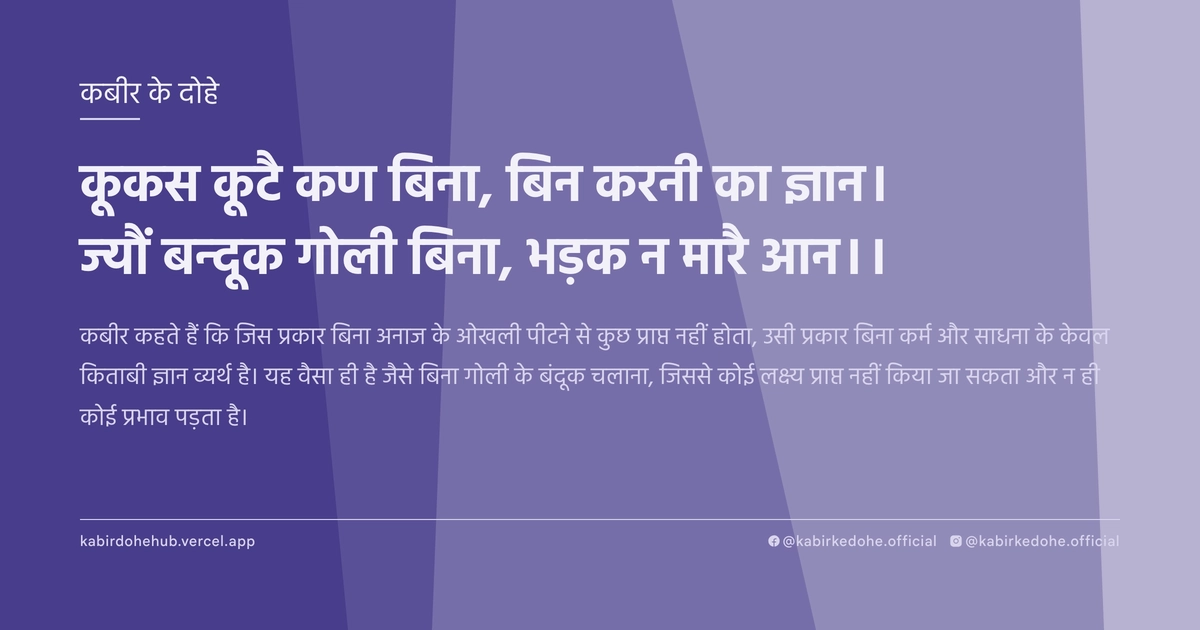
कूकस कूटै कण बिना, बिन करनी का ज्ञान।
ज्यौं बन्दूक गोली बिना, भड़क न मारै आन।।
Kookas kootai kan bina, bin karani ka gyaan. Jyun bandook goli bina, bhadak na maarai aan.
इस पृष्ठ पर इस कबीर दोहे का अर्थ (meaning), हिंदी व्याख्या और अंग्रेज़ी अनुवाद, दार्शनिक विश्लेषण और व्यावहारिक जीवन सीख दी गई है। यह दोहा सत्य (Truth) विषय से जुड़ा है — Kabir doha meaning and explanation in Hindi and English.
अर्थ (Meaning):
कबीर कहते हैं कि जिस प्रकार बिना अनाज के ओखली पीटने से कुछ प्राप्त नहीं होता, उसी प्रकार बिना कर्म और साधना के केवल किताबी ज्ञान व्यर्थ है। यह वैसा ही है जैसे बिना गोली के बंदूक चलाना, जिससे कोई लक्ष्य प्राप्त नहीं किया जा सकता और न ही कोई प्रभाव पड़ता है।
Kabir asserts that just as pounding a mortar without grain yields no flour, spiritual knowledge without practical application and disciplined action is futile. He likens this to firing a gun without a bullet; though the noise and gesture exist, there is no impact and no target is ever hit.
व्याख्या (Interpretation):
इस दोहे का शाब्दिक अर्थ है कि साधन के बिना साध्य की प्राप्ति असंभव है। रूपक के माध्यम से कबीर 'कण' (अनाज) को वास्तविक अनुभव और 'करनी' (कर्म) को साधना का प्रतीक बताते हैं। यहाँ 'ज्ञान' का अर्थ केवल सूचना नहीं, बल्कि वह बोध है जो जीवन को बदल दे। निर्गुण भक्ति के संदर्भ में, यह इस बात पर जोर देता है कि केवल मंत्रोच्चार या शास्त्रों का पाठ करना माया के पर्दे को नहीं हटा सकता। जब तक साधक अपने अहंकार का विसर्जन नहीं करता और ज्ञान को आचरण में नहीं उतारता, वह केवल एक खोखली बंदूक की तरह है। यह अद्वैत वेदांत के उस सिद्धांत को पुष्ट करता है जहाँ ज्ञान (Jnana) और कर्म (Karma) का समन्वय आवश्यक है ताकि आत्मा और ब्रह्म की एकता का अनुभव हो सके।
Literally, the verse suggests that the tool is useless without the substance it is meant to process. Metaphorically, 'grain' represents authentic spiritual experience and 'action' represents the disciplined practice (Sadhana). Kabir distinguishes between intellectual information and transformative realization. In the context of Nirgun Bhakti, he argues that ritualistic chanting or rote memorization of scriptures cannot pierce the veil of Maya. Unless the seeker dissolves the ego and embodies the truth through action, they remain like a gun without a bullet—noisy but powerless. This aligns with Advaita Vedanta, emphasizing that while knowledge of non-duality is essential, it must be integrated with right action to bridge the gap between the perceived individual self (Atman) and the Universal Consciousness (Brahman).
दार्शनिक विश्लेषण (Philosophical Analysis):
कबीर का यह दोहा उनके युग के उस सामाजिक और धार्मिक पाखंड पर कड़ा प्रहार है जहाँ लोग केवल बाहरी दिखावे और कर्मकांडों को ही धर्म मान बैठे थे। उन्होंने देखा कि पंडित और मौलवी केवल ग्रंथों के शब्दों को रट रहे थे, लेकिन उनके व्यवहार में करुणा और सत्य का अभाव था। कबीर का दर्शन यहाँ 'प्रैक्टिकल स्पिरिचुअलिटी' पर केंद्रित है। वे कहते हैं कि ज्ञान यदि व्यवहार में नहीं उतरा, तो वह केवल एक मानसिक बोझ है।
अद्वैत वेदांत के नजरिए से, केवल यह जान लेना कि 'अहं ब्रह्मास्मि' पर्याप्त नहीं है; इस सत्य को हर सांस और हर कार्य में जीना पड़ता है। सूफी मत में इसे 'हाल' (आध्यात्मिक अवस्था) और 'मक़ाम' (स्तर) के बीच का अंतर कहा जाता है। केवल किताबों को पढ़ना 'इल्म' है, लेकिन अनुभव करना 'मारिफ़त' है। कबीर इसी मारिफ़त की वकालत कर रहे हैं।
यहाँ 'बंदूक' और 'गोली' का रूपक बहुत गहरा है। बंदूक हमारा शरीर और बुद्धि है, और गोली वह 'अनुभव' या 'साधना' है जो लक्ष्य (मोक्ष) को भेदती है। बिना साधना के बुद्धि केवल शोर मचाती है, जो अहंकार को और बढ़ाता है। यह अहंकार ही वह सबसे बड़ी बाधा है जो मनुष्य को सत्य से दूर रखती है।
कबीर जाति और धर्म के भेदभाव को नकारते हुए यह स्पष्ट करते हैं कि ईश्वर की प्राप्ति किसी विशेष कुल में जन्म लेने से नहीं, बल्कि शुद्ध आचरण और निरंतर अभ्यास से होती है। वे कर्म को ज्ञान की कसौटी मानते हैं। यदि आपका ज्ञान आपको अधिक विनम्र और प्रेमपूर्ण नहीं बना रहा, तो वह ज्ञान नहीं, बल्कि अज्ञान का एक परिष्कृत रूप है।
अंततः, यह विश्लेषण हमें इस निष्कर्ष पर ले जाता है कि आध्यात्मिक विकास एक आंतरिक यात्रा है जिसे बाहरी क्रियाओं (जैसे तीर्थयात्रा या व्रत) से नहीं, बल्कि आंतरिक रूपांतरण और निस्वार्थ सेवा से प्राप्त किया जा सकता है। ज्ञान का वास्तविक उद्देश्य अहंकार का विनाश है, न कि बौद्धिक श्रेष्ठता का प्रदर्शन।
This Doha is a scathing critique of the religious hypocrisy prevalent during Kabir's era, where spirituality was reduced to external rituals and the rote memorization of scriptures. Kabir observed that the clergy—both Pandits and Maulvis—possessed vast textual knowledge but lacked compassion and truth in their conduct. His philosophy here centers on 'Practical Spirituality,' arguing that knowledge not translated into behavior is merely a mental burden.
From the perspective of Advaita Vedanta, simply knowing the phrase 'Aham Brahmasmi' (I am Brahman) is insufficient; this truth must be lived in every breath and action. In Sufism, this is the distinction between 'Ilm' (intellectual knowledge) and 'Ma'rifat' (gnostic realization). Kabir advocates for Ma'rifat, where the truth is not read but experienced through the heart.
The metaphor of the 'gun' and the 'bullet' is profound. The gun represents the human body and intellect, while the bullet represents 'Sadhana' (disciplined practice) or direct experience. Without the bullet, the intellect only makes noise, which often serves to inflate the ego rather than dissolve it. This ego is the primary obstacle hindering the realization of the Self.
By rejecting caste and sectarian divides, Kabir clarifies that liberation is not a birthright of any specific caste but a result of pure conduct and persistent practice. He posits that action is the litmus test for knowledge. If one's knowledge does not manifest as humility and universal love, it is not wisdom but a sophisticated form of ignorance.
Ultimately, this analysis leads to the conclusion that spiritual evolution is an internal journey. It cannot be achieved through external acts like pilgrimages or fasting, but through internal transformation and selfless service. The true purpose of knowledge is the annihilation of the ego, not the demonstration of intellectual superiority.
मूल संदेश (Core Message):
- सूचना ज्ञान नहीं है; अनुभव ही वास्तविक बोध है।
- बिना आचरण के शास्त्र केवल मानसिक बोझ हैं।
- अहंकार का विसर्जन ही ज्ञान की पहली शर्त है।
- सत्य को पढ़ा नहीं, बल्कि जिया जाना चाहिए।
- कर्म ही वह सेतु है जो सिद्धांत को सत्य बनाता है।
- बाहरी शोर को छोड़कर आंतरिक रूपांतरण पर ध्यान दें।
- Information is not wisdom; only lived experience is true realization.
- Scriptures without conduct are merely intellectual baggage.
- The dissolution of ego is the primary prerequisite for knowledge.
- Truth is not to be read, but to be embodied and lived.
- Action is the only bridge that transforms theory into truth.
- Cease the external noise and focus on internal transformation.
व्यावहारिक उदाहरण (Practical Example):
वाराणसी के एक पुराने घाट पर रहने वाली एक वृद्ध विधवा, जानकी, का जीवन केवल पूजा-पाठ और शास्त्रों के सुनने में बीतता था। वह शहर की सबसे ज्ञानी महिला मानी जाती थी क्योंकि उसने दर्जनों पुराण रटे थे। वह हर किसी को धर्म और नैतिकता का उपदेश देती थी, लेकिन उसका हृदय कठोर था। वह अपने पड़ोस में रहने वाले एक गरीब मछुआरे के परिवार की मदद कभी नहीं करती थी, क्योंकि वह उसे 'अशुद्ध' मानती थी।
एक दिन, भारी बारिश के कारण घाट पर बाढ़ आ गई। जानकी का घर पानी में डूब गया और वह असहाय होकर एक ऊंचे चबूतरे पर खड़ी थी। उसके पास ज्ञान की सारी बातें थीं, लेकिन उस संकट की घड़ी में कोई भी 'पंडित' उसकी मदद के लिए नहीं आया, क्योंकि वे सब अपने-अपने घरों में सुरक्षित थे।
तभी वही मछुआरा, जिसे वह अछूत समझती थी, अपनी छोटी सी नाव लेकर आया। उसने जानकी को सहारा दिया, उसे सुरक्षित स्थान पर पहुँचाया और अपने हिस्से का सूखा भोजन उसे खिलाया। जानकी ने देखा कि जिस व्यक्ति के पास कोई शास्त्र नहीं था, उसके भीतर वह करुणा थी जिसे वह केवल किताबों में पढ़ती आई थी।
उस रात जानकी को कबीर का यह दोहा याद आया। उसे अहसास हुआ कि उसका वर्षों का अध्ययन 'बिना गोली की बंदूक' की तरह था—शोर बहुत था, लेकिन जीवन में उसका कोई वास्तविक प्रभाव नहीं था। उसका ज्ञान केवल शब्दों का ढेर था, उसमें 'करनी' (कर्म) का अभाव था।
इस अनुभव ने जानकी के भीतर एक गहरा बदलाव लाया। उसने अपनी पहचान एक 'ज्ञानी' के रूप में देखना छोड़ दिया। उसने महसूस किया कि असली धर्म शास्त्रों के पन्नों में नहीं, बल्कि दूसरे के दुख को दूर करने में है।
अगले कुछ महीनों में, जानकी ने अपने घर के बचे हुए संसाधनों से एक छोटा सा सामुदायिक केंद्र खोला जहाँ वह केवल उपदेश नहीं देती थी, बल्कि बीमारों की सेवा करती थी और बच्चों को मुफ्त शिक्षा देती थी।
उसने अब धर्म को 'पढ़ना' बंद कर दिया और उसे 'जीना' शुरू किया। उसकी कठोरता करुणा में बदल गई और वह वास्तव में उस शांति का अनुभव करने लगी जिसकी तलाश वह दशकों से किताबों में कर रही थी।
यह 'कबीर ट्विस्ट' था—जहाँ एक बाहरी संकट ने उसके आंतरिक अहंकार को तोड़ा और उसे यह सिखाया कि बिना कर्म के ज्ञान केवल एक भ्रम है। जानकी अब केवल एक विद्वान नहीं, बल्कि एक वास्तविक साधक बन गई थी।
In the ancient ghats of Varanasi lived an elderly widow named Janki, whose life revolved entirely around rituals and listening to scriptures. She was regarded as the most learned woman in her colony, having memorized dozens of Puranas. She spent her days preaching morality and dharma to others, yet her heart remained cold. She never helped a poor fisherman's family living nearby, viewing them as 'impure' due to their caste.
One day, torrential rains caused the Ganges to overflow, flooding the ghats. Janki's small hut was submerged, and she found herself stranded and terrified on a high stone platform. Despite her vast knowledge of spiritual texts, none of the 'learned' priests she associated with came to her rescue, as they were preoccupied with their own safety.
Suddenly, the very fisherman she had shunned appeared in his small boat. Without hesitation, he rescued her, took her to a safe shelter, and shared his meager portion of dry food with her. Janki realized that this man, who had never read a single scripture, possessed the very compassion she had only read about in books.
That night, Kabir's words echoed in her mind. She realized her years of study were like a 'gun without a bullet'—there was a lot of noise and prestige, but no real impact on her soul or the world. Her knowledge was a heap of words devoid of 'Karni' (action).
This experience triggered a profound shift. Janki stopped identifying herself as a 'scholar.' She understood that true dharma does not reside in the pages of a book but in the act of alleviating another's suffering.
Over the following months, Janki used her remaining resources to start a small community center. She stopped giving lectures and started nursing the sick and teaching village children for free.
She ceased 'reading' religion and began 'living' it. Her rigidity transformed into tenderness, and she finally experienced the inner peace she had spent decades searching for in texts.
This was the 'Kabir Twist'—where an external crisis shattered her internal ego, teaching her that knowledge without application is a mere illusion. Janki evolved from a scholar of words into a practitioner of truth.
अभ्यास मार्गदर्शन (Practice Guidance):
- दैनिक आत्म-निरीक्षण: हर रात सोने से पहले खुद से पूछें, 'आज मैंने जो ज्ञान पढ़ा या सुना, उसे मैंने किस वास्तविक कार्य में बदला?'
- सेवा का संकल्प: सप्ताह में एक बार ऐसा कार्य करें जो आपकी सुख-सुविधा के दायरे से बाहर हो और जिसमें आपका कोई व्यक्तिगत लाभ न हो।
- मौन चिंतन: प्रतिदिन 20 मिनट मौन रहें और केवल अपनी सांसों और वर्तमान क्षण के प्रति जागरूक रहें, बिना किसी बौद्धिक विश्लेषण के।
- डायरी लेखन: उन स्थितियों को लिखें जहाँ आपका 'अहंकार' आपके 'ज्ञान' पर हावी हो गया, और विश्लेषण करें कि उस समय सही कर्म क्या होता।
- डायग्नोस्टिक चेकलिस्ट: यदि आप दूसरों को सुधारने की तीव्र इच्छा रखते हैं लेकिन स्वयं के व्यवहार में बदलाव नहीं देख रहे, तो समझ लें कि आपका ज्ञान अभी 'बिना गोली की बंदूक' है।
- Daily Self-Audit: Before sleeping, ask yourself, 'What piece of knowledge did I encounter today, and how did I translate it into a concrete, helpful action?'
- Vow of Service: Once a week, perform a task that is outside your comfort zone and offers no personal gain or recognition.
- Silent Contemplation: Spend 20 minutes daily in absolute silence, focusing on the breath and the present moment, stripping away all intellectual theorizing.
- Shadow Journaling: Document instances where your 'intellectual ego' overrode your 'compassion,' and analyze what the rightful action should have been.
- Diagnostic Checklist: If you feel a strong urge to correct others while seeing no change in your own behavior, recognize that your knowledge is currently a 'gun without a bullet.'
चिंतन प्रश्न (Reflection Questions):
- क्या मेरी आध्यात्मिक पहचान मेरे वास्तविक व्यवहार को ढकने का एक मुखौटा है?
- मैं किन लोगों को 'अयोग्य' मानता हूँ, और क्या मेरा ज्ञान मुझे उनसे श्रेष्ठ महसूस कराता है?
- यदि आज मेरे पास मेरी सारी डिग्रियां और धार्मिक ज्ञान छिन जाए, तो मेरे व्यक्तित्व में क्या बचेगा?
- क्या मैं सत्य की खोज कर रहा हूँ, या केवल अपनी पहले से बनी धारणाओं की पुष्टि?
- मेरे जीवन का कौन सा ऐसा हिस्सा है जहाँ मैं 'जानता' तो हूँ कि सही क्या है, लेकिन 'करता' कुछ और हूँ?
- क्या मेरी करुणा केवल शब्दों तक सीमित है या यह मेरे कार्यों में झलकती है?
- Is my spiritual identity merely a mask used to hide the flaws in my actual behavior?
- Who do I deem 'unworthy,' and does my knowledge serve to make me feel superior to them?
- If all my degrees and religious knowledge were stripped away today, what would remain of my character?
- Am I truly seeking the Truth, or am I merely seeking confirmation of my existing biases?
- In which area of my life do I 'know' the right path but consistently choose a different action?
- Is my compassion limited to words, or does it manifest tangibly in my daily interactions?