
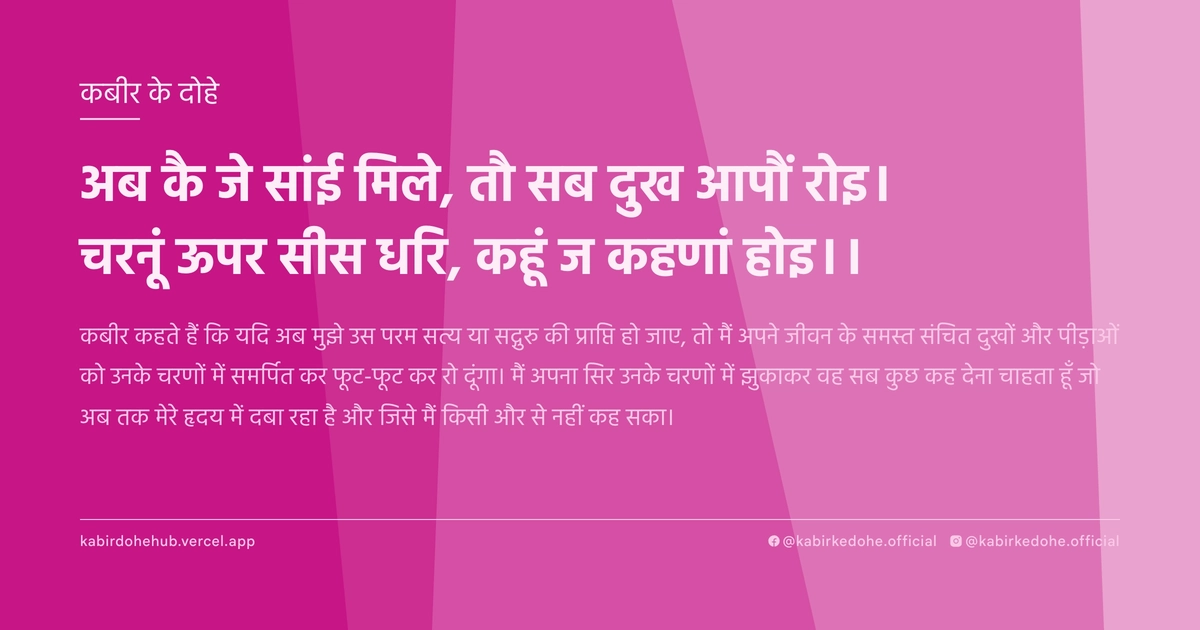
अब कै जे सांई मिले, तौ सब दुख आपौं रोइ।
चरनूं ऊपर सीस धरि, कहूं ज कहणां होइ।।
Ab kai je sai mile, tau sab dukh aapau roi. Charun upar sees dhari, kahun ja kahna hoye.
इस पृष्ठ पर इस कबीर दोहे का अर्थ (meaning), हिंदी व्याख्या और अंग्रेज़ी अनुवाद, दार्शनिक विश्लेषण और व्यावहारिक जीवन सीख दी गई है। यह दोहा प्रपत्ति (Surrender) विषय से जुड़ा है — Kabir doha meaning and explanation in Hindi and English.
अर्थ (Meaning):
कबीर कहते हैं कि यदि अब मुझे उस परम सत्य या सद्गुरु की प्राप्ति हो जाए, तो मैं अपने जीवन के समस्त संचित दुखों और पीड़ाओं को उनके चरणों में समर्पित कर फूट-फूट कर रो दूंगा। मैं अपना सिर उनके चरणों में झुकाकर वह सब कुछ कह देना चाहता हूँ जो अब तक मेरे हृदय में दबा रहा है और जिसे मैं किसी और से नहीं कह सका।
Kabir expresses a profound longing for the Divine or a true spiritual guide. He suggests that upon finding this ultimate Presence, he would release all his accumulated sorrows through tears of surrender. By bowing his head at the feet of the Master, he wishes to pour out every unspoken grief and secret longing that has burdened his soul in solitude.
व्याख्या (Interpretation):
यह दोहा पूर्ण समर्पण (शरणागति) की पराकाष्ठा है। 'सांई' यहाँ केवल एक व्यक्ति नहीं, बल्कि उस निर्गुण ब्रह्म का प्रतीक है जो गुरु के रूप में प्रकट होता है। सिर झुकाना अहंकार के विसर्जन का प्रतीक है। जब साधक का 'मैं' समाप्त होता है, तभी वह अपने वास्तविक दुखों को देख पाता है। यह दुख सांसारिक नहीं, बल्कि विरह का दुख है—आत्मा का परमात्मा से बिछड़ने का दर्द। यहाँ रोना कमजोरी नहीं, बल्कि हृदय का शुद्धिकरण है। यह अद्वैत वेदांत की उस स्थिति को दर्शाता है जहाँ द्वैत (मैं और तुम) समाप्त हो जाता है और केवल एक अनंत प्रेम शेष रहता है।
This couplet represents the pinnacle of total surrender (Prapatti). 'Saai' refers not merely to a person, but to the Formless Absolute (Nirgun Brahman) manifesting as a Guru. The act of bowing the head symbolizes the dissolution of the ego (Ahamkara). Only when the 'I' vanishes can the seeker perceive the true nature of their suffering. This sorrow is not mundane, but 'Viraha'—the existential ache of the soul separated from its Source. Here, weeping is not a sign of weakness but a spiritual catharsis. It mirrors the Advaita Vedanta realization where duality collapses, leaving only the resonance of infinite, non-dual love.
दार्शनिक विश्लेषण (Philosophical Analysis):
कबीर का यह दृष्टिकोण उनके युग के कर्मकांडीय धर्म के विरुद्ध एक सशक्त विद्रोह है। जहाँ उस समय लोग बाहरी तीर्थों और मूर्तियों में शांति खोज रहे थे, कबीर ने 'सांई' या आंतरिक गुरु के साथ एक व्यक्तिगत और भावनात्मक संबंध पर जोर दिया। यह सूफी मत के 'इश्क-ए-हकीकी' (ईश्वरीय प्रेम) से गहराई से प्रेरित है, जहाँ प्रेमी अपने प्रिय (ईश्वर) के सामने पूरी तरह नग्न और निस्सहाय हो जाता है।
दार्शनिक स्तर पर, यह दोहा 'अहं' के विलोपन की प्रक्रिया है। जब तक मनुष्य स्वयं को कर्ता मानता है, वह अपने दुखों का बोझ स्वयं ढोता है। लेकिन जब वह उस विराट सत्ता के चरणों में सिर रखता है, तो वह बोझ 'सांई' का हो जाता है। यह अद्वैत की वह स्थिति है जहाँ भक्त और भगवान एक हो जाते हैं।
कबीर यहाँ यह स्पष्ट करते हैं कि आध्यात्मिक प्रगति केवल ज्ञान या शास्त्रों के अध्ययन से नहीं, बल्कि हृदय के विरेचन (Emotional purging) से होती है। जब तक हृदय के भीतर दबी हुई पीड़ा बाहर नहीं निकलती, तब तक सत्य का प्रकाश प्रवेश नहीं कर सकता।
यह दोहा जाति और वर्ग की सीमाओं को तोड़ता है। एक जुलाहा होकर भी कबीर उस सार्वभौमिक सत्य की बात कर रहे हैं जो किसी मंदिर या मस्जिद का मोहताज नहीं है। यह 'सहज मार्ग' है, जहाँ प्रेम ही एकमात्र पात्रता है।
अंततः, यह विश्लेषण हमें बताता है कि वास्तविक मुक्ति बाहरी दुनिया को जीतने में नहीं, बल्कि अपने आंतरिक दुख को स्वीकार करने और उसे परमात्मा में विलीन करने में है। यह मनोवैज्ञानिक रूपांतरण की वह प्रक्रिया है जहाँ शोक, आनंद में बदल जाता है।
Kabir's perspective is a powerful rebellion against the ritualistic religion of his era. While contemporaries sought peace in external pilgrimages and idols, Kabir emphasized a personal, visceral connection with the 'Saai' or the Inner Guru. This is deeply influenced by the Sufi concept of 'Ishq-e-Haqiqi' (Divine Love), where the lover becomes completely vulnerable and stripped of pretense before the Beloved.
Philosophically, this couplet describes the process of the annihilation of the ego. As long as a human perceives themselves as the 'doer' (Karta), they carry the burden of their suffering alone. However, by placing the head at the feet of the Absolute, that burden is transferred. This aligns with Advaita's non-duality, where the distinction between the seeker and the Sought evaporates.
Kabir clarifies that spiritual evolution occurs not through intellectual mastery of scriptures, but through emotional catharsis. Until the suppressed agony of the heart is released, the light of Truth cannot penetrate the consciousness. The 'tears' mentioned are the solvent that dissolves the crust of the ego.
Furthermore, this teaching transcends caste and social hierarchy. As a weaver, Kabir speaks of a universal truth that requires no temple or mosque. This is the 'Sahaja Marg' (the Natural Path), where love is the only prerequisite for entry into the Divine presence.
Ultimately, this analysis reveals that true liberation is not found in conquering the external world, but in acknowledging one's internal fragmentation and merging it into the Whole. It is a psychological transformation where profound grief is transmuted into spiritual ecstasy.
मूल संदेश (Core Message):
- अहंकार का अंत ही वास्तविक मिलन की पहली शर्त है।
- आँसू केवल पानी नहीं, बल्कि आत्मा की शुद्धि का मार्ग हैं।
- सच्चा गुरु वह है जो आपके दुख को अपना ले।
- मौन समर्पण शब्दों की सभी सीमाओं को पार कर जाता है।
- जब 'मैं' मिटता है, तभी 'सांई' का अनुभव होता है।
- The end of ego is the primary condition for Divine union.
- Tears are not mere water, but the path to spiritual purification.
- A true Master is one who absorbs your suffering into their own.
- Silent surrender transcends all limitations of language.
- Only when the 'I' vanishes does the 'Saai' become manifest.
व्यावहारिक उदाहरण (Practical Example):
एक समय की बात है, वाराणसी के घाटों पर एक वृद्ध विधवा रहती थी, जिसका नाम जानकी था। जानकी ने अपना पूरा जीवन समाज की कठोर मर्यादाओं और अकेलेपन के बोझ तले बिताया था। उसने अपने पति और पुत्र को खो दिया था और समाज ने उसे केवल एक 'अशुभ' साया मान लिया था। वह हर दिन गंगा किनारे बैठती, लेकिन उसके मन में शांति नहीं, बल्कि वर्षों का संचित क्रोध और दुख था।
वह अक्सर लोगों को देखती जो पूजा-पाठ कर रहे थे, लेकिन उसे लगता था कि यह सब ढोंग है। उसके भीतर एक चीख थी जिसे उसने दशकों से दबा रखा था। वह किसी से बात नहीं करती थी क्योंकि उसे लगता था कि दुनिया उसकी पीड़ा को नहीं समझेगी।
एक दिन, घाट की सीढ़ियों पर एक फकीर बैठा था, जिसकी आँखों में एक अजीब सी गहराई और करुणा थी। वह कोई उपदेश नहीं दे रहा था, बस मौन बैठा था। जानकी उसके पास से गुजरी, और अचानक उसकी नजर फकीर की शांत आँखों से मिली। उस एक क्षण में, जानकी को महसूस हुआ कि यह व्यक्ति उसे देख रहा है—न कि एक विधवा के रूप में, बल्कि एक तड़पती हुई आत्मा के रूप में।
जानकी के भीतर कुछ टूट गया। वह अचानक उस फकीर के चरणों में गिर पड़ी। वह चिल्लाई नहीं, लेकिन उसकी आँखों से आंसुओं का सैलाब उमड़ पड़ा। वह उन सभी बातों को कहने लगी जो उसने कभी किसी से नहीं कही थीं—अपनी उपेक्षा, अपना अकेलापन, और वह गहरा शून्य जो उसके जीवन में था।
वह घंटों रोती रही, अपने जीवन की हर कड़वाहट को उन चरणों में बहा देती रही। फकीर ने उसे कुछ नहीं कहा, बस उसका सिर अपने हाथों से सहलाता रहा। उस मौन स्वीकृति में जानकी को वह 'सांई' मिल गया जिसकी उसे तलाश थी।
जब वह उठी, तो उसका चेहरा बदल चुका था। वह बोझ जो उसने दशकों से ढोया था, अब गायब था। उसने महसूस किया कि उसका दुख अब उसका अपना नहीं रहा, बल्कि वह उस विराट करुणा में विलीन हो गया है।
जानकी ने अब दूसरों के प्रति अपनी कड़वाहट छोड़ दी। वह अब घाट पर आने वाले अन्य दुखी लोगों की बात सुनने लगी। उसने पाया कि जब हम अपना दुख स्वीकार कर उसे समर्पित कर देते हैं, तो हम दूसरों के दुख को समझने के योग्य बन जाते हैं।
उसका जीवन अब भी सरल था, लेकिन वह अब 'अकेली' नहीं थी। वह उस आंतरिक शांति के साथ जी रही थी जिसे उसने समर्पण के आंसुओं से खरीदा था। यह जानकी का 'कबीर मोड़' था—जहाँ उसने अपनी पहचान एक 'पीड़ित' से बदलकर एक 'साक्षी' की बना ली।
Once, on the ghats of Varanasi, lived an elderly widow named Janaki. Janaki had spent her entire life under the crushing weight of rigid social norms and profound loneliness. Having lost both her husband and son, society viewed her merely as an 'inauspicious' shadow. Every day she sat by the Ganges, but her heart held no peace—only decades of accumulated anger and sorrow.
She watched people performing elaborate rituals, but to her, it all seemed like a facade. Inside her was a scream that she had suppressed for years. She spoke to no one, believing the world was incapable of understanding her agony.
One day, a fakir sat on the stone steps of the ghat, his eyes possessing a strange depth and compassion. He was not preaching; he was simply existing in silence. As Janaki passed by, her gaze met his. In that single moment, Janaki felt that this man truly saw her—not as a widow, but as a suffering soul.
Something within Janaki snapped. She suddenly collapsed at the fakir's feet. She didn't scream, but a torrent of tears erupted from her eyes. She began to pour out everything she had never told anyone—the neglect, the isolation, and the profound void that had consumed her life.
She wept for hours, washing away every bitterness of her existence at those feet. The fakir said nothing; he simply stroked her head with his hands. In that silent acceptance, Janaki found the 'Saai' she had been unconsciously seeking.
When she finally stood up, her countenance had transformed. The burden she had carried for decades had vanished. She felt that her sorrow was no longer hers alone, but had merged into a vast, cosmic compassion.
Janaki ceased her bitterness toward others. She began to listen to the other grieving souls who came to the ghats. She discovered that once we accept our pain and surrender it, we become capable of holding the pain of others.
Her life remained simple, but she was no longer 'alone.' She lived with an internal peace bought through the tears of surrender. This was Janaki's 'Kabir Twist'—where she shifted her identity from a 'victim' to a 'witness.'
अभ्यास मार्गदर्शन (Practice Guidance):
- प्रतिदिन 20 मिनट मौन बैठें और अपने भीतर के उन दुखों को पहचानें जिन्हें आपने दुनिया से छिपाया है। उन्हें दबाएँ नहीं, बल्कि उन्हें महसूस करें।
- एक 'भावनात्मक पत्रिका' (Emotional Journal) लिखें। इसमें वह सब लिखें जो आप किसी इंसान से नहीं कह सकते। अंत में लिखें: 'मैं इसे उस परम सत्ता को समर्पित करता हूँ'।
- अभ्यास करें कि जब आप किसी के सामने झुकते हैं, तो वह केवल शारीरिक क्रिया न हो, बल्कि अपने अहंकार के एक छोटे से हिस्से को विसर्जित करने का प्रयास हो।
- निदान चेकलिस्ट: क्या आप अभी भी अपनी समस्याओं के लिए दूसरों को दोष दे रहे हैं? क्या आप अपने दुख को अपनी पहचान (Identity) बना चुके हैं? यदि हाँ, तो आप अभी भी 'अहं' में हैं और समर्पण की प्रक्रिया से दूर हैं।
- Sit in silence for 20 minutes daily and identify the sorrows you have hidden from the world. Do not suppress them; feel them fully in your body.
- Maintain an 'Emotional Journal.' Write everything you cannot say to any human being. Conclude each entry with: 'I surrender this to the Ultimate Presence.'
- Practice the act of bowing—not as a physical gesture, but as a conscious effort to dissolve a small piece of your ego each time.
- Diagnostic Checklist: Are you still blaming others for your problems? Have you turned your suffering into your primary identity? If yes, you are still operating from the ego and are distant from the process of surrender.
चिंतन प्रश्न (Reflection Questions):
- वह कौन सा दुख है जिसे आप दुनिया के सामने 'मजबूत' दिखने के लिए छिपा रहे हैं?
- क्या आपका 'दुख' वास्तव में आपकी पीड़ा है, या यह आपकी ईगो को विशेष बनाने का एक तरीका है?
- यदि आज आपको वह पूर्ण स्वीकृति मिल जाए, तो क्या आप वास्तव में अपना अहंकार छोड़ने को तैयार हैं?
- आपकी डिजिटल पहचान (Social Media) आपके वास्तविक आंतरिक शून्य को कितना ढक रही है?
- क्या आप किसी ऐसे व्यक्ति को क्षमा कर सकते हैं जिसने आपको वह दुख दिया जिसे आप आज समर्पित करना चाहते हैं?
- What is the specific sorrow you hide in order to appear 'strong' to the world?
- Is your suffering truly pain, or has it become a tool for your ego to feel unique or special?
- If you were granted absolute acceptance today, would you actually be willing to let go of your ego?
- To what extent does your digital persona mask the actual internal void you carry?
- Can you forgive the person who caused the very pain you now wish to surrender?