
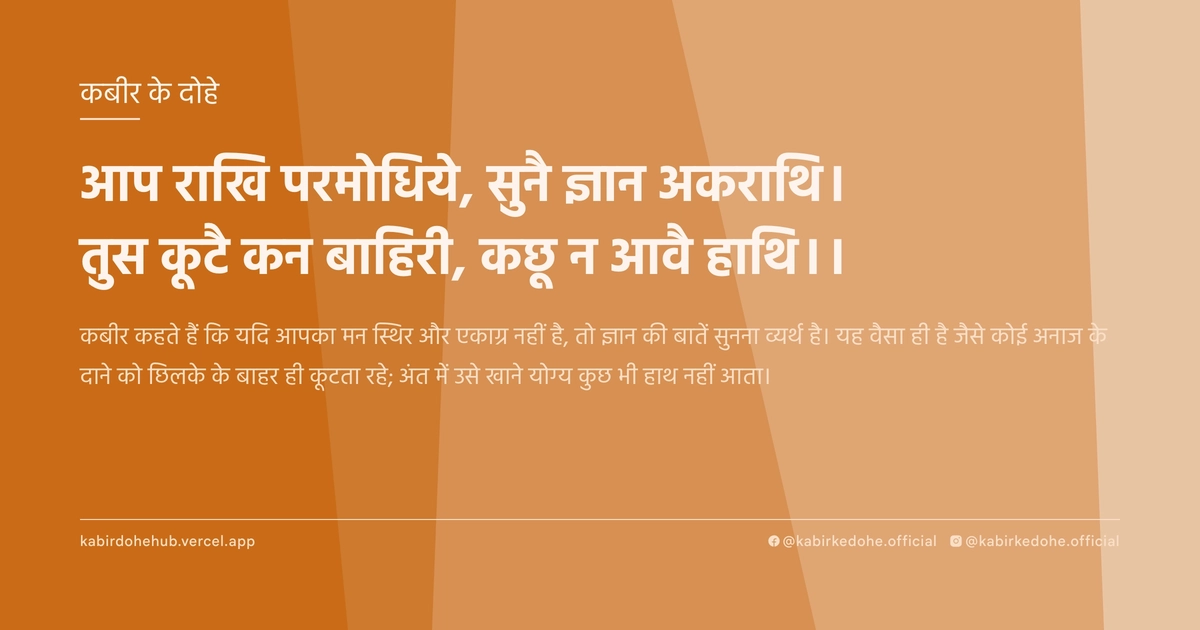
आप राखि परमोधिये, सुनै ज्ञान अकराथि।
तुस कूटै कन बाहिरी, कछू न आवै हाथि।।
Aap rakhi paramodhiye, sunai gyaan akrathi. Tus kootai kan bahiri, kachhu na aavai haathi.
इस पृष्ठ पर इस कबीर दोहे का अर्थ (meaning), हिंदी व्याख्या और अंग्रेज़ी अनुवाद, दार्शनिक विश्लेषण और व्यावहारिक जीवन सीख दी गई है। यह दोहा आत्मनिरीक्षण (Self-introspection) विषय से जुड़ा है — Kabir doha meaning and explanation in Hindi and English.
अर्थ (Meaning):
कबीर कहते हैं कि यदि आपका मन स्थिर और एकाग्र नहीं है, तो ज्ञान की बातें सुनना व्यर्थ है। यह वैसा ही है जैसे कोई अनाज के दाने को छिलके के बाहर ही कूटता रहे; अंत में उसे खाने योग्य कुछ भी हाथ नहीं आता।
Kabir asserts that if the mind is not centered and stabilized, listening to spiritual wisdom is futile. It is akin to pounding a grain of corn from the outside of its husk; despite the effort, nothing nourishing or useful is ever obtained.
व्याख्या (Interpretation):
इस दोहे में कबीर बाहरी आडंबर और आंतरिक तैयारी के बीच के विरोधाभास को दर्शाते हैं। 'परमोधिये' यहाँ उस मानसिक स्थिरता का संकेत है जो सत्य को ग्रहण करने के लिए आवश्यक है। शाब्दिक अर्थ में, वे अनाज कूटने की प्रक्रिया का उदाहरण देते हैं, लेकिन आध्यात्मिक स्तर पर, 'कन' (दाना) आत्मा है और 'बाहिरी' (बाहर) अहंकार या माया है। जब तक साधक अपने अहंकार के खोल को नहीं तोड़ता, तब तक ज्ञान केवल शब्दों का शोर बनकर रह जाता है। यह निर्गुण भक्ति का मूल है—जहाँ सत्य बाहर नहीं, बल्कि भीतर की गहराई में स्थित है। अद्वैत वेदांत के अनुसार, जब तक ज्ञाता और ज्ञेय के बीच का भेद (माया) बना रहता है, तब तक वास्तविक बोध संभव नहीं है।
In this couplet, Kabir highlights the paradox between external ritual and internal readiness. 'Paramodhiye' signifies the mental stability required to absorb truth. Literally, he uses the metaphor of pounding grain, but spiritually, the 'grain' represents the Atman (Soul) and the 'exterior' represents the ego or Maya. Until the seeker breaks the husk of the ego, knowledge remains mere noise. This is the essence of Nirgun Bhakti—where truth resides not in external forms, but in internal depth. According to Advaita Vedanta, as long as the illusion of duality persists between the knower and the known, true realization remains unattainable. The paradox is that we seek the truth through words, while the truth is found only in the silence of a stabilized mind.
दार्शनिक विश्लेषण (Philosophical Analysis):
कबीर का यह दोहा उस युग की प्रतिक्रिया है जहाँ धर्म केवल कर्मकांडों और शास्त्र-पाठ तक सीमित हो गया था। उन्होंने स्पष्ट किया कि केवल ग्रंथों को पढ़ना या उपदेश सुनना मोक्ष का मार्ग नहीं है। यह दृष्टिकोण सूफीवाद के 'इश्क' और 'फना' के करीब है, जहाँ प्रेमी को स्वयं को मिटाना पड़ता है ताकि वह परमात्मा में विलीन हो सके।
यहाँ कबीर 'अहंकार' को उस छिलके की तरह देखते हैं जो सत्य को ढकता है। जब तक व्यक्ति अपनी सामाजिक पहचान, जाति या धार्मिक श्रेष्ठता के गर्व में रहता है, वह ज्ञान को केवल बौद्धिक स्तर पर ग्रहण करता है, अनुभव स्तर पर नहीं। यह बौद्धिक ज्ञान एक बोझ बन जाता है, न कि मुक्ति का साधन।
अद्वैत वेदांत के परिप्रेक्ष्य में, यह दोहा 'माया' के प्रभाव की व्याख्या करता है। माया वह पर्दा है जो हमें यह विश्वास दिलाता है कि हम शरीर या मन हैं। जब तक यह भ्रम बना रहता है, तब तक कोई भी गुरु या शास्त्र हमें सत्य नहीं दिखा सकता, क्योंकि हम सत्य को 'बाहर' खोज रहे होते हैं।
मनोवैज्ञानिक रूप से, कबीर 'संज्ञानात्मक विसंगति' की बात कर रहे हैं। जब हमारा आंतरिक स्वभाव (अहंकार) हमारे द्वारा सुने गए ज्ञान (विनम्रता) के विपरीत होता है, तो ज्ञान आत्मसात नहीं होता। वह केवल स्मृति में रहता है, चरित्र में नहीं।
अंततः, कबीर का संदेश यह है कि साधना का पहला चरण 'सुनना' नहीं, बल्कि 'तैयार होना' है। तैयारी का अर्थ है—चित्त की शुद्धि और अहंकार का विसर्जन। बिना इस आंतरिक रूपांतरण के, आध्यात्मिक यात्रा केवल एक बौद्धिक व्यायाम है जिसका कोई वास्तविक फल नहीं मिलता।
Kabir’s couplet is a reaction to an era where religion had become confined to rituals and the rote recitation of scriptures. He clarifies that merely reading texts or listening to sermons is not the path to liberation. This perspective aligns closely with the Sufi concepts of 'Ishq' (divine love) and 'Fana' (annihilation), where the seeker must erase the self to merge with the Divine.
Kabir views the 'ego' as the husk that conceals the truth. As long as an individual clings to social identity, caste, or religious superiority, they absorb knowledge only intellectually, not experientially. Such knowledge becomes a burden rather than a vehicle for liberation.
From the lens of Advaita Vedanta, this verse explains the influence of 'Maya'. Maya is the veil that convinces us we are the body or the mind. As long as this illusion persists, no guru or scripture can reveal the truth, because the seeker is searching for truth 'outside' themselves.
Psychologically, Kabir is addressing cognitive dissonance. When our internal disposition (ego) contradicts the knowledge we hear (humility), the wisdom is not assimilated; it remains in the memory but does not penetrate the character.
Ultimately, Kabir’s message is that the first step of spiritual practice is not 'listening,' but 'becoming ready.' Readiness means the purification of the consciousness and the dissolution of the ego. Without this internal transformation, the spiritual journey is merely an intellectual exercise with no tangible fruit.
मूल संदेश (Core Message):
- अहंकार वह पर्दा है जो ज्ञान को अनुभव बनने से रोकता है।
- बिना आंतरिक तैयारी के, आध्यात्मिक श्रवण केवल मानसिक मनोरंजन है।
- सत्य शब्दों में नहीं, बल्कि अहंकार के विसर्जन में निहित है।
- बाहरी धार्मिकता अक्सर आंतरिक शून्यता को छिपाने का एक तरीका होती है।
- जब 'मैं' मिटता है, तभी 'वह' (परमात्मा) प्रकट होता है।
- Ego is the veil that prevents knowledge from becoming a lived experience.
- Without internal readiness, spiritual listening is merely mental entertainment.
- Truth resides not in words, but in the dissolution of the self.
- External religiosity is often a mask to hide internal emptiness.
- Only when the 'I' vanishes does the 'Divine' manifest.
व्यावहारिक उदाहरण (Practical Example):
वाराणसी के घाटों पर रहने वाली एक वृद्ध विधवा, जानकी, का जीवन केवल पूजा-पाठ और शास्त्रों के श्रवण में बीतता था। वह प्रतिदिन बड़े विद्वानों के प्रवचन सुनती और स्वयं को बहुत धार्मिक मानती थी।
वह अक्सर दूसरों को उनके पापों का एहसास कराती और उन्हें बताती कि कैसे वे धर्म के मार्ग से भटक गए हैं। उसका ज्ञान उसके शब्दों में तो था, लेकिन उसके व्यवहार में कठोरता थी।
एक दिन, घाट की सीढ़ियों पर एक छोटा बच्चा भूख से रो रहा था। जानकी ने उसे देखा, लेकिन अपने मन में सोचा कि यह बच्चा किसी अशुद्ध कुल का होगा और इसे छूना धर्म के विरुद्ध है।
तभी उसकी नज़र एक साधारण से साधु पर पड़ी, जो बिना किसी शास्त्र के, केवल उस बच्चे को अपनी रोटी खिला रहे थे और उसके आंसू पोंछ रहे थे।
उस साधु ने जानकी की ओर देखा और मुस्कुराते हुए कहा, 'माता, आप शब्दों के दाने कूट रही हैं, लेकिन भूख का सच तो इस बच्चे की आँखों में है।'
यह वाक्य जानकी के हृदय पर प्रहार कर गया। उसे अचानक महसूस हुआ कि वर्षों से सुने गए उपदेश केवल उसके अहंकार की परतें बढ़ा रहे थे।
उसने महसूस किया कि वह 'बाहरी छिलके' को कूट रही थी—यानी वह केवल धार्मिक होने का ढोंग कर रही थी, जबकि उसके भीतर करुणा का अभाव था।
उस दिन जानकी ने पहली बार अपनी किताबों और प्रवचनों को किनारे रखा और उस बच्चे का हाथ पकड़कर उसे भोजन कराने ले गई।
उसका अहंकार टूट गया और उसने पाया कि वास्तविक ज्ञान सुनने में नहीं, बल्कि दूसरे के दुख को महसूस करने और उसे दूर करने में है।
जानकी का जीवन अब शास्त्रों के रटने से बदलकर सेवा के मौन संगीत में परिवर्तित हो गया, और उसे वह शांति मिली जो हज़ारों प्रवचनों में नहीं मिली थी।
Janaki, an elderly widow living on the ghats of Varanasi, spent her life immersed in rituals and listening to scriptures. She attended discourses by great scholars daily and considered herself deeply religious.
She often pointed out the sins of others, lecturing them on how they had strayed from the path of righteousness. Her knowledge existed in her words, but her behavior remained rigid and harsh.
One day, a small child was crying from hunger on the steps of the ghat. Janaki saw him but thought to herself that the child must belong to an 'impure' lineage and touching him would be against her religious purity.
Just then, she noticed a simple monk who, without reciting any scripture, was simply sharing his bread with the child and wiping away his tears.
The monk looked at Janaki and smiled, saying, 'Mother, you are pounding the grains of words, but the truth of hunger lies in this child's eyes.'
This sentence struck Janaki’s heart like a bolt of lightning. She suddenly realized that the sermons she had heard for years were only thickening the layers of her ego.
She understood that she had been pounding the 'outer husk'—pretending to be religious while lacking actual compassion within.
That day, for the first time, Janaki set aside her books and discourses and took the child's hand to feed him.
Her ego shattered, and she discovered that true knowledge is not in listening, but in feeling another's pain and acting to alleviate it.
Janaki's life transformed from the rote memorization of texts to the silent music of service, finding a peace that thousands of sermons had never provided.
अभ्यास मार्गदर्शन (Practice Guidance):
- प्रतिदिन 20 मिनट मौन का अभ्यास करें। शब्दों को सुनने के बजाय, अपने भीतर उठने वाले विचारों के शोर को देखें।
- आत्म-पूछताछ जर्नल: लिखें कि आज मैंने किस बात पर गर्व महसूस किया और वह गर्व मेरे और सत्य के बीच कैसे बाधा बना।
- व्यवहार परिवर्तन: किसी ऐसे व्यक्ति की मदद करें जिसे आप नापसंद करते हैं, ताकि आपके भीतर का 'श्रेष्ठता का भाव' (Ego) टूट सके।
- निदान चेकलिस्ट: क्या मैं ज्ञान का उपयोग दूसरों को नीचा दिखाने के लिए कर रहा हूँ? क्या मेरी आध्यात्मिक चर्चाएं मेरे व्यवहार में विनम्रता ला रही हैं? यदि नहीं, तो मैं केवल 'छिलके' कूट रहा हूँ।
- Practice 20 minutes of absolute silence daily. Instead of listening to words, observe the noise of the thoughts arising within you.
- Self-Inquiry Journal: Record moments where you felt a sense of superiority and analyze how that pride acted as a barrier between you and the truth.
- Behavioral Shift: Perform an act of selfless service for someone you personally dislike to consciously break the 'sense of superiority' (Ego).
- Diagnostic Checklist: Am I using my knowledge to belittle others? Is my spiritual discourse translating into humility in my behavior? If not, I am merely pounding the 'husk'.
चिंतन प्रश्न (Reflection Questions):
- क्या मेरा आध्यात्मिक ज्ञान मुझे अधिक विनम्र बना रहा है, या मुझे दूसरों से श्रेष्ठ होने का एक नया आधार दे रहा है?
- मेरे जीवन का वह कौन सा 'छिलका' (पहचान, पद, धर्म) है जिसे मैं पकड़े हुए हूँ और जो मुझे सत्य देखने से रोक रहा है?
- जब मैं किसी को उपदेश देता हूँ, तो क्या मैं वास्तव में उसकी मदद करना चाहता हूँ या अपनी बौद्धिक श्रेष्ठता सिद्ध करना चाहता हूँ?
- यदि मुझसे मेरी सभी धार्मिक और बौद्धिक पहचान छीन ली जाए, तो मेरे भीतर क्या बचेगा?
- क्या मैं सत्य को खोज रहा हूँ, या मैं केवल उस सत्य की पुष्टि करना चाहता हूँ जिसे मैं पहले से सही मानता हूँ?
- Is my spiritual knowledge making me more humble, or is it providing a new foundation for me to feel superior to others?
- What is the 'husk' (identity, status, religion) in my life that I am clinging to, which prevents me from seeing the truth?
- When I give advice to others, do I truly want to help them, or am I seeking to validate my own intellectual superiority?
- If all my religious and intellectual identities were stripped away, what would remain within me?
- Am I searching for the truth, or am I merely seeking confirmation of the truth I already believe in?