
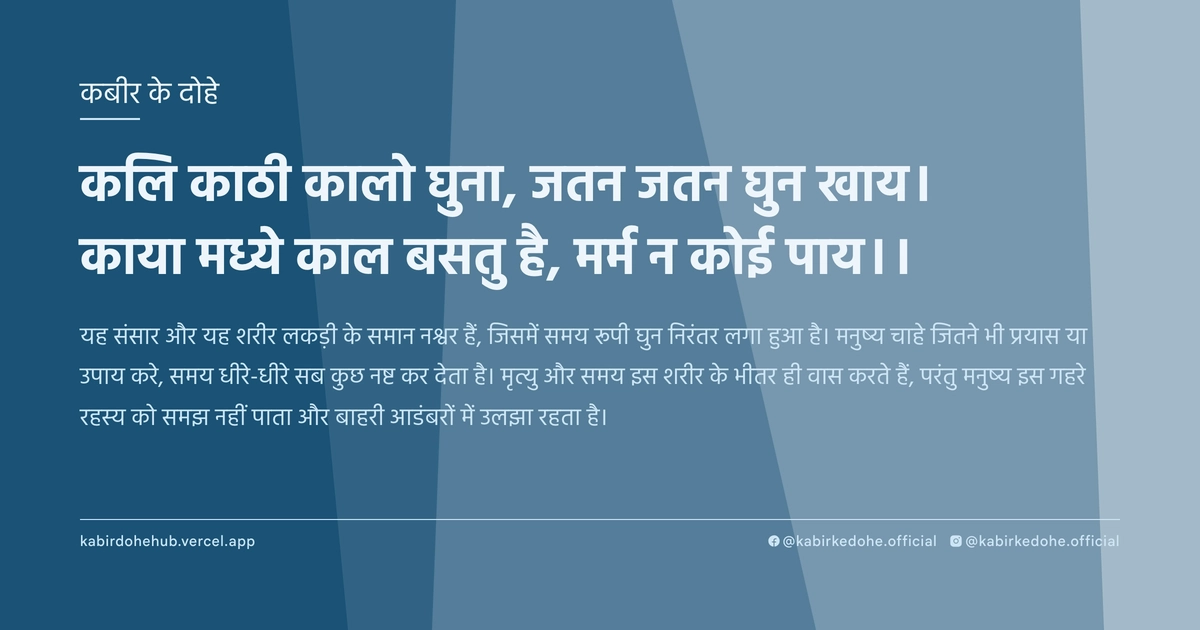
कलि काठी कालो घुना, जतन जतन घुन खाय।
काया मध्ये काल बसतु है, मर्म न कोई पाय।।
Kali kaathi kaalo ghuna, jatan jatan ghun khaye. Kaya madhye kaal basatu hai, marm na koi paaye.
इस पृष्ठ पर इस कबीर दोहे का अर्थ (meaning), हिंदी व्याख्या और अंग्रेज़ी अनुवाद, दार्शनिक विश्लेषण और व्यावहारिक जीवन सीख दी गई है। यह दोहा मृतुक्यता (Mortality) विषय से जुड़ा है — Kabir doha meaning and explanation in Hindi and English.
अर्थ (Meaning):
यह संसार और यह शरीर लकड़ी के समान नश्वर हैं, जिसमें समय रूपी घुन निरंतर लगा हुआ है। मनुष्य चाहे जितने भी प्रयास या उपाय करे, समय धीरे-धीरे सब कुछ नष्ट कर देता है। मृत्यु और समय इस शरीर के भीतर ही वास करते हैं, परंतु मनुष्य इस गहरे रहस्य को समझ नहीं पाता और बाहरी आडंबरों में उलझा रहता है।
This world and the physical body are like a piece of wood infested by the termite of Time. No matter how many precautions or efforts one makes, the termite of decay relentlessly consumes everything. Death and Time reside within the very core of our existence, yet the secret of this impermanence remains hidden from the oblivious human mind.
व्याख्या (Interpretation):
कबीर यहाँ शरीर की तुलना 'काठी' (लकड़ी) से और समय को 'घुन' (दीमक) से करते हैं। शाब्दिक अर्थ यह है कि जैसे दीमक लकड़ी को अंदर ही अंदर खोखला कर देती है, वैसे ही काल हमारे जीवन को क्षीण करता है। आध्यात्मिक स्तर पर, यह 'माया' के प्रभाव का वर्णन है जो हमें यह विश्वास दिलाता है कि हम अमर हैं। यह निर्गुण भक्ति का संकेत है जहाँ साधक को यह बोध होता है कि केवल आत्मा अविनाशी है, जबकि यह भौतिक ढांचा क्षणभंगुर है। अद्वैत वेदांत के अनुसार, जब तक हम स्वयं को इस 'काठी' या शरीर से जोड़कर देखते हैं, हम काल के अधीन रहते हैं। जिस क्षण हम अपनी पहचान ब्रह्म या शुद्ध चेतना से करते हैं, हम समय के इस चक्र से मुक्त हो जाते हैं। यह विरोधाभास है कि जिसे हम अपना 'घर' (शरीर) कहते हैं, वही हमारी मृत्यु का निवास स्थान है।
Kabir employs a potent metaphor, comparing the human body to 'kathi' (wood) and Time to 'ghun' (termites). Literally, just as termites hollow out wood from within, Time relentlessly erodes our physical existence. Metaphorically, this illustrates the grip of 'Maya' (illusion), which blinds us to our own transience. In the context of Nirgun Bhakti, this serves as a wake-up call to shift focus from the perishable body to the imperishable Soul. According to Advaita Vedanta, suffering arises from the false identification of the Self with the physical form; once the realization of Atman-Brahman non-duality occurs, one transcends the linear constraints of time. The central paradox presented is that the very vessel we cherish as our identity is the primary site of our decay. To find the 'marm' (secret) is to realize that the eternal dwells within the ephemeral.
दार्शनिक विश्लेषण (Philosophical Analysis):
कबीर का यह दोहा उस युग की उपज है जहाँ कर्मकांड और बाहरी दिखावे चरम पर थे। उन्होंने देखा कि लोग तीर्थयात्राओं और कठिन उपवासों के माध्यम से मृत्यु पर विजय पाना चाहते थे, जबकि मृत्यु उनके भीतर ही सांस ले रही थी। कबीर का प्रहार उन धार्मिक पाखंडों पर है जो यह दावा करते हैं कि बाहरी अनुष्ठानों से जीवन बढ़ाया जा सकता है। वे स्पष्ट करते हैं कि शरीर की नश्वरता एक सार्वभौमिक सत्य है जिसे कोई भी जाति, धर्म या सामाजिक स्तर नहीं बदल सकता।
दार्शनिक रूप से, यह विचार सूफी मत के 'फना' (अहंकार का विनाश) के करीब है। जब तक मनुष्य का 'मैं' या अहंकार जीवित है, वह समय के डर में जीता है। कबीर सिखाते हैं कि अहंकार का विसर्जन ही वास्तविक मुक्ति है। यदि हम स्वयं को शरीर मानते हैं, तो हम घुन के शिकार हैं; यदि हम स्वयं को चेतना मानते हैं, तो हम समय के स्वामी हैं।
अद्वैत वेदांत के परिप्रेक्ष्य में, यह दोहा 'विवेक' (भेद करने की क्षमता) को जागृत करता है। यह शरीर और आत्मा के बीच के अंतर को स्पष्ट करता है। कबीर यहाँ यह तर्क दे रहे हैं कि सत्य की खोज बाहर नहीं, बल्कि भीतर है, लेकिन वह खोज शरीर की नहीं, बल्कि उस तत्व की होनी चाहिए जो शरीर के नष्ट होने के बाद भी शेष रहता है।
मनोवैज्ञानिक स्तर पर, यह दोहा मृत्यु की अनिवार्यता को स्वीकार करने का आह्वान है। जब मनुष्य मृत्यु के भय को स्वीकार कर लेता है, तब वह वास्तव में जीना शुरू करता है। यह 'Memento Mori' का एक भारतीय संस्करण है, जो हमें वर्तमान क्षण की मूल्यवानता समझाता है।
अंततः, कबीर का संदेश यह है कि समय का क्षय केवल शरीर का नहीं, बल्कि हमारी अज्ञानता का भी होना चाहिए। यदि हम समय के साथ अपनी वासनाओं और अहंकार को नष्ट कर सकें, तो हम उस 'मर्म' को पा लेंगे जिसे दुनिया अनदेखा कर देती है।
This couplet emerges from an era dominated by rigid ritualism and external displays of piety. Kabir observed people seeking immortality through pilgrimages and severe penances, oblivious to the fact that decay was already operating within them. His critique is aimed at the religious hypocrisy that suggests external rituals can circumvent the biological and cosmic law of death. He asserts that impermanence is a universal equalizer, transcending caste, creed, and social hierarchy.
Philosophically, this aligns with the Sufi concept of 'Fana'—the annihilation of the ego. As long as the 'I' persists, the individual remains a prisoner of time. Kabir suggests that the dissolution of the ego is the only path to liberation. If one identifies as the body, they are merely fuel for the termite of time; if they identify as pure consciousness, they transcend the temporal cycle.
From the lens of Advaita Vedanta, the doha invokes 'Viveka' (discernment). It forces a sharp distinction between the 'Anatman' (the non-self/body) and the 'Atman' (the eternal self). Kabir argues that the search for truth is not an outward journey but an inward realization—not of the physical organs, but of the timeless essence that persists beyond the body's collapse.
Psychologically, this is a call to embrace the inevitability of death. By confronting the reality of decay, the seeker is stripped of superficial attachments, allowing a more authentic existence to emerge. It is a profound exercise in 'Memento Mori,' urging the practitioner to value the present moment over the illusion of a permanent future.
Ultimately, Kabir suggests that while the body must succumb to time, our ignorance must also be eroded. If we can use the passage of time to wear away our desires and ego, we uncover the 'marm'—the secret of eternal existence hidden within the transient shell.
मूल संदेश (Core Message):
- शरीर एक अस्थायी वस्त्र है, इसे स्थायी घर न समझें।
- समय सबसे बड़ा भक्षक है, इससे केवल जागरूकता से बचा जा सकता है।
- बाहरी अनुष्ठान मृत्यु के सत्य को नहीं बदल सकते।
- अहंकार का विनाश ही वास्तविक अमरता का मार्ग है।
- आत्मा समय की सीमाओं से परे, शुद्ध चेतना है।
- The body is a temporary garment; do not mistake it for a permanent home.
- Time is the ultimate consumer; only awareness provides a sanctuary.
- External rituals cannot alter the fundamental truth of mortality.
- The annihilation of the ego is the only gateway to true immortality.
- The Soul is pure consciousness, existing beyond the constraints of time.
व्यावहारिक उदाहरण (Practical Example):
वाराणसी के घाटों पर रहने वाले एक वृद्ध बुनकर थे, जिनका नाम माधव था। माधव अपनी कला में इतने निपुण थे कि उनके बनाए कपड़ों की मांग दूर-दूर तक थी। उन्होंने अपना पूरा जीवन इस विश्वास में बिताया कि उनकी कला उन्हें अमर बना देगी और उनका नाम इतिहास में दर्ज रहेगा। वे दिन-रात केवल अपनी संपत्ति बढ़ाने और अपने परिवार के लिए एक विशाल हवेली बनाने में लगे रहे, यह सोचकर कि यह उनकी स्थायी पहचान होगी।
जैसे-जैसे समय बीता, माधव के हाथों में कंपन आने लगा। जिस करघे पर उन्होंने दशकों तक जादू चलाया था, अब वह उन्हें बोझ लगने लगा। एक दिन उन्होंने देखा कि उनकी हवेली की दीवारों में दीमक लग गई थी और उनके महंगे रेशमी कपड़ों को घुन खा रहा था। अचानक उन्हें अहसास हुआ कि जिस 'स्थायित्व' के पीछे वे भाग रहे थे, वह वास्तव में रेत के महल जैसा था।
उसी शाम, उन्होंने एक युवा साधु को देखा जो केवल एक फटे हुए कपड़े में था, लेकिन उसके चेहरे पर एक असीम शांति थी। माधव ने उनसे पूछा, "मैंने सब कुछ संचित किया, फिर भी मैं खाली हूँ। आपने कुछ नहीं कमाया, फिर भी आप पूर्ण हैं। ऐसा क्यों?"
साधु ने मुस्कुराते हुए कहा, "आप उस लकड़ी को बचाने की कोशिश कर रहे थे जिसे घुन खाना ही था। मैंने उस घुन को ही अपना गुरु बना लिया, जिसने मुझे सिखाया कि जो नष्ट हो सकता है, वह मेरा कभी था ही नहीं।"
यह 'कबीर ट्विस्ट' था। माधव को समझ आया कि उनकी पूरी पहचान उनके काम और संपत्ति से जुड़ी थी, जो कि 'काठी' के समान थी। उन्होंने महसूस किया कि उन्होंने जीवन भर बाहरी दीवारों को सजाया, लेकिन अपने भीतर के शून्य को कभी नहीं देखा।
अगले दिन से माधव का व्यवहार बदल गया। उन्होंने अपनी संपत्ति का बड़ा हिस्सा गरीबों और अनाथों के लिए समर्पित कर दिया। अब वे कपड़े इसलिए नहीं बुनते थे कि उनका नाम अमर हो, बल्कि इसलिए कि वे उस प्रक्रिया में स्वयं को विलीन कर सकें।
उनकी चिंता अब इस बात पर नहीं थी कि उनकी हवेली कितनी टिकेगी, बल्कि इस पर थी कि उनका हृदय कितना शुद्ध होगा। उन्होंने अपनी कला को एक साधना बना लिया, जहाँ हर धागा उन्हें ईश्वर की याद दिलाता था।
जब माधव का अंतिम समय आया, तो उनके चेहरे पर कोई भय नहीं था। उन्होंने अपनी आँखों में एक चमक के साथ कहा, "घुन ने लकड़ी तो खा ली, लेकिन उसने मुझे मुक्त कर दिया।"
माधव की कहानी यह सिखाती है कि जब हम भौतिक संचय के मोह को छोड़ देते हैं, तभी हम उस आंतरिक सत्य को पा सकते हैं जो समय से परे है।
In the ancient lanes of Varanasi lived an elderly weaver named Madhav. Madhav was a master of his craft, creating textiles so exquisite that they were coveted across the land. He spent his entire life believing that his artistic brilliance would grant him a form of immortality and that his name would be etched in history forever. He worked tirelessly to accumulate wealth and build a sprawling mansion for his family, convinced that this physical legacy would be his permanent identity.
As the years passed, a tremor began to shake Madhav's hands. The loom that had been his instrument of magic for decades now felt like an unbearable burden. One afternoon, he noticed that termites had infested the beams of his grand mansion, and moths were eating away at his most expensive silk fabrics. Suddenly, it struck him that the 'permanence' he had chased was nothing more than a castle of sand.
That evening, he encountered a young monk by the Ganges. The monk wore only a tattered cloth, yet his face radiated an unfathomable peace. Madhav asked, "I have accumulated everything, yet I feel empty. You have nothing, yet you are complete. Why?"
The monk smiled and replied, "You spent your life trying to protect the wood from the termites. I made the termites my teacher; they taught me that anything which can be destroyed was never truly mine to begin with."
This was the 'Kabir Twist.' Madhav realized that his entire identity was anchored to his work and possessions—the 'kathi' or wood of the metaphor. He saw that he had spent a lifetime decorating the outer walls while ignoring the void within.
From that day forward, Madhav's life transformed. He donated a vast portion of his wealth to the poor and orphans. He continued to weave, but no longer for the sake of fame or legacy; instead, he wove to lose himself in the act of creation.
His concern shifted from the longevity of his mansion to the purity of his heart. Weaving became a meditation, where every thread served as a reminder of the Divine.
When Madhav's final hour arrived, there was no fear in his eyes. With a serene smile, he whispered, "The termites ate the wood, but in doing so, they set me free."
Madhav's story illustrates that only when we relinquish the attachment to material accumulation can we discover the internal truth that exists beyond the reach of time.
अभ्यास मार्गदर्शन (Practice Guidance):
- प्रतिदिन 15 मिनट 'शवासन' में लेटकर यह चिंतन करें कि शरीर के प्रत्येक अंग का क्षय हो रहा है, जिससे भौतिक मोह कम हो।
- एक 'नश्वरता जर्नल' (Impermanence Journal) बनाएँ, जिसमें उन चीजों की सूची लिखें जिन्हें आपने खोया है और कैसे उस क्षति ने आपको मानसिक रूप से मजबूत बनाया।
- व्यवहार परिवर्तन: दिन में कम से कम एक बार किसी ऐसी वस्तु का त्याग करें जिसका आप अत्यधिक मोह रखते हों, ताकि 'त्याग' की आदत विकसित हो।
- निदान चेकलिस्ट: क्या आप अभी भी अपनी पहचान अपने पद, संपत्ति या शरीर की सुंदरता से जोड़ रहे हैं? यदि हाँ, तो आप 'घुन' के प्रभाव में हैं। क्या आप मृत्यु के विचार से भयभीत होते हैं या उसे एक स्वाभाविक परिवर्तन मानते हैं?
- Practice 15 minutes of 'Shavasana' daily, contemplating the gradual decay of the physical body to diminish material attachment.
- Maintain an 'Impermanence Journal,' listing things you have lost and analyzing how those losses contributed to your spiritual growth.
- Behavioral Shift: Once a day, consciously let go of a small material possession you are overly attached to, cultivating the habit of detachment.
- Diagnostic Checklist: Do you still define yourself by your title, wealth, or physical appearance? If so, you are under the influence of the 'termites.' Do you react to the thought of death with fear or with the acceptance of a natural transition?
चिंतन प्रश्न (Reflection Questions):
- यदि आज आपकी सारी भौतिक उपलब्धियाँ छीन ली जाएँ, तो आपके पास 'स्वयं' के रूप में क्या बचेगा?
- आप अपनी डिजिटल पहचान (सोशल मीडिया) को कितना स्थायी मानते हैं, और यह आपके वास्तविक अस्तित्व को कैसे ढक रहा है?
- क्या आपका डर मृत्यु से है, या उस पहचान के खोने से जिसे आपने बड़ी मेहनत से बनाया है?
- आप अपने जीवन के 'घुन' (नकारात्मक आदतों) को कैसे पहचानते हैं जो आपकी आध्यात्मिक प्रगति को अंदर ही अंदर खा रहे हैं?
- क्या आप वास्तव में स्वतंत्र हैं, या आप केवल अपनी इच्छाओं के गुलाम हैं जो समय के साथ बदल रहे हैं?
- If all your material achievements were stripped away today, what would remain of 'you'?
- How permanent do you perceive your digital identity to be, and how does it obscure your authentic existence?
- Is your fear truly about death, or is it about the loss of the identity you have meticulously constructed?
- Can you identify the 'termites' (negative patterns) in your own life that are silently eroding your spiritual progress?
- Are you truly free, or are you merely a slave to desires that shift with the passage of time?