
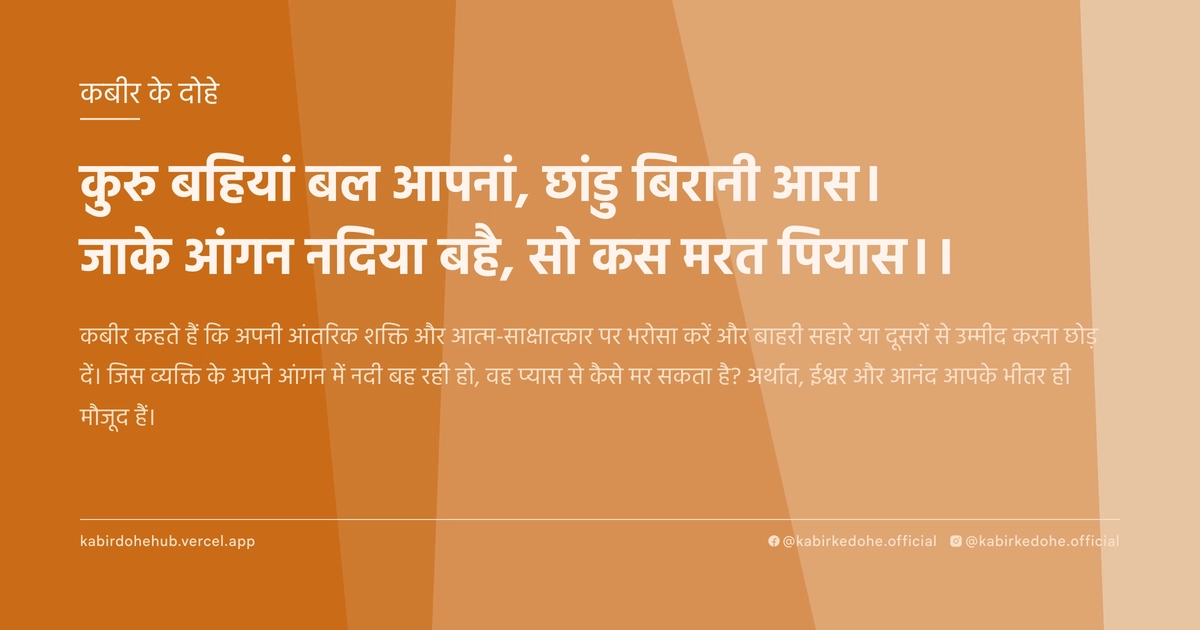
कुरु बहियां बल आपनां, छांडु बिरानी आस।
जाके आंगन नदिया बहै, सो कस मरत पियास।।
Kuru bahiyan bal aapnan, chhandu birani aas. Jaake aangan nadiya bahai, so kas marat piyas.
इस पृष्ठ पर इस कबीर दोहे का अर्थ (meaning), हिंदी व्याख्या और अंग्रेज़ी अनुवाद, दार्शनिक विश्लेषण और व्यावहारिक जीवन सीख दी गई है। यह दोहा अंतर ज्योति (The Inner Light) विषय से जुड़ा है — Kabir doha meaning and explanation in Hindi and English.
अर्थ (Meaning):
कबीर कहते हैं कि अपनी आंतरिक शक्ति और आत्म-साक्षात्कार पर भरोसा करें और बाहरी सहारे या दूसरों से उम्मीद करना छोड़ दें। जिस व्यक्ति के अपने आंगन में नदी बह रही हो, वह प्यास से कैसे मर सकता है? अर्थात, ईश्वर और आनंद आपके भीतर ही मौजूद हैं।
Kabir urges the seeker to cultivate their own inner strength and abandon the futile hope for external salvation. He asks rhetorically: how can one perish of thirst when a river flows within their own courtyard? The essence is that the Divine and ultimate fulfillment reside within the self.
व्याख्या (Interpretation):
यह दोहा आत्म-निर्भरता और अंतर्मुखी होने का आह्वान है। 'बहियां' यहाँ आंतरिक संकल्प और आध्यात्मिक प्रयास का प्रतीक है। 'बिरानी आस' उस मोह को दर्शाता है जहाँ मनुष्य शांति को तीर्थों, गुरुओं या बाहरी अनुष्ठानों में खोजता है। कबीर का 'आंगन' मानव हृदय है, और 'नदिया' वह निरंतर बहने वाली चेतना या परमात्मा है जो हर जीव में व्याप्त है। यह निर्गुण भक्ति का सार है, जहाँ ईश्वर किसी मंदिर या मस्जिद में नहीं, बल्कि आत्मा के गहरे मौन में स्थित है। यह अद्वैत वेदांत के उस सत्य को पुष्ट करता है कि आत्मा और ब्रह्म एक ही हैं। विरोधाभास यह है कि मनुष्य पूरी दुनिया में प्यास बुझाने का साधन खोजता है, जबकि वह स्वयं जल का स्रोत है।
This couplet is a clarion call for spiritual self-reliance and introspection. 'Bahiyan' symbolizes inner resolve and spiritual effort, while 'birani aas' represents the delusion of seeking peace through pilgrimages, external gurus, or ritualistic adherence. Kabir's 'courtyard' is a metaphor for the human heart, and the 'river' is the eternal flow of consciousness or the Divine residing within every being. This aligns with Nirgun Bhakti, where God is not confined to temples or mosques but exists in the profound silence of the soul. It reinforces the Advaita Vedanta truth of non-duality between Atman and Brahman. The central paradox highlighted is the human tendency to wander the world in search of fulfillment while remaining oblivious to the ocean of bliss flowing within.
दार्शनिक विश्लेषण (Philosophical Analysis):
कबीर का यह संदेश उस युग की प्रतिक्रिया है जहाँ धर्म केवल बाहरी आडंबरों, जातिगत श्रेष्ठता और कर्मकांडों तक सीमित हो गया था। वे स्पष्ट करते हैं कि मोक्ष किसी बाहरी व्यक्ति की कृपा से नहीं, बल्कि स्वयं के बोध से प्राप्त होता है। यह दृष्टिकोण सूफी मत के 'अनल हक' (मैं ही सत्य हूँ) और वेदांत के 'अहं ब्रह्मास्मि' के करीब है। कबीर यहाँ अहंकार के विसर्जन की बात कर रहे हैं; जब तक 'मैं' और 'मेरा' का भ्रम रहता है, तब तक आंतरिक नदी अदृश्य रहती है।
ऐतिहासिक रूप से, कबीर ने समाज के वंचित वर्ग को यह सिखाया कि उन्हें किसी मध्यस्थ (पुजारी या मुल्ला) की आवश्यकता नहीं है। यह एक क्रांतिकारी मनोवैज्ञानिक बदलाव था, जिसने व्यक्ति को उसकी अपनी आध्यात्मिक गरिमा से परिचित कराया। वे बताते हैं कि बाहरी खोज वास्तव में एक पलायन है, जो हमें अपनी वास्तविक प्रकृति से दूर ले जाती है।
दार्शनिक स्तर पर, 'प्यास' वह अतृप्ति है जो माया के कारण उत्पन्न होती है। माया हमें विश्वास दिलाती है कि सुख बाहर है, जिससे हम निरंतर इच्छाओं के जाल में फंसे रहते हैं। जब साधक अपनी दृष्टि बाहर से हटाकर भीतर की ओर मोड़ता है, तो उसे अनुभव होता है कि वह जिसे खोज रहा था, वह खोजकर्ता स्वयं ही है।
यह शिक्षण केवल धार्मिक नहीं, बल्कि मनोवैज्ञानिक भी है। यह सिखाता है कि मानसिक शांति और भावनात्मक स्थिरता बाहरी परिस्थितियों पर निर्भर नहीं होनी चाहिए। जो व्यक्ति अपनी आंतरिक शक्ति (बल) को पहचान लेता है, वह संसार के उतार-चढ़ाव से अप्रभावित रहता है।
अंततः, कबीर यह स्थापित करते हैं कि परमात्मा कोई दूरस्थ सत्ता नहीं है, बल्कि एक जीवंत अनुभव है। इस अनुभव तक पहुँचने का एकमात्र मार्ग 'स्व' का साक्षात्कार है। जब बाहरी उम्मीदें समाप्त होती हैं, तभी आंतरिक स्रोत सक्रिय होता है।
Kabir's message is a direct response to an era where religion had devolved into mere external ostentation, caste superiority, and rigid ritualism. He asserts that liberation is not a gift bestowed by an external authority but a realization achieved through self-awareness. This perspective mirrors the Sufi concept of 'Ana al-Haqq' (I am the Truth) and the Vedantic 'Aham Brahmasmi' (I am Brahman). Kabir emphasizes the annihilation of the ego; as long as the illusion of 'I' and 'mine' persists, the inner river remains hidden.
Historically, Kabir empowered the marginalized sections of society by teaching them that they required no intermediaries—neither priests nor clerics—to access the Divine. This was a revolutionary psychological shift, restoring the individual's sense of spiritual dignity. He argues that the external search is essentially an escape, a diversion that distances the seeker from their true nature.
Philosophically, the 'thirst' represents the chronic dissatisfaction born of Maya (illusion). Maya convinces us that happiness is an external commodity, trapping us in an endless cycle of desire. When the seeker redirects their gaze inward, they discover the profound truth: the sought-after goal is the seeker themselves.
This teaching transcends religion and enters the realm of psychology. It posits that mental peace and emotional stability should not be contingent upon external circumstances. One who recognizes their inner strength (bal) remains unshaken by the volatility of the material world.
Ultimately, Kabir establishes that the Divine is not a distant entity but a living, breathing experience. The only path to this experience is the realization of the 'Self'. Only when external expectations are surrendered does the internal source become active and overflowing.
मूल संदेश (Core Message):
- बाहरी सहारे की खोज वास्तव में आंतरिक शून्यता का डर है।
- सच्ची शक्ति स्वयं के बोध और आत्म-निर्भरता में निहित है।
- परमात्मा कोई गंतव्य नहीं, बल्कि आपकी अपनी वास्तविक प्रकृति है।
- जब आप स्वयं को जान लेते हैं, तो संसार की कोई भी कमी आपको प्यासा नहीं रख सकती।
- अहंकार का त्याग ही वह द्वार है जिससे आंतरिक नदी प्रवाहित होती है।
- Searching for external support is actually a fear of inner emptiness.
- True strength resides in self-awareness and spiritual self-reliance.
- The Divine is not a destination, but your own authentic nature.
- Once you know yourself, no worldly lack can leave you thirsty.
- The surrender of ego is the only gateway through which the inner river flows.
व्यावहारिक उदाहरण (Practical Example):
वाराणसी के एक पुराने घाट पर रहने वाली एक वृद्ध विधवा, जानकी, का जीवन अकेलेपन और अभावों से भरा था। वह हर साल बड़े मंदिरों में जाती, घंटों प्रार्थना करती और दान देती, इस उम्मीद में कि कोई दैवीय शक्ति उसके जीवन के दुखों को दूर कर देगी और उसे मानसिक शांति प्रदान करेगी। वह अपनी शांति के लिए दूसरों की सहानुभूति और धार्मिक गुरुओं के आश्वासनों पर निर्भर थी।
एक दिन, वह एक शांत कोने में बैठी थी, जहाँ उसने एक फकीर को देखा जो बिना किसी माला या मंत्र के, बस अपनी आँखों को बंद किए गहरे आनंद में मुस्कुरा रहा था। जानकी ने उससे पूछा, 'बाबा, मैं सालों से पूजा कर रही हूँ, फिर भी मेरा मन अशांत है। आप बिना किसी कर्मकांड के इतने शांत कैसे हैं?'
फकीर ने मुस्कुराकर कहा, 'बेटी, तुम प्यास बुझाने के लिए रेगिस्तान में कुएँ खोज रही हो, जबकि तुम्हारे अपने घर के आंगन में गंगा बह रही है। तुमने बाहर की दुनिया को अपना सहारा बनाया, लेकिन अपने भीतर की शक्ति को कभी नहीं देखा।'
जानकी को यह बात समझ नहीं आई, लेकिन उसने उस दिन एक प्रयोग किया। उसने मंदिर जाना बंद नहीं किया, लेकिन प्रार्थना के बाद वह चुपचाप अपनी सांसों को देखना शुरू किया। उसने महसूस किया कि वह जिस शांति को बाहर खोज रही थी, वह वास्तव में उसके भीतर के मौन में छिपी थी।
धीरे-धीरे, उसने दूसरों से उम्मीद करना छोड़ दिया कि कोई उसे खुश करेगा या उसकी समस्याओं को हल करेगा। उसने अपनी आंतरिक शक्ति को पहचानना शुरू किया। उसने पाया कि जब वह स्वयं के साथ सहज होती है, तो बाहरी अभाव उसे दुखी नहीं करते।
उसने अपने जीवन के दुखों को एक बोझ के बजाय एक अनुभव के रूप में देखना शुरू किया। उसने महसूस किया कि उसकी आत्मा का आनंद किसी बाहरी परिस्थिति का मोहताज नहीं है।
एक समय ऐसा आया जब जानकी अब केवल एक विधवा या एक गरीब महिला नहीं रही, बल्कि वह एक ऐसी स्त्री बन गई जिसकी उपस्थिति मात्र से दूसरों को शांति मिलती थी।
उसने सीखा कि असली 'बल' बाहरी समर्थन नहीं, बल्कि आत्म-साक्षात्कार है। अब उसके आंगन में वह नदी बह रही थी, और उसकी आत्मा की प्यास हमेशा के लिए शांत हो गई थी।
Janaki, an elderly widow living on an ancient ghat in Varanasi, led a life defined by loneliness and scarcity. Every year, she visited grand temples, prayed for hours, and gave donations, hoping some divine power would erase her sorrows and grant her mental peace. Her stability depended entirely on the sympathy of others and the assurances of religious gurus.
One day, while sitting in a quiet corner, she noticed a fakir who, without any prayer beads or mantras, sat with closed eyes, smiling in a state of profound bliss. Janaki asked, 'Baba, I have worshipped for years, yet my mind is restless. How are you so peaceful without any ritual?'
The fakir smiled and replied, 'Daughter, you are searching for wells in a desert to quench your thirst, while the Ganges flows in your own courtyard. You made the external world your crutch, but you never looked at the strength within.'
Janaki didn't fully grasp the meaning at first, but she decided to experiment. She didn't stop visiting the temple, but after her prayers, she began to sit in silence and observe her breath. She realized that the peace she sought externally was actually hidden in the silence within her.
Gradually, she stopped expecting others to make her happy or solve her problems. She began to recognize her own inner strength. She discovered that when she was at peace with herself, external lack no longer caused her suffering.
She started viewing her life's hardships not as a burden, but as an experience. She realized that the joy of her soul was not dependent on any external circumstance.
Eventually, Janaki was no longer just a widow or a poor woman; she became a woman whose mere presence brought peace to others.
She learned that true 'strength' is not external support, but self-realization. Now, the river flowed in her own courtyard, and the thirst of her soul was quenched forever.
अभ्यास मार्गदर्शन (Practice Guidance):
- प्रतिदिन 20 मिनट 'साक्षी भाव' का अभ्यास करें: अपने विचारों को बिना किसी निर्णय के देखें, जैसे आप किसी और के विचारों को देख रहे हों।
- आत्म-पूछताछ जर्नल: हर रात लिखें कि आज आपने किस बाहरी व्यक्ति या परिस्थिति से अपनी खुशी की उम्मीद की, और उसे आंतरिक शांति में कैसे बदल सकते थे।
- मौन व्रत: सप्ताह में एक बार कुछ घंटों के लिए पूर्ण मौन धारण करें ताकि बाहरी शोर कम हो और आंतरिक नदी की ध्वनि सुनाई दे।
- डायग्नोस्टिक चेकलिस्ट: क्या मैं तनाव में सबसे पहले दूसरों को दोष देता हूँ? क्या मेरी शांति मेरी परिस्थितियों पर निर्भर है? यदि हाँ, तो मैं अभी भी 'बिरानी आस' (बाहरी उम्मीद) में हूँ।
- Practice 'Witness Consciousness' for 20 minutes daily: Observe your thoughts without judgment, as if you are watching someone else's thoughts.
- Self-Inquiry Journaling: Every night, record instances where you relied on an external person or situation for happiness, and reflect on how that could have been shifted inward.
- Vow of Silence: Observe complete silence for a few hours once a week to diminish external noise and hear the sound of the inner river.
- Diagnostic Checklist: Do I instinctively blame others when stressed? Is my peace contingent on my circumstances? If yes, I am still living in 'birani aas' (external hope).
चिंतन प्रश्न (Reflection Questions):
- मेरे जीवन का वह कौन सा 'बाहरी सहारा' है जिसके बिना मैं खुद को अधूरा महसूस करता हूँ?
- क्या मेरी धार्मिक या आध्यात्मिक पहचान वास्तव में मेरी है, या यह केवल सामाजिक स्वीकृति पाने का एक तरीका है?
- यदि कल मेरे जीवन के सभी बाहरी सुख और संबंध छीन लिए जाएं, तो मेरे भीतर क्या बचेगा?
- मैं अपनी आंतरिक शांति को बाहरी परिस्थितियों का गुलाम क्यों बनाता हूँ?
- मेरे भीतर की वह कौन सी 'नदी' है जिसे मैंने डर या संकोच के कारण अनदेखा कर दिया है?
- What is that 'external support' in my life without which I feel incomplete?
- Is my religious or spiritual identity truly mine, or is it merely a tool for social validation?
- If all external comforts and relationships were stripped away tomorrow, what would remain within me?
- Why do I make my inner peace a slave to external circumstances?
- What is that 'river' within me that I have ignored out of fear or hesitation?