
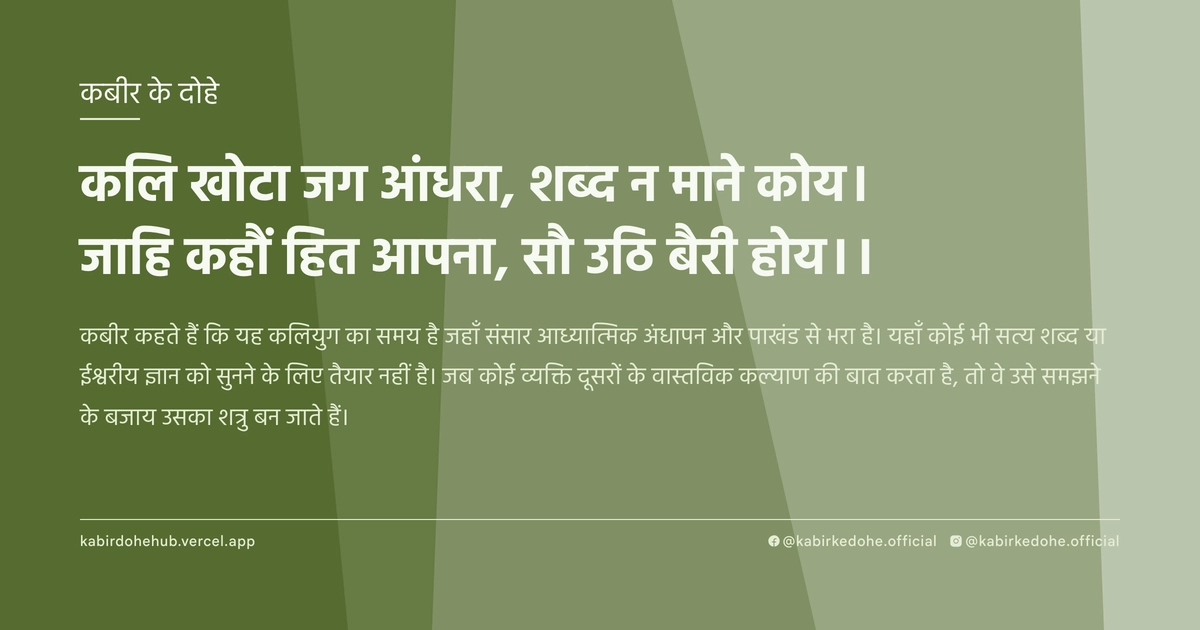
कलि खोटा जग आंधरा, शब्द न माने कोय।
जाहि कहौं हित आपना, सौ उठि बैरी होय।।
Kali khota jag andhara, shabd na maane koy. Jahi kahon hit aapna, sau uthi bairi hoye.
इस पृष्ठ पर इस कबीर दोहे का अर्थ (meaning), हिंदी व्याख्या और अंग्रेज़ी अनुवाद, दार्शनिक विश्लेषण और व्यावहारिक जीवन सीख दी गई है। यह दोहा सत्संग (Satsang) विषय से जुड़ा है — Kabir doha meaning and explanation in Hindi and English.
अर्थ (Meaning):
कबीर कहते हैं कि यह कलियुग का समय है जहाँ संसार आध्यात्मिक अंधापन और पाखंड से भरा है। यहाँ कोई भी सत्य शब्द या ईश्वरीय ज्ञान को सुनने के लिए तैयार नहीं है। जब कोई व्यक्ति दूसरों के वास्तविक कल्याण की बात करता है, तो वे उसे समझने के बजाय उसका शत्रु बन जाते हैं।
Kabir observes that in the age of Kali Yuga, the world is blinded by ignorance and spiritual darkness. No one is willing to listen to the Truth or the Divine Word. When a seeker attempts to guide others toward their own ultimate well-being and spiritual liberation, those people react with hostility and become enemies instead of allies.
व्याख्या (Interpretation):
इस दोहे का शाब्दिक अर्थ है कि समाज सत्य के प्रति उदासीन है। गहरे स्तर पर, 'अंधापन' माया के उस आवरण को दर्शाता है जो आत्मा को उसके वास्तविक स्वरूप से अलग करता है। 'शब्द' यहाँ केवल ध्वनि नहीं, बल्कि 'अनहद नाद' या वह शाश्वत सत्य है जो निर्गुण भक्ति का आधार है। कबीर इस विरोधाभास को उजागर करते हैं कि जिसे हम 'हित' या भलाई समझते हैं, वह अहंकार से ग्रस्त व्यक्ति को अपनी पहचान के लिए खतरा लगता है। यह अद्वैत वेदांत के उस सिद्धांत को दर्शाता है जहाँ अज्ञान (Avidya) के कारण जीव स्वयं को ब्रह्म से अलग मानता है और सत्य के मार्ग पर चलने वाले को शत्रु समझने लगता है।
Literally, the verse describes a society indifferent to truth. Metaphorically, 'blindness' represents the veil of Maya that obscures the soul's realization of its true nature. The 'Shabd' (Word) refers not to mere speech, but to the 'Anhad Nad' or the eternal vibration of the formless Divine, central to Nirgun Bhakti. Kabir highlights the paradox where an attempt to offer spiritual welfare is perceived as a threat by the ego. This aligns with Advaita Vedanta's concept of Avidya (ignorance), where the individual, blinded by the illusion of separation, views the mirror of truth as an enemy because it threatens the fragile construct of the false self.
दार्शनिक विश्लेषण (Philosophical Analysis):
कबीर का यह दोहा उनके समय के सामाजिक और धार्मिक पाखंड पर एक तीखा प्रहार है। उन्होंने देखा कि लोग बाहरी कर्मकांडों, जातिगत श्रेष्ठता और धार्मिक पहचानों में इतने उलझे हुए थे कि वे आंतरिक रूपांतरण की संभावना को पूरी तरह भूल चुके थे। यह विश्लेषण सूफीवाद के 'नफ्स' (अहंकार) के विनाश की अवधारणा से मिलता-जुलता है, जहाँ अहंकार सत्य के मार्ग में सबसे बड़ी बाधा बनता है।
निर्गुण भक्ति के परिप्रेक्ष्य में, कबीर यह समझाते हैं कि ईश्वर किसी मंदिर या मस्जिद में नहीं, बल्कि 'शब्द' या आंतरिक चेतना में है। जब कोई व्यक्ति इस सत्य को साझा करता है, तो वह समाज के स्थापित ढांचों को चुनौती देता है। लोग अपनी मानसिक गुलामी को छोड़ने के बजाय उस व्यक्ति से घृणा करना आसान समझते हैं जो उन्हें जगाने का प्रयास करता है।
अद्वैत वेदांत के अनुसार, जब तक 'मैं' और 'तू' का भेद बना रहता है, तब तक द्वैत रहता है। कबीर का 'बैरी' (शत्रु) बनना इसी द्वैत का परिणाम है। जब तक साधक अपनी पहचान को शरीर और नाम से जोड़ता है, वह उस सत्य को स्वीकार नहीं कर पाता जो उसे शून्य होने की प्रेरणा देता है।
यहाँ 'कलियुग' केवल एक समय काल नहीं, बल्कि एक मानसिक अवस्था है—एक ऐसी स्थिति जहाँ भौतिकता और अहंकार आध्यात्मिक दृष्टि पर हावी हो जाते हैं। कबीर का संदेश यह है कि सत्य का मार्ग एकाकी होता है क्योंकि यह भीड़ के विपरीत चलने की मांग करता है।
अंततः, यह दोहा हमें सिखाता है कि आध्यात्मिक मार्गदर्शन केवल उन्हें दिया जा सकता है जो वास्तव में जिज्ञासु हों। बिना पात्रता के दिया गया ज्ञान अक्सर क्रोध और विरोध को जन्म देता है, क्योंकि अहंकार अपनी सत्ता खोने से डरता है।
This couplet is a searing critique of the social and religious hypocrisy prevalent during Kabir's era. He observed a society deeply entrenched in external rituals, caste hierarchies, and rigid religious identities, which effectively blinded them to the possibility of internal transformation. This analysis resonates with the Sufi concept of the 'Nafs' (ego), where the lower self acts as the primary barrier to Divine realization.
From the perspective of Nirgun Bhakti, Kabir asserts that the Divine resides not in temples or mosques, but within the 'Shabd' or the inner consciousness. By sharing this truth, the seeker inadvertently challenges the established power structures of society. People find it easier to hate the messenger than to relinquish the comfort of their mental servitude.
According to Advaita Vedanta, as long as the distinction between 'I' and 'Thou' persists, duality remains. The emergence of the 'enemy' (Bairi) is a direct consequence of this duality. As long as a person identifies with the body and the social label, they cannot accept a truth that urges them to dissolve into the void of the Absolute.
In this context, 'Kali Yuga' is not merely a chronological age but a psychological state—a condition where materialism and ego dominate spiritual vision. Kabir suggests that the path of truth is inherently solitary because it requires walking against the current of collective delusion.
Ultimately, the verse teaches that spiritual guidance is only effective for those who possess genuine longing. Knowledge offered without the recipient's readiness often triggers anger and opposition, as the ego perceives the truth as an existential threat to its perceived sovereignty.
मूल संदेश (Core Message):
- सत्य का मार्ग अक्सर अकेला और कठिन होता है।
- अहंकार सत्य को शत्रु के रूप में देखता है।
- बाहरी विरोध आंतरिक जागृति का संकेत हो सकता है।
- शब्दों से अधिक आचरण में शक्ति होती है।
- वास्तविक कल्याण अहंकार के विसर्जन में है।
- माया हमें सत्य के प्रति अंधा बना देती है।
- The path of truth is often solitary and arduous.
- The ego perceives the truth as a hostile enemy.
- External opposition can be a sign of internal awakening.
- Conduct possesses more power than mere words.
- True welfare lies in the dissolution of the ego.
- Maya blinds us to the obviousness of the Truth.
व्यावहारिक उदाहरण (Practical Example):
एक समय की बात है, बनारस के घाटों पर रहने वाला एक वृद्ध विधवा, जिसे सब 'काकी' कहते थे, अत्यंत सरल और ईश्वर-भक्त थी। वह अपना पूरा दिन दूसरों की सेवा और नाम-स्मरण में बिताती थी।
उसी घाट पर कुछ पंडित और विद्वान रहते थे जो शास्त्रार्थ में निपुण थे और अपनी विद्वता का प्रदर्शन कर समाज में सम्मान पाना चाहते थे।
काकी अक्सर उन विद्वानों से कहती कि वे केवल शब्दों के जाल में फंसे हैं और असली ईश्वर तो हृदय की करुणा और सादगी में बसता है, बाहरी दिखावे में नहीं।
शुरुआत में विद्वानों ने उसकी बातों को अनसुना किया, लेकिन जब काकी ने उनके पाखंड और अहंकार को सबके सामने विनम्रता से उजागर करना शुरू किया, तो वे क्रोधित हो गए।
वे उसे 'अज्ञानी' और 'पागल' कहने लगे और धीरे-धीरे वे उसके शत्रु बन गए, यहाँ तक कि उन्होंने उसे घाट से बाहर निकालने की कोशिश की।
काकी दुखी नहीं हुई, बल्कि उसने महसूस किया कि लोग सत्य से नहीं, बल्कि उस सत्य के कारण टूटने वाले अपने अहंकार से डरते हैं।
एक दिन एक भीषण बाढ़ आई और घाट के कई हिस्से बह गए। उन विद्वानों के पास केवल उनकी किताबें थीं, जबकि काकी की करुणा ने कई डूबते हुए लोगों की जान बचाई।
जब उन विद्वानों ने देखा कि जिस 'अज्ञान' का वे उपहास कर रहे थे, वही वास्तव में जीवन का सार था, तो उनका अहंकार टूट गया।
उन्होंने महसूस किया कि काकी उनकी शत्रु नहीं थी, बल्कि वह एकमात्र व्यक्ति थी जो उन्हें उनके स्वयं के भ्रम से मुक्त कराना चाहती थी।
इस 'कबीर मोड़' ने उन्हें यह सिखाया कि वास्तविक ज्ञान शास्त्रों के रटने में नहीं, बल्कि अहंकार के विसर्जन और निस्वार्थ प्रेम में है।
Once, on the ghats of Varanasi, lived an elderly widow known as 'Kaki,' a woman of profound simplicity and devotion. She spent her days in selfless service and constant remembrance of the Divine.
On the same ghats lived several scholars and priests, masters of scripture and debate, who sought social prestige through their intellectual prowess.
Kaki would often gently suggest to these scholars that they were trapped in a web of words and that the true Divine resides in the compassion of the heart, not in external displays of piety.
Initially, the scholars ignored her, but when Kaki began to subtly expose their hypocrisy and ego before the public, they became enraged.
They labeled her 'ignorant' and 'mad,' eventually becoming her enemies and even attempting to drive her away from the ghats.
Kaki remained undisturbed, realizing that people do not hate the truth itself, but rather the pain of the ego shattering upon encountering that truth.
One day, a devastating flood struck, washing away parts of the ghats. The scholars clung to their books, while Kaki’s instinctive compassion led her to save many drowning strangers.
When the scholars witnessed that the 'ignorance' they had mocked was actually the highest form of wisdom, their pride finally collapsed.
They realized that Kaki was never their enemy; she was the only one attempting to liberate them from their own delusions.
This 'Kabir Twist' taught them that true knowledge is not found in the rote memorization of texts, but in the annihilation of the ego and the practice of selfless love.
अभ्यास मार्गदर्शन (Practice Guidance):
- दैनिक मौन अभ्यास: प्रतिदिन 30 मिनट पूर्ण मौन रहें और देखें कि जब आप कुछ नहीं बोलते, तो आपका अहंकार कैसे प्रतिक्रिया करता है।
- आत्म-पूछताछ जर्नल: जब कोई आपकी आलोचना करे या आपसे शत्रुता रखे, तो लिखें कि क्या आप वास्तव में उनके 'हित' की बात कर रहे थे या अपनी 'श्रेष्ठता' सिद्ध कर रहे थे।
- व्यवहार परिवर्तन: किसी को सही साबित करने की जिद छोड़ें। सत्य को शब्दों के बजाय अपने आचरण से प्रदर्शित करें।
- निदान चेकलिस्ट: क्या मैं सत्य बोलने पर दूसरों की प्रतिक्रिया से विचलित होता हूँ? क्या मैं दूसरों को बदलने की कोशिश में क्रोधित होता हूँ? यदि हाँ, तो मैं अभी भी अहंकार के प्रभाव में हूँ।
- Daily Silence Practice: Spend 30 minutes in total silence daily and observe how your ego reacts when you are not projecting an image to the world.
- Self-Inquiry Journaling: When someone criticizes you or becomes hostile, record whether you were truly speaking for their 'benefit' or subconsciously trying to prove your own 'superiority'.
- Behavioral Shift: Relinquish the urge to prove others wrong. Let the truth manifest through your conduct rather than your arguments.
- Diagnostic Checklist: Do I feel disturbed by others' reactions to the truth? Do I get angry while trying to 'correct' others? If yes, I am still operating from the ego.
चिंतन प्रश्न (Reflection Questions):
- क्या मेरी 'दूसरों की भलाई' करने की इच्छा वास्तव में उनके लिए है, या यह मेरे अपने 'मसीहा' होने के अहंकार को संतुष्ट करती है?
- जब लोग मेरी बात नहीं मानते, तो मुझे दुख क्यों होता है? क्या यह सत्य के प्रति मेरी निष्ठा है या मेरी इच्छाशक्ति का टकराव?
- मेरे जीवन में वह कौन सा 'शब्द' या सत्य है जिसे मैं स्वीकार करने से डरता हूँ क्योंकि वह मेरी वर्तमान पहचान को नष्ट कर देगा?
- क्या मैं अपनी डिजिटल पहचान (Social Media Image) के माध्यम से एक ऐसा मुखौटा पहन रहा हूँ जो मुझे वास्तविक सत्य से दूर कर रहा है?
- यदि पूरी दुनिया मेरे विरुद्ध हो जाए, तब भी क्या मैं उस सत्य पर अडिग रहूँगा जिसे मैंने अनुभव किया है?
- Is my desire to 'help others' truly for their benefit, or is it satisfying my own ego's need to be a 'savior'?
- Why do I feel distressed when people do not follow my advice? Is it loyalty to the truth or a clash of my will?
- What is the one 'word' or truth in my life that I am afraid to accept because it would destroy my current identity?
- Am I wearing a digital mask (social media image) that distances me from my authentic, raw truth?
- If the entire world turned against me, would I still remain steadfast in the truth I have experienced?