
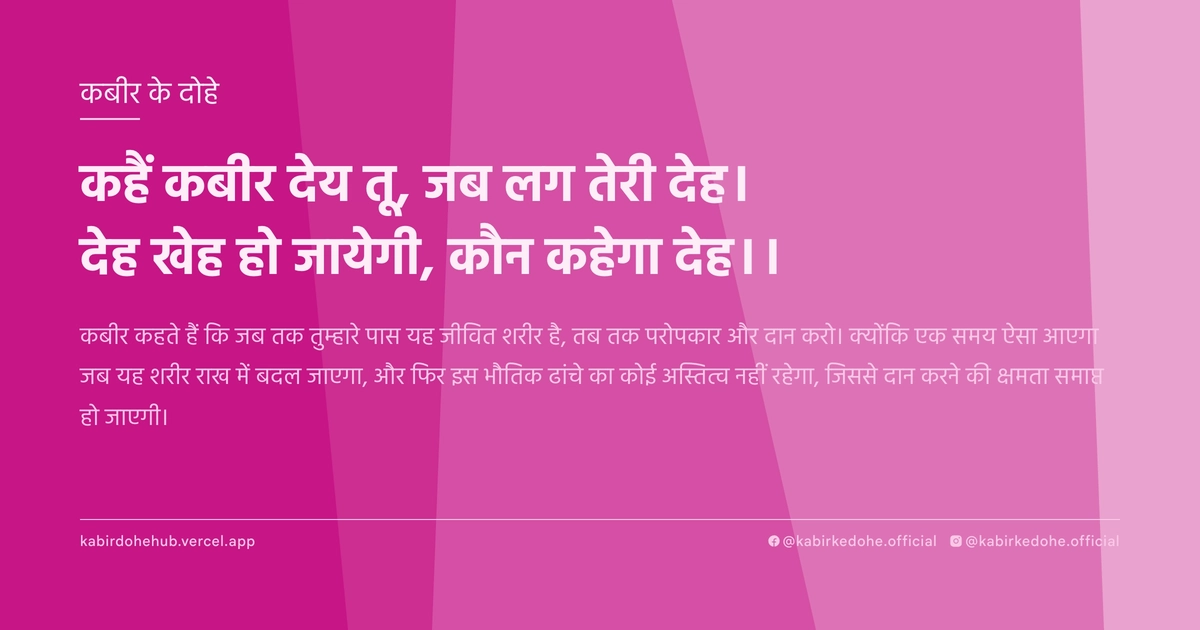
कहैं कबीर देय तू, जब लग तेरी देह।
देह खेह हो जायेगी, कौन कहेगा देह।।
Kahein Kabir dey tu, jab lag teri deh. Deh kheh ho jayegi, kaun kahega deh.
इस पृष्ठ पर इस कबीर दोहे का अर्थ (meaning), हिंदी व्याख्या और अंग्रेज़ी अनुवाद, दार्शनिक विश्लेषण और व्यावहारिक जीवन सीख दी गई है। यह दोहा मृतुक्यता (Mortality) विषय से जुड़ा है — Kabir doha meaning and explanation in Hindi and English.
अर्थ (Meaning):
कबीर कहते हैं कि जब तक तुम्हारे पास यह जीवित शरीर है, तब तक परोपकार और दान करो। क्योंकि एक समय ऐसा आएगा जब यह शरीर राख में बदल जाएगा, और फिर इस भौतिक ढांचे का कोई अस्तित्व नहीं रहेगा, जिससे दान करने की क्षमता समाप्त हो जाएगी।
Kabir urges us to practice generosity and selfless giving while we still possess a living body. He warns that the physical form is transient and will eventually turn to ash, leaving behind nothing of the material self to act or give.
व्याख्या (Interpretation):
इस दोहे का शाब्दिक अर्थ शरीर की नश्वरता की याद दिलाना है। गहरे स्तर पर, कबीर 'देह' (शरीर) और 'आत्मा' के बीच के द्वंद्व को दर्शाते हैं। यहाँ 'देय' (दान) केवल भौतिक वस्तुओं का त्याग नहीं है, बल्कि अहंकार का विसर्जन है। यह निर्गुण भक्ति का मार्ग है जहाँ साधक को यह समझना होता है कि मायावी शरीर केवल एक माध्यम है। जब शरीर राख (खेह) हो जाता है, तो केवल वह कर्म शेष रहता है जो निस्वार्थ भाव से किया गया था। यह अद्वैत वेदांत के उस सत्य की ओर संकेत करता है जहाँ व्यक्ति अपनी सीमित पहचान को त्यागकर उस अनंत ब्रह्म में विलीन होने की तैयारी करता है।
Literally, the couplet serves as a memento mori, reminding us of bodily decay. Metaphorically, Kabir explores the tension between the transient 'Deh' (body) and the eternal spirit. 'Giving' here transcends material charity; it symbolizes the shedding of the ego. In the context of Nirgun Bhakti, the body is viewed as a temporary vessel within the illusion of Maya. When the body becomes 'kheh' (ash), the only remnant is the vibration of selfless action. This aligns with Advaita Vedanta, where the realization of non-duality requires the practitioner to detach from the false identity of the physical form to realize the universal Atman.
दार्शनिक विश्लेषण (Philosophical Analysis):
कबीर का यह संदेश उस युग की प्रतिक्रिया है जहाँ लोग कर्मकांडों और बाहरी दिखावे में फंसे थे। उन्होंने स्पष्ट किया कि मोक्ष किसी मंदिर या मस्जिद में नहीं, बल्कि जीवित रहते हुए मानवता की सेवा में है। यह सूफी मत के 'फना' (अहंकार का विनाश) के सिद्धांत से मेल खाता है, जहाँ स्वयं को मिटाकर ही ईश्वर को पाया जा सकता है।
ऐतिहासिक रूप से, कबीर ने जाति और वर्ग के भेदभाव को चुनौती दी। उनके लिए दान का अर्थ केवल धन देना नहीं, बल्कि अपने भीतर के संचित अहंकार को समाज के कल्याण के लिए समर्पित करना था। यह दृष्टिकोण अद्वैत वेदांत के इस विचार को पुष्ट करता है कि हम सब एक ही चेतना के अंश हैं, इसलिए दूसरे की सेवा ही वास्तव में स्वयं की सेवा है।
मनोवैज्ञानिक स्तर पर, यह दोहा मृत्यु के भय को एक उपकरण के रूप में उपयोग करता है ताकि मनुष्य वर्तमान क्षण में जागृत हो सके। जब हम यह स्वीकार कर लेते हैं कि शरीर नश्वर है, तो हमारी वस्तुओं के प्रति आसक्ति कम हो जाती है। यह 'मोह' का अंत है, जो आध्यात्मिक उन्नति की पहली सीढ़ी है।
कबीर यहाँ यह भी समझाते हैं कि धार्मिक पाखंड—जैसे मृत्यु के बाद पुण्य कमाने की इच्छा—निरर्थक है। वास्तविक धर्म वह है जो जीवित शरीर के माध्यम से प्रवाहित हो। यदि शरीर रहते हुए करुणा नहीं जागी, तो राख होने के बाद कोई प्रार्थना काम नहीं आएगी।
अंततः, यह दर्शन हमें 'साक्षी भाव' की ओर ले जाता है। जब हम शरीर को केवल एक अस्थाई वस्त्र की तरह देखते हैं, तो हम उस शाश्वत सत्य से जुड़ जाते हैं जो जन्म और मृत्यु के चक्र से परे है। यह भौतिकता से आध्यात्मिकता की ओर एक निर्णायक संक्रमण है।
Kabir’s message is a direct critique of the ritualistic obsession of his era, where spiritual merit was often sought through superficial ceremonies rather than lived ethics. He posits that liberation is not found in the sanctuary of a temple or mosque, but in the active practice of compassion while embodied. This mirrors the Sufi concept of 'Fana'—the annihilation of the ego—suggesting that only by erasing the 'I' can one merge with the Divine.
Historically, Kabir dismantled the hierarchies of caste and class. To him, 'giving' was not merely a philanthropic act of the wealthy, but a spiritual necessity for all. This resonates with Advaita Vedanta’s core tenet: since all beings are manifestations of the one Brahman, serving another is fundamentally serving oneself. The distinction between giver and receiver is an illusion of Maya.
Psychologically, the couplet employs the contemplation of death as a catalyst for awakening. By confronting the inevitability of 'kheh' (ash), the practitioner is forced to evaluate the vanity of material accumulation. This process reduces 'Moha' (attachment), which is the primary psychological barrier to spiritual enlightenment.
Kabir further dismantles the fallacy of posthumous merit. He argues that spiritual currency is earned through the conscious use of the living body. Rituals performed after death are useless if the living heart remained closed to the suffering of others. The body is the only laboratory where the experiment of liberation can be conducted.
Ultimately, this philosophy steers the seeker toward the 'Sakshi' (witness) consciousness. By viewing the body as a temporary garment, the individual transcends the fear of mortality and aligns with the eternal truth that exists beyond the cycle of birth and decay. It is a transition from the finite to the infinite.
मूल संदेश (Core Message):
- देह नश्वर है, केवल कर्म शाश्वत हैं।
- संग्रह अहंकार को बढ़ाता है, त्याग आत्मा को मुक्त करता है।
- मृत्यु का भय ही जीवन का सबसे बड़ा शिक्षक है।
- परोपकार ही वास्तविक आध्यात्मिक निवेश है।
- मायावी शरीर से परे अपनी दिव्य पहचान खोजें।
- The body is transient; only selfless deeds are eternal.
- Accumulation feeds the ego; surrender liberates the soul.
- The awareness of death is the greatest teacher of life.
- Altruism is the only authentic spiritual investment.
- Seek your divine identity beyond the illusory physical form.
व्यावहारिक उदाहरण (Practical Example):
वाराणसी के एक पुराने घाट पर माधव नाम का एक वृद्ध कुम्हार रहता था। माधव अपनी कला में निपुण था और उसके बनाए मिट्टी के बर्तनों की पूरे शहर में मांग थी। वह बहुत मेहनती था, लेकिन उसका स्वभाव अत्यंत संकीर्ण था। वह अपनी कमाई का एक-एक पैसा संचित करता और किसी की मदद करने से कतराता था। उसका मानना था कि उसकी संपत्ति ही उसके बुढ़ापे का एकमात्र सहारा है।
एक दिन माधव ने देखा कि उसके पड़ोस में एक युवा कलाकार, जो बहुत गरीब था, अपनी कला के माध्यम से लोगों की मदद कर रहा था और बदले में केवल प्रेम पा रहा था। माधव ने उसका मजाक उड़ाया और कहा, 'तुम अपनी सारी ऊर्जा दूसरों पर लुटा रहे हो, अंत में तुम्हारे पास कुछ नहीं बचेगा।'
कुछ समय बाद, माधव गंभीर रूप से बीमार पड़ गया। वह बिस्तर पर पड़ा था और उसकी सारी संचित संपत्ति उसके सामने रखी थी, लेकिन वह संपत्ति उसे एक घूँट पानी या एक पल का सुकून नहीं दे सकी। उसने देखा कि जिन लोगों की उसने कभी मदद नहीं की, वे उसके पास आने से कतरा रहे थे।
तभी वह युवा कलाकार उसके पास आया। उसने बिना किसी स्वार्थ के माधव की सेवा की, उसे दवाइयाँ दिलाईं और उसके अकेलेपन को दूर किया। माधव की आँखों में आँसू आ गए। उसे कबीर का वह दोहा याद आया कि शरीर तो एक दिन राख हो जाएगा, लेकिन जो हमने दिया, वही हमारे साथ रहेगा।
माधव ने महसूस किया कि उसने अपनी पूरी जिंदगी 'बर्तन' भरने में लगा दी, लेकिन अपनी 'आत्मा' को खाली रखा। उसने अपनी बची हुई संपत्ति से गाँव में एक छोटा सा निःशुल्क कला केंद्र खोलने का निर्णय लिया ताकि अन्य गरीब बच्चे अपनी कला सीख सकें।
उसने अपनी अंतिम सांसों तक उस केंद्र के निर्माण में मदद की। अब उसके चेहरे पर वह शांति थी जो उसे करोड़ों रुपयों के संचय से नहीं मिली थी। उसने सीखा कि देने का आनंद पाने के आनंद से कहीं अधिक गहरा होता है।
जब माधव की मृत्यु हुई, तो पूरा गाँव उसके अंतिम संस्कार में शामिल हुआ। वह अब केवल एक शरीर नहीं था जो राख होने जा रहा था, बल्कि वह एक ऐसी विरासत बन चुका था जो जीवित थी।
उसकी राख तो हवा में मिल गई, लेकिन उसकी उदारता की गूँज उस कला केंद्र की दीवारों में हमेशा के लिए बस गई। यह माधव का वास्तविक रूपांतरण था—एक संकीर्ण संग्रहकर्ता से एक उदार मार्गदर्शक बनने तक का सफर।
On an ancient ghat in Varanasi lived an elderly potter named Madhav. Madhav was a master of his craft, and his earthenware was coveted across the city. Despite his skill and hard work, he possessed a narrow heart. He hoarded every coin he earned, refusing to help anyone, believing that his accumulated wealth was his only security in old age.
One day, Madhav observed a young artist in his neighborhood. This youth was destitute but spent his time teaching art to street children and helping the needy, receiving nothing in return but love. Madhav mocked him, saying, 'You are squandering your energy on others; in the end, you will have nothing for yourself.'
Some time later, Madhav fell gravely ill. He lay bedridden, his piles of gold and coins staring back at him, yet that wealth could not provide him a single drop of genuine comfort or a moment of peace. He noticed that those he had ignored or belittled in his greed were hesitant to visit him.
Then, the young artist arrived. Without a shred of resentment, he tended to Madhav, brought him medicines, and filled his silent room with warmth and companionship. Tears streamed down Madhav's face as he recalled the essence of Kabir's wisdom: the body will eventually turn to ash, and only the act of giving survives.
Madhav realized he had spent his entire life filling 'pots' of wealth while leaving his own soul empty. In a sudden surge of clarity, he decided to use his remaining assets to establish a free art center for the village's impoverished children.
He spent his final days overseeing the creation of this center. For the first time, a profound peace settled over him—a peace that millions of coins could never buy. He discovered that the joy of giving is infinitely deeper than the joy of possessing.
When Madhav finally passed away, the entire village gathered for his last rites. He was no longer just a body destined for the cremation pyre; he had become a living legacy.
While his physical form turned to ash, the vibration of his generosity remained etched in the walls of the art center. This was Madhav's ultimate transformation—from a narrow hoarder to a luminous guide.
अभ्यास मार्गदर्शन (Practice Guidance):
- दैनिक चिंतन: प्रतिदिन 10 मिनट इस विचार पर ध्यान दें कि आपका शरीर एक अस्थायी ऋण है। विचार करें कि यदि आज अंतिम दिन हो, तो आप क्या साझा करना चाहेंगे।
- निस्वार्थ कर्म: सप्ताह में एक बार ऐसा कार्य करें जिसका कोई भौतिक या सामाजिक लाभ न हो, केवल दूसरे की खुशी के लिए।
- आत्म-पूछताछ जर्नल: लिखें कि आप किन चीजों (वस्तुओं, विचारों, क्रोध) को पकड़ कर बैठे हैं जिन्हें छोड़ना आपके लिए कठिन है।
- निदान चेकलिस्ट: क्या मैं किसी की मदद करते समय बदले में प्रशंसा की उम्मीद करता हूँ? क्या मैं अपनी संपत्ति को अपनी पहचान मानता हूँ? यदि हाँ, तो आप अभी भी 'देह' के मोह में हैं।
- Daily Contemplation: Spend 10 minutes meditating on the fact that your body is a temporary loan. Reflect on what you would wish to share if today were your final day.
- Selfless Action: Once a week, perform an act of kindness that offers no material or social gain, driven solely by the desire to alleviate another's suffering.
- Self-Inquiry Journal: Document the things (possessions, grudges, identities) you are clinging to and analyze why letting go feels frightening.
- Diagnostic Checklist: Do I expect praise when helping others? Do I equate my net worth with my self-worth? If yes, you are still operating under the illusion of the 'Deh' (body).
चिंतन प्रश्न (Reflection Questions):
- यदि आज आपकी सारी भौतिक पहचान (नाम, पद, संपत्ति) छीन ली जाए, तो आपके भीतर क्या बचेगा?
- आपकी 'डिजिटल ईगो' (सोशल मीडिया छवि) आपको वास्तविक मानवीय संबंधों से कैसे दूर कर रही है?
- क्या आपका दान वास्तव में त्याग है, या यह आपके अहंकार को संतुष्ट करने का एक तरीका है?
- आप किस डर से अपनी खुशियों को दूसरों के साथ साझा करने में संकोच करते हैं?
- क्या आप शरीर की राख होने की प्रक्रिया को स्वीकार कर चुके हैं, या आप अभी भी अमरता का भ्रम पाले हुए हैं?
- If all your material identifiers (name, title, wealth) were stripped away today, what would remain of you?
- How is your 'digital ego' (social media persona) distancing you from authentic human connection?
- Is your charity truly an act of surrender, or is it a sophisticated tool to feed your ego?
- What is the underlying fear that prevents you from sharing your abundance with others?
- Have you truly accepted the inevitable decay of the body, or are you still clinging to the illusion of permanence?