
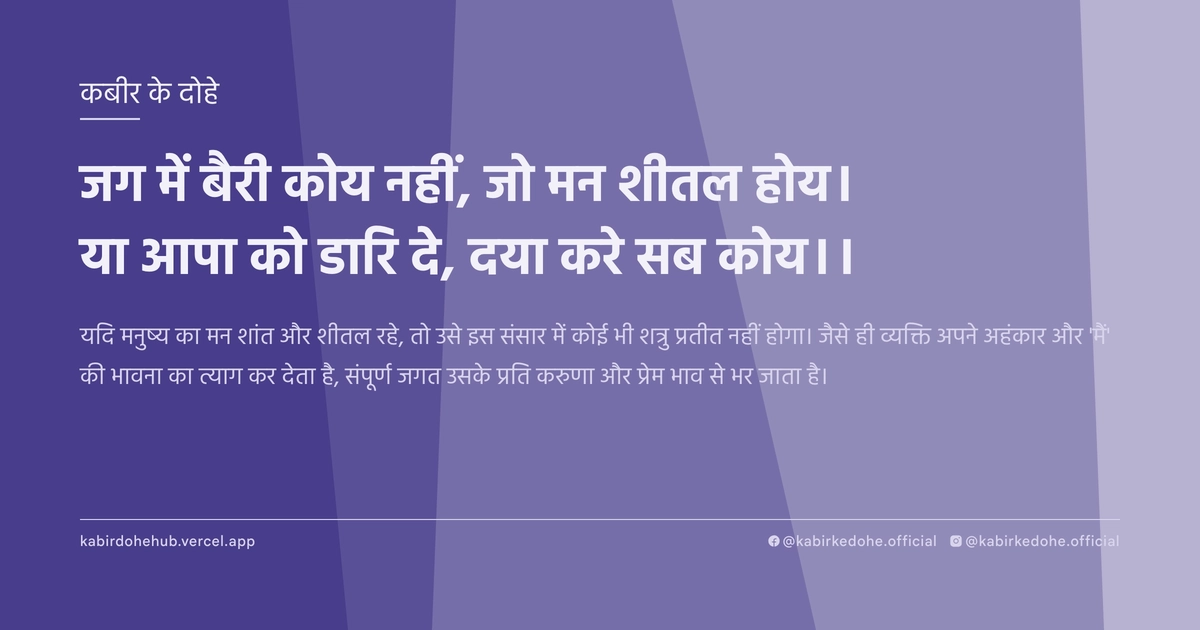
जग में बैरी कोय नहीं, जो मन शीतल होय।
या आपा को डारि दे, दया करे सब कोय।।
Jag me bairi koy nahi, jo man sheetal hoye. Ya aapa ko dari de, daya kare sab koy.
इस पृष्ठ पर इस कबीर दोहे का अर्थ (meaning), हिंदी व्याख्या और अंग्रेज़ी अनुवाद, दार्शनिक विश्लेषण और व्यावहारिक जीवन सीख दी गई है। यह दोहा अहंकार (The Ego) विषय से जुड़ा है — Kabir doha meaning and explanation in Hindi and English.
अर्थ (Meaning):
यदि मनुष्य का मन शांत और शीतल रहे, तो उसे इस संसार में कोई भी शत्रु प्रतीत नहीं होगा। जैसे ही व्यक्ति अपने अहंकार और 'मैं' की भावना का त्याग कर देता है, संपूर्ण जगत उसके प्रति करुणा और प्रेम भाव से भर जाता है।
If a person's mind remains calm and cool, they will find no enemies in this world. The moment one discards the ego and the sense of 'I-ness', the entire universe responds with compassion and kindness toward them.
व्याख्या (Interpretation):
इस दोहे का शाब्दिक अर्थ है कि आंतरिक शांति बाहरी शत्रुता को समाप्त कर देती है। रूपक के स्तर पर, 'शीतल मन' उस अवस्था को दर्शाता है जहाँ क्रोध और वासना की अग्नि शांत हो चुकी है। 'आपा' यहाँ अहंकार (Ego) का प्रतीक है, जो व्यक्ति को दूसरों से अलग करता है। निर्गुण भक्ति के अनुसार, जब यह पृथकता समाप्त होती है, तो साधक को अनुभव होता है कि वह और दूसरा एक ही ब्रह्म का अंश हैं। यह अद्वैत वेदांत के उस सत्य को पुष्ट करता है जहाँ द्वैत का अंत ही मोक्ष है। माया हमें यह विश्वास दिलाती है कि हम अलग हैं, जिससे संघर्ष जन्म लेता है; अतः अहंकार का विसर्जन ही वास्तविक शांति का मार्ग है।
Literally, the couplet suggests that inner peace annihilates external enmity. Metaphorically, the 'cool mind' represents a state where the fires of anger and desire have been extinguished. 'Aapa' symbolizes the Ego, the illusory construct that separates the self from the other. In the context of Nirgun Bhakti, when this separation vanishes, the seeker realizes that they and the 'other' are manifestations of the same formless Divine. This aligns with Advaita Vedanta, where the dissolution of duality is the essence of liberation. Maya creates the illusion of separation, fueling conflict; thus, the surrender of the ego is the only path to universal harmony.
दार्शनिक विश्लेषण (Philosophical Analysis):
कबीर का यह दर्शन उनके समय के कट्टरपंथी सामाजिक और धार्मिक वातावरण के विरुद्ध एक सशक्त प्रतिक्रिया था। उन्होंने देखा कि धर्म और जाति के नाम पर लोग एक-दूसरे के शत्रु बने हुए हैं, जबकि समस्या बाहरी नहीं बल्कि आंतरिक अहंकार की है। कबीर कर्मकांडों के बजाय हृदय की शुद्धि पर बल देते हैं, क्योंकि उनके अनुसार मंदिर या मस्जिद जाने से नहीं, बल्कि 'मैं' को मिटाने से ईश्वर की प्राप्ति होती है।
यह विचार सूफी मत के 'फना' (अहंकार का विलीनीकरण) के अत्यंत निकट है, जहाँ प्रेमी अपने अस्तित्व को परमात्मा में विलीन कर देता है। जब 'मैं' मिटता है, तो केवल 'वह' (परमात्मा) बचता है, और तब शत्रुता का कोई आधार नहीं रहता। यह मनोवैज्ञानिक रूपांतरण की प्रक्रिया है जहाँ व्यक्ति अपनी पहचान को एक सीमित शरीर या सामाजिक पद से हटाकर सार्वभौमिक चेतना में विस्तृत करता है।
अद्वैत वेदांत के परिप्रेक्ष्य में, यह दोहा 'अहं ब्रह्मास्मि' की व्यावहारिक अभिव्यक्ति है। यदि मैं ही सब कुछ हूँ, तो मेरा शत्रु कौन हो सकता है? शत्रुता केवल तब तक अस्तित्व में है जब तक हम स्वयं को एक अलग इकाई मानते हैं। कबीर यहाँ चेतावनी देते हैं कि बाहरी दुनिया केवल हमारे आंतरिक प्रतिबिंब का दर्पण है।
अक्सर लोग इस दोहे का अर्थ केवल 'विनम्र होने' से लगाते हैं, जो एक सतही व्याख्या है। वास्तव में, कबीर 'विनम्रता' की बात नहीं कर रहे, बल्कि 'अहंकार के पूर्ण विनाश' की बात कर रहे हैं। विनम्रता में भी एक सूक्ष्म अहंकार हो सकता है कि 'मैं विनम्र हूँ', लेकिन 'आपा को डारि दे' का अर्थ है उस पहचान का पूरी तरह मिट जाना जो हमें दूसरों से अलग करती है।
अंततः, यह दर्शन सिखाता है कि करुणा कोई ऐसी वस्तु नहीं है जिसे दूसरों से माँगा जाए, बल्कि यह वह स्वाभाविक परिणाम है जो तब उत्पन्न होता है जब हम अपनी कृत्रिम सीमाओं को तोड़ देते हैं। जब हम स्वयं को जगत से अलग नहीं मानते, तो जगत स्वतः ही हमारा मित्र बन जाता है।
Kabir's philosophy serves as a potent reaction to the rigid social and religious atmosphere of his era. He observed that people remained enemies in the name of religion and caste, while the core issue was not external but the internal ego. Kabir emphasizes the purification of the heart over ritualism, asserting that God is found not in temples or mosques, but in the annihilation of the 'I'.
This concept closely mirrors the Sufi notion of 'Fana' (annihilation of the self), where the lover merges their existence into the Divine. When the 'I' is erased, only the 'He' (the Absolute) remains, leaving no ground for enmity. This is a process of psychological transformation where the individual shifts their identity from a limited body or social status to a universal consciousness.
From the perspective of Advaita Vedanta, this couplet is a practical manifestation of 'Aham Brahmasmi' (I am Brahman). If I am everything, who could possibly be my enemy? Enmity exists only as long as we perceive ourselves as separate entities. Kabir warns that the external world is merely a mirror reflecting our internal state.
Common literalist interpretations often mistake this for a simple call to be 'humble,' which is a superficial reading. Kabir is not merely suggesting humility—which can still harbor a subtle ego ('I am humble')—but the total dissolution of the ego. 'Daari de' implies the complete casting away of the identity that creates separation.
Ultimately, this philosophy teaches that compassion is not something to be requested from others, but a natural consequence that emerges when we break our artificial boundaries. When we cease to view ourselves as separate from the world, the world spontaneously becomes our friend.
मूल संदेश (Core Message):
- बाहरी शत्रुता वास्तव में आंतरिक अशांति का प्रतिबिंब है।
- अहंकार का त्याग ही सार्वभौमिक प्रेम का एकमात्र द्वार है।
- शांति कोई गंतव्य नहीं, बल्कि एक आंतरिक मानसिक अवस्था है।
- जब 'मैं' मिटता है, तब संपूर्ण अस्तित्व मित्र बन जाता है।
- करुणा वह सेतु है जो द्वैत को अद्वैत में बदल देता है।
- External enmity is merely a reflection of internal turmoil.
- The surrender of ego is the only gateway to universal love.
- Peace is not a destination, but an internal state of being.
- When the 'I' vanishes, the entire existence becomes a friend.
- Compassion is the bridge that transforms duality into non-duality.
व्यावहारिक उदाहरण (Practical Example):
एक समय की बात है, वाराणसी के घाटों पर माधव नाम का एक वृद्ध बुनकर रहता था। वह अपने काम में निपुण था, लेकिन स्वभाव से अत्यंत क्रोधी और अहंकारी था। उसे लगता था कि उसके द्वारा बुने गए वस्त्र सबसे श्रेष्ठ हैं और अन्य बुनकर उसके प्रतिद्वंद्वी हैं।
माधव का अपने पड़ोस के बुनकर, शिवराम से वर्षों पुराना विवाद था। दोनों एक-दूसरे से बात नहीं करते थे और छोटी-छोटी बातों पर झगड़ पड़ते थे। माधव का मन हमेशा अशांत रहता था और उसे हर व्यक्ति में एक संभावित शत्रु दिखाई देता था।
एक दिन माधव एक पहुंचे हुए संत के पास गया और अपनी मानसिक पीड़ा का वर्णन किया। उसने कहा, 'महाराज, यह संसार बहुत क्रूर है, लोग मुझसे ईर्ष्या करते हैं और मुझे नीचा दिखाने की कोशिश करते हैं।'
संत ने मुस्कुराते हुए माधव को एक खाली बर्तन दिया और कहा, 'इसमें तब तक पानी भरो जब तक यह ऊपर तक न भर जाए, लेकिन याद रहे, इसमें एक छोटा सा कंकड़ भी नहीं गिरना चाहिए।'
माधव ने वैसा ही किया, लेकिन जैसे ही बर्तन भरा, उसने देखा कि कंकड़ तो नहीं गिरा, पर उसकी अपनी सांसों की हलचल से पानी में लहरें उठ रही थीं। संत ने समझाया, 'माधव, बाहरी दुनिया तो बस एक शांत झील है, लेकिन तुम्हारी अपनी अशांति उसमें लहरें पैदा कर रही है। तुम जिसे शत्रु कह रहे हो, वह वास्तव में तुम्हारे अपने अहंकार का प्रतिबिंब है।'
माधव को अपनी गलती का अहसास हुआ। उसने महसूस किया कि उसकी श्रेष्ठता का अहंकार ही उसे दूसरों से अलग कर रहा था। उसने तय किया कि वह अब अपनी कला को 'अपनी' उपलब्धि नहीं, बल्कि ईश्वर की देन मानेगा।
अगली सुबह, माधव ने स्वयं शिवराम के घर जाकर उनसे माफी मांगी और उनके काम की सराहना की। उसने अपने 'आपा' (अहंकार) को त्याग दिया और यह स्वीकार किया कि वह और शिवराम दोनों केवल धागों के माध्यम से एक ही सत्य को बुन रहे हैं।
जैसे ही माधव का मन शीतल हुआ, शिवराम का क्रोध भी गायब हो गया। जो व्यक्ति कल तक उसका सबसे बड़ा शत्रु था, वह अब उसका सबसे प्रिय मित्र बन गया। पूरे मोहल्ले में अब शांति थी क्योंकि माधव ने बाहरी दुनिया को बदलने के बजाय अपने भीतर के 'मैं' को बदल दिया था।
माधव अब केवल वस्त्र नहीं बुनता था, बल्कि प्रेम के सूत्र पिरोता था। उसने अनुभव किया कि जब उसने खुद को दूसरों से श्रेष्ठ मानना छोड़ दिया, तो दुनिया ने उसे वह सम्मान और प्रेम दिया जो वह सालों से जबरदस्ती पाने की कोशिश कर रहा था।
यह परिवर्तन केवल उसके व्यवहार में नहीं, बल्कि उसके अस्तित्व में था। वह अब हर व्यक्ति में उसी परमात्मा को देखता था जिसे वह पहले केवल अपने काम की पूर्णता में खोजता था।
Once, in the ghats of Varanasi, lived an elderly weaver named Madhav. He was masterly in his craft but possessed a temperament of extreme anger and arrogance. He believed the textiles he wove were superior to all others and viewed fellow weavers as mere rivals.
Madhav had a years-old feud with his neighbor, Shivram. They ceased speaking to one another and clashed over the smallest trifles. Madhav's mind was perpetually turbulent, and he perceived a potential enemy in every person he encountered.
One day, Madhav approached an enlightened saint and described his mental agony. He lamented, 'Maharaj, this world is cruel; people envy me and constantly strive to belittle me.'
The saint smiled and handed Madhav an empty vessel, instructing, 'Fill this with water to the brim, but ensure that not a single pebble falls into it.'
Madhav complied, but as the vessel filled, he noticed that while no pebble had fallen, the mere agitation of his own breath was creating ripples in the water. The saint explained, 'Madhav, the external world is but a still lake, but your own inner turmoil is creating these ripples. The enemy you speak of is actually a reflection of your own ego.'
Madhav realized his error. He understood that his pride in his superiority was the very wall separating him from others. He decided that he would no longer view his art as a 'personal' achievement, but as a gift from the Divine.
The next morning, Madhav went to Shivram's house, apologized, and praised his neighbor's work. He discarded his 'Aapa' (ego) and accepted that both he and Shivram were merely weaving the same Truth through different threads.
As Madhav's mind became cool and calm, Shivram's anger vanished instantly. The man who was once his greatest enemy became his dearest friend. Peace returned to the neighborhood because Madhav chose to change the 'I' within rather than trying to change the world outside.
Madhav no longer just wove cloth; he wove threads of love. He discovered that once he stopped claiming superiority, the world granted him the respect and affection he had spent years trying to force from others.
This transformation was not merely behavioral but existential. He began to see the Divine in every individual, a presence he had previously sought only in the perfection of his own work.
अभ्यास मार्गदर्शन (Practice Guidance):
- दैनिक ध्यान: प्रतिदिन 20 मिनट मौन बैठें और अपने भीतर उठने वाले क्रोध या ईर्ष्या के विचारों को केवल एक साक्षी (witness) की तरह देखें, बिना किसी निर्णय के।
- आत्म-पूछताछ जर्नल: प्रतिदिन एक ऐसी घटना लिखें जहाँ आपको किसी पर क्रोध आया। स्वयं से पूछें, 'मेरे अहंकार का कौन सा हिस्सा यहाँ चोटिल हुआ था?'
- व्यवहारिक परिवर्तन: दिन में कम से कम एक बार किसी ऐसे व्यक्ति की मदद करें या उसकी प्रशंसा करें जिससे आपके संबंध तनावपूर्ण रहे हैं, बिना किसी अपेक्षा के।
- निदान चेकलिस्ट: यदि आप छोटी बातों पर चिड़चिड़े हो रहे हैं या दूसरों की सफलता से असुरक्षित महसूस कर रहे हैं, तो समझें कि आपका 'आपा' (अहंकार) पुनः जागृत हो गया है और मन की शीतलता खो गई है।
- Daily Meditation: Sit in silence for 20 minutes daily and observe rising thoughts of anger or jealousy as a mere witness, without judgment.
- Self-Inquiry Journal: Record one incident daily where you felt anger. Ask yourself, 'Which part of my ego was wounded in this moment?'
- Behavioral Shift: At least once a day, help or sincerely praise someone with whom you have a strained relationship, without expecting anything in return.
- Diagnostic Checklist: If you find yourself irritable over trivialities or feeling insecure about others' success, recognize that your 'Aapa' (ego) has resurfaced and inner coolness is lost.
चिंतन प्रश्न (Reflection Questions):
- मेरे जीवन में जिसे मैं 'शत्रु' मानता हूँ, वह वास्तव में मेरा कौन सा अनसुलझा आंतरिक द्वंद्व प्रतिबिंबित कर रहा है?
- क्या मेरी विनम्रता वास्तव में अहंकार का त्याग है, या यह केवल एक 'सभ्य' मुखौटा है जिसे मैं दुनिया को दिखाने के लिए पहनता हूँ?
- यदि मेरी सामाजिक पहचान (पद, प्रतिष्ठा, जाति) छीन ली जाए, तो मेरे भीतर क्या बचेगा?
- मैं अपनी डिजिटल पहचान (सोशल मीडिया) के माध्यम से किस प्रकार के 'आपा' या कृत्रिम श्रेष्ठता का निर्माण कर रहा हूँ?
- क्या मैं वास्तव में दूसरों को क्षमा करता हूँ, या मैं केवल अपनी श्रेष्ठता सिद्ध करने के लिए क्षमा का ढोंग करता हूँ?
- Who is the 'enemy' in my life, and which unresolved internal conflict of mine are they reflecting?
- Is my humility a genuine surrender of ego, or merely a 'civilized' mask I wear for public perception?
- If my social identity (status, prestige, caste) were stripped away, what would actually remain of me?
- In what ways am I constructing a digital 'Aapa' or artificial superiority through my social media presence?
- Do I truly forgive others, or do I perform forgiveness to reinforce my own sense of moral superiority?