
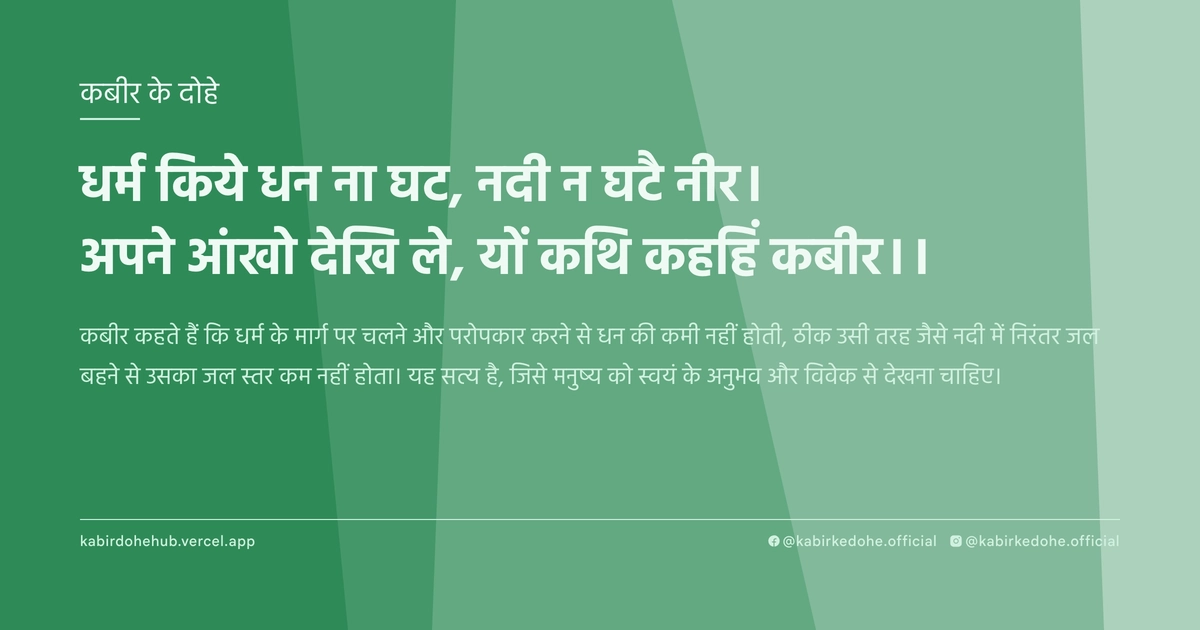
धर्म किये धन ना घट, नदी न घटै नीर।
अपने आंखो देखि ले, यों कथि कहहिं कबीर।।
Dharm kiye dhan na ghat, nadi na ghate neer. Apne aankho dekhi le, yon kathi kahahin Kabir.
इस पृष्ठ पर इस कबीर दोहे का अर्थ (meaning), हिंदी व्याख्या और अंग्रेज़ी अनुवाद, दार्शनिक विश्लेषण और व्यावहारिक जीवन सीख दी गई है। यह दोहा दान (Generosity) विषय से जुड़ा है — Kabir doha meaning and explanation in Hindi and English.
अर्थ (Meaning):
कबीर कहते हैं कि धर्म के मार्ग पर चलने और परोपकार करने से धन की कमी नहीं होती, ठीक उसी तरह जैसे नदी में निरंतर जल बहने से उसका जल स्तर कम नहीं होता। यह सत्य है, जिसे मनुष्य को स्वयं के अनुभव और विवेक से देखना चाहिए।
Kabir asserts that practicing righteousness and selfless service does not diminish one's wealth, just as a river does not lose its water by flowing. He urges the seeker to witness this truth through their own direct experience and spiritual intuition.
व्याख्या (Interpretation):
यह दोहा भौतिक और आध्यात्मिक समृद्धि के बीच के विरोधाभास को सुलझाता है। शाब्दिक अर्थ में, यह दान और धर्म की बात करता है, लेकिन रूपक के स्तर पर, यह 'प्रवाह' के सिद्धांत को समझाता है। जिस प्रकार नदी का स्वभाव बहना है और वह बहकर ही शुद्ध और जीवंत रहती है, उसी प्रकार मनुष्य का स्वभाव देना और प्रेम बांटना है। निर्गुण भक्ति के संदर्भ में, यहाँ 'धन' केवल मुद्रा नहीं, बल्कि आंतरिक ऊर्जा और कृपा है। जब हम अहंकार का त्याग कर दूसरों की सेवा करते हैं, तो हम उस अनंत स्रोत (ब्रह्म) से जुड़ जाते हैं, जिससे हमारी आंतरिक रिक्तता कभी नहीं आती। यह अद्वैत वेदांत के उस सत्य को दर्शाता है जहाँ देने वाला और लेने वाला एक ही चेतना के दो रूप हैं, अतः कुछ भी घटता नहीं, बल्कि विस्तार होता है।
This couplet resolves the paradox between material and spiritual abundance. Literally, it speaks of charity, but metaphorically, it illustrates the principle of 'flow.' Just as a river's nature is to flow—and it remains pure and vibrant only by doing so—the human spirit thrives by giving and spreading love. In the context of Nirgun Bhakti, 'wealth' refers not to currency, but to inner energy and divine grace. By shedding the ego and serving others, the individual aligns with the infinite source (Brahman), ensuring that their inner reservoir never runs dry. This reflects the Advaita Vedanta truth where the giver and the receiver are manifestations of the same consciousness; thus, nothing is lost, but everything is expanded.
दार्शनिक विश्लेषण (Philosophical Analysis):
कबीर का यह कथन उस युग की प्रतिक्रिया है जहाँ धर्म को केवल कर्मकांडों और बाहरी दिखावे तक सीमित कर दिया गया था। उन्होंने पुरोहितवाद और जातिगत श्रेष्ठता को चुनौती देते हुए यह स्थापित किया कि वास्तविक धर्म 'मानवता' और 'परोपकार' है। उनके लिए धर्म कोई ऐसी वस्तु नहीं थी जिसे खरीदा जा सके, बल्कि एक ऐसी अवस्था थी जिसे जिया जाए।
दार्शनिक रूप से, यह विचार सूफीवाद के 'इश्क-ए-हकीकी' (ईश्वरीय प्रेम) से मेल खाता है, जहाँ स्वयं को मिटाकर दूसरे में विलीन होना ही पूर्णता है। जब व्यक्ति 'मैं' और 'मेरा' के मोह से मुक्त होता है, तो वह माया के उस भ्रम को तोड़ देता है जो उसे यह विश्वास दिलाता है कि संसाधन सीमित हैं। यह कमी का मनोविज्ञान (Psychology of Scarcity) है, जिसे कबीर प्रचुरता के मनोविज्ञान (Psychology of Abundance) से प्रतिस्थापित करते हैं।
अद्वैत वेदांत के दृष्टिकोण से, यदि आत्मा और परमात्मा एक हैं, तो दान वास्तव में स्वयं को ही दिया जा रहा है। यहाँ 'घटने' का भय केवल अज्ञान (Avidya) के कारण है। कबीर तर्क देते हैं कि जो व्यक्ति इस सत्य को जान लेता है, वह भयमुक्त होकर जीवन जीता है।
कबीर का जोर 'अनुभव' (Experience) पर है। वे कहते हैं 'अपने आंखो देखि ले', जिसका अर्थ है कि किसी शास्त्र या गुरु के शब्दों पर आँख मूंदकर विश्वास न करें, बल्कि उसे अपने जीवन में उतारकर उसकी सत्यता की जाँच करें। यह बौद्धिक विद्रोह और आध्यात्मिक सशक्तिकरण का संगम है।
अंततः, यह दोहा यह स्पष्ट करता है कि आध्यात्मिक समृद्धि भौतिक संचय से नहीं, बल्कि मानसिक विसर्जन से आती है। जब हम संचय की प्रवृत्ति को त्यागकर प्रवाह की प्रवृत्ति अपनाते हैं, तो हम उस सार्वभौमिक चेतना का हिस्सा बन जाते हैं जहाँ अभाव शब्द का कोई अस्तित्व नहीं है।
Kabir's assertion is a reaction to an era where religion was reduced to mere rituals and outward displays. By challenging priestly hegemony and caste superiority, he established that true Dharma is rooted in 'humanity' and 'altruism.' For him, religion was not a commodity to be purchased, but a state of being to be lived.
Philosophically, this aligns with the Sufi concept of 'Ishq-e-Haqiqi' (Divine Love), where the annihilation of the self in the service of others leads to wholeness. When an individual liberates themselves from the attachment to 'I' and 'Mine,' they shatter the illusion of Maya, which falsely suggests that resources are finite. This is a transition from a 'Psychology of Scarcity' to a 'Psychology of Abundance.'
From the perspective of Advaita Vedanta, if the Atman and Brahman are one, then charity is essentially giving to oneself. The fear of 'depletion' exists only due to Avidya (ignorance). Kabir argues that the one who realizes this truth lives a life free from fear and greed.
Kabir emphasizes 'Anubhav' (Direct Experience). His command to 'see with your own eyes' implies that one should not blindly trust scriptures or authorities but validate the truth through personal practice. This is a convergence of intellectual rebellion and spiritual empowerment.
Ultimately, this couplet clarifies that spiritual prosperity comes not from material accumulation, but from mental relinquishment. By replacing the instinct to hoard with the instinct to flow, we become part of a universal consciousness where the concept of 'lack' ceases to exist.
मूल संदेश (Core Message):
- संग्रह भय पैदा करता है, प्रवाह शांति लाता है।
- परोपकार से आत्मा का विस्तार होता है, संकुचन नहीं।
- सच्ची समृद्धि आंतरिक उदारता में निहित है।
- अहंकार का त्याग ही वास्तविक लाभ है।
- ईश्वर की कृपा देने की क्षमता में प्रकट होती है।
- Accumulation breeds fear; flow brings peace.
- Altruism expands the soul rather than diminishing it.
- True prosperity resides in inner generosity.
- The surrender of ego is the only real profit.
- Divine grace manifests in the capacity to give.
व्यावहारिक उदाहरण (Practical Example):
वाराणसी के एक पुराने घाट पर, माधव नाम का एक वृद्ध बुनकर रहता था। माधव के पास बहुत अधिक धन नहीं था, लेकिन उसका हृदय करुणा से भरा था। वह अपनी साड़ियों का एक छोटा हिस्सा उन लोगों को मुफ्त में दे देता था जो ठंड से कांपते थे। उसके साथी बुनकर अक्सर उसका उपहास करते थे कि वह अपनी मेहनत की कमाई को 'बर्बाद' कर रहा है और जल्द ही कंगाल हो जाएगा।
माधव केवल मुस्कुराता और कहता, 'नदी का पानी बहता है, तभी वह मीठा रहता है।' एक समय आया जब शहर में भीषण अकाल पड़ा। बड़े-बड़े व्यापारियों के गोदाम अनाज से भरे थे, लेकिन उनके पास खरीदने वाले लोग नहीं थे और वे डर के मारे अपना सामान छिपाकर बैठे थे। उनके पास धन तो था, लेकिन शांति और सुरक्षा नहीं थी।
दूसरी ओर, माधव के पास बहुत कम था, लेकिन पूरा मोहल्ला उसके साथ खड़ा था। जिन लोगों की उसने निस्वार्थ मदद की थी, उन्होंने मिलकर उसके लिए भोजन और संसाधनों का प्रबंध किया। माधव की सादगी और उदारता ने उसके चारों ओर एक ऐसा सुरक्षा चक्र बना दिया था जिसे सोना नहीं खरीद सकता था।
एक दिन, शहर का सबसे अमीर व्यापारी, जो अपनी तिजोरियों की रखवाली में रातों को सो नहीं पाता था, माधव के पास आया। उसने पूछा, 'मैं इतना सब संचित करके भी भयभीत हूँ, और तुम सब कुछ बांटकर भी इतने शांत कैसे हो?'
माधव ने उसे एक बहती नदी की ओर इशारा किया और कहा, 'साहब, जो पानी रुक जाता है, वह सड़ जाता है। जो बहता रहता है, वह पवित्र रहता है। मेरा धन मेरे पास नहीं, बल्कि उन लोगों की दुआओं में है जिन्हें मैंने सहारा दिया।'
On an ancient ghat in Varanasi lived an elderly weaver named Madhav. Madhav did not possess great wealth, but his heart overflowed with compassion. He would often give away small portions of his hand-woven fabrics for free to those shivering in the winter cold. His fellow weavers frequently mocked him, claiming he was 'wasting' his hard-earned income and would soon end up a beggar.
Madhav would only smile and say, 'The river water flows, and that is why it remains sweet.' A time came when a severe famine struck the city. The warehouses of the wealthiest merchants were full of grain, yet they had no one to buy from, and they sat in fear, hiding their stock. They had wealth, but no peace or security.
On the other hand, while Madhav had very little, the entire neighborhood stood by him. The people he had selflessly helped organized food and resources for him. Madhav's simplicity and generosity had created a circle of protection around him that gold could never purchase.
One day, the city's richest merchant, who suffered from insomnia due to the constant worry of guarding his vaults, approached Madhav. He asked, 'I have accumulated so much, yet I am terrified. You give everything away, yet how are you so serene?'
Madhav pointed toward the flowing river and replied, 'Sir, water that stagnates becomes putrid. Water that flows remains pure. My wealth is not in my possession, but in the blessings of those I have supported.'
अभ्यास मार्गदर्शन (Practice Guidance):
- दैनिक चिंतन: प्रतिदिन 10 मिनट इस विचार पर ध्यान केंद्रित करें कि आप ब्रह्मांड के एक छोटे हिस्से नहीं, बल्कि संपूर्ण ब्रह्मांड का एक प्रवाह हैं।
- निस्वार्थ सेवा: सप्ताह में एक बार ऐसी मदद करें जिसके बदले में आपको किसी प्रशंसा या भौतिक लाभ की अपेक्षा न हो।
- आत्म-पूछताछ जर्नल: लिखें कि 'जब मैं कुछ देता हूँ, तो मेरे मन में डर पैदा होता है या खुशी?' इस डर के मूल कारण को खोजें।
- निदान चेकलिस्ट: यदि आप किसी की मदद करते समय यह सोचते हैं कि 'मेरा नुकसान हो रहा है', तो समझें कि आप अभी भी माया के संचय-भ्रम में हैं।
- Daily Contemplation: Spend 10 minutes daily focusing on the idea that you are not a small part of the universe, but the flow of the entire universe itself.
- Selfless Service: Once a week, perform an act of kindness where you expect absolutely no praise, recognition, or material return.
- Self-Inquiry Journal: Record your feelings: 'When I give, do I feel a sense of loss or a sense of joy?' Trace the root of any fear associated with giving.
- Diagnostic Checklist: If you feel a sense of 'personal loss' while helping someone, recognize that you are still operating under the illusion of scarcity (Maya).
चिंतन प्रश्न (Reflection Questions):
- क्या मेरी उदारता वास्तव में निस्वार्थ है, या मैं केवल अपनी सामाजिक छवि (Digital Ego) को सुधारने के लिए दान करता हूँ?
- मैं किन चीजों को 'अपना' मानता हूँ, और यदि वे मुझसे छिन जाएं, तो क्या मेरी शांति बनी रहेगी?
- क्या मैं दूसरों की सफलता को अपनी कमी के रूप में देखता हूँ, या एक साझा प्रचुरता के रूप में?
- मेरे जीवन में वह कौन सा 'रुका हुआ पानी' (stagnant emotion) है जिसे मुझे प्रवाहित करने की आवश्यकता है?
- क्या मैं धर्म को एक निवेश (Investment) के रूप में देखता हूँ जहाँ मुझे बदले में कुछ चाहिए?
- Is my generosity truly selfless, or do I give merely to polish my social image (Digital Ego)?
- What things do I label as 'mine,' and if they were taken away, would my inner peace remain intact?
- Do I perceive others' success as my own lack, or as a manifestation of shared abundance?
- What is the 'stagnant water' (repressed emotion) in my life that needs to be allowed to flow?
- Do I view righteousness as an investment where I expect a specific return on my spiritual capital?