
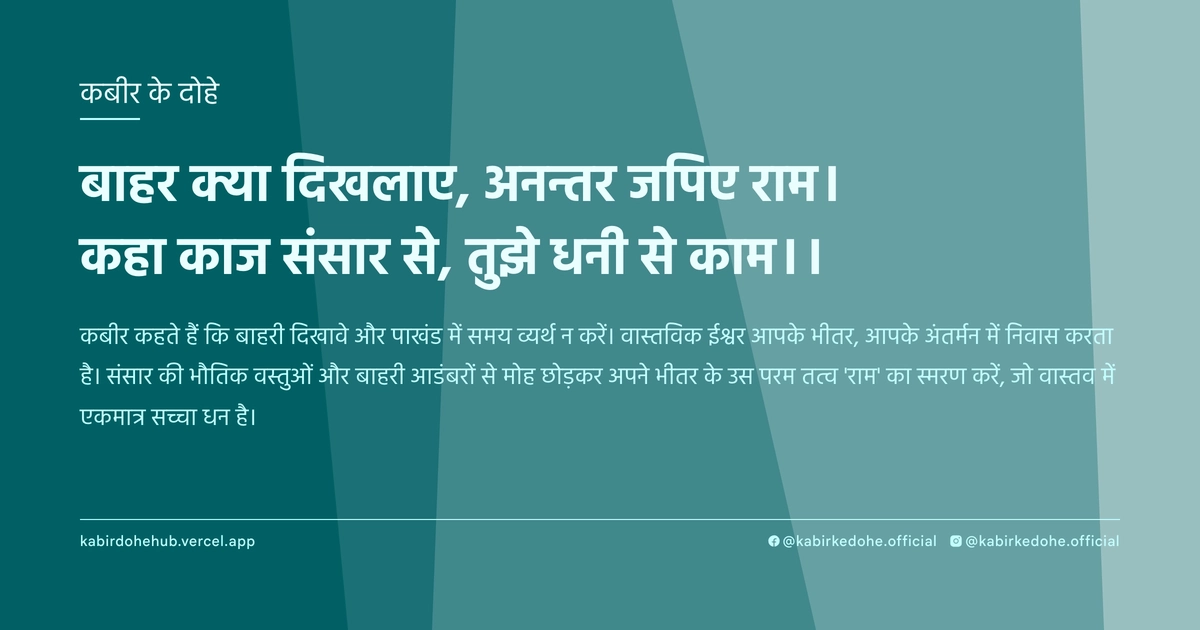
बाहर क्या दिखलाए, अनन्तर जपिए राम।
कहा काज संसार से, तुझे धनी से काम।।
Bahar kya dikhlaaye, anantar japiye Ram. Kaha kaaj sansar se, tujhe dhani se kaam.
इस पृष्ठ पर इस कबीर दोहे का अर्थ (meaning), हिंदी व्याख्या और अंग्रेज़ी अनुवाद, दार्शनिक विश्लेषण और व्यावहारिक जीवन सीख दी गई है। यह दोहा अंतर ज्योति (The Inner Light) विषय से जुड़ा है — Kabir doha meaning and explanation in Hindi and English.
अर्थ (Meaning):
कबीर कहते हैं कि बाहरी दिखावे और पाखंड में समय व्यर्थ न करें। वास्तविक ईश्वर आपके भीतर, आपके अंतर्मन में निवास करता है। संसार की भौतिक वस्तुओं और बाहरी आडंबरों से मोह छोड़कर अपने भीतर के उस परम तत्व 'राम' का स्मरण करें, जो वास्तव में एकमात्र सच्चा धन है।
Kabir advises against the futility of external displays of piety and superficial rituals. He asserts that the true Divine resides within the depths of one's own consciousness. Instead of seeking validation or fulfillment from the material world and its fleeting riches, one should focus on the internal remembrance of the formless 'Ram', the only eternal wealth.
व्याख्या (Interpretation):
इस दोहे का शाब्दिक अर्थ है कि बाहरी प्रदर्शन व्यर्थ है और आंतरिक जप ही सत्य है। यहाँ 'राम' किसी पौराणिक राजा का प्रतीक नहीं, बल्कि 'निरुपाधिक' चेतना या निर्गुण ब्रह्म का प्रतीक है। कबीर माया के उस जाल की ओर संकेत करते हैं जहाँ मनुष्य बाहरी प्रतीकों (माला, तिलक, मंदिर) में ईश्वर को खोजता है, जबकि वह स्वयं आत्मा के रूप में मौजूद है। यह अद्वैत वेदांत के उस सिद्धांत को पुष्ट करता है कि आत्मा और परमात्मा एक ही हैं। जब तक हम 'बाहर' देखते हैं, हम द्वैत (separation) में जीते हैं; जब हम 'अनंतर' (भीतर) देखते हैं, तो हम शून्य में विलीन हो जाते हैं। यह विरोधाभास है कि जिसे हम पूरी दुनिया में खोज रहे हैं, वह खोजने वाले के भीतर ही छिपा है।
Literally, the verse dismisses external ostentation in favor of internal invocation. 'Ram' here does not refer to a mythological deity but symbolizes the Nirgun (formless) consciousness or the Absolute Brahman. Kabir highlights the trap of Maya, where humans seek the Divine through external symbols like beads, tilaks, or temples, ignoring the spark of divinity within. This aligns with Advaita Vedanta's core tenet of non-duality: the Atman is Brahman. As long as the gaze is outward, the seeker remains in a state of duality; once the focus shifts 'anantar' (internally), the ego dissolves into the void. The central paradox is that the object of the search is the very seeker themselves, hidden by the veil of ignorance.
दार्शनिक विश्लेषण (Philosophical Analysis):
कबीर का यह दोहा उस युग की प्रतिक्रिया है जहाँ धर्म केवल कर्मकांडों और बाहरी दिखावे तक सीमित हो गया था। उन्होंने ब्राह्मणवादी और सूफी दोनों परंपराओं के उन पहलुओं की आलोचना की जो केवल बाहरी स्वरूप पर जोर देते थे। उनके लिए 'राम' शब्द एक सेतु है जो हिंदू और मुस्लिम दोनों को जोड़ता है, क्योंकि यह शब्द आंतरिक शांति और सार्वभौमिक सत्य का प्रतिनिधित्व करता है।
दार्शनिक स्तर पर, यह सूफीवाद के 'इंसान-ए-कामिल' (पूर्ण मानव) की अवधारणा से मिलता-जुलता है, जहाँ ईश्वर को हृदय के भीतर खोजा जाता है। कबीर का तर्क है कि जब तक मनुष्य बाहरी दुनिया में 'धनी' (धन या प्रतिष्ठा) की तलाश करता है, वह अपनी वास्तविक आध्यात्मिक संपदा से दूर रहता है। यह अहंकार का विनाश है—यह मानना कि मैं कुछ भी बाहरी प्राप्त करके पूर्ण हो सकता हूँ, एक भ्रम है।
अद्वैत वेदांत के अनुसार, जगत मिथ्या है और केवल ब्रह्म सत्य है। कबीर इसी सत्य को सरल भाषा में समझाते हैं कि संसार के साथ हमारा संबंध केवल एक खेल या माया है। वास्तविक उपलब्धि 'स्व' का साक्षात्कार है। वे ritualism (अनुष्ठानवाद) को एक बाधा मानते हैं क्योंकि यह व्यक्ति को आत्म-निरीक्षण से हटाकर प्रदर्शन की ओर ले जाता है।
मनोवैज्ञानिक रूप से, यह दोहा 'बाह्य प्रमाणीकरण' (external validation) की लत को चुनौती देता है। आधुनिक मनुष्य सोशल मीडिया या सामाजिक स्थिति के माध्यम से अपनी पहचान बनाने की कोशिश करता है, जो कबीर के समय के 'बाहरी दिखावे' का ही आधुनिक रूप है। कबीर हमें आंतरिक स्थिरता की ओर लौटने का आह्वान करते हैं।
अंततः, यह संदेश है कि आध्यात्मिक यात्रा बाहर से भीतर की ओर एक यात्रा है। जब साधक यह समझ जाता है कि वह स्वयं वह 'धनी' (समृद्ध तत्व) है जिसकी वह तलाश कर रहा था, तब संसार की सारी व्यर्थता समाप्त हो जाती है और केवल शाश्वत आनंद शेष रहता है।
This Doha is a visceral reaction to an era where religion had devolved into mere ritualism and superficial displays. Kabir critiqued both Brahmanical and Sufi traditions that emphasized outward forms over inner realization. For him, 'Ram' is a linguistic bridge connecting Hindus and Muslims, representing the universal, formless truth rather than a sectarian deity.
Philosophically, this resonates with the Sufi concept of 'Insan-e-Kamil' (the Perfect Human), where the Divine is discovered within the heart. Kabir argues that as long as one seeks 'Dhani' (wealth or status) in the external world, they remain estranged from their true spiritual inheritance. This is a call for the annihilation of the ego—the delusion that completeness can be achieved through external acquisition.
According to Advaita Vedanta, the world is Maya (illusion) and only Brahman is real. Kabir simplifies this by suggesting that our engagement with the world is a transient play. The only true achievement is the realization of the Self. He views ritualism as a spiritual obstacle because it diverts the seeker from introspection toward performance.
Psychologically, this verse challenges the addiction to external validation. The modern obsession with social media and status is merely a contemporary version of the 'external display' Kabir condemned. He urges a return to internal stability and psychic wholeness.
Ultimately, the spiritual journey is a movement from the periphery to the center. When the seeker realizes they are the 'Dhani' (the wealthy one) they were searching for, the futility of the world vanishes, leaving only the residue of eternal bliss.
मूल संदेश (Core Message):
- बाहरी आडंबर केवल आत्मा के ऊपर चढ़ी धूल है।
- सच्ची समृद्धि भौतिक वस्तुओं में नहीं, आंतरिक मौन में है।
- ईश्वर कोई बाहरी गंतव्य नहीं, बल्कि स्वयं की गहराई है।
- अहंकार का त्याग ही वास्तविक धन की प्राप्ति है।
- जब खोज समाप्त होती है, तब खोजकर्ता ही खोज बन जाता है।
- External ostentation is but dust settled upon the soul.
- True prosperity lies in internal silence, not material possession.
- The Divine is not an external destination, but the depth of the Self.
- The surrender of ego is the attainment of real wealth.
- When the search ends, the seeker becomes the discovery.
व्यावहारिक उदाहरण (Practical Example):
एक समय की बात है, वाराणसी के घाटों पर रहने वाला एक वृद्ध बुनकर था, जिसका नाम माधव था। माधव अपनी कला में निपुण था, लेकिन वह हमेशा इस बात से दुखी रहता था कि उसके पास पर्याप्त धन नहीं है। वह शहर के बड़े सेठों की तरह रेशमी वस्त्र नहीं पहन पाता था और समाज में उसे वह सम्मान नहीं मिलता था जो धनवानों को मिलता था।
वह अक्सर मंदिरों में जाकर घंटों प्रार्थना करता और दान देता, इस उम्मीद में कि भगवान उसे अमीर बना देंगे। वह अपनी गरीबी को अपने भाग्य का दोष मानता और बाहरी दुनिया की चमक-धमक को ही सफलता का पैमाना मानता था। वह जितना अधिक बाहरी पूजा-पाठ में लगा, उतना ही वह अंदर से खाली और निराश महसूस करने लगा।
एक दिन उसकी मुलाकात एक घुमक्कड़ संत से हुई, जिसने माधव की बेचैनी को देखा। संत ने उससे पूछा, "तुम बाहर क्या खोज रहे हो, माधव? क्या तुम्हें लगता है कि रेशम के कपड़े तुम्हारी आत्मा को शांति देंगे?"
माधव ने उत्तर दिया, "महाराज, दुनिया मुझे गरीब समझती है। मैं चाहता हूँ कि लोग मेरी कद्र करें और मेरे पास वह धन हो जिससे मैं सुखी रह सकूँ।"
संत ने मुस्कुराते हुए कहा, "तुम उस धन की तलाश कर रहे हो जो दूसरों के पास है, लेकिन तुम उस खजाने को भूल गए जो तुम्हारे भीतर है। तुम्हारी कला, तुम्हारा धैर्य और तुम्हारी सादगी ही तुम्हारा असली धन है। बाहर का दिखावा केवल एक परदा है।"
माधव को यह बात समझ नहीं आई, लेकिन संत ने उसे एक प्रयोग करने को कहा। उन्होंने कहा, "अगले सात दिनों तक, जब भी तुम करघे पर बैठो, यह मत सोचो कि तुम कपड़ा बेचकर कितने पैसे कमाओगे। बस यह महसूस करो कि तुम उस परमात्मा के लिए बुन रहे हो जो तुम्हारे भीतर है।"
माधव ने ऐसा ही किया। धीरे-धीरे उसका ध्यान बाहरी लाभ से हटकर बुनने की प्रक्रिया पर केंद्रित हो गया। उसे महसूस हुआ कि जब वह पूरी तरह से वर्तमान क्षण में होता है, तो उसे एक असीम शांति का अनुभव होता है। उसे अब इस बात की परवाह नहीं थी कि लोग उसे गरीब कहते हैं या अमीर।
एक दिन, उसने एक ऐसा वस्त्र बुना जिसमें उसकी पूरी आत्मा समाहित थी। वह वस्त्र इतना सुंदर था कि एक विदेशी यात्री ने उसे बहुत बड़ी कीमत पर खरीदा। लेकिन आश्चर्य यह था कि माधव को अब उस धन की लालसा नहीं थी।
उसने महसूस किया कि असली 'धनी' वह नहीं है जिसके पास सोना है, बल्कि वह है जिसका मन शांत है और जो अपने भीतर के 'राम' से जुड़ा हुआ है। उसने अपनी बाहरी गरीबी को स्वीकार कर लिया, लेकिन आंतरिक रूप से वह दुनिया का सबसे अमीर व्यक्ति बन गया।
माधव ने अब दिखावे की सारी कोशिशें छोड़ दीं और अपनी सादगी में ही आनंद खोजने लगा। उसकी आँखों में अब वह लालसा नहीं थी, बल्कि एक गहरी चमक थी, जो केवल आंतरिक संतोष से आती है।
Once, on the ghats of Varanasi, lived an elderly weaver named Madhav. Madhav was a master of his craft, yet he lived in constant sorrow because he lacked material wealth. He could not afford the fine silks worn by the city's wealthy merchants and felt he lacked the social respect accorded to the rich.
He spent hours in temples, praying and donating meager sums, hoping the gods would grant him riches. He viewed his poverty as a cosmic injustice and measured success solely by the glitter of the external world. The more he immersed himself in outward rituals, the emptier and more desperate he felt inside.
One day, he encountered a wandering monk who noticed Madhav's restlessness. The monk asked, "What are you searching for outside, Madhav? Do you believe silk robes can bring peace to your soul?"
Madhav replied, "Maharaj, the world sees me as poor. I want the wealth that earns respect and brings happiness."
The monk smiled and said, "You seek the wealth others possess, forgetting the treasure within yourself. Your art, your patience, and your simplicity are your true riches. External display is merely a veil."
Madhav didn't fully grasp this, but the monk challenged him to an experiment: "For the next seven days, when you sit at your loom, stop thinking about how much money you will earn. Instead, feel that you are weaving for the Divine that resides within you."
Madhav obeyed. Gradually, his focus shifted from external profit to the act of creation. He discovered that when he was fully present in the moment, he experienced an immense, nameless peace. He stopped caring whether people labeled him poor or rich.
Eventually, he wove a garment so exquisite that it contained the essence of his entire soul. A foreign traveler saw it and bought it for a vast sum of money. However, the miracle was that Madhav no longer craved that wealth.
He realized that the true 'Dhani' (wealthy one) is not he who possesses gold, but he whose mind is still and who is connected to the internal 'Ram'. He accepted his external poverty but became the richest man in the world internally.
Madhav abandoned all attempts at social pretense and found joy in his simplicity. The longing in his eyes was replaced by a deep radiance—a glow that only comes from internal contentment.
अभ्यास मार्गदर्शन (Practice Guidance):
- दैनिक मौन अभ्यास: प्रतिदिन 20 मिनट के लिए पूर्ण मौन रहें। बाहरी शोर को हटाकर केवल अपनी सांसों और भीतर उठने वाले विचारों का अवलोकन करें।
- आत्म-पूछताछ जर्नल: हर रात लिखें—'आज मैंने कितनी बार बाहरी प्रशंसा के लिए कार्य किया और कितनी बार अपनी आंतरिक शांति के लिए?'
- सादगी का संकल्प: सप्ताह में एक दिन ऐसा चुनें जब आप किसी भी प्रकार के दिखावे (महंगे कपड़े, दिखावटी बातचीत) से बचें और अपनी मूल पहचान के साथ रहें।
- निदान चेकलिस्ट: यदि आप दूसरों की राय से विचलित हो रहे हैं या बाहरी वस्तुओं से खुशी ढूंढ रहे हैं, तो समझ लें कि आप 'बाहर' देख रहे हैं। यदि आप अकेलेपन में भी पूर्ण महसूस करते हैं, तो आप 'अनंतर' की ओर बढ़ रहे हैं।
- Daily Silence Practice: Spend 20 minutes in absolute silence. Strip away external noise and observe only your breath and the arising thoughts within.
- Self-Inquiry Journaling: Every night, record: 'How many times today did I act for external validation, and how many times for my internal peace?'
- Vow of Simplicity: Designate one day a week to avoid all forms of ostentation (expensive attire, pretentious conversation) and exist in your most authentic, raw state.
- Diagnostic Checklist: If you are easily swayed by others' opinions or seek happiness in material acquisitions, you are looking 'outside'. If you feel complete even in solitude, you are moving toward the 'internal' (Anantar).
चिंतन प्रश्न (Reflection Questions):
- मेरे व्यक्तित्व का वह कौन सा हिस्सा है जिसे मैं केवल दूसरों को दिखाने के लिए बनाए रखता हूँ?
- यदि मुझसे मेरी सारी सामाजिक उपलब्धियां और संपत्ति छीन ली जाए, तो मेरे पास 'मैं' के रूप में क्या बचेगा?
- मैं अपनी आध्यात्मिक यात्रा में 'दिखावे' और 'अनुभव' के बीच अंतर कैसे करता हूँ?
- क्या मेरी प्रार्थनाएं ईश्वर तक पहुँचने का माध्यम हैं, या मेरी अपनी धार्मिक श्रेष्ठता सिद्ध करने का तरीका?
- मेरे भीतर का वह कौन सा डर है जो मुझे अकेले रहने और अपने आंतरिक शून्य का सामना करने से रोकता है?
- Which part of my personality do I maintain solely for the gaze of others?
- If all my social achievements and assets were stripped away, what would remain of 'Me'?
- How do I distinguish between 'performance' and 'experience' in my spiritual practice?
- Are my prayers a medium to reach the Divine, or a way to validate my own religious superiority?
- What is the fear within me that prevents me from being alone and facing my internal void?