
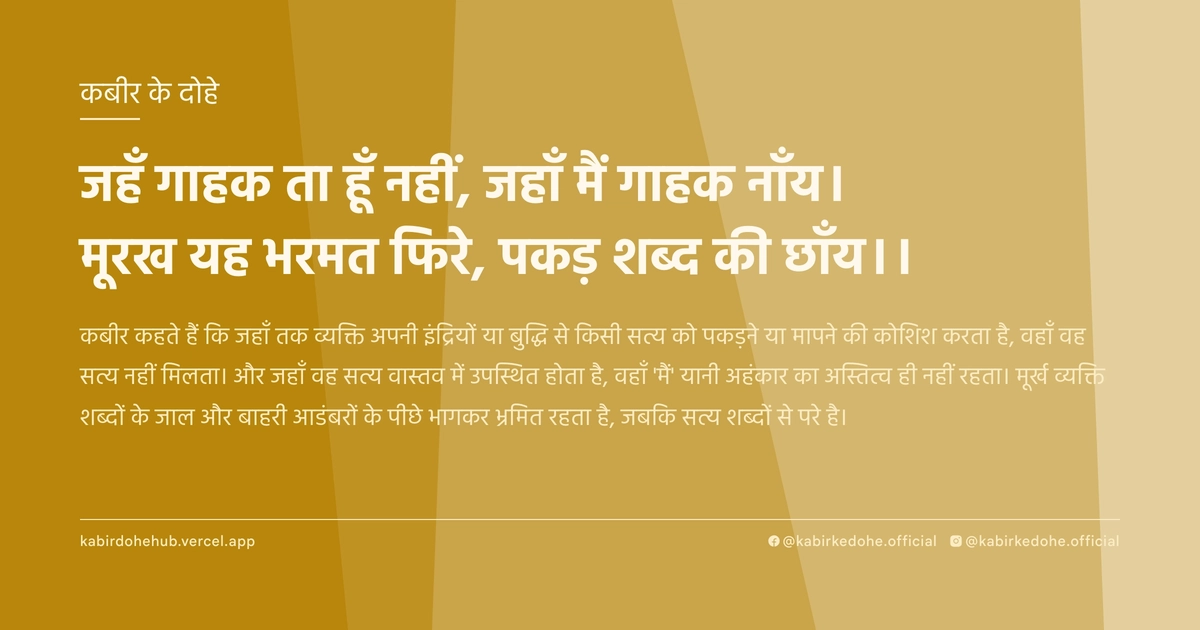
जहँ गाहक ता हूँ नहीं, जहाँ मैं गाहक नाँय।
मूरख यह भरमत फिरे, पकड़ शब्द की छाँय।।
Jahan gahak ta hun nahi, jahan main gahak naaye. Murakh yeh bharmat phire, pakad shabd ki chhaay.
इस पृष्ठ पर इस कबीर दोहे का अर्थ (meaning), हिंदी व्याख्या और अंग्रेज़ी अनुवाद, दार्शनिक विश्लेषण और व्यावहारिक जीवन सीख दी गई है। यह दोहा निर्गुण ब्रह्म (Nirguna Brahman) विषय से जुड़ा है — Kabir doha meaning and explanation in Hindi and English.
अर्थ (Meaning):
कबीर कहते हैं कि जहाँ तक व्यक्ति अपनी इंद्रियों या बुद्धि से किसी सत्य को पकड़ने या मापने की कोशिश करता है, वहाँ वह सत्य नहीं मिलता। और जहाँ वह सत्य वास्तव में उपस्थित होता है, वहाँ 'मैं' यानी अहंकार का अस्तित्व ही नहीं रहता। मूर्ख व्यक्ति शब्दों के जाल और बाहरी आडंबरों के पीछे भागकर भ्रमित रहता है, जबकि सत्य शब्दों से परे है।
Kabir asserts that wherever the seeker attempts to grasp or measure the Truth through the senses or the intellect, the Truth remains absent. Conversely, where the Truth actually resides, the 'I'—the ego—ceases to exist. The foolish wander in delusion, chasing the mere shadows of words and linguistic constructs, failing to realize that the Ultimate Reality transcends all verbal descriptions.
व्याख्या (Interpretation):
यह दोहा द्वैत और अद्वैत के बीच के गहन संघर्ष को दर्शाता है। 'गाहक' का अर्थ है पकड़ने वाला या मापने वाला; जब तक 'पकड़ने वाला' (अहंकार) मौजूद है, तब तक 'पकड़ा जाने वाला' (ईश्वर/सत्य) ओझल रहता है। यह निर्गुण भक्ति का सार है जहाँ ईश्वर किसी आकार या शब्द में नहीं, बल्कि शून्य में है। माया हमें शब्दों और परिभाषाओं के भ्रम में उलझाती है, जिससे हम सत्य की छाया को ही सत्य मान लेते हैं। जब तक 'मैं' का भाव है, तब तक केवल पृथकता है। जैसे ही यह 'मैं' विलीन होता है, केवल ब्रह्म शेष रहता है। यह विरोधाभास है कि सत्य को पाने का एकमात्र तरीका उसे खोजने की इच्छा का त्याग करना है।
This couplet illustrates the profound tension between duality and non-duality. 'Gahak' refers to the one who grasps or measures; as long as the 'grasper' (the ego) exists, the 'grasped' (Truth/God) remains elusive. This is the essence of Nirgun Bhakti, where the Divine is not found in forms or words, but in the void of selflessness. Maya entangles us in the illusion of definitions, leading us to mistake the shadow of the word for the substance of the Truth. As long as the sense of 'I' persists, only separation exists. Once this 'I' dissolves, only Brahman remains. It is the central paradox: the only way to attain the Truth is to surrender the desire to capture it.
दार्शनिक विश्लेषण (Philosophical Analysis):
कबीर का यह दृष्टिकोण उनके युग के कट्टरपंथी धार्मिक ढांचे पर एक प्रहार है। उस समय लोग वेदों, कुरान या अन्य ग्रंथों के शब्दों को ही अंतिम सत्य मानकर उनमें उलझे थे। कबीर ने स्पष्ट किया कि शब्द केवल संकेत हैं, गंतव्य नहीं। यह विचार अद्वैत वेदांत के 'नेति नेति' (यह नहीं, वह नहीं) के सिद्धांत से मेल खाता है, जहाँ सत्य को सभी सीमित परिभाषाओं को नकार कर ही पाया जा सकता है।
सूफीवाद के 'फना' (अहंकार का विनाश) की अवधारणा यहाँ स्पष्ट दिखती है। जब तक साधक अपनी पहचान को बनाए रखता है, वह परमात्मा से अलग रहता है। जैसे ही वह 'मैं' को मिटाता है, वह परमात्मा में विलीन हो जाता है। कबीर यहाँ शब्दों की 'छाया' की बात कर रहे हैं, जो कि बौद्धिक अहंकार का प्रतीक है। लोग शास्त्रों की व्याख्याओं में इतने खो जाते हैं कि वे अनुभव के वास्तविक मार्ग को भूल जाते हैं।
यह दोहा कर्मकांड और बाहरी पूजा के विरोध में खड़ा है। कबीर का तर्क है कि यदि आप किसी मंदिर या मस्जिद में 'मैं' लेकर जाते हैं, तो आप केवल अपनी ईगो को संतुष्ट कर रहे हैं, ईश्वर को नहीं पा रहे। वास्तविक भक्ति वह है जहाँ भक्त और भगवान के बीच का अंतर समाप्त हो जाए। यह मनोवैज्ञानिक रूपांतरण की प्रक्रिया है जहाँ व्यक्ति अपनी सीमित पहचान को सार्वभौमिक चेतना में बदल देता है।
ऐतिहासिक रूप से, कबीर ने जाति और धर्म की दीवारों को तोड़ने के लिए इस 'शून्य' या 'निर्गुण' की बात की। क्योंकि शब्द और शास्त्र अलग-अलग समुदायों को बांटते हैं, लेकिन मौन और अहंकार-शून्यता सबको एक करती है। उन्होंने सिखाया कि सत्य किसी विशेष भाषा या लिपि का मोहताज नहीं है।
अंततः, यह विश्लेषण हमें बताता है कि सत्य कोई वस्तु नहीं है जिसे 'पकड़ा' जा सके, बल्कि यह एक अवस्था है जिसमें 'पाया' जाता है। जब खोजने वाला ही खो जाता है, तब जो बचता है, वही सत्य है। यह बौद्धिक विसर्जन का आह्वान है ताकि हृदय का अनुभव जागृत हो सके।
Kabir's perspective is a direct assault on the rigid religious frameworks of his era. During his time, people were entangled in the literal interpretations of the Vedas, Quran, and other scriptures, treating the words as the ultimate truth. Kabir clarifies that words are merely signposts, not the destination. This aligns with the Advaita Vedanta principle of 'Neti Neti' (not this, not that), where Truth is realized only by negating all limited definitions.
The Sufi concept of 'Fana' (the annihilation of the self) is vividly present here. As long as the seeker maintains their separate identity, they remain apart from the Divine. The moment the 'I' is extinguished, they merge into the Absolute. Kabir speaks of the 'shadow of words,' symbolizing intellectual arrogance. People become so lost in the exegesis of texts that they forget the actual path of direct experience.
This couplet stands in opposition to ritualism and external worship. Kabir argues that if one enters a temple or mosque carrying the 'I', they are merely satisfying their ego, not encountering God. True devotion is that where the distinction between the devotee and the Divine vanishes. This is a process of psychological transformation where the individual shifts from a limited identity to a universal consciousness.
Historically, Kabir utilized the concept of the 'Void' or 'Nirgun' to dismantle the walls of caste and religion. While words and scriptures divide communities, silence and ego-lessness unite them. He taught that Truth is not dependent on any specific language or script.
Ultimately, this analysis reveals that Truth is not an object to be 'grasped,' but a state to be 'become.' When the seeker himself is lost, what remains is the Truth. It is a call for intellectual surrender so that the experiential heart may awaken.
मूल संदेश (Core Message):
- अहंकार की उपस्थिति सत्य की अनुपस्थिति है।
- शब्द केवल संकेत हैं, वे स्वयं सत्य नहीं हैं।
- सत्य को पकड़ा नहीं जा सकता, उसमें विलीन होना पड़ता है।
- बौद्धिक ज्ञान अक्सर वास्तविक अनुभव के मार्ग में बाधा बनता है।
- जब 'मैं' मिटता है, तब ब्रह्मांड का संगीत सुनाई देता है।
- मौन ही वह भाषा है जिसे सत्य समझता है।
- The presence of ego is the absence of Truth.
- Words are mere pointers; they are not the Truth itself.
- Truth cannot be grasped; one must merge into it.
- Intellectual knowledge often obstructs the path of direct experience.
- When the 'I' vanishes, the music of the universe is heard.
- Silence is the only language that Truth understands.
व्यावहारिक उदाहरण (Practical Example):
एक समय की बात है, वाराणसी के घाटों पर माधव नाम का एक वृद्ध बुनकर रहता था। माधव अपनी कला में निपुण था, लेकिन वह बहुत अहंकारी था। वह मानता था कि उसकी बुनाई की तकनीक दुनिया में सबसे श्रेष्ठ है और वह घंटों तक अन्य बुनकरों को उनके 'गलत' तरीकों के बारे में उपदेश देता था। वह खुद को सत्य का ज्ञाता मानता था क्योंकि उसने कई धार्मिक ग्रंथ पढ़े थे।
एक दिन वह एक फकीर से मिला जो नदी किनारे चुपचाप बैठा था। माधव ने अपने ज्ञान का प्रदर्शन करते हुए फकीर से पूछा, 'ईश्वर को पकड़ने का सही तरीका क्या है? मैंने शास्त्रों में पढ़ा है कि इसके लिए विशेष मंत्र और कठिन तपस्या चाहिए।' माधव को लगा कि फकीर उसे कोई गुप्त मंत्र देगा जिसे वह 'पकड़' कर अपनी श्रेष्ठता सिद्ध कर सकेगा।
फकीर ने मुस्कुराते हुए माधव से कहा, 'तुम जिस जाल को बुन रहे हो, उसमें मछली नहीं, बल्कि तुम खुद फंसे हो।' माधव क्रोधित हो गया और उसने तर्क दिया कि वह सत्य के शब्दों को जानता है। फकीर ने उसे एक खाली बर्तन दिया और कहा, 'इसमें वह पानी भरो जो कहीं नहीं बहता।'
माधव कई दिनों तक भटकता रहा। वह हर उस जगह गया जहाँ 'पवित्र' शब्द लिखे थे। वह गंगा के सबसे पवित्र घाटों पर गया, बड़े-बड़े पंडितों से मिला, और शब्दों के जाल में उलझ गया। उसे लगा कि वह सत्य के बहुत करीब है क्योंकि वह सही शब्दों का प्रयोग कर रहा था।
लेकिन एक शाम, जब वह पूरी तरह थक कर हार गया और उसका सारा अहंकार टूट गया, वह चुपचाप एक पत्थर पर बैठ गया। उसने अपनी सारी किताबों, अपनी श्रेष्ठता और अपनी 'मैं' की पहचान को किनारे रख दिया। उस गहरे मौन में, उसे अचानक महसूस हुआ कि जिस शांति को वह शब्दों में खोज रहा था, वह उसके भीतर ही मौजूद थी।
उसे समझ आया कि जब तक वह 'पकड़ने' की कोशिश कर रहा था, वह केवल अपनी इच्छाओं को पकड़ रहा था। जैसे ही उसने 'पकड़ने वाले' (स्वयं को) को भुला दिया, वह उस अनंत शांति का हिस्सा बन गया।
माधव का व्यवहार पूरी तरह बदल गया। अब वह दूसरों को उपदेश नहीं देता था, बल्कि उनकी मदद करता था। उसकी बुनाई अब अहंकार का प्रदर्शन नहीं, बल्कि एक प्रार्थना बन गई थी।
उसने जान लिया कि सत्य शब्दों की छाया में नहीं, बल्कि उस शून्य में है जहाँ 'मैं' समाप्त हो जाता है। वह अब एक महान बुनकर नहीं, बल्कि एक सरल मनुष्य बन गया था।
Once, on the ghats of Varanasi, lived an elderly weaver named Madhav. Madhav was masterly in his craft, but he was deeply arrogant. He believed his weaving technique was the finest in the world and spent hours lecturing other weavers on their 'incorrect' methods. He considered himself a knower of Truth because he had read many religious texts.
One day, he encountered a wandering dervish sitting silently by the river. To showcase his knowledge, Madhav asked, 'What is the correct way to grasp God? I have read in the scriptures that specific mantras and rigorous penance are required.' Madhav believed the dervish would give him a secret formula that he could 'grasp' to prove his superiority.
The dervish smiled and said, 'The net you are weaving has caught not the fish, but you yourself.' Madhav became angry and argued that he knew the exact words of Truth. The dervish handed him an empty vessel and said, 'Fill this with the water that flows nowhere.'
Madhav wandered for many days. He visited every place where 'sacred' words were written. He went to the holiest ghats of the Ganges, met high priests, and became entangled in a web of words. He felt he was close to the Truth because he was using the 'correct' terminology.
But one evening, completely exhausted and defeated, his arrogance finally broke. He sat silently on a stone. He cast aside all his books, his sense of superiority, and his identity as the 'knower.' In that profound silence, he suddenly realized that the peace he was searching for in words was already present within him.
He understood that as long as he was trying to 'grasp,' he was only grasping his own desires. The moment he forgot the 'grasper' (himself), he became a part of that infinite peace.
Madhav's behavior transformed completely. He no longer lectured others; instead, he served them. His weaving was no longer a display of ego, but a form of prayer.
He realized that Truth does not lie in the shadow of words, but in the void where the 'I' ends. He ceased to be a 'great weaver' and became a simple human being.
अभ्यास मार्गदर्शन (Practice Guidance):
- प्रतिदिन 20 मिनट 'शून्य ध्यान' का अभ्यास करें, जहाँ आप किसी भी विचार या शब्द को पकड़ने के बजाय केवल साक्षी बनें।
- एक डायरी लिखें जिसमें आप उन क्षणों को दर्ज करें जब आपका 'अहंकार' (मैं) आपको दूसरों से श्रेष्ठ या निम्न महसूस कराता है।
- जब भी आप किसी धार्मिक या आध्यात्मिक बहस में उलझें, तो स्वयं से पूछें: 'क्या मैं सत्य खोज रहा हूँ या केवल शब्दों की जीत?'
- व्यवहार परिवर्तन: दिन में कम से कम एक बार ऐसा कार्य करें जिसमें आपकी कोई पहचान न हो और आप पूरी तरह गुमनाम रहकर किसी की सेवा करें।
- निदान चेकलिस्ट: यदि आप अभी भी दूसरों को सुधारने की तीव्र इच्छा रखते हैं या शब्दों के माध्यम से अपनी आध्यात्मिक श्रेष्ठता सिद्ध करना चाहते हैं, तो आप अभी भी 'शब्दों की छाया' में हैं।
- Practice 20 minutes of 'Void Meditation' daily, where you act as a witness rather than trying to grasp any thought or word.
- Keep a journal recording moments when your 'ego' (the I) makes you feel superior or inferior to others.
- Whenever you are caught in a religious or spiritual debate, ask yourself: 'Am I seeking Truth, or merely the victory of words?'
- Behavioral Shift: Once a day, perform an act of service where your identity is completely hidden and you remain anonymous.
- Diagnostic Checklist: If you still feel an intense urge to correct others or prove your spiritual superiority through terminology, you are still chasing the 'shadow of words'.
चिंतन प्रश्न (Reflection Questions):
- मेरे जीवन में वे कौन से 'शब्द' या 'परिभाषाएं' हैं जिन्हें मैं सत्य मानकर अपनी पहचान बना चुका हूँ?
- क्या मेरी आध्यात्मिकता वास्तव में अहंकार का विसर्जन है, या यह केवल एक 'आध्यात्मिक अहंकार' का नया रूप है?
- जब मैं चुप होता हूँ, तो मेरे भीतर कौन सा डर उभरता है जो मुझे शब्दों के शोर में वापस धकेलता है?
- क्या मैं सत्य को खोजने की कोशिश कर रहा हूँ, या मैं केवल अपनी पूर्व-धारणाओं की पुष्टि करना चाहता हूँ?
- मेरे डिजिटल व्यक्तित्व (Social Media Ego) में मैं किस 'छाया' को असली सत्य के रूप में प्रस्तुत कर रहा हूँ?
- यदि मुझसे मेरी सभी उपाधियाँ, ज्ञान और मान्यताएं छीन ली जाएं, तो जो बचेगा, क्या वह सत्य के करीब होगा?
- What are the 'words' or 'definitions' in my life that I have mistaken for Truth to build my identity?
- Is my spirituality truly a dissolution of ego, or is it merely a new form of 'spiritual ego'?
- When I am silent, what fear emerges that pushes me back into the noise of words?
- Am I seeking the Truth, or am I merely seeking confirmation of my pre-existing beliefs?
- In my digital persona, what 'shadow' am I presenting as the ultimate truth?
- If all my titles, knowledge, and beliefs were stripped away, would what remains be closer to the Truth?