
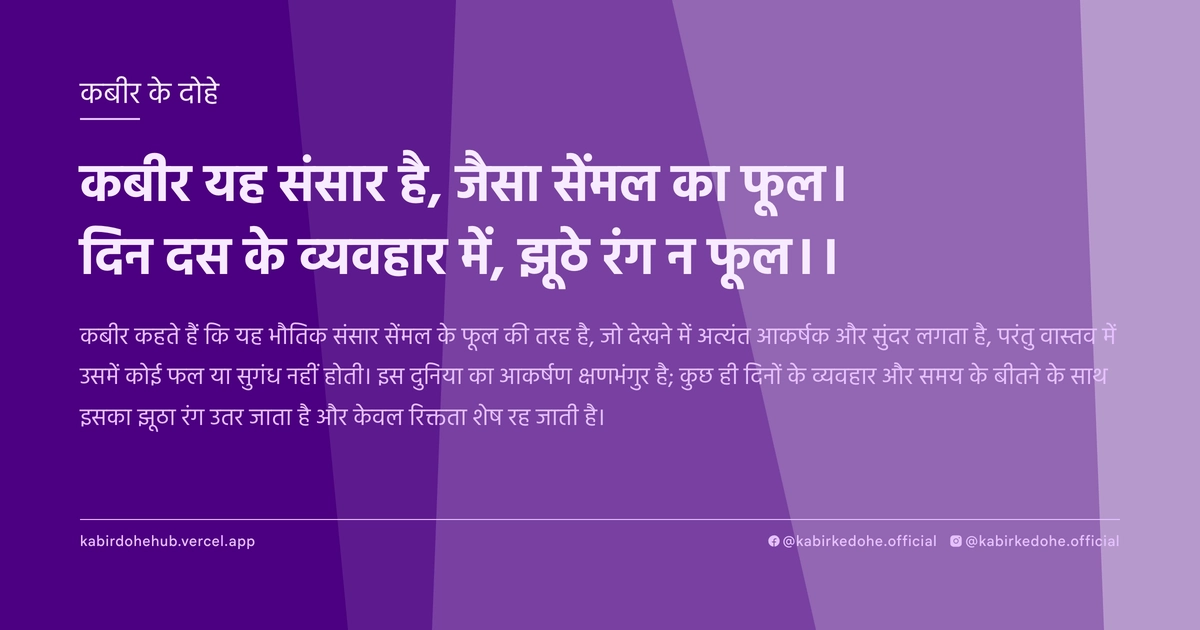
कबीर यह संसार है, जैसा सेंमल का फूल।
दिन दस के व्यवहार में, झूठे रंग न फूल।।
Kabir yeh sansar hai, jaisa semal ka phool. Din das ke vyavhar me, jhoothe rang na phool.
इस पृष्ठ पर इस कबीर दोहे का अर्थ (meaning), हिंदी व्याख्या और अंग्रेज़ी अनुवाद, दार्शनिक विश्लेषण और व्यावहारिक जीवन सीख दी गई है। यह दोहा अनित्य (Impermanence) विषय से जुड़ा है — Kabir doha meaning and explanation in Hindi and English.
अर्थ (Meaning):
कबीर कहते हैं कि यह भौतिक संसार सेंमल के फूल की तरह है, जो देखने में अत्यंत आकर्षक और सुंदर लगता है, परंतु वास्तव में उसमें कोई फल या सुगंध नहीं होती। इस दुनिया का आकर्षण क्षणभंगुर है; कुछ ही दिनों के व्यवहार और समय के बीतने के साथ इसका झूठा रंग उतर जाता है और केवल रिक्तता शेष रह जाती है।
Kabir asserts that this material world is akin to the flower of the silk-cotton tree (Semal), which appears strikingly beautiful and alluring to the eye, yet possesses neither fragrance nor fruit. The attractions of this world are ephemeral; within a short span of time and experience, the deceptive colors fade away, leaving behind only a hollow void.
व्याख्या (Interpretation):
कबीर यहाँ सेंमल के फूल का रूपकを用いて संसार की मायावी प्रकृति को दर्शाते हैं। जिस प्रकार सेंमल का फूल अपनी बाहरी चमक से भ्रमित करता है पर उसमें कोई实质िक लाभ नहीं होता, वैसे ही सांसारिक सुख और संबंध बाहरी तौर पर लुभावने होते हैं। यह 'माया' का वह जाल है जो जीव को सत्य से दूर रखता है। यह व्याख्या निर्गुण भक्ति के इस सिद्धांत पर आधारित है कि जो कुछ भी दृश्यमान और परिवर्तनशील है, वह मिथ्या है। आत्मा का वास्तविक मिलन उस निराकार ब्रह्म से है, न कि इन क्षणिक सुखों से। यहाँ 'दस दिन' का अर्थ जीवन की अल्पकालिकता से है, जो यह याद दिलाता है कि अहंकार और मोह का आधार अत्यंत कमजोर है। अंततः, यह दोहा अद्वैत वेदांत के उस सत्य की ओर संकेत करता है जहाँ केवल शुद्ध चेतना ही शाश्वत है और शेष सब एक भ्रम है।
Kabir employs the metaphor of the Semal flower to illustrate the illusory nature of the material world. Just as the silk-cotton flower deceives with its external brilliance while lacking any intrinsic fruit or scent, worldly pleasures and attachments appear alluring but are devoid of lasting substance. This is the veil of 'Maya' that keeps the soul estranged from the Ultimate Truth. The interpretation is rooted in the Nirgun Bhakti tradition, asserting that everything visible and subject to change is ephemeral. True union occurs with the Formless Brahman, not through transient gratifications. The phrase 'ten days' symbolizes the brevity of human existence, reminding us that the foundations of ego and attachment are fragile. Ultimately, this doha points toward the Advaita Vedanta truth where only pure consciousness is eternal, and all else is a fleeting mirage.
दार्शनिक विश्लेषण (Philosophical Analysis):
कबीर का यह दोहा उस सामाजिक और धार्मिक परिवेश में लिखा गया था जहाँ बाहरी आडंबरों और कर्मकांडों का बोलबाला था। उन्होंने देखा कि लोग बाहरी दिखावे, जातिगत श्रेष्ठता और धार्मिक प्रतीकों में उलझे हुए हैं, जबकि आंतरिक शुद्धि की उपेक्षा कर रहे हैं। सेंमल के फूल का उदाहरण देकर वे यह स्पष्ट करते हैं कि जिस प्रकार फूल की सुंदरता क्षणिक है, उसी प्रकार सामाजिक प्रतिष्ठा और भौतिक संपदा भी नश्वर है।
दार्शनिक स्तर पर, यह विचार सूफी मत के 'फना' (अहंकार का विनाश) और अद्वैत वेदांत के 'माया' सिद्धांत का संगम है। कबीर तर्क देते हैं कि जब तक मनुष्य इस संसार को सत्य मानता रहेगा, वह वास्तव में एक भ्रम में जी रहा है। वे ritualism का विरोध करते हैं क्योंकि कर्मकांड अक्सर बाहरी 'रंग' होते हैं जो आंतरिक शून्यता को ढकने का प्रयास करते हैं।
यहाँ मनोवैज्ञानिक परिवर्तन की बात की गई है। कबीर चाहते हैं कि साधक अपनी दृष्टि को 'बाहर' से हटाकर 'भीतर' की ओर मोड़े। जब व्यक्ति यह अनुभव करता है कि संसार का आकर्षण झूठा है, तब उसका मोह भंग होता है और वह वैराग्य की ओर अग्रसर होता है। यह वैराग्य पलायन नहीं, बल्कि सत्य की खोज है।
कबीर का दृष्टिकोण यह है कि ईश्वर किसी मंदिर या मस्जिद में नहीं, बल्कि उस सत्य में है जो इन सभी झूठे रंगों से परे है। वे मनुष्य को चेतावनी देते हैं कि यदि वह केवल बाहरी चमक-धमक के पीछे भागेगा, तो अंत में उसे केवल निराशा मिलेगी।
अंततः, यह विश्लेषण हमें सिखाता है कि वास्तविक शांति केवल तभी प्राप्त हो सकती है जब हम इस द्वैत (संसार बनाम आत्मा) को पार कर लें और यह समझ लें कि केवल वह निराकार तत्व ही सत्य है जिसे न तो समय नष्ट कर सकता है और न ही रंग फीके पड़ते हैं।
This doha was composed during an era dominated by external rituals and rigid social hierarchies. Kabir observed people entangled in outward displays, caste superiority, and religious symbols, while neglecting internal purification. By using the Semal flower as a metaphor, he clarifies that just as the flower's beauty is fleeting, so too are social prestige and material wealth.
Philosophically, this thought is a confluence of the Sufi concept of 'Fana' (annihilation of the ego) and the Advaita Vedanta doctrine of 'Maya'. Kabir argues that as long as a human perceives the material world as the ultimate reality, they are living within a delusion. He rejects ritualism because rituals are often mere external 'colors' used to mask an internal void.
There is a strong emphasis on psychological transformation. Kabir urges the seeker to shift their gaze from the 'external' to the 'internal'. When an individual realizes that worldly attraction is deceptive, their attachment breaks, leading them toward Vairagya (dispassion). This is not an escape from life, but a pursuit of Truth.
Kabir's perspective is that the Divine does not reside in temples or mosques, but in the Truth that exists beyond all these false colors. He warns that chasing external brilliance leads only to eventual despair and emptiness.
Ultimately, this analysis teaches us that true peace is attainable only when we transcend the duality of the world versus the soul and realize that only the Formless Element is eternal, untouched by time and immune to fading colors.
मूल संदेश (Core Message):
- बाहरी चमक अक्सर आंतरिक शून्यता का पर्दा होती है।
- संसार का आकर्षण क्षणभंगुर है, सत्य केवल निराकार है।
- मोह का त्याग ही वास्तविक स्वतंत्रता का एकमात्र मार्ग है।
- अहंकार की पहचान को मिटाकर ही आत्मा का बोध होता है।
- स्थायी सुख वस्तुओं में नहीं, बल्कि चेतना की गहराई में है।
- External brilliance is often a veil for internal emptiness.
- Worldly attraction is ephemeral; only the Formless is Truth.
- Renunciation of attachment is the only path to true freedom.
- The realization of the soul occurs only after erasing the ego's identity.
- Lasting happiness lies not in objects, but in the depths of consciousness.
व्यावहारिक उदाहरण (Practical Example):
वाराणसी के घाटों पर रहने वाली एक वृद्ध विधवा, जानकी, का जीवन अत्यंत कठिन था। वह दूसरों के घरों में छोटे-मोटे काम करके अपना गुजारा करती थी। उसके मन में हमेशा एक टीस रहती थी कि उसकी बेटी शहर में बहुत बड़े घर में ब्याही गई है और उसके पास गहनों और रेशमी साड़ियों का ढेर है। जानकी अक्सर अपनी बेटी की विलासितापूर्ण जीवनशैली की कल्पना करती और सोचती कि काश वह भी उस 'सुंदर संसार' का हिस्सा होती।
एक दिन उसकी बेटी उससे मिलने आई। वह महंगे वस्त्रों और सोने के आभूषणों से लदी हुई थी, लेकिन उसकी आँखों में एक गहरा दुख और थकान थी। उसने रोते हुए अपनी माँ को बताया कि उसका पति उसे समय नहीं देता, घर में निरंतर कलह है, और वह उन गहनों के बोझ तले दबी हुई है जो उसे समाज में 'सुंदर' दिखाते हैं, पर अंदर से वह अकेली और टूट चुकी है।
जानकी ने अपनी बेटी को देखा और उसे कबीर का वह दोहा याद आया—'सेंमल का फूल'। उसने महसूस किया कि जिस विलासिता को वह अब तक स्वर्ग समझ रही थी, वह वास्तव में एक झूठा रंग था। उसकी बेटी का जीवन बाहर से तो चमक रहा था, लेकिन अंदर से वह वैसा ही था जैसा सेंमल का फूल—बिना किसी सुगंध और फल के।
उस क्षण जानकी के भीतर एक गहरा परिवर्तन हुआ। उसने अपनी ईर्ष्या और अभाव की भावना को त्याग दिया। उसने महसूस किया कि उसकी अपनी गरीबी, जिसमें वह कम से कम मानसिक शांति और संतोष पाती थी, उस सोने के पिंजरे से कहीं बेहतर थी।
उसने अपनी बेटी का हाथ थामा और उसे समझाया कि असली सुंदरता आत्मा की शांति में है, न कि उन वस्तुओं में जो समय के साथ फीकी पड़ जाती हैं। जानकी ने अब अपनी छोटी सी कुटिया को ही अपना मंदिर मान लिया।
उसने अपनी बेटी को भी सिखाया कि कैसे बाहरी दिखावे के मोह को छोड़कर आंतरिक संतोष की खोज की जाए। धीरे-धीरे, उसकी बेटी ने भी अपनी भौतिक इच्छाओं को कम किया और अपने मानसिक स्वास्थ्य पर ध्यान देना शुरू किया।
जानकी अब घाटों पर बैठकर अन्य दुखियारे लोगों को सांत्वना देती थी। वह उन्हें बताती थी कि संसार के आकर्षण केवल कुछ दिनों के मेहमान हैं।
इस 'कबीर ट्विस्ट' ने जानकी को अभाव के दुख से मुक्त कर दिया और उसे एक ऐसी आंतरिक समृद्धि दी, जिसे कोई भी भौतिक संपत्ति नहीं खरीद सकती थी। वह अब वास्तव में स्वतंत्र थी।
Janaki, an elderly widow living on the ghats of Varanasi, led a precarious existence, earning a meager living by doing odd jobs in other people's homes. A constant ache lingered in her heart regarding her daughter, who had married into a wealthy family in the city and possessed an abundance of jewelry and silk sarees. Janaki often fantasized about her daughter's luxurious lifestyle, wishing she too could be part of that 'beautiful world'.
One day, her daughter came to visit. She was adorned in expensive clothes and gold ornaments, but her eyes held a profound sorrow and exhaustion. Weeping, she told her mother that her husband neglected her, the household was plagued by constant conflict, and she felt crushed under the weight of the jewelry that made her look 'beautiful' to society, while she remained lonely and broken inside.
Looking at her daughter, Janaki recalled Kabir's doha about the 'Semal flower'. She realized that the luxury she had long perceived as paradise was, in reality, a deceptive color. Her daughter's life shone brightly on the outside, but internally it was like the silk-cotton flower—devoid of any fragrance or fruit.
In that moment, a profound transformation occurred within Janaki. She relinquished her jealousy and the feeling of deprivation. She realized that her own poverty, which at least offered her mental peace and contentment, was far superior to that golden cage.
She held her daughter's hand and explained that true beauty lies in the peace of the soul, not in objects that fade with time.
Janaki then taught her daughter how to let go of the attachment to external appearances and seek internal satisfaction. Gradually, the daughter also reduced her material desires and began focusing on her mental well-being.
Janaki now spent her time on the ghats, offering solace to other suffering souls. She told them that the attractions of the world are merely guests for a few days.
This 'Kabir Twist' liberated Janaki from the pain of scarcity and granted her an internal richness that no material wealth could purchase. She was now truly free.
अभ्यास मार्गदर्शन (Practice Guidance):
- दैनिक चिंतन: प्रतिदिन 15 मिनट मौन बैठें और अपने जीवन की उन चीजों की सूची बनाएं जिन्हें आप 'अनिवार्य' मानते हैं। फिर विचार करें कि यदि वे कल गायब हो जाएं, तो आपकी आत्मा पर क्या प्रभाव पड़ेगा।
- आत्म-पूछताछ जर्नल: लिखें कि आपकी कौन सी सामाजिक पहचान (पद, प्रतिष्ठा, संपत्ति) आपको सबसे अधिक परिभाषित करती है और यह पहचान आपके आंतरिक सत्य को कैसे ढक रही है।
- व्यवहारिक परिवर्तन: सप्ताह में एक दिन 'सादगी दिवस' मनाएं, जहाँ आप न्यूनतम भौतिक सुखों का उपयोग करें और केवल अपनी सांसों और वर्तमान क्षण के प्रति जागरूक रहें।
- डायग्नोस्टिक चेकलिस्ट: क्या आप किसी की प्रशंसा पाकर अत्यधिक उत्साहित होते हैं? क्या किसी भौतिक वस्तु के खोने पर आप गहरे अवसाद में चले जाते हैं? यदि हाँ, तो आप अभी भी 'सेंमल के फूल' के आकर्षण में हैं।
- Daily Contemplation: Sit in silence for 15 minutes daily and list the things in your life you consider 'essential'. Then reflect on how your soul would be affected if they vanished tomorrow.
- Self-Inquiry Journal: Write about which social identity (status, prestige, wealth) defines you most and how this identity masks your internal truth.
- Behavioral Change: Observe a 'Simplicity Day' once a week, using minimal material luxuries and remaining consciously aware only of your breath and the present moment.
- Diagnostic Checklist: Do you feel excessively elated by someone's praise? Do you fall into deep despair upon losing a material object? If yes, you are still under the spell of the 'Semal flower'.
चिंतन प्रश्न (Reflection Questions):
- यदि आपकी सारी सामाजिक उपलब्धियां और डिजिटल पहचान (Social Media Profile) छीन ली जाएं, तो आपके पास 'स्वयं' के रूप में क्या बचेगा?
- आप अपने जीवन में किन 'झूठे रंगों' को सत्य मानकर पकड़े हुए हैं, जबकि वे आपको अंदर से खोखला कर रहे हैं?
- क्या आपकी दयालुता वास्तव में निस्वार्थ है, या यह समाज में अपनी छवि सुधारने का एक सूक्ष्म तरीका है?
- आप किस डर से उस शांति की ओर नहीं बढ़ पा रहे हैं जहाँ कोई बाहरी आकर्षण नहीं है?
- क्या आप अपनी आत्मा की सुगंध को पहचानते हैं, या आप अभी भी दूसरों द्वारा दिए गए 'इत्र' (प्रशंसा) पर निर्भर हैं?
- If all your social achievements and digital identities were stripped away, what would remain of 'you' as a self?
- Which 'false colors' are you clinging to as truth in your life, while they are actually hollowing you out from within?
- Is your kindness truly selfless, or is it a subtle way of improving your image in society?
- What fear prevents you from moving toward that peace where no external attraction exists?
- Do you recognize the fragrance of your own soul, or are you still dependent on the 'perfume' (praise) given by others?