
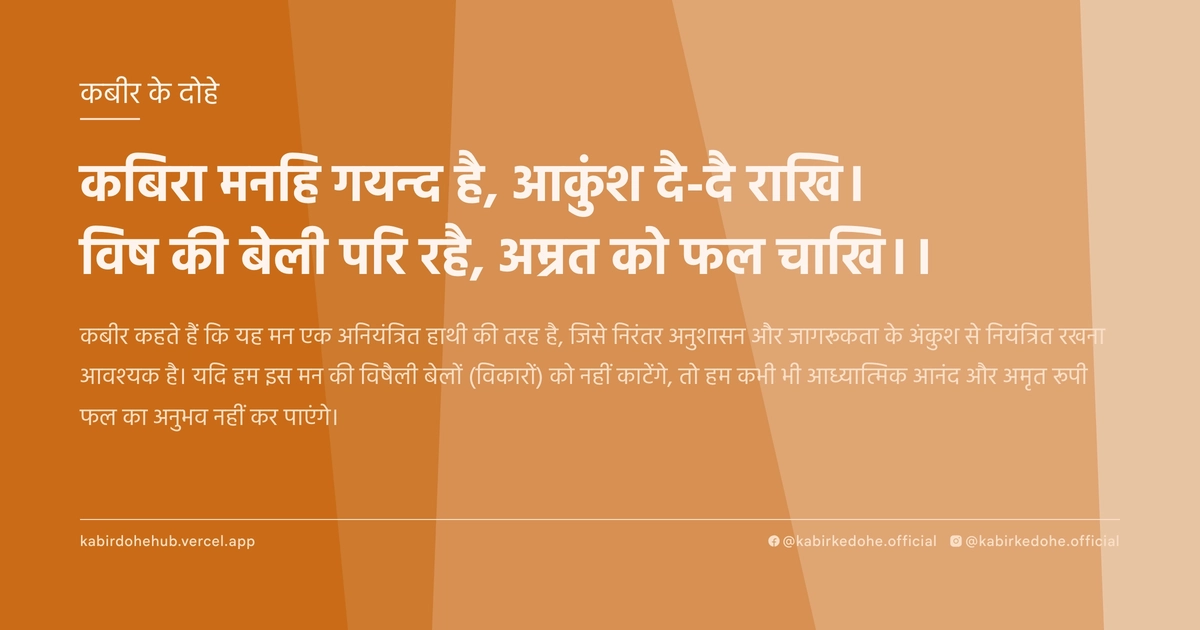
कबिरा मनहि गयन्द है, आकुंश दै-दै राखि।
विष की बेली परि रहै, अम्रत को फल चाखि।।
Kabira manahi gayand hai, akunsh dai-dai rakh. Vish ki beli pari rahai, amrat ko phal chakh.
इस पृष्ठ पर इस कबीर दोहे का अर्थ (meaning), हिंदी व्याख्या और अंग्रेज़ी अनुवाद, दार्शनिक विश्लेषण और व्यावहारिक जीवन सीख दी गई है। यह दोहा मन नियंत्रण (Mind Control) विषय से जुड़ा है — Kabir doha meaning and explanation in Hindi and English.
अर्थ (Meaning):
कबीर कहते हैं कि यह मन एक अनियंत्रित हाथी की तरह है, जिसे निरंतर अनुशासन और जागरूकता के अंकुश से नियंत्रित रखना आवश्यक है। यदि हम इस मन की विषैली बेलों (विकारों) को नहीं काटेंगे, तो हम कभी भी आध्यात्मिक आनंद और अमृत रूपी फल का अनुभव नहीं कर पाएंगे।
Kabir asserts that the human mind is akin to a wild, unrestrained elephant that must be kept in check through the constant application of the 'ankush' or goad of mindfulness. Only by pruning the poisonous vines of desire and ego can one eventually taste the nectar of divine liberation.
व्याख्या (Interpretation):
यहाँ 'गयन्द' (हाथी) मन की अदम्य इच्छाओं और अहंकार का प्रतीक है जो विवेक को कुचल देता है। 'आकुंश' का अर्थ है आत्म-संयम और निरंतर सजगता। कबीर समझाते हैं कि मन स्वभाव से चंचल और वासनाओं से भरा है, जो एक विषैली बेल की तरह आत्मा को जकड़े रहता है। यह निरगुण भक्ति का मार्ग है जहाँ बाहरी कर्मकांडों के बजाय आंतरिक युद्ध पर बल दिया गया है। जब साधक माया के भ्रम को पहचान कर मन को वश में करता है, तब वह द्वैत से अद्वैत की ओर बढ़ता है। अंततः, जब विष (काम, क्रोध, लोभ) समाप्त होता है, तब आत्मा का वास्तविक स्वरूप 'अमृत' के रूप में प्रकट होता है।
The 'gayand' (elephant) symbolizes the untamed mind and the towering ego that tramples over reason and spiritual discernment. The 'aakunsh' represents the discipline of mindfulness and the sharp edge of self-awareness. Kabir posits that the mind is inherently erratic, entwined in 'vish ki beli'—the poisonous vines of worldly attachments and sensory cravings. This aligns with Nirgun Bhakti, emphasizing an internal struggle over external rituals. The central paradox is that the very mind which enslaves the seeker is the only tool available for liberation. By applying the goad of spiritual practice, the seeker transcends the illusion of Maya, moving from the duality of 'I' and 'Thou' toward the non-dual realization of Atman-Brahman, where the poison of ego transforms into the nectar of enlightenment.
दार्शनिक विश्लेषण (Philosophical Analysis):
कबीर का यह दोहा मध्यकालीन भारत के सामाजिक और धार्मिक संक्रमण काल की उपज है, जहाँ कर्मकांड और बाहरी आडंबर चरम पर थे। कबीर ने स्पष्ट किया कि मोक्ष किसी मंदिर, मस्जिद या तीर्थयात्रा में नहीं, बल्कि मन के रूपांतरण में है। यह दृष्टिकोण सूफी मत के 'नफ्स' (lower self) के नियंत्रण और अद्वैत वेदांत के 'मनोनाश' के सिद्धांत से मेल खाता है।
यहाँ 'विष की बेल' केवल पाप नहीं, बल्कि वह सूक्ष्म अहंकार है जो हमें सत्य से अलग करता है। कबीर का तर्क है कि जब तक मन अनियंत्रित है, तब तक ज्ञान केवल सूचना है, अनुभव नहीं। वे जाति और धर्म के भेदभाव को नकारते हुए यह बताते हैं कि मन का अनुशासन सार्वभौमिक है।
मनोवैज्ञानिक स्तर पर, यह दोहा 'इच्छा-शक्ति' और 'विवेक' के बीच के संघर्ष को दर्शाता है। हाथी की तरह मन शक्तिशाली है, लेकिन दिशाहीन है। अंकुश का प्रयोग कठोरता नहीं, बल्कि प्रेमपूर्ण अनुशासन है।
सूफीवाद में इसे 'मुजाहदा' (आंतरिक संघर्ष) कहा गया है, जहाँ साधक अपनी वासनाओं को मारकर ईश्वर के प्रेम में विलीन होता है। कबीर इसे 'सहज' मार्ग कहते हैं, जहाँ जागरूकता ही सबसे बड़ा शस्त्र है।
अंततः, यह विश्लेषण हमें बताता है कि आध्यात्मिक प्रगति का पैमाना बाहरी उपलब्धियाँ नहीं, बल्कि मन की शांति और स्थिरता है। जब मन शांत होता है, तब वह दर्पण बन जाता है जिसमें परमात्मा का प्रतिबिंब स्पष्ट दिखाई देता है।
This couplet emerges from the socio-religious ferment of medieval India, a period dominated by rigid ritualism and caste hierarchies. Kabir disrupts these norms by relocating the site of liberation from the external temple or mosque to the internal landscape of the mind. His philosophy mirrors the Sufi concept of 'Nafs' (the lower self) and the Advaita Vedanta principle of dissolving the ego to realize the Absolute.
The 'poisonous vine' is not merely sin, but the subtle overlay of Maya—the illusion of separation. Kabir argues that without the 'ankush' of discernment, spiritual knowledge remains mere intellectual data rather than a lived experience. He rejects the notion that salvation is a gift of grace alone; it requires the active, disciplined pruning of the ego.
Psychologically, the metaphor of the elephant illustrates the raw power of subconscious drives. The mind is an engine of immense energy, but without a driver, it leads to chaos. The 'goad' is not an instrument of torture, but a tool of redirection, transforming chaotic energy into focused consciousness.
Connecting this to the Bhakti movement, Kabir emphasizes 'Nirgun' (formless) devotion. He suggests that the highest form of worship is the mastery of one's own impulses. This is the 'annihilation of the self' (Fana in Sufism), where the individual identity vanishes into the universal truth.
Ultimately, the philosophical core is the transformation of consciousness. The shift from 'poison' to 'nectar' is not a change in external circumstances, but a shift in perception. When the mind ceases to be a wild animal and becomes a steady flame, the seeker realizes that the nectar was always there, hidden beneath the vines of desire.
मूल संदेश (Core Message):
- अनियंत्रित मन आध्यात्मिक मार्ग की सबसे बड़ी बाधा है।
- सजगता और अनुशासन ही मन को शांत करने के एकमात्र साधन हैं।
- बाहरी आडंबरों से अधिक महत्वपूर्ण आंतरिक शुद्धि है।
- वासनाओं का त्याग ही वास्तविक आनंद का द्वार खोलता है।
- जब अहंकार मिटता है, तब आत्मा का अमृत स्वरूप प्रकट होता है।
- An unrestrained mind is the primary obstacle on the spiritual path.
- Mindfulness and discipline are the only tools to tame the internal chaos.
- Internal purification is far more vital than external religious displays.
- The renunciation of cravings opens the gateway to authentic bliss.
- When the ego dissolves, the nectar of the soul is finally revealed.
व्यावहारिक उदाहरण (Practical Example):
वाराणसी के एक पुराने घाट पर माधव नाम का एक वृद्ध बुनकर रहता था। वह अपनी कला में निपुण था, लेकिन उसका स्वभाव अत्यंत क्रोधी था। छोटी सी बात पर वह अपने शिष्यों और परिवार पर चिल्लाने लगता था। उसका मन उस जंगली हाथी की तरह था जो क्रोध के आवेश में सब कुछ तहस-नहस कर देता था।
एक दिन उसने देखा कि एक छोटा बच्चा बड़ी शांति से एक उलझे हुए धागे को सुलझा रहा है। माधव ने उससे पूछा, 'बेटा, तुम इतनी शांति से यह कैसे कर रहे हो?' बच्चे ने मासूमियत से कहा, 'बाबा, अगर मैं गुस्से में धागे को खींचूँगा, तो वह और उलझ जाएगा। मुझे बस रुकना है और देखना है कि धागा कहाँ से मुड़ा है।'
यह बात माधव के हृदय में गहरे तक उतर गई। उसे एहसास हुआ कि उसका क्रोध उस 'विष की बेल' की तरह है जिसने उसके जीवन के सुखों को जकड़ लिया है। उसने तय किया कि वह अपने मन को 'अंकुश' देगा।
अगली बार जब उसे क्रोध आया, तो उसने तुरंत प्रतिक्रिया देने के बजाय अपनी सांसों पर ध्यान केंद्रित किया। उसने मन में कहा, 'रुको, यह हाथी फिर से भाग रहा है।' उसने अपनी प्रतिक्रिया को रोकने का अभ्यास शुरू किया।
शुरुआत में यह बहुत कठिन था। उसका मन उसे उकसाता था कि वह चिल्लाए और अपनी श्रेष्ठता सिद्ध करे। लेकिन माधव ने हर बार मौन का अंकुश लगाया।
धीरे-धीरे, उसके व्यवहार में परिवर्तन आने लगा। जो लोग उससे डरते थे, अब वे उसके पास शांति और सलाह के लिए आने लगे। उसके घर का वातावरण तनावपूर्ण से प्रेमपूर्ण हो गया।
उसने पाया कि जब उसने क्रोध की बेल को काटा, तो उसके भीतर एक अद्भुत शांति का अनुभव हुआ। वह अब केवल कपड़े नहीं बुन रहा था, बल्कि अपने जीवन के बिखरे हुए रिश्तों को बुन रहा था।
माधव ने महसूस किया कि असली 'अमृत' किसी बाहरी तीर्थ में नहीं, बल्कि उस क्षण में था जब उसने अपने मन के हाथी को वश में किया। उसकी कला में अब एक नई गहराई थी, क्योंकि वह अब शांति से सृजन कर रहा था।
On an ancient ghat in Varanasi lived an elderly weaver named Madhav. While he was a master of his craft, his temperament was volatile. He was prone to sudden outbursts of rage, shouting at his apprentices and family over the smallest mistakes. His mind was like that wild elephant, trampling everything in its path during a fit of anger.
One afternoon, he observed a young child patiently untangling a knot of silk thread. Madhav asked, 'Child, how are you so calm while dealing with this mess?' The boy replied simply, 'Baba, if I pull the thread in anger, the knot only tightens. I must stop, breathe, and see where the thread has turned.'
These words struck a chord deep within Madhav. He realized that his anger was the 'poisonous vine' that had strangled the joy and peace of his existence. He decided that he must apply the 'ankush' to his own mind.
The next time a surge of rage rose within him, instead of reacting, he focused on his breath. He whispered to himself, 'Stop; the elephant is running wild again.' He began the rigorous practice of pausing before responding.
Initially, the struggle was immense. His ego urged him to shout and assert his dominance to feel powerful. However, he consistently applied the goad of silence and awareness.
Slowly, a transformation occurred. Those who once feared him began to seek his company for peace and guidance. The atmosphere of his home shifted from one of tension to one of tenderness.
He discovered that by pruning the vine of anger, a profound inner stillness emerged. He was no longer just weaving fabric; he was weaving the fragmented relationships of his life back together.
Madhav realized that the true 'nectar' was not found in any distant pilgrimage, but in the precise moment he mastered the wild elephant of his mind. His art attained a new dimension of grace, for it was now born of serenity.
अभ्यास मार्गदर्शन (Practice Guidance):
- साक्षी भाव का अभ्यास: दिन में तीन बार 10 मिनट के लिए बैठें और अपने विचारों को बिना किसी निर्णय के देखें, जैसे आप किसी और के विचारों को देख रहे हों।
- प्रतिक्रिया अंतराल (The Pause): जब भी क्रोध या तीव्र इच्छा जागे, प्रतिक्रिया देने से पहले 5 लंबी गहरी सांसें लें। इसे 'मन का अंकुश' कहें।
- आत्म-पूछताछ जर्नल: प्रतिदिन रात को लिखें—'आज मेरे मन के हाथी ने कब विद्रोह किया? मैंने उसे कैसे नियंत्रित किया या मैं कहाँ विफल रहा?'
- डायग्नोस्टिक चेकलिस्ट: क्या मैं छोटी बातों पर विचलित होता हूँ? क्या मेरी प्रतिक्रियाएं मेरी जागरूकता से तेज हैं? क्या मैं दूसरों को नियंत्रित करने की कोशिश करता हूँ जबकि मेरा अपना मन अनियंत्रित है?
- Practice of Witness Consciousness: Sit for 10 minutes three times a day and observe your thoughts without judgment, as if you are watching a stranger's mind.
- The Response Gap: Whenever a surge of anger or intense desire arises, take 5 long, deep breaths before reacting. Label this action as 'Applying the Goad'.
- Self-Inquiry Journaling: Every night, record—'When did the elephant of my mind rebel today? How did I restrain it, or where did I fail?'
- Diagnostic Checklist: Do I get agitated by trivialities? Are my reactions faster than my awareness? Am I attempting to control others while my own mind remains wild?
चिंतन प्रश्न (Reflection Questions):
- मेरे जीवन में वह 'जंगली हाथी' कौन सी इच्छा या आदत है जो मेरे विवेक को कुचल रही है?
- मैं अपनी छवि (Image) को बचाने के लिए कितनी बार अपने आंतरिक सत्य का गला घोंटता हूँ?
- क्या मेरी 'आध्यात्मिकता' केवल एक सामाजिक मुखौटा है, या मैंने वास्तव में अपने विकारों पर अंकुश लगाया है?
- वह कौन सा 'विष' है जिसे मैं अमृत समझकर वर्षों से संजोए हुए हूँ?
- यदि मेरा मन एक दर्पण होता, तो आज उसमें क्या दिखाई देता—शांति या तूफान?
- Which specific desire or habit in my life is the 'wild elephant' currently trampling my discernment?
- How often do I sacrifice my internal truth simply to preserve my public image or digital ego?
- Is my 'spirituality' merely a social mask, or have I actually applied the goad to my inner vices?
- What is the 'poison' that I have been nurturing for years, mistakenly believing it to be nectar?
- If my mind were a mirror right now, would it reflect a still lake or a raging storm?