
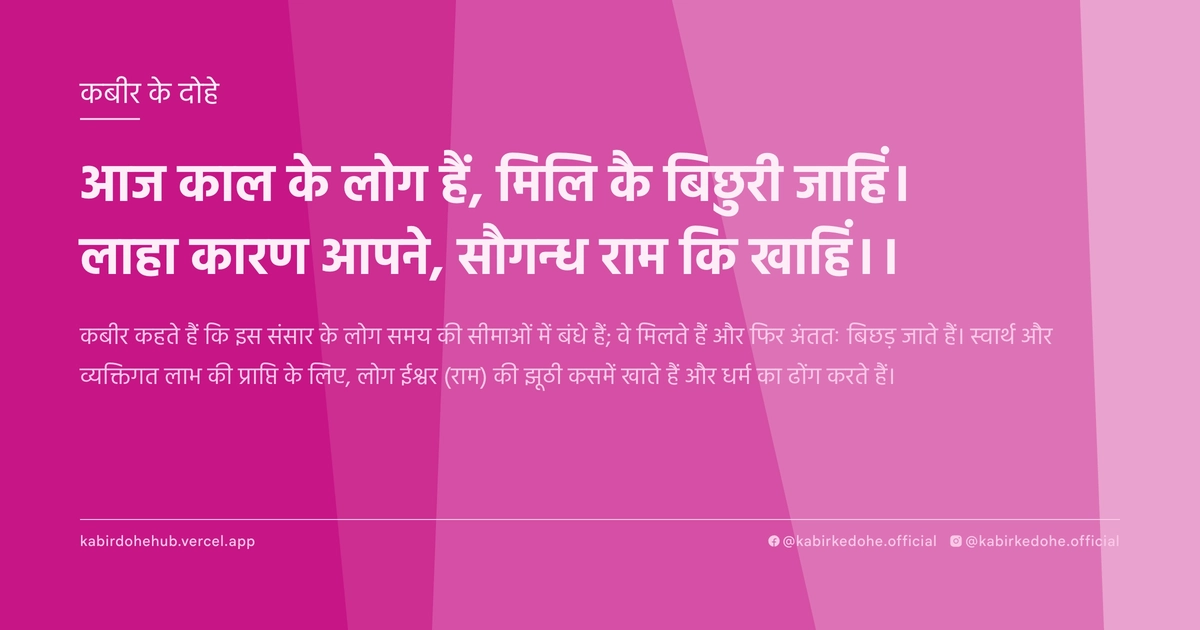
आज काल के लोग हैं, मिलि कै बिछुरी जाहिं।
लाहा कारण आपने, सौगन्ध राम कि खाहिं।।
Aaj kaal ke log hain, mili kai bichhuri jahin. Laha karan apne, saugandh Ram ki khahin.
इस पृष्ठ पर इस कबीर दोहे का अर्थ (meaning), हिंदी व्याख्या और अंग्रेज़ी अनुवाद, दार्शनिक विश्लेषण और व्यावहारिक जीवन सीख दी गई है। यह दोहा अनित्य (Impermanence) विषय से जुड़ा है — Kabir doha meaning and explanation in Hindi and English.
अर्थ (Meaning):
कबीर कहते हैं कि इस संसार के लोग समय की सीमाओं में बंधे हैं; वे मिलते हैं और फिर अंततः बिछड़ जाते हैं। स्वार्थ और व्यक्तिगत लाभ की प्राप्ति के लिए, लोग ईश्वर (राम) की झूठी कसमें खाते हैं और धर्म का ढोंग करते हैं।
Kabir observes that the inhabitants of this temporal world are bound by time; they meet only to eventually part ways. Driven by personal greed and selfish gain, they swear oaths in the name of the Divine (Ram) to deceive others and validate their lies.
व्याख्या (Interpretation):
इसका शाब्दिक अर्थ है कि मानवीय संबंध क्षणभंगुर हैं। गहरे स्तर पर, 'काल' केवल समय नहीं, बल्कि अज्ञानता और माया का प्रतीक है। कबीर यहाँ उस विरोधाभास को उजागर कर रहे हैं जहाँ मनुष्य अपनी भौतिक इच्छाओं (लाहा) को पूरा करने के लिए उस अनंत सत्य (राम) का उपयोग एक उपकरण के रूप में करता है। यह निर्गुण भक्ति का आह्वान है, जो बाहरी कर्मकांडों और झूठी शपथों के बजाय आंतरिक सत्य पर जोर देता है। आत्मा और परमात्मा की एकता तब तक संभव नहीं है जब तक अहंकार और लोभ का पर्दा मौजूद है।
Literally, it speaks of the transience of human bonds. Metaphorically, 'Kaal' represents not just time, but the grip of Maya (illusion) and ignorance. Kabir highlights the paradox where humans use the Eternal Truth (Ram) as a mere tool to achieve temporal, selfish gains. This is a call toward Nirgun Bhakti, emphasizing internal authenticity over external rituals and false oaths. The non-duality of Atman and Brahman remains obscured as long as the veil of ego and greed persists, reducing the Divine to a witness for human deception.
दार्शनिक विश्लेषण (Philosophical Analysis):
कबीर का यह दोहा उनके युग के सामाजिक और धार्मिक पाखंड पर एक तीखा प्रहार है। उन्होंने देखा कि कैसे धर्म का उपयोग सत्ता और संपत्ति के संचय के लिए किया जाता था। यह विश्लेषण अद्वैत वेदांत के इस सिद्धांत से मेल खाता है कि जब तक मनुष्य स्वयं को शरीर और नाम (अहंकार) से जोड़ता है, वह माया के जाल में फंसा रहता है।
सूफी मत के 'फना' (अहंकार का विनाश) के विचार की तरह, कबीर यहाँ चेतावनी देते हैं कि जब तक 'मैं' (स्वार्थ) जीवित है, तब तक 'राम' केवल एक शब्द है, अनुभव नहीं। वे जाति और संप्रदाय से ऊपर उठकर सत्य की खोज की बात करते हैं।
यहाँ 'राम' शब्द का प्रयोग दशरथ पुत्र राम के लिए नहीं, बल्कि उस सर्वव्यापी चेतना के लिए है जो कण-कण में व्याप्त है। जब कोई व्यक्ति राम की शपथ खाता है, तो वह वास्तव में उस चेतना का अपमान कर रहा होता है क्योंकि वह सत्य को झूठ के साथ मिला रहा है।
मनोवैज्ञानिक स्तर पर, यह दोहा मानवीय असुरक्षा और लालच के अंतर्संबंध को दर्शाता है। हम दूसरों को धोखा देने के लिए सबसे पवित्र चीज़ों का सहारा लेते हैं क्योंकि हमारा डर और लोभ हमारी चेतना पर हावी होता है।
अंततः, कबीर यह समझाते हैं कि वास्तविक भक्ति बाहरी प्रदर्शन में नहीं, बल्कि ईमानदारी और निस्वार्थता में है। जब तक व्यक्ति अपने स्वार्थ (लाहा) का त्याग नहीं करता, वह काल के चक्र से मुक्त नहीं हो सकता और न ही वास्तविक मोक्ष प्राप्त कर सकता है।
This couplet is a sharp critique of the social and religious hypocrisy prevalent during Kabir's era. He observed how religion was weaponized for the accumulation of power and wealth. This analysis aligns with Advaita Vedanta's principle that as long as a human identifies with the body and name (ego), they remain trapped in the web of Maya.
Mirroring the Sufi concept of 'Fana' (annihilation of the self), Kabir warns that as long as the 'I' (selfishness) survives, 'Ram' remains a mere word rather than a lived experience. He transcends caste and sect to advocate for a raw, unadulterated search for Truth.
Crucially, 'Ram' here does not refer to the historical king of Ayodhya, but to the omnipresent consciousness pervading every atom. When a person swears by Ram to deceive, they are insulting that very consciousness by blending the Eternal Truth with a temporal lie.
Psychologically, the verse illustrates the intersection of human insecurity and greed. We lean on the most sacred symbols to deceive others because our fear and desire dominate our conscious awareness.
Ultimately, Kabir posits that genuine devotion lies not in external displays but in integrity and selflessness. Until one renounces the pursuit of personal gain (Laaha), they cannot escape the cycle of time (Kaal) or achieve true liberation.
मूल संदेश (Core Message):
- स्वार्थ के लिए धर्म का उपयोग आध्यात्मिक पतन है।
- सत्य की शपथ नहीं, सत्य का आचरण ही वास्तविक पूजा है।
- मानवीय संबंध क्षणभंगुर हैं, केवल शाश्वत सत्य स्थायी है।
- अहंकार और लोभ ईश्वर और आत्मा के बीच की दीवार हैं।
- बाहरी पाखंड को त्यागकर आंतरिक ईमानदारी को अपनाएं।
- Using faith for selfish gain is a path of spiritual decline.
- Living the truth is superior to swearing by it.
- Human bonds are transient; only the Eternal Truth endures.
- Ego and greed are the walls between the soul and the Divine.
- Discard external hypocrisy to embrace internal integrity.
व्यावहारिक उदाहरण (Practical Example):
एक समय की बात है, बनारस के घाटों पर रहने वाला एक वृद्ध बुनकर था, जिसका नाम माधव था। माधव अपनी ईमानदारी के लिए जाना जाता था, लेकिन उसके चारों ओर के व्यापारी अक्सर एक-दूसरे को धोखा देते थे और ईश्वर की कसमें खाकर झूठ बोलते थे।
माधव का एक प्रतिद्वंद्वी था, जो उससे भी अधिक कपड़े बेचता था क्योंकि वह घटिया धागों का उपयोग करता था और ग्राहकों से कहता था, 'राम की सौगंध, यह सबसे शुद्ध रेशम है।'
माधव चुपचाप देखता रहा कि कैसे उसका प्रतिद्वंद्वी झूठ बोलकर अधिक धन कमा रहा था और समाज में प्रतिष्ठित बन रहा था। माधव को लगा कि शायद ईमानदारी का मार्ग कठिन और असफल है।
एक दिन, उस व्यापारी का सारा माल एक बड़ी आग में जल गया। उसने अपनी पूरी संपत्ति खो दी और उसके जिन ग्राहकों को उसने धोखा दिया था, उनमें से कोई भी उसकी मदद के लिए आगे नहीं आया।
व्यापारी माधव के पास गया और रोते हुए कहा, 'मैंने राम की कसमें खाकर दुनिया को ठगा, लेकिन अंत में मैं अकेला रह गया। मेरा धन तो गया ही, मेरा विश्वास भी चला गया।'
माधव ने उसे शांत किया और कहा, 'तुमने राम का नाम अपनी जेब भरने के लिए लिया, जबकि राम तो उस सत्य में बसते हैं जो हमें दूसरों से जोड़ता है, अलग नहीं करता।'
उस क्षण व्यापारी को कबीर की इस बात का बोध हुआ कि स्वार्थ के लिए ली गई शपथ केवल एक बोझ है जो अंततः व्यक्ति को तोड़ देती है।
व्यापारी ने अपना शेष जीवन ईमानदारी से जीने का संकल्प लिया। उसने अब 'राम' की शपथ नहीं ली, बल्कि अपने काम की गुणवत्ता को ही अपनी प्रार्थना बना लिया।
उसने सीखा कि भौतिक लाभ क्षणभंगुर है, लेकिन सत्य की नींव पर बनाया गया जीवन ही स्थायी होता है।
माधव और वह पूर्व-प्रतिद्वंद्वी अब साथ मिलकर काम करते थे, जहाँ लाभ से अधिक महत्व सत्य और आपसी विश्वास को दिया जाता था।
Once, in the ghats of Varanasi, lived an elderly weaver named Madhav. Madhav was known for his unwavering honesty, while the merchants around him often deceived one another, swearing by God to validate their lies.
Madhav had a rival who outsold him because he used inferior threads but told customers, 'I swear by Ram, this is the purest silk.'
Madhav watched silently as his rival amassed wealth and prestige through deception. For a moment, Madhav wondered if the path of integrity was merely a road to failure.
One day, a massive fire broke out in the rival's warehouse, destroying all his stock. He lost his entire fortune, and not a single customer he had cheated stepped forward to help him.
The broken merchant approached Madhav and wept, 'I used Ram's name to cheat the world, but in the end, I am utterly alone. I lost my wealth, and more importantly, my credibility.'
Madhav comforted him, saying, 'You used Ram's name to fill your pockets, forgetting that Ram resides in the Truth that unites us, not the lies that divide us.'
In that moment, the merchant realized the essence of Kabir's warning: an oath taken for selfish gain is merely a burden that eventually crushes the soul.
The merchant vowed to spend the rest of his life in honesty. He stopped swearing oaths of Ram and instead made the quality of his work his living prayer.
He learned that material gain is transient, but a life built on the foundation of Truth is the only enduring achievement.
Madhav and his former rival began working together, where integrity and mutual trust were valued far above profit.
अभ्यास मार्गदर्शन (Practice Guidance):
- दैनिक आत्म-निरीक्षण: प्रतिदिन 15 मिनट मौन बैठें और विचार करें कि आज आपने कितनी बार अपनी छवि बचाने के लिए या लाभ के लिए सत्य को मोड़ा।
- सत्य-अभ्यास जर्नल: एक डायरी लिखें जिसमें उन स्थितियों का वर्णन करें जहाँ आपने 'सुविधाजनक झूठ' बोला। विश्लेषण करें कि उस झूठ के पीछे कौन सा डर या लालच था।
- वाक्-शुद्धि: संकल्प लें कि आप किसी भी बात की पुष्टि के लिए ईश्वर, परिवार या किसी पवित्र वस्तु की शपथ नहीं लेंगे। अपनी बात की जिम्मेदारी स्वयं लें।
- निदान चेकलिस्ट: क्या आप दूसरों की प्रशंसा पाने के लिए अपनी उपलब्धियों को बढ़ा-चढ़ाकर बताते हैं? क्या आप धर्म का उपयोग दूसरों को नियंत्रित करने के लिए करते हैं? यदि हाँ, तो आप अभी भी 'काल' के प्रभाव में हैं।
- Daily Self-Inquiry: Sit in silence for 15 minutes daily and reflect on how many times you bent the truth today to protect your image or gain an advantage.
- Truth-Practice Journal: Keep a diary documenting situations where you told 'convenient lies.' Analyze the specific fear or greed that drove that deception.
- Purification of Speech: Vow to stop using oaths in the name of God, family, or sacred objects to validate your words. Take full personal responsibility for your statements.
- Diagnostic Checklist: Do you exaggerate achievements to win admiration? Do you use religion or morality to manipulate others? If yes, you are still operating under the influence of 'Kaal' (egoic time).
चिंतन प्रश्न (Reflection Questions):
- मैं अपनी सार्वजनिक छवि को बनाए रखने के लिए किन 'पवित्र झूठों' का सहारा लेता हूँ?
- क्या मेरा धर्म मेरे भीतर करुणा जगाता है, या यह केवल मेरी श्रेष्ठता सिद्ध करने का एक साधन है?
- यदि आज मेरे पास कोई सामाजिक पद या संपत्ति न हो, तो क्या मेरी ईमानदारी तब भी बनी रहेगी?
- मैं किन लोगों के साथ केवल इसलिए जुड़ा हूँ क्योंकि वे मेरे किसी भौतिक लाभ के काम आ सकते हैं?
- क्या मैं ईश्वर को एक प्रेमी के रूप में देखता हूँ या एक ऐसे न्यायाधीश के रूप में जिससे मैं डरकर झूठ बोलता हूँ?
- What 'sacred lies' do I employ to maintain my public persona?
- Does my faith evoke genuine compassion, or is it merely a tool to prove my superiority?
- If I were stripped of all social status and wealth, would my integrity remain intact?
- Which of my relationships are based solely on the potential for material gain?
- Do I perceive the Divine as a beloved presence or as a judge whom I fear and deceive?