
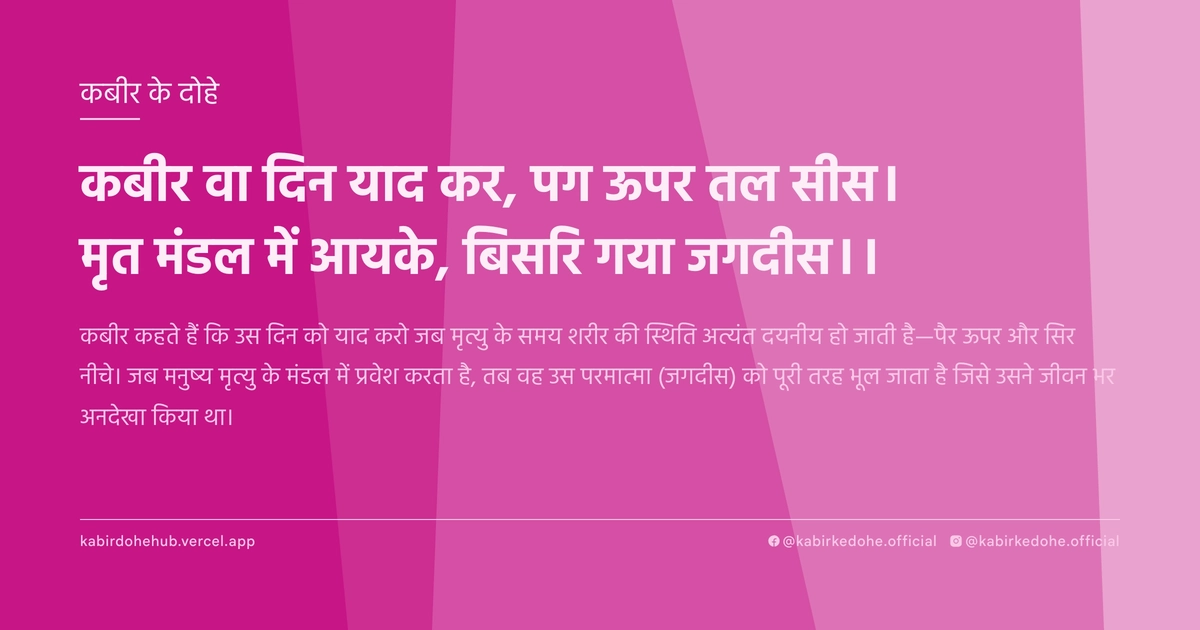
कबीर वा दिन याद कर, पग ऊपर तल सीस।
मृत मंडल में आयके, बिसरि गया जगदीस।।
Kabir va din yaad kar, pag upar tal sees. Mrit mandal mein aayke, bisari gaya jagdees.
इस पृष्ठ पर इस कबीर दोहे का अर्थ (meaning), हिंदी व्याख्या और अंग्रेज़ी अनुवाद, दार्शनिक विश्लेषण और व्यावहारिक जीवन सीख दी गई है। यह दोहा मृतुक्यता (Mortality) विषय से जुड़ा है — Kabir doha meaning and explanation in Hindi and English.
अर्थ (Meaning):
कबीर कहते हैं कि उस दिन को याद करो जब मृत्यु के समय शरीर की स्थिति अत्यंत दयनीय हो जाती है—पैर ऊपर और सिर नीचे। जब मनुष्य मृत्यु के मंडल में प्रवेश करता है, तब वह उस परमात्मा (जगदीस) को पूरी तरह भूल जाता है जिसे उसने जीवन भर अनदेखा किया था।
Kabir urges us to contemplate the moment of death, where the physical body is rendered helpless, often overturned in its final rites. He warns that upon entering the realm of the dead, the soul realizes it has forgotten the Divine (Jagdees) throughout its earthly existence, leading to a profound spiritual void.
व्याख्या (Interpretation):
यह दोहा मृत्यु की नश्वरता और मानवीय विस्मृति के बीच के विरोधाभास को दर्शाता है। 'पग ऊपर तल सीस' केवल शारीरिक स्थिति नहीं, बल्कि अहंकार के पूर्ण पतन का प्रतीक है। कबीर यहाँ निरगुण भक्ति के उस पहलू को छूते हैं जहाँ माया का पर्दा केवल मृत्यु के क्षण में हटता है। यह अद्वैत वेदांत के उस सत्य को उजागर करता है कि आत्मा और ब्रह्म एक हैं, लेकिन अहंकार (माया) ने हमें इस सत्य से दूर कर दिया है। जब शरीर मृत मंडल में होता है, तब व्यक्ति को अहसास होता है कि उसने बाहरी आडंबरों में समय गँवाया और आंतरिक परमात्मा को भुला दिया। यह एक चेतावनी है कि जागृति मृत्यु के बाद नहीं, बल्कि जीवन के दौरान होनी चाहिए।
This couplet illustrates the paradox between physical mortality and spiritual oblivion. The phrase 'feet above, head below' symbolizes not just the physical state of a corpse, but the total collapse of the human ego. Kabir touches upon the Nirgun Bhakti aspect where the veil of Maya is only lifted at the moment of death. It highlights the Advaita Vedanta truth that the Atman and Brahman are one, yet the ego has estranged us from this reality. When the body enters the 'mrit mandal' (realm of the dead), the soul realizes it squandered its life on external rituals while forgetting the internal Divine. It serves as a stark warning that spiritual awakening must occur during life, not as a post-mortem realization.
दार्शनिक विश्लेषण (Philosophical Analysis):
कबीर का यह दोहा मध्यकालीन भारत के उस समय का है जब धर्म केवल कर्मकांडों और बाहरी दिखावे तक सीमित था। कबीर ने पुरजोर तरीके से उन रीति-रिवाजों का विरोध किया जो मनुष्य को वास्तविक ईश्वर से दूर ले जाते थे। यहाँ 'जगदीस' का अर्थ किसी मूर्ति या मंदिर के देवता से नहीं, बल्कि उस सर्वव्यापी चेतना से है जो हर कण में व्याप्त है।
दार्शनिक स्तर पर, यह सूफी मत के 'फना' (अहंकार का विनाश) और वेदांत के 'माया' सिद्धांत का संगम है। कबीर तर्क देते हैं कि मनुष्य अपनी सामाजिक पहचान, जाति और संपत्ति के अहंकार में इतना डूबा रहता है कि वह अपनी वास्तविक प्रकृति को भूल जाता है। मृत्यु वह अंतिम सत्य है जो सभी सामाजिक मुखौटों को उतार फेंकता है।
यह विश्लेषण स्पष्ट करता है कि कबीर केवल मृत्यु का भय नहीं दिखा रहे, बल्कि 'मृत्यु-चेतना' (Memento Mori) के माध्यम से जीवन को सार्थक बनाने का आह्वान कर रहे हैं। वे बताते हैं कि जब तक हम जीवित हैं, हमारे पास अपनी चेतना को शुद्ध करने का अवसर है।
अहंकार का विलोपन ही मोक्ष का मार्ग है। कबीर के अनुसार, जो व्यक्ति जीवन में ही 'मर गया' (अर्थात जिसने अपने अहंकार को मार दिया), वह मृत्यु के समय विचलित नहीं होता।
अंततः, यह दोहा हमें याद दिलाता है कि आध्यात्मिक यात्रा बाहरी तीर्थों की नहीं, बल्कि भीतर की ओर है। यदि हम जीवन भर आंतरिक मौन और प्रेम का अभ्यास नहीं करते, तो मृत्यु के समय केवल पछतावा शेष रहता है।
Kabir's couplet emerges from a medieval Indian context where religion had devolved into mere ritualism and outward displays of piety. Kabir vehemently rejected these practices, arguing that they distanced the seeker from the actual Divine. Here, 'Jagdees' does not refer to an idol or a temple deity, but to the omnipresent consciousness pervading every atom of existence.
Philosophically, this is a confluence of the Sufi concept of 'Fana' (annihilation of the ego) and the Vedantic theory of 'Maya'. Kabir argues that humans are so immersed in their social identities, caste, and material wealth that they forget their true nature. Death is the ultimate truth that strips away all social masks.
This analysis clarifies that Kabir is not merely instilling a fear of death, but is calling for a meaningful life through 'death-consciousness' (Memento Mori). He suggests that as long as we are alive, we possess the opportunity to purify our consciousness.
The dissolution of the ego is the only path to liberation. According to Kabir, one who has 'died' while living (meaning one who has slain their ego) remains undisturbed at the moment of physical death.
Ultimately, this couplet reminds us that the spiritual journey is not toward external pilgrimages but inward. If we do not practice internal silence and love during our lifetime, only regret remains at the end.
मूल संदेश (Core Message):
- अहंकार वह पर्दा है जो हमें परमात्मा से अलग करता है।
- मृत्यु का भय केवल उन्हें होता है जिन्होंने जीवन को नहीं जिया।
- बाहरी कर्मकांड आंतरिक शून्यता को नहीं भर सकते।
- सच्ची भक्ति स्वयं के मिथ्या अहंकार का विसर्जन है।
- जागृति का समय 'अभी' है, अंत समय की प्रतीक्षा न करें।
- आत्मा का मिलन केवल निस्वार्थता के मार्ग से संभव है।
- The ego is the veil that separates us from the Divine.
- Fear of death exists only for those who never truly lived.
- External rituals cannot fill an internal void of spirit.
- True devotion is the dissolution of the false self.
- The time for awakening is 'now'; do not wait for the end.
- Union of the soul is possible only through the path of selflessness.
व्यावहारिक उदाहरण (Practical Example):
वाराणसी के घाटों पर रहने वाले एक वृद्ध बुनकर, रामदीन की कहानी है। रामदीन ने अपना पूरा जीवन केवल बेहतरीन रेशमी वस्त्र बनाने और धन संचय करने में लगा दिया। वह स्वयं को शहर का सबसे कुशल बुनकर मानता था और अन्य बुनकरों को तुच्छ समझता था। उसका अहंकार उसके कौशल के साथ बढ़ता गया।
वह अक्सर मंदिरों में भारी दान देता था ताकि समाज में उसकी प्रतिष्ठा बढ़े, लेकिन उसने कभी किसी गरीब की वास्तविक मदद नहीं की और न ही अपने मन के भीतर झाँका। वह मानता था कि उसकी धार्मिकता उसके दान और अनुष्ठानों से सिद्ध होती है।
एक दिन रामदीन गंभीर रूप से बीमार पड़ा। उसके पास धन तो बहुत था, लेकिन उसके बच्चे केवल उसकी संपत्ति के उत्तराधिकारी बनने की प्रतीक्षा कर रहे थे, उनके मन में पिता के प्रति कोई वास्तविक प्रेम नहीं था।
अपनी अंतिम सांसों के दौरान, जब वह बिस्तर पर असहाय पड़ा था, उसने देखा कि उसकी सारी रेशमी साड़ियाँ और सोने के सिक्के अब उसके किसी काम के नहीं थे। उसे याद आया कि कैसे उसने जीवन भर केवल 'बाहरी चमक' को पूजा।
तभी उसकी मुलाकात एक साधारण साधु से हुई जिसने उससे कहा, 'रामदीन, तूने कपड़े तो बहुत सुंदर बुने, लेकिन अपनी आत्मा का वस्त्र मैला छोड़ दिया।'
यह बात रामदीन के हृदय में एक बिजली की तरह कौंधी। उसे अहसास हुआ कि जिस 'जगदीस' को वह मंदिर की मूर्तियों में खोज रहा था, वह वास्तव में उसके भीतर की करुणा और सरलता में था जिसे उसने अहंकार की भेंट चढ़ा दिया था।
उसने अपने अंतिम क्षणों में अपनी सारी संपत्ति उन बुनकरों के बच्चों की शिक्षा के लिए समर्पित कर दी जिन्हें उसने कभी नीचा दिखाया था।
उसकी आँखों में आँसू थे, लेकिन मन में एक असीम शांति थी। उसने महसूस किया कि अहंकार का गिरना ही वास्तव में जागृति की शुरुआत है।
रामदीन ने अब यह जान लिया था कि मृत्यु शरीर का अंत है, लेकिन अहंकार का अंत ही वास्तविक जीवन की शुरुआत है।
उसका जीवन अब एक बोझ नहीं, बल्कि एक समर्पण बन गया था, और उसने अंततः उस परमात्मा को पा लिया जिसे वह जीवन भर भूल गया था।
This is the story of Ramdeen, an elderly weaver living on the ghats of Varanasi. Ramdeen spent his entire life focusing solely on creating the finest silk garments and accumulating wealth. He considered himself the most skilled weaver in the city and looked down upon others.
His ego grew alongside his skill. He often made lavish donations to temples to enhance his social prestige, but he never truly helped a poor soul or looked within his own heart. He believed his righteousness was proven by his donations and rituals.
One day, Ramdeen fell gravely ill. While he had immense wealth, his children were merely waiting to become heirs to his property; there was no genuine love for their father in their hearts.
During his final breaths, lying helpless in bed, he realized that all his silk sarees and gold coins were now useless. He remembered how he had spent his entire life worshipping only 'external brilliance'.
At that moment, he met a simple monk who told him, 'Ramdeen, you wove beautiful clothes, but you left the garment of your soul soiled.'
These words struck Ramdeen like a bolt of lightning. He realized that the 'Jagdees' he sought in temple idols was actually within the compassion and simplicity he had sacrificed to his ego.
In his final moments, he dedicated all his wealth to the education of the children of the weavers he had once belittled.
There were tears in his eyes, but an infinite peace in his mind. He felt that the fall of the ego is actually the beginning of awakening.
Ramdeen now understood that while death is the end of the body, the end of the ego is the beginning of true life.
His life was no longer a burden but a surrender, and he finally found the Divine that he had forgotten throughout his existence.
अभ्यास मार्गदर्शन (Practice Guidance):
- प्रतिदिन 15 मिनट 'मृत्यु-ध्यान' करें: कल्पना करें कि आप अपने शरीर को छोड़ चुके हैं और केवल एक साक्षी के रूप में अपने जीवन के कार्यों को देख रहे हैं।
- आत्म-पूछताछ जर्नल: हर रात लिखें कि आज आपने कितनी बार अपने अहंकार (मैं, मेरा, मेरा पद) को प्राथमिकता दी और कितनी बार निस्वार्थ प्रेम को।
- व्यवहार परिवर्तन: दिन में कम से कम एक ऐसा कार्य करें जिसमें आपको कोई श्रेय (Credit) न मिले और वह पूरी तरह गुप्त रहे।
- डायग्नोस्टिक चेकलिस्ट: क्या आप अभी भी अपनी पहचान अपने पद, धन या ज्ञान से जोड़ते हैं? क्या आप दूसरों को उनकी सामाजिक स्थिति से आंकते हैं? यदि हाँ, तो आप अभी भी 'माया' के प्रभाव में हैं।
- Daily 'Death Meditation' for 15 minutes: Imagine you have left your body and are observing your life's actions solely as a witness.
- Self-Inquiry Journal: Every night, record how many times you prioritized your ego (I, mine, my status) versus selfless love.
- Behavioral Shift: Perform at least one act of kindness daily that brings you no credit and remains completely anonymous.
- Diagnostic Checklist: Do you still tie your identity to your position, wealth, or knowledge? Do you judge others by their social status? If yes, you are still under the influence of 'Maya'.
चिंतन प्रश्न (Reflection Questions):
- यदि आज आपकी मृत्यु हो जाए, तो आपकी कौन सी उपलब्धियाँ वास्तव में मायने रखेंगी और कौन सी निरर्थक होंगी?
- आपकी सार्वजनिक छवि (Public Image) और आपके आंतरिक एकांत के बीच कितना अंतर है?
- क्या आपका धर्म दूसरों को छोटा दिखाने का साधन बन गया है या यह आपको विनम्र बना रहा है?
- आप किस 'माया' (पद, संबंध, संपत्ति) को अपना स्थायी सत्य मान बैठे हैं?
- जब आप अकेले होते हैं, तो क्या आप उस 'जगदीस' को महसूस कर पाते हैं या केवल अपने विचारों के शोर में खो जाते हैं?
- क्या आप अपनी गलतियों को स्वीकार करने का साहस रखते हैं, या आपका अहंकार उन्हें सही ठहराता है?
- If you were to die today, which of your achievements would truly matter and which would be meaningless?
- How wide is the gap between your public image and your internal solitude?
- Has your religion become a tool to belittle others, or is it making you more humble?
- Which 'Maya' (status, relationship, wealth) have you mistaken for your permanent truth?
- When you are alone, can you feel the 'Jagdees' or are you lost in the noise of your own thoughts?
- Do you have the courage to accept your mistakes, or does your ego justify them?