
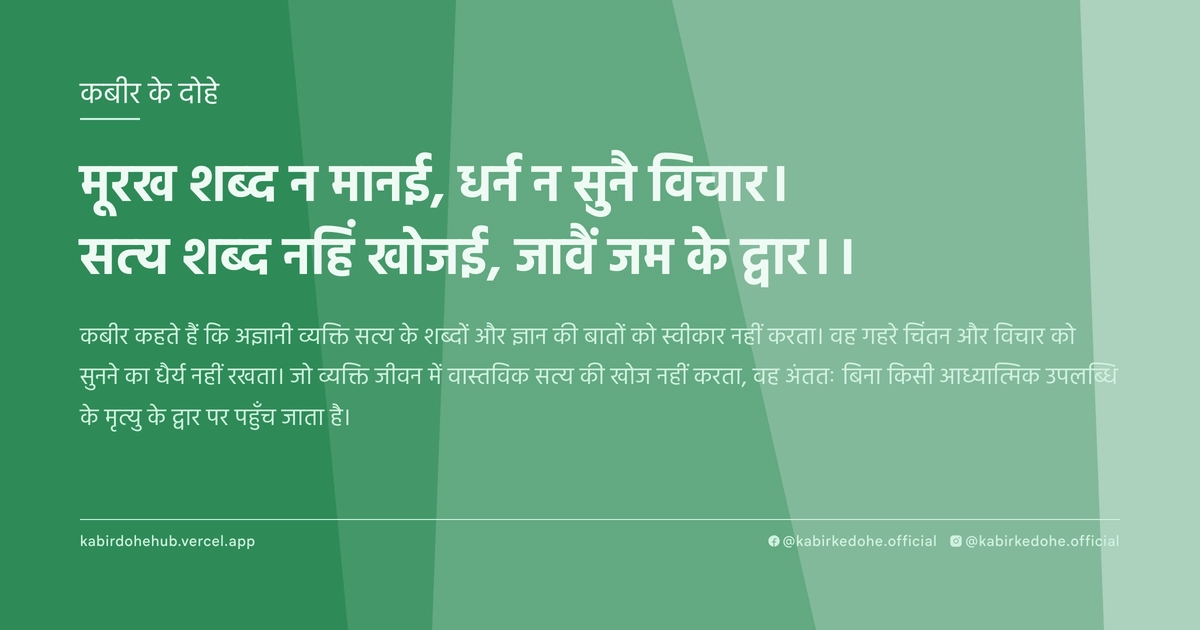
मूरख शब्द न मानई, धर्न न सुनै विचार।
सत्य शब्द नहिं खोजई, जावैं जम के द्वार।।
Murakh shabd na manai, dharn na sunai vichaar. Satya shabd nahin khojai, jaaven jam ke dwaar.
इस पृष्ठ पर इस कबीर दोहे का अर्थ (meaning), हिंदी व्याख्या और अंग्रेज़ी अनुवाद, दार्शनिक विश्लेषण और व्यावहारिक जीवन सीख दी गई है। यह दोहा सत्य (Truth) विषय से जुड़ा है — Kabir doha meaning and explanation in Hindi and English.
अर्थ (Meaning):
कबीर कहते हैं कि अज्ञानी व्यक्ति सत्य के शब्दों और ज्ञान की बातों को स्वीकार नहीं करता। वह गहरे चिंतन और विचार को सुनने का धैर्य नहीं रखता। जो व्यक्ति जीवन में वास्तविक सत्य की खोज नहीं करता, वह अंततः बिना किसी आध्यात्मिक उपलब्धि के मृत्यु के द्वार पर पहुँच जाता है।
Kabir asserts that the ignorant person refuses to acknowledge the words of truth or heed the call of spiritual wisdom. Such an individual lacks the patience for deep contemplation and introspection. By failing to seek the ultimate Truth during their lifetime, they inevitably face the gates of death in a state of spiritual bankruptcy.
व्याख्या (Interpretation):
यहाँ 'मूरख' केवल साक्षरता की कमी नहीं, बल्कि आध्यात्मिक अंधता है। 'शब्द' का अर्थ यहाँ केवल ध्वनि नहीं, बल्कि 'नाद' या वह ईश्वरीय कंपन है जो सत्य का बोध कराता है। कबीर समझाते हैं कि जब मनुष्य अहंकार के वश में होता है, तो वह सत्य को सुनने की क्षमता खो देता है। यह स्थिति अद्वैत वेदांत के 'अविद्या' (अज्ञान) के समान है, जहाँ आत्मा स्वयं को शरीर और अहंकार मान लेती है। जब तक व्यक्ति बाहरी शोर को छोड़कर आंतरिक मौन में सत्य को नहीं खोजता, वह माया के जाल में फँसा रहता है। अंततः, यह अज्ञान उसे जन्म-मृत्यु के चक्र में बांधे रखता है, जिससे वह 'जम के द्वार' यानी विनाश की ओर अग्रसर होता है।
In this context, 'Murakh' (fool) does not refer to a lack of formal education, but to spiritual blindness. 'Shabd' represents more than mere words; it is the 'Naad' or the divine vibration that awakens consciousness. Kabir explains that when a human is consumed by ego, they lose the capacity to perceive the Truth. This state mirrors the concept of 'Avidya' (ignorance) in Advaita Vedanta, where the Atman mistakenly identifies with the transient body and ego. Until one transcends external noise to find the Truth in inner silence, they remain trapped in Maya. Consequently, this ignorance binds them to the cycle of Samsara, leading them toward the 'gates of Yama,' symbolizing spiritual failure and inevitable decay.
दार्शनिक विश्लेषण (Philosophical Analysis):
कबीर का यह दोहा मध्यकालीन भारत के उस दौर का है जब धर्म केवल कर्मकांडों और बाहरी दिखावे तक सीमित हो गया था। कबीर ने पुरोहितवाद और रूढ़िवादिता पर कड़ा प्रहार किया, क्योंकि उनका मानना था कि सत्य किसी मंदिर, मस्जिद या शास्त्र में नहीं, बल्कि स्वयं के भीतर है। यह विचार निर्गुण भक्ति का मूल है, जहाँ ईश्वर को किसी आकार या गुण में नहीं, बल्कि एक निराकार चेतना के रूप में देखा जाता है।
दार्शनिक स्तर पर, यह दोहा सूफीवाद के 'फना' (अहंकार का विनाश) और वेदांत के 'ज्ञान मार्ग' का संगम है। कबीर तर्क देते हैं कि जब तक 'मैं' (अहंकार) जीवित है, तब तक 'सत्य' का प्रवेश असंभव है। अज्ञानी वह है जो शब्दों को केवल सूचना मानता है, जबकि सत्य एक अनुभव है। वह व्यक्ति जो केवल शास्त्र पढ़ता है पर उसे जीवन में नहीं उतारता, वह भी कबीर की दृष्टि में 'मूरख' है।
यहाँ 'जम के द्वार' का उल्लेख केवल मृत्यु के भय के रूप में नहीं, बल्कि चेतना के पतन के रूप में किया गया है। यह एक चेतावनी है कि समय सीमित है और आध्यात्मिक जागृति के बिना जीवन व्यर्थ है। कबीर यहाँ मनोवैज्ञानिक रूपांतरण की बात कर रहे हैं—अहंकार से शून्य की ओर यात्रा।
यह दोहा सामाजिक भेदभाव और जाति व्यवस्था की जड़ों पर प्रहार करता है। कबीर का मानना था कि सत्य किसी विशेष जाति या धर्म की बपौती नहीं है। जो भी सत्य की खोज में समर्पित है, वह ज्ञानी है, चाहे उसकी सामाजिक स्थिति कुछ भी हो।
अंततः, यह विश्लेषण हमें बताता है कि सत्य की खोज के लिए सबसे पहले अपनी अज्ञानता को स्वीकार करना आवश्यक है। जब तक हम यह नहीं मानते कि हम अज्ञानी हैं, हम सीखने की प्रक्रिया शुरू नहीं कर सकते। यही वह बिंदु है जहाँ से मोक्ष का मार्ग प्रशस्त होता है।
This couplet emerges from a medieval Indian era where religion had devolved into mere ritualism and outward displays of piety. Kabir launched a fierce critique against priestly hegemony and orthodoxy, asserting that Truth resides not in temples, mosques, or scriptures, but within the self. This is the cornerstone of Nirgun Bhakti, where the Divine is perceived as a formless consciousness rather than a deity with specific attributes.
Philosophically, this verse is a confluence of the Sufi concept of 'Fana' (annihilation of the ego) and the 'Jnana Marga' (path of knowledge) of Advaita Vedanta. Kabir argues that as long as the 'I' (ego) persists, the realization of Truth remains impossible. The 'fool' is not the unlettered, but the one who treats spiritual words as mere information rather than a lived experience. One who recites scriptures without embodying them is, in Kabir's eyes, equally ignorant.
The reference to the 'gates of Yama' is not merely a threat of death, but a metaphor for the degradation of consciousness. It serves as a stark warning that time is finite and a life devoid of spiritual awakening is a wasted existence. Kabir is advocating for a psychological transformation—a journey from the density of ego to the lightness of emptiness.
Furthermore, this teaching strikes at the roots of social stratification and the caste system. Kabir believed that Truth is not the monopoly of any specific caste or creed. Anyone dedicated to the pursuit of Truth is a sage, regardless of their social standing.
Ultimately, this analysis reveals that the first step toward Truth is the courageous admission of one's own ignorance. Until we acknowledge our blindness, the process of learning cannot begin. This admission is the precise threshold where the path to liberation opens.
मूल संदेश (Core Message):
- अहंकार सत्य के मार्ग में सबसे बड़ी बाधा है।
- बाहरी कर्मकांड आंतरिक रूपांतरण का विकल्प नहीं हो सकते।
- सत्य को सुनने के लिए पहले सुनना सीखना होगा।
- अज्ञानता का अर्थ जानकारी का अभाव नहीं, बल्कि अहंकार की उपस्थिति है।
- जीवन का वास्तविक उद्देश्य स्वयं के भीतर के सत्य को खोजना है।
- Ego is the primary obstacle on the path to Truth.
- External rituals can never substitute for internal transformation.
- To hear the Truth, one must first learn the art of listening.
- Ignorance is not a lack of information, but the presence of ego.
- The true purpose of life is to discover the Truth within oneself.
व्यावहारिक उदाहरण (Practical Example):
वाराणसी के घाटों पर रहने वाला एक वृद्ध विधवा, जिसे लोग 'काकी' कहते थे, अपना पूरा जीवन केवल कठिन व्रतों और घंटों की पूजा-अर्चना में बिता रही थी। वह मानती थी कि मोक्ष केवल उन नियमों के पालन से मिलेगा जो पंडितों ने बताए हैं। वह किसी भी ऐसे व्यक्ति की बात नहीं सुनती थी जो उसे आंतरिक शांति या ध्यान के बारे में बताता था, क्योंकि उसे लगता था कि वह पहले से ही सबसे अधिक धार्मिक है।
एक दिन उसकी मुलाकात एक साधारण से बुनकर से हुई, जिसने उसे केवल एक प्रश्न पूछा: 'काकी, क्या तुम्हारी पूजा ने तुम्हारे भीतर के क्रोध और मोह को शांत किया है?' काकी ने अहंकार में उत्तर दिया कि वह ईश्वर की भक्त है और उसे क्रोध नहीं आता, जबकि वास्तव में वह अपने परिवार के सदस्यों के प्रति अत्यंत कठोर और पूर्वाग्रही थी।
बुनकर ने मुस्कुराकर कहा, 'जो केवल शब्दों को रटता है और अपने भीतर के अंधेरे को नहीं देखता, वह केवल पत्थर पूज रहा है, परमात्मा को नहीं।' यह बात काकी के हृदय में एक बीज की तरह बैठ गई। उसने महसूस किया कि वर्षों की पूजा के बावजूद, उसका अहंकार और बढ़ गया था।
उसने धीरे-धीरे बाहरी आडंबरों को कम किया और मौन में बैठना शुरू किया। उसने पाया कि जब वह चुप होती है, तब उसे अपनी गलतियाँ और दूसरों के प्रति उसकी कड़वाहट साफ़ दिखाई देने लगती है।
उसने अब केवल मंत्रों का जाप नहीं किया, बल्कि उन शब्दों के अर्थ को अपने व्यवहार में उतारना शुरू किया। उसने अपने उन रिश्तेदारों को माफ करना शुरू किया जिनसे वह वर्षों से बात नहीं कर रही थी।
उसने महसूस किया कि असली 'सत्य शब्द' वह नहीं है जो कानों से सुना जाए, बल्कि वह है जो आचरण में झलके। उसकी आँखों में अब एक अलग तरह की करुणा थी, जो पहले कभी नहीं थी।
गाँव के लोग हैरान थे कि जो काकी पहले केवल नियमों की बात करती थी, अब वह प्रेम और क्षमा की मूरत बन गई थी। उसने जान लिया था कि धार्मिकता और आध्यात्मिकता में बहुत बड़ा अंतर है।
अंत में, जब उसने अपनी आँखें बंद कीं, तो वह किसी डर या पश्चाताप के साथ नहीं, बल्कि एक गहरी शांति और पूर्णता के साथ विदा हुई। उसने 'जम के द्वार' पहुँचने से पहले ही अपने भीतर के अज्ञान को जीत लिया था।
In the ghats of Varanasi lived an elderly widow known as 'Kaki,' who spent her entire life in rigorous fasting and hours of ritualistic prayer. She believed that salvation could only be achieved by following the strict rules prescribed by the priests. She dismissed anyone who spoke of inner peace or meditation, believing her outward piety made her spiritually superior.
One day, she encountered a simple weaver who asked her a single question: 'Kaki, has your worship silenced the anger and attachment within you?' In her pride, Kaki replied that as a devotee of God, she felt no anger, though in reality, she was extremely harsh and prejudiced toward her own family members.
The weaver smiled and said, 'One who merely recites words but refuses to look at the darkness within is merely worshipping a stone, not the Divine.' These words planted a seed in Kaki's heart. She realized that despite years of ritual, her ego had only grown larger.
Slowly, she reduced her outward displays of piety and began practicing silence. She discovered that in the stillness, her mistakes and her bitterness toward others became vividly apparent.
She stopped merely chanting mantras and started embodying the essence of those words in her behavior. She began forgiving relatives with whom she had not spoken for decades.
She realized that the true 'Satya Shabd' (Word of Truth) is not something heard with the ears, but something reflected in one's conduct. A new kind of compassion entered her eyes, one that had never been there before.
The villagers were astonished that the woman who once spoke only of rules had become an embodiment of love and forgiveness. She had finally understood the profound difference between religiosity and spirituality.
In the end, when she closed her eyes for the last time, she departed not with fear or regret, but with a deep sense of peace and wholeness. She had conquered her ignorance long before reaching the 'gates of Yama.'
अभ्यास मार्गदर्शन (Practice Guidance):
- प्रतिदिन 20 मिनट पूर्ण मौन का अभ्यास करें, जहाँ आप केवल अपने विचारों के साक्षी बनें, उन्हें नियंत्रित करने का प्रयास न करें।
- एक 'अहंकार जर्नल' बनाएँ: प्रतिदिन लिखें कि किस क्षण आपने सत्य को सुनने के बजाय अपनी बात ऊपर रखी या किसी को नीचा दिखाया।
- स्व-पूछताछ (Self-Inquiry): जब भी आप किसी बात पर क्रोधित हों, पूछें—'यह क्रोध किसका है? क्या यह मेरी आत्मा का है या मेरे निर्मित अहंकार का?'
- डायग्नोस्टिक चेकलिस्ट: क्या मैं दूसरों की सलाह को तुरंत खारिज करता हूँ? क्या मैं अपनी धार्मिक पहचान को अपनी श्रेष्ठता का आधार मानता हूँ? यदि हाँ, तो आप 'मूरख' की स्थिति में हैं।
- Practice 20 minutes of absolute silence daily, acting only as a witness to your thoughts without attempting to control them.
- Maintain an 'Ego Journal': Record moments each day where you prioritized your own opinion over the Truth or looked down upon another.
- Self-Inquiry: Whenever anger arises, ask—'Whose anger is this? Does it belong to the eternal Atman or to the constructed ego?'
- Diagnostic Checklist: Do I instinctively dismiss advice from others? Do I use my religious or social identity as a basis for superiority? If yes, you are currently in the state of 'Murakh' (spiritual ignorance).
चिंतन प्रश्न (Reflection Questions):
- क्या मेरी 'धार्मिकता' वास्तव में मुझे विनम्र बना रही है, या यह मुझे दूसरों से श्रेष्ठ महसूस कराने का एक साधन बन गई है?
- मैं उन शब्दों को सुनने से क्यों डरता हूँ जो मेरी स्थापित मान्यताओं को चुनौती देते हैं?
- मेरे जीवन में 'सत्य' का अर्थ क्या है—एक नैतिक नियम, एक सामाजिक परंपरा, या एक जीवित अनुभव?
- यदि आज मेरा सारा सामाजिक पद और पहचान छीन ली जाए, तो मेरे पास क्या बचेगा?
- क्या मैं अपनी गलतियों को स्वीकार करने की क्षमता रखता हूँ, या मैं हमेशा बाहरी परिस्थितियों को दोष देता हूँ?
- Is my 'religiosity' truly making me humble, or has it become a tool to feel superior to others?
- Why do I fear listening to words that challenge my deeply held beliefs?
- What does 'Truth' mean in my life—a moral rule, a social tradition, or a living experience?
- If all my social status and identity were stripped away today, what would remain of me?
- Do I possess the capacity to genuinely acknowledge my mistakes, or do I always blame external circumstances?