
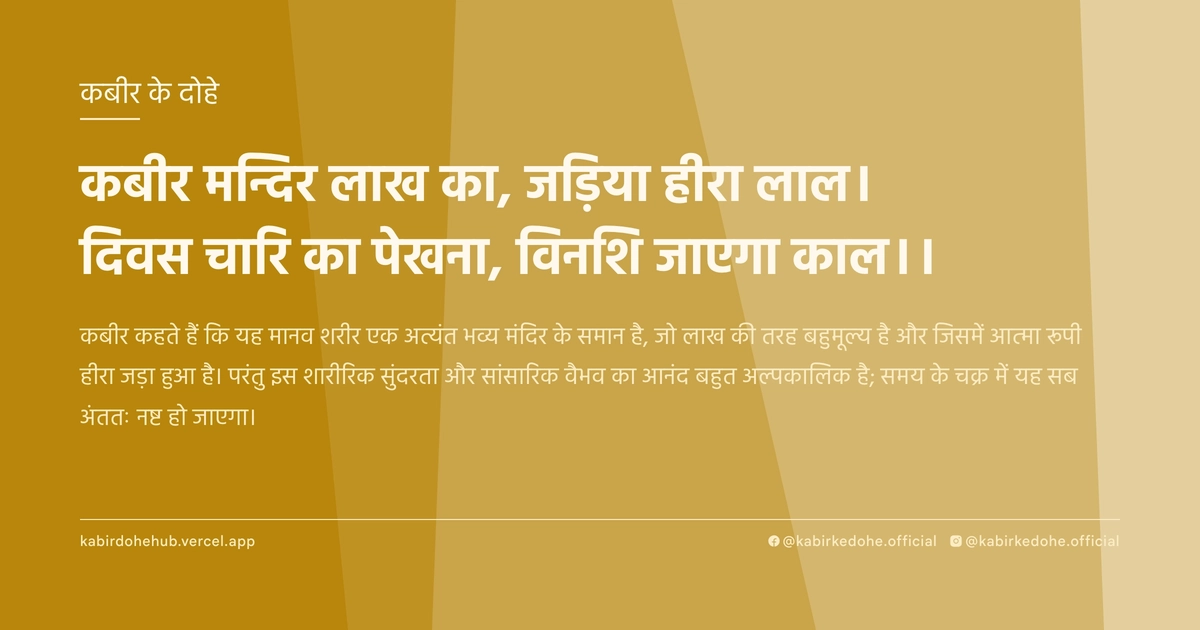
कबीर मन्दिर लाख का, जड़िया हीरा लाल।
दिवस चारि का पेखना, विनशि जाएगा काल।।
Kabir mandir laakh ka, jadiya heera laal. Divas chaari ka pekhna, vinashi jaayega kaal.
इस पृष्ठ पर इस कबीर दोहे का अर्थ (meaning), हिंदी व्याख्या और अंग्रेज़ी अनुवाद, दार्शनिक विश्लेषण और व्यावहारिक जीवन सीख दी गई है। यह दोहा अनित्य (Impermanence) विषय से जुड़ा है — Kabir doha meaning and explanation in Hindi and English.
अर्थ (Meaning):
कबीर कहते हैं कि यह मानव शरीर एक अत्यंत भव्य मंदिर के समान है, जो लाख की तरह बहुमूल्य है और जिसमें आत्मा रूपी हीरा जड़ा हुआ है। परंतु इस शारीरिक सुंदरता और सांसारिक वैभव का आनंद बहुत अल्पकालिक है; समय के चक्र में यह सब अंततः नष्ट हो जाएगा।
Kabir asserts that the human body is like a magnificent temple crafted from precious lacquer, embedded with a brilliant diamond—the soul. However, the splendor of this physical form and worldly existence is fleeting; in the relentless march of time, everything material is destined for inevitable decay and dissolution.
व्याख्या (Interpretation):
शाब्दिक अर्थ में, कबीर शरीर की तुलना एक रत्नजड़ित महल से करते हैं। रूपक के स्तर पर, 'लाख का मन्दिर' भौतिक शरीर और अहंकार का प्रतीक है, जबकि 'हीरा' उस शुद्ध चेतना या आत्मा का प्रतीक है जो इस नश्वर खोल के भीतर कैद है। यह दोहा निर्गुण भक्ति के उस सिद्धांत को रेखांकित करता है जहाँ शरीर को केवल एक माध्यम माना गया है, गंतव्य नहीं। माया का भ्रम हमें यह विश्वास दिलाता है कि यह भौतिक सौंदर्य स्थायी है, जबकि अद्वैत वेदांत के अनुसार, केवल वह 'हीरा' (ब्रह्म) ही शाश्वत है। यहाँ विरोधाभास यह है कि मनुष्य उस मंदिर को सजाने में जीवन व्यतीत कर देता है जिसे अंततः ढहना ही है, जबकि भीतर के हीरे की चमक को अनदेखा कर देता है।
Literally, Kabir compares the body to a jewel-encrusted palace. Metaphorically, the 'temple of lacquer' represents the physical vessel and the ego, while the 'diamond' symbolizes the pure consciousness or Atman imprisoned within this perishable shell. This couplet underscores the principle of Nirgun Bhakti, where the body is viewed merely as a vehicle, not the destination. The illusion of Maya deceives us into believing that physical beauty and worldly status are permanent, whereas according to Advaita Vedanta, only the 'diamond' (Brahman) is eternal. The central paradox lies in the human tendency to spend a lifetime decorating a temple destined for collapse, while utterly neglecting the brilliance of the inner diamond.
दार्शनिक विश्लेषण (Philosophical Analysis):
कबीर का यह दोहा उनके युग के धार्मिक पाखंड और बाहरी आडंबरों पर एक तीखा प्रहार है। उन्होंने देखा कि लोग पत्थरों के मंदिरों को सजाने और बाहरी अनुष्ठानों में लीन थे, जबकि अपने भीतर के वास्तविक मंदिर—चेतना—की उपेक्षा कर रहे थे। यह विश्लेषण सूफी मत के 'फना' (अहंकार का विनाश) और अद्वैत वेदांत के 'माया' सिद्धांत से गहराई से जुड़ा है। कबीर तर्क देते हैं कि शरीर की नश्वरता को स्वीकार करना ही वास्तविक ज्ञान की शुरुआत है।
ऐतिहासिक रूप से, कबीर ने जाति व्यवस्था और कर्मकांडों का विरोध किया क्योंकि ये दोनों ही मनुष्य को बाहरी पहचानों में बांधते हैं। जब व्यक्ति खुद को एक विशेष जाति या पद से जोड़ता है, तो वह उसी 'लाख के मंदिर' की बाहरी चमक से मोहित हो जाता है। कबीर का दर्शन यह है कि जब तक 'मैं' और 'मेरा' का भाव है, तब तक आत्मा का हीरा धूल से ढका रहता है।
मनोवैज्ञानिक स्तर पर, यह दोहा 'अस्तित्वगत चिंता' (Existential Anxiety) को संबोधित करता है। हम अपनी पहचान को अपनी संपत्ति, रूप और उपलब्धियों से जोड़ते हैं, जो कि समय के साथ नष्ट होने वाली चीजें हैं। कबीर हमें इस मनोवैज्ञानिक बंधन से मुक्त कर उस शाश्वत सत्य की ओर ले जाना चाहते हैं जो समय और मृत्यु से परे है।
यहाँ 'दिवस चारि' (चार दिन) का अर्थ केवल कुछ दिन नहीं, बल्कि जीवन की क्षणभंगुरता है। यह बौद्ध धर्म के 'अनित्य' (Impermanence) के विचार के समान है। यदि हम यह समझ लें कि शरीर केवल एक वस्त्र है, तो हम भौतिक आसक्ति को छोड़कर आत्म-साक्षात्कार की ओर बढ़ सकते हैं।
अंततः, कबीर का संदेश यह है कि आध्यात्मिक साधना का उद्देश्य शरीर को सजाना नहीं, बल्कि उस हीरे को तराशना है। यह रूपांतरण तब होता है जब साधक यह महसूस करता है कि वह शरीर नहीं, बल्कि वह चेतना है जो इस शरीर के माध्यम से अनुभव कर रही है। यह अहसास ही अहंकार का विसर्जन है और मोक्ष का द्वार है।
This couplet is a sharp critique of the religious hypocrisy and external ostentation prevalent in Kabir's era. He observed people obsessing over decorating stone temples and performing elaborate rituals while neglecting the true temple within—consciousness. This analysis is deeply intertwined with the Sufi concept of 'Fana' (annihilation of the ego) and the Advaita Vedanta principle of 'Maya' (illusion).
Historically, Kabir opposed the caste system and ritualism because both bind the individual to external identities. When a person identifies with a specific caste or social rank, they become enamored by the external glitter of the 'lacquer temple.' Kabir's philosophy posits that as long as the sense of 'I' and 'mine' persists, the diamond of the soul remains covered in dust.
Psychologically, the verse addresses 'existential anxiety.' Humans tend to anchor their identity in wealth, appearance, and achievements—all of which are subject to temporal decay. Kabir seeks to liberate us from this psychological bondage, directing us toward the eternal truth that transcends time and death.
The phrase 'divas chaari' (four days) does not literally mean four days, but symbolizes the ephemeral nature of existence. This mirrors the Buddhist concept of 'Anicca' (impermanence). By realizing that the body is merely a garment, one can shift from material attachment to the pursuit of self-realization.
Ultimately, Kabir suggests that the goal of spiritual practice is not to adorn the body, but to polish the diamond within. This transformation occurs when the seeker realizes they are not the body, but the consciousness experiencing through the body. This realization is the dissolution of the ego and the gateway to liberation.
मूल संदेश (Core Message):
- शरीर नश्वर है, केवल चेतना शाश्वत है।
- बाहरी दिखावा आत्मा की चमक को ढकता है।
- अहंकार का विसर्जन ही वास्तविक सौंदर्य है।
- क्षणभंगुरता को स्वीकार करना ही मुक्ति का मार्ग है।
- भीतर के हीरे को तराशें, बाहरी मंदिर को नहीं।
- The body is ephemeral; only consciousness is eternal.
- External pretension obscures the radiance of the soul.
- The dissolution of ego is the only true beauty.
- Accepting impermanence is the gateway to liberation.
- Polish the inner diamond, not the outer temple.
व्यावहारिक उदाहरण (Practical Example):
वाराणसी के घाटों पर रहने वाली एक वृद्ध विधवा, जानकी, का जीवन केवल अपनी छोटी सी कुटिया की सफाई और दूसरों की नजरों में 'पवित्र' दिखने के संघर्ष में बीता। वह दिन भर कठोर उपवास करती और सफेद वस्त्र पहनकर अपनी सादगी का प्रदर्शन करती, ताकि समाज उसे एक आदर्श सन्यासिनी माने। वह अपनी बाहरी छवि को एक मंदिर की तरह संवारती रही, यह सोचकर कि यही उसकी मुक्ति का मार्ग है।
एक दिन, उसने देखा कि एक छोटा बच्चा कीचड़ में खेल रहा था, लेकिन उसकी आँखों में एक ऐसी चमक और शांति थी जो जानकी ने अपने वर्षों के तप में भी नहीं पाई थी। वह बच्चा किसी भी सामाजिक नियम या बाहरी दिखावे से बेखबर था; वह बस वर्तमान क्षण में पूरी तरह उपस्थित था।
जानकी ने बच्चे से पूछा, "बेटा, तुम इतने खुश कैसे हो जबकि तुम्हारे कपड़े गंदे हैं?" बच्चे ने मासूमियत से जवाब दिया, "दादी, कपड़े तो धुल जाएंगे, लेकिन यह खुशी तो मेरे अंदर है, इसे कौन धोएगा?"
यह सरल वाक्य जानकी के लिए एक बिजली की तरह था। उसे अचानक अहसास हुआ कि उसने अपना पूरा जीवन 'लाख के मंदिर' यानी अपनी बाहरी छवि और सामाजिक प्रतिष्ठा को सजाने में लगा दिया। उसने पवित्रता के बाहरी ढोंग को तो अपनाया, लेकिन अपने भीतर के क्रोध, ईर्ष्या और अहंकार रूपी कचरे को कभी साफ नहीं किया।
उसने महसूस किया कि उसकी सफेद साड़ी और कठोर व्रत केवल एक मुखौटा थे। वह दुनिया को यह दिखाना चाहती थी कि वह आध्यात्मिक है, जबकि वास्तव में वह अपनी पहचान (Identity) के अहंकार में फंसी हुई थी।
उस रात, जानकी ने पहली बार अपनी आँखें बंद कीं और बाहरी दुनिया की परवाह करना छोड़ दिया। उसने अपनी सांसों पर ध्यान केंद्रित किया और यह स्वीकार किया कि उसका शरीर एक दिन मिट्टी में मिल जाएगा और उसकी 'पवित्र' छवि भी मिट जाएगी।
उसने अपने भीतर के उस 'हीरे' को खोजने का प्रयास किया—वह प्रेम और करुणा जो किसी बाहरी नियम की मोहताज नहीं थी। उसने महसूस किया कि असली मंदिर वह शांति है जो बिना किसी दिखावे के भीतर घटित होती है।
अगले दिन से, जानकी का व्यवहार बदल गया। उसने उपवास करना बंद नहीं किया, लेकिन अब वह इसे प्रदर्शन के लिए नहीं, बल्कि आत्म-संयम के लिए करती थी। उसने अन्य महिलाओं की मदद करना शुरू किया, न कि उन्हें उपदेश देने के लिए, बल्कि उनके दुख को साझा करने के लिए।
उसकी मुस्कान अब बनावटी नहीं थी। उसने जान लिया था कि शरीर की सुंदरता और सामाजिक सम्मान 'दिवस चारि' के खेल हैं। उसने अपनी आंतरिक शांति को प्राथमिकता दी और अंततः वह वास्तविक मुक्ति पा सकी जिसे वह बाहरी आडंबरों में खोज रही थी।
Janaki, an elderly widow living on the ghats of Varanasi, spent her life struggling to maintain a 'pure' image in the eyes of others. She fasted rigorously and wore pristine white clothes, projecting an image of an ideal ascetic so that society would admire her piety. She meticulously curated her external persona like a temple, believing this was the path to liberation.
One day, she noticed a small child playing in the mud. Despite his filth, there was a radiance and peace in his eyes that Janaki had not found in years of austerity. The child was oblivious to social norms or external appearances; he was simply and fully present in the moment.
Janaki asked, "Child, how are you so happy when your clothes are so dirty?" The child replied innocently, "Grandmother, the clothes will be washed, but this happiness is inside me; who will wash that?"
This simple sentence struck Janaki like a bolt of lightning. She suddenly realized she had spent her entire life decorating the 'temple of lacquer'—her external image and social reputation. She had adopted the facade of purity but had never cleansed the internal grime of anger, jealousy, and ego.
She realized her white saree and strict fasts were merely masks. She wanted the world to see her as spiritual, while in reality, she was trapped in the ego of her own identity.
That night, for the first time, Janaki closed her eyes and stopped caring about the external world. She focused on her breath and accepted that her body would one day return to dust, and her 'pure' image would vanish with it.
She began to seek the 'diamond' within—that love and compassion which required no external validation. She realized the true temple is the silence that occurs within, devoid of all pretense.
From the next day, Janaki's behavior transformed. She didn't stop her fasts, but she no longer did them for show; they became tools for self-discipline. She began helping other women, not to preach to them, but to share in their sorrows.
Her smile was no longer artificial. She understood that physical beauty and social honor are but a 'four-day game.' By prioritizing inner peace over outer perception, she finally found the liberation she had been chasing through rituals.
अभ्यास मार्गदर्शन (Practice Guidance):
- प्रतिदिन 20 मिनट मौन ध्यान करें, जहाँ आप अपने शरीर को एक अस्थायी वस्त्र के रूप में देखें और अपनी चेतना को उस शाश्वत हीरे के रूप में महसूस करें जो समय से परे है।
- आत्म-पूछताछ जर्नल: प्रतिदिन लिखें कि आज आपने अपनी किस 'बाहरी छवि' (Ego-Image) को बनाए रखने के लिए संघर्ष किया और वह प्रयास कितना व्यर्थ था।
- व्यवहार परिवर्तन: किसी ऐसे व्यक्ति की मदद करें जिससे आपको कोई सामाजिक लाभ न मिले, ताकि आप अपनी पहचान के अहंकार को तोड़ सकें।
- निदान चेकलिस्ट: क्या आप अपनी प्रशंसा सुनकर खुश होते हैं? क्या आप अपनी शारीरिक उपस्थिति या पद के खोने के विचार से डरते हैं? यदि हाँ, तो आप अभी भी 'लाख के मंदिर' से चिपके हुए हैं।
- Practice 20 minutes of silent meditation daily, visualizing your body as a temporary garment and your consciousness as the eternal diamond that exists beyond time.
- Self-Inquiry Journaling: Record daily instances where you struggled to maintain an 'external image' (Ego-Image) and reflect on the futility of that effort.
- Behavioral Shift: Perform an act of service for someone from whom you can gain no social or material benefit, effectively breaking the ego of identity.
- Diagnostic Checklist: Do you feel a surge of pride when praised? Do you fear the loss of your physical appearance or social status? If yes, you are still clinging to the 'temple of lacquer'.
चिंतन प्रश्न (Reflection Questions):
- यदि आपकी सारी सामाजिक उपलब्धियाँ और शारीरिक सुंदरता आज छीन ली जाए, तो आपके भीतर क्या बचेगा?
- आप अपनी 'डिजिटल पहचान' (सोशल मीडिया) को सजाने में कितना समय बिताते हैं, और वह आपके वास्तविक आत्म से कितना अलग है?
- क्या आपकी धार्मिकता वास्तव में आंतरिक शांति के लिए है, या यह दूसरों को प्रभावित करने का एक साधन है?
- आप किस डर से अपनी नश्वरता को स्वीकार नहीं कर पा रहे हैं?
- आपके जीवन का वह कौन सा 'लाख का मंदिर' है जिसे आप ढहने से बचाने के लिए संघर्ष कर रहे हैं?
- If all your social achievements and physical beauty were stripped away today, what would remain within you?
- How much time do you spend decorating your 'digital identity,' and how far is it from your authentic self?
- Is your spirituality truly for inner peace, or is it a tool to influence how others perceive you?
- What is the underlying fear that prevents you from accepting your own impermanence?
- What is the 'temple of lacquer' in your life that you are desperately struggling to keep from collapsing?