
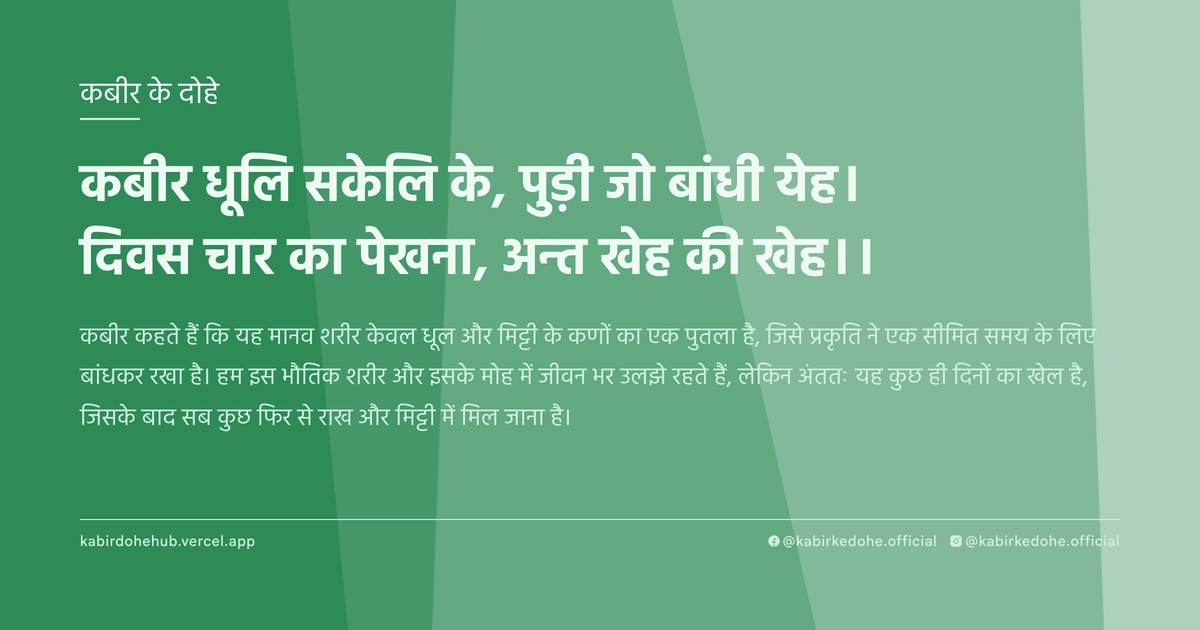
कबीर धूलि सकेलि के, पुड़ी जो बांधी येह।
दिवस चार का पेखना, अन्त खेह की खेह।।
Kabir dhuli sakeli ke, pudi jo bandhi yeh. Divas chaar ka pekhna, ant kheh ki kheh.
इस पृष्ठ पर इस कबीर दोहे का अर्थ (meaning), हिंदी व्याख्या और अंग्रेज़ी अनुवाद, दार्शनिक विश्लेषण और व्यावहारिक जीवन सीख दी गई है। यह दोहा अनित्य (Impermanence) विषय से जुड़ा है — Kabir doha meaning and explanation in Hindi and English.
अर्थ (Meaning):
कबीर कहते हैं कि यह मानव शरीर केवल धूल और मिट्टी के कणों का एक पुतला है, जिसे प्रकृति ने एक सीमित समय के लिए बांधकर रखा है। हम इस भौतिक शरीर और इसके मोह में जीवन भर उलझे रहते हैं, लेकिन अंततः यह कुछ ही दिनों का खेल है, जिसके बाद सब कुछ फिर से राख और मिट्टी में मिल जाना है।
Kabir asserts that the human body is merely a collection of dust and earth, bound together by nature for a fleeting moment. We spend our lives clinging to this physical form and its attachments, yet this existence is but a brief flicker, destined to dissolve back into ash and dust in the end.
व्याख्या (Interpretation):
साब्दिक अर्थ यह है कि शरीर मिट्टी से बना है और मिट्टी में ही मिलेगा। आध्यात्मिक स्तर पर, यह दोहा 'माया' के भ्रम और शरीर की नश्वरता पर प्रहार करता है। कबीर यहाँ 'पुड़ी' (एक छोटी पोटली) का रूपक उपयोग कर रहे हैं, जो यह दर्शाता है कि आत्मा इस नश्वर शरीर में केवल एक अस्थायी अतिथि है। यह निर्गुण भक्ति का सार है, जहाँ साधक को यह समझना होता है कि वह यह हाड़-मांस का शरीर नहीं, बल्कि वह अविनाशी चेतना है जो ब्रह्म का अंश है। जब व्यक्ति यह पहचान लेता है कि बाहरी आवरण केवल 'धूल' है, तब वह द्वैत से मुक्त होकर अद्वैत की स्थिति में पहुँचता है, जहाँ केवल शुद्ध अस्तित्व शेष रहता है।
Literally, the verse states that the body is made of earth and shall return to it. Metaphorically, it strikes at the illusion of 'Maya' and the transience of physical existence. Kabir uses the imagery of a 'pudi' (a small pouch), suggesting that the soul is merely a temporary guest within this perishable vessel. This aligns with Nirgun Bhakti, where the seeker must realize they are not this frame of flesh and bone, but the indestructible consciousness—a fragment of Brahman. Once the individual recognizes the external shell as mere 'dust,' they transcend duality and enter the state of Advaita, where only pure, formless existence remains.
दार्शनिक विश्लेषण (Philosophical Analysis):
कबीर का यह दोहा उस युग की प्रतिक्रिया है जहाँ लोग बाहरी कर्मकांडों, जातिगत श्रेष्ठता और शारीरिक सौंदर्य को मोक्ष का मार्ग मानते थे। कबीर ने स्पष्ट किया कि जब अंत सबका एक ही है—राख होना—तो फिर अहंकार और भेदभाव का कोई आधार नहीं बचता। यह विचार अद्वैत वेदांत के 'नेति नेति' (यह नहीं, वह नहीं) के करीब है, जहाँ शरीर को नकार कर आत्मा की खोज की जाती है।
सूफीवाद के 'फना' के सिद्धांत से जुड़ते हुए, कबीर यहाँ अहंकार के विनाश की बात कर रहे हैं। जब तक मनुष्य स्वयं को इस शरीर के साथ जोड़कर देखता है, वह जन्म और मृत्यु के चक्र में फंसा रहता है। शरीर को 'धूल' कहना वास्तव में उस मनोवैज्ञानिक बंधन को तोड़ना है जो हमें भौतिकता का दास बनाता है।
कबीर का विरोध केवल धर्म से नहीं, बल्कि उस अज्ञानता से था जो मनुष्य को उसकी वास्तविक प्रकृति से दूर रखती है। वे सिखाते हैं कि शरीर की नश्वरता का बोध ही वास्तविक वैराग्य है। यह वैराग्य पलायनवाद नहीं, बल्कि सत्य का सामना करना है।
यहाँ 'दिवस चार' का अर्थ जीवन की अल्पता है। यह समय की सापेक्षता को दर्शाता है कि अनंत ब्रह्मांड के सामने मानव जीवन एक क्षण मात्र है। इस बोध के माध्यम से कबीर साधक को प्रेरित करते हैं कि वह समय व्यर्थ के विवादों में न गंवाकर आंतरिक सत्य की खोज करे।
अंततः, यह विश्लेषण हमें इस निष्कर्ष पर ले जाता है कि शरीर एक माध्यम है, गंतव्य नहीं। जब हम शरीर की पहचान को त्याग देते हैं, तब हम उस सार्वभौमिक चेतना के साथ एकाकार हो जाते हैं जो न कभी जन्म लेती है और न कभी मरती है।
This couplet is a reaction to an era where people viewed ritualistic purity, caste superiority, and physical attributes as paths to salvation. Kabir clarifies that since the ultimate end for all is the same—becoming ash—there is no logical basis for ego or discrimination. This mirrors the 'Neti Neti' (not this, not that) approach of Advaita Vedanta, where the physical self is negated to discover the true Self.
Connecting to the Sufi concept of 'Fana' (annihilation), Kabir speaks of the dissolution of the ego. As long as a human identifies solely with the body, they remain trapped in the cycle of birth and death. Labeling the body as 'dust' is a psychological tool to break the bondage of materialism.
Kabir's opposition was not merely toward religion, but toward the ignorance that distances humans from their true nature. He teaches that the realization of the body's transience is the foundation of true detachment. This detachment is not escapism, but a courageous confrontation with reality.
The phrase 'divas chaar' (four days) symbolizes the brevity of life. It highlights temporal relativity, suggesting that compared to the infinite cosmos, a human life is but a blink. Through this realization, Kabir urges the seeker to stop wasting time on trivial conflicts and seek internal truth.
Ultimately, this analysis leads to the conclusion that the body is a vehicle, not the destination. By shedding the identity of the physical form, one merges with the universal consciousness that is neither born nor subject to death.
मूल संदेश (Core Message):
- शरीर एक अस्थायी वस्त्र है, इसे अपनी पहचान न बनाएँ।
- अहंकार केवल भ्रम है, क्योंकि अंत सबका समान है।
- नश्वरता का बोध ही वास्तविक वैराग्य का द्वार है।
- बाहरी दिखावे से ऊपर उठकर आंतरिक चेतना को खोजें।
- प्रेम और करुणा ही इस क्षणभंगुर जीवन की एकमात्र सार्थकता हैं।
- The body is a temporary garment; do not mistake it for your identity.
- Ego is a delusion, for the end is identical for all.
- Awareness of mortality is the gateway to true detachment.
- Rise above external appearances to discover the inner consciousness.
- Love and compassion are the only meaningful pursuits in this fleeting life.
व्यावहारिक उदाहरण (Practical Example):
वाराणसी के एक पुराने घाट पर रहने वाले एक वृद्ध विधवा, जानकी, का जीवन केवल दूसरों की सेवा और अपनी कठोर दिनचर्या में बीता। उन्होंने अपना पूरा जीवन इस विश्वास में बिताया कि उनकी पवित्रता उनके पहनावे और उनके कठोर नियमों में है। वे अक्सर अन्य महिलाओं को उनके 'अशुद्ध' व्यवहार के लिए टोकती थीं और स्वयं को आध्यात्मिक रूप से श्रेष्ठ मानती थीं।
एक दिन, उन्होंने देखा कि एक युवा लड़का, जो उनके पड़ोस में रहता था, एक मिट्टी के बर्तन को बड़े प्यार से गूँथ रहा था। वह लड़का उस मिट्टी से एक सुंदर आकृति बना रहा था, लेकिन अचानक उसका हाथ लगा और वह आकृति बिखर कर फिर से मिट्टी का ढेर बन गई। लड़का मुस्कुराया और बोला, 'मिट्टी थी, मिट्टी में मिल गई, अब फिर से कुछ नया बनाऊँगा।'
जानकी को अचानक कबीर का यह दोहा याद आया। उन्हें अहसास हुआ कि जिस 'पवित्रता' और 'श्रेष्ठता' के अहंकार को उन्होंने जीवन भर संजोया था, वह भी उसी मिट्टी की तरह है। उनकी सारी कठोरता, उनके नियम और उनका अहंकार केवल उस 'धूल की पुड़ी' का हिस्सा थे जिसे वे सच मान बैठी थीं।
इस बोध ने उनके भीतर एक गहरा परिवर्तन किया। उन्होंने दूसरों को टोकना बंद कर दिया और अपनी कठोरता को करुणा में बदल दिया। उन्होंने महसूस किया कि यदि अंत में सब कुछ राख होना है, तो वर्तमान में केवल प्रेम और दया ही सार्थक हैं।
अब जानकी घाट पर आने वाले हर अजनबी का स्वागत एक मुस्कान से करती हैं। वे अब यह नहीं देखतीं कि कौन किस जाति का है या कौन कितना 'शुद्ध' है।
उनकी दिनचर्या अब नियमों से नहीं, बल्कि सहजता से संचालित होती है। वे अब अपनी देह की व्याधियों को भी शांति से स्वीकार करती हैं, क्योंकि वे जानती हैं कि यह केवल एक अस्थायी आवरण है।
गाँव के लोग हैरान थे कि जो महिला कभी क्रोधित रहती थी, वह अब शांति का पर्याय बन गई है। जानकी ने समझ लिया था कि अहंकार की पुड़ी को फाड़ना ही वास्तविक मुक्ति है।
उनकी कहानी यह सिखाती है कि जब हम अपनी नश्वरता को स्वीकार कर लेते हैं, तब हम वास्तव में जीना शुरू करते हैं। शरीर का अंत निश्चित है, लेकिन आत्मा का विस्तार प्रेम के माध्यम से संभव है।
अंततः, जानकी ने अपनी सारी भौतिक संपत्ति और पुराने संकीर्ण विचारों का त्याग कर दिया, और स्वयं को उस निराकार ईश्वर के प्रति समर्पित कर दिया जो हर कण में व्याप्त है।
Janaki, an elderly widow living on an ancient ghat in Varanasi, spent her life adhering to a rigid routine and a strict code of purity. She believed her spiritual superiority lay in her austere clothing and uncompromising rules, often criticizing other women for their 'impure' behavior.
One day, she observed a young boy in her neighborhood molding a piece of clay with great affection. He was creating a beautiful figure, but suddenly, a clumsy move caused the sculpture to collapse back into a shapeless heap of mud. The boy simply smiled and said, 'It was mud, it returned to mud; now I shall make something new.'
This moment triggered a memory of Kabir's verse in Janaki. She suddenly realized that the 'purity' and 'superiority' she had guarded so fiercely were as fragile as that clay figure. Her rigidity, her rules, and her ego were merely parts of that 'pouch of dust' she had mistaken for her true identity.
This realization sparked a profound transformation. She stopped judging others and replaced her severity with compassion. She understood that if everything is destined to become ash, then only love and kindness hold any lasting value in the present.
Now, Janaki welcomes every stranger on the ghat with a genuine smile. She no longer cares about caste or the perceived 'purity' of the people she encounters.
Her daily life is no longer governed by strict mandates but by a natural flow of grace. She accepts the ailments of her aging body with peace, knowing it is only a temporary veil.
The villagers were astonished that the woman who once radiated anger had become a beacon of serenity. Janaki had learned that tearing open the pouch of ego is the only path to true liberation.
Her story teaches us that when we accept our mortality, we truly begin to live. While the body's end is certain, the soul's expansion is possible through unconditional love.
Ultimately, Janaki relinquished her material attachments and narrow beliefs, surrendering herself to the formless Divine that permeates every grain of existence.
अभ्यास मार्गदर्शन (Practice Guidance):
- प्रतिदिन 15 मिनट 'शव साधना' या शरीर के अवलोकन का अभ्यास करें, जहाँ आप मानसिक रूप से शरीर के प्रत्येक अंग को मिट्टी में विलीन होते हुए देखें।
- एक जर्नल लिखें जिसमें आप अपनी उन पहचानों (पद, प्रतिष्ठा, रूप) की सूची बनाएँ जिनसे आप सबसे अधिक जुड़े हैं, और फिर विचार करें कि उनके बिना आप कौन हैं।
- व्यवहार परिवर्तन: जब भी अहंकार या क्रोध महसूस हो, तो स्वयं से कहें, 'मैं केवल धूल की एक पुड़ी हूँ, यह क्रोध किस पहचान के लिए है?'
- निदान चेकलिस्ट: क्या आप अभी भी अपनी शारीरिक सुंदरता या सामाजिक स्थिति पर गर्व करते हैं? क्या आप मृत्यु के विचार से डरते हैं? यदि हाँ, तो आप अभी भी 'पुड़ी' के मोह में हैं।
- Practice 15 minutes of 'Body Contemplation' daily, mentally visualizing each part of the physical body dissolving back into the earth.
- Maintain a journal listing the identities (status, beauty, titles) you cling to most, then inquire: 'Who am I without these labels?'
- Behavioral Shift: Whenever ego or anger arises, ask yourself, 'I am but a pouch of dust; for which identity am I fighting this battle?'
- Diagnostic Checklist: Do you still take pride in your physical appearance or social standing? Do you fear the thought of death? If yes, you are still clinging to the 'pouch'.
चिंतन प्रश्न (Reflection Questions):
- यदि आज आपकी सारी सामाजिक पहचान छीन ली जाए, तो आपके भीतर क्या बचेगा?
- आप अपनी देह के प्रति कितने आसक्त हैं, और यह आसक्ति आपके निर्णयों को कैसे प्रभावित करती है?
- क्या आपका 'डिजिटल व्यक्तित्व' (सोशल मीडिया प्रोफाइल) आपकी 'धूल की पुड़ी' का एक आधुनिक विस्तार है?
- मृत्यु का भय वास्तव में किसका भय है—जीवन के अंत का, या उस अहंकार के अंत का जिसे आपने संजोया है?
- आप दूसरों को उनके बाहरी स्वरूप के आधार पर कैसे आंकते हैं, यह जानते हुए भी कि वे भी मिट्टी के पुतले हैं?
- If all your social identities were stripped away today, what would remain within you?
- How attached are you to your physical form, and how does this attachment skew your decisions?
- Is your 'digital persona' (social media profile) merely a modern extension of your 'pouch of dust'?
- Is the fear of death actually a fear of the end of life, or a fear of the annihilation of the ego you've built?
- How do you judge others based on their external appearance, despite knowing they too are but figures of clay?