
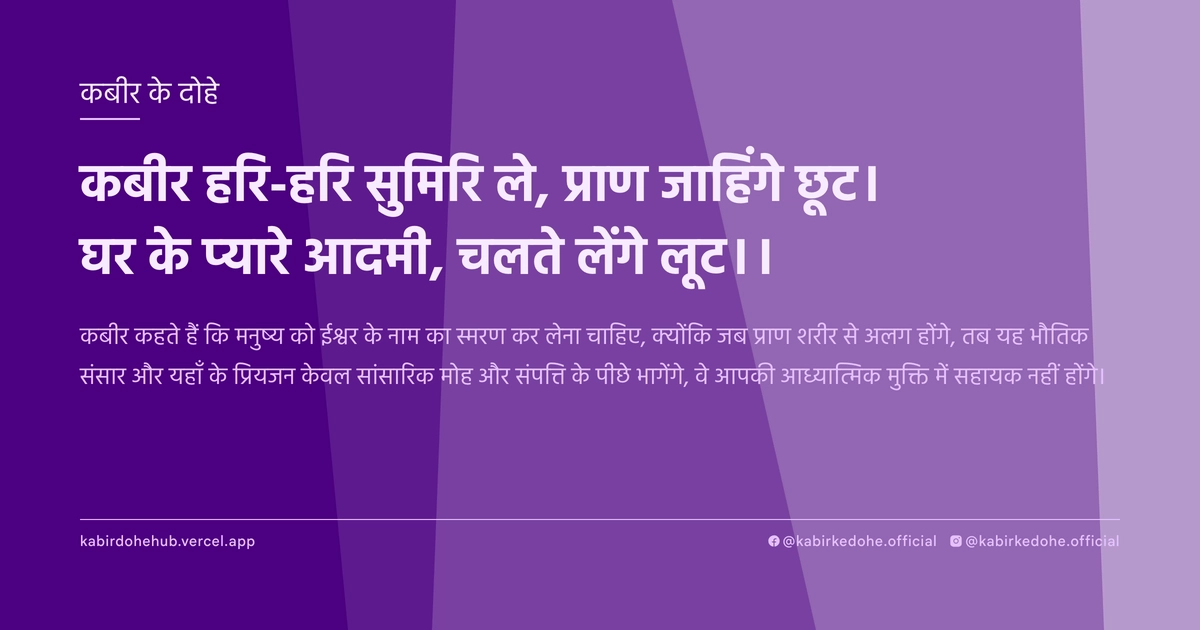
कबीर हरि-हरि सुमिरि ले, प्राण जाहिंगे छूट।
घर के प्यारे आदमी, चलते लेंगे लूट।।
Kabir Hari-Hari sumiri le, praan jahinge chhoot. Ghar ke pyare aadmi, chalte lenge loot.
इस पृष्ठ पर इस कबीर दोहे का अर्थ (meaning), हिंदी व्याख्या और अंग्रेज़ी अनुवाद, दार्शनिक विश्लेषण और व्यावहारिक जीवन सीख दी गई है। यह दोहा मृतुक्यता (Mortality) विषय से जुड़ा है — Kabir doha meaning and explanation in Hindi and English.
अर्थ (Meaning):
कबीर कहते हैं कि मनुष्य को ईश्वर के नाम का स्मरण कर लेना चाहिए, क्योंकि जब प्राण शरीर से अलग होंगे, तब यह भौतिक संसार और यहाँ के प्रियजन केवल सांसारिक मोह और संपत्ति के पीछे भागेंगे, वे आपकी आध्यात्मिक मुक्ति में सहायक नहीं होंगे।
Kabir urges the seeker to immerse themselves in the remembrance of the Divine now, for when the breath departs, the worldly kin and beloveds—whom one cherished most—will be preoccupied with the spoils of the material estate rather than the soul's liberation.
व्याख्या (Interpretation):
साब्दिक अर्थ यह है कि मृत्यु के समय परिवार केवल संपत्ति के बंटवारे में व्यस्त रहता है। रूपकात्मक रूप से, 'घर के प्यारे' उन मानसिक आसक्तियों और मायावी बंधनों का प्रतीक हैं जो हमें सत्य से दूर रखते हैं। यह दोहा निर्गुण भक्ति के उस सिद्धांत पर आधारित है जहाँ आत्मा का मिलन केवल परमात्मा से संभव है, किसी मानवीय संबंध से नहीं। माया हमें विश्वास दिलाती है कि सांसारिक प्रेम शाश्वत है, जबकि वास्तव में वह केवल एक भ्रम है। जब अहंकार का पर्दा गिरता है, तब यह स्पष्ट होता है कि केवल 'हरि' (परमात्मा) ही एकमात्र सत्य है। यह द्वैत से अद्वैत की ओर संक्रमण की पुकार है, जहाँ साधक को यह समझना होता है कि आत्मा अकेली आती है और अकेली जाती है।
Literally, the verse warns that family members often prioritize material inheritance over the spiritual state of the dying. Metaphorically, the 'beloveds of the home' represent the psychic attachments and illusory bonds of Maya that tether the soul to the transient world. This aligns with Nirgun Bhakti, emphasizing that the soul's ultimate union is with the formless Divine, not through human intermediaries. Maya creates the illusion of eternal worldly love, but this is a veil over the truth of Atman-Brahman non-duality. The central paradox is that the very people we love most in the physical realm become the greatest distractions from the spiritual realization of the Self. It is a call to transition from the duality of 'mine and thine' to the singular truth of the Absolute.
दार्शनिक विश्लेषण (Philosophical Analysis):
कबीर का यह दोहा उनके युग के कट्टर कर्मकांडों और सामाजिक संरचनाओं पर एक गहरा प्रहार है। वे उस समय के समाज को देखते हैं जहाँ लोग बाहरी आडंबरों और पारिवारिक प्रतिष्ठा में इतने डूबे थे कि उन्होंने आंतरिक खोज को भुला दिया था। यहाँ 'हरि' का अर्थ किसी मूर्ति या विशेष देवता से नहीं, बल्कि उस सर्वव्यापी चेतना से है जो कण-कण में व्याप्त है। यह दृष्टिकोण अद्वैत वेदांत के करीब है, जहाँ यह माना जाता है कि जीव और ब्रह्म एक ही हैं, और केवल अज्ञानता (माया) ही उन्हें अलग करती है।
सूफी मत के 'फना' (अहंकार का विनाश) के सिद्धांत की तरह, कबीर यहाँ सांसारिक पहचान के विनाश की बात कर रहे हैं। जब व्यक्ति यह समझ लेता है कि उसके प्रियजन केवल शरीर के स्तर पर हैं, तब वह अपनी वास्तविक पहचान को खोजने के लिए प्रेरित होता है। कबीर जाति और धर्म के भेदभाव को नकारते हुए यह संदेश देते हैं कि मुक्ति का मार्ग केवल आंतरिक सुमिरन (स्मरण) से संभव है, न कि किसी बाहरी अनुष्ठान से।
मनोवैज्ञानिक स्तर पर, यह दोहा मृत्यु की अनिवार्यता का उपयोग करके वर्तमान में जागरूकता लाने का प्रयास करता है। यह 'मोमेंटो मोरी' (मृत्यु को याद रखो) की तरह है, जो मनुष्य को यह सोचने पर मजबूर करता है कि अंततः वह क्या लेकर जाएगा। भौतिक संपत्ति और पारिवारिक संबंध केवल मानसिक सुरक्षा प्रदान करते हैं, लेकिन आध्यात्मिक शून्यता को नहीं भर सकते।
अक्सर लोग इस दोहे को केवल परिवार के प्रति निराशा के रूप में देखते हैं, लेकिन यह वास्तव में 'वैराग्य' की शिक्षा है। वैराग्य का अर्थ संसार को छोड़ना नहीं, बल्कि संसार में रहते हुए उससे अनासक्त होना है। यह वह अवस्था है जहाँ प्रेम तो है, लेकिन उसमें 'ममत्व' या स्वामित्व की भावना नहीं है।
अंततः, कबीर यह स्पष्ट करते हैं कि आध्यात्मिक यात्रा एक एकाकी यात्रा है। जिस तरह एक व्यक्ति अपनी बीमारी का दर्द स्वयं सहता है, उसी तरह मुक्ति का मार्ग भी स्वयं ही तय करना पड़ता है। बाहरी सहारे केवल भ्रम हैं; केवल आंतरिक प्रकाश ही अंधकार से मुक्त कर सकता है।
This couplet serves as a profound critique of the ritualistic and social structures of Kabir's era, where individuals were consumed by external appearances and familial prestige, neglecting the internal quest. 'Hari' here does not refer to a specific deity or idol, but to the omnipresent consciousness pervading every atom. This perspective closely aligns with Advaita Vedanta, which posits that the individual soul (Atman) and the ultimate reality (Brahman) are one, separated only by the veil of ignorance (Maya).
Similar to the Sufi concept of 'Fana' (the annihilation of the ego), Kabir advocates for the dissolution of the worldly identity. By recognizing that familial bonds are limited to the physical plane, the seeker is propelled toward discovering their true, eternal identity. Kabir transcends caste and creed, asserting that liberation is achieved solely through internal remembrance (Sumiran), not through external rituals or religious intermediaries.
Psychologically, the verse employs the inevitability of death to trigger immediate mindfulness. It functions as a 'Memento Mori,' forcing the individual to confront the reality of what truly remains at the end of life. Material wealth and familial attachments provide a facade of security but cannot fill the existential void of the spirit.
Common literalist interpretations often mistake this as a call to hate or abandon one's family. However, it is actually a teaching on 'Vairagya' (dispassion). Vairagya is not the act of fleeing the world, but the art of living within it without being possessed by it. It is a state of love devoid of the desire for ownership or attachment.
Ultimately, Kabir emphasizes that the spiritual journey is fundamentally solitary. Just as one must endure their own physical pain, the path to liberation must be walked alone. External supports are mere illusions; only the internal light can dispel the darkness of ignorance.
मूल संदेश (Core Message):
- सांसारिक मोह एक सुंदर भ्रम है जो आत्मा को जकड़े रखता है।
- सच्चा सहारा केवल वह निराकार परमात्मा है जो कभी नहीं छोड़ता।
- अहंकार का विसर्जन ही वास्तविक मुक्ति का एकमात्र द्वार है।
- रिश्ते शरीर के स्तर पर होते हैं, आत्मा के स्तर पर केवल एकता है।
- वर्तमान क्षण में सुमिरन ही मृत्यु के भय का एकमात्र उपचार है।
- Worldly attachment is a beautiful illusion that shackles the soul.
- The only true refuge is the Formless Divine who never departs.
- The dissolution of ego is the sole gateway to real liberation.
- Relationships exist at the bodily level; at the soul level, there is only Oneness.
- Remembrance in the present moment is the only cure for the fear of death.
व्यावहारिक उदाहरण (Practical Example):
वाराणसी के एक पुराने मोहल्ले में माधव नाम का एक वृद्ध बुनकर रहता था। माधव ने अपना पूरा जीवन अपने बेटों और पोतों के लिए धन संचित करने में बिता दिया। वह दिन-रात करघे पर काम करता, ताकि उसके परिवार की सुख-सुविधाएं बढ़ सकें। उसने अपने बेटों को सर्वश्रेष्ठ शिक्षा दिलाई और उन्हें बड़े शहरों में बसाया। माधव को विश्वास था कि उसका परिवार ही उसका सबसे बड़ा सहारा है और मृत्यु के समय वे ही उसकी आत्मा को शांति दिलाएंगे।
जैसे-जैसे माधव की आयु बढ़ी, उसका स्वास्थ्य गिरने लगा। वह बिस्तर पर पड़ गया। उसके बेटे शहर से आए, लेकिन उनकी बातचीत केवल पिता की जमीन और पुश्तैनी मकान के बंटवारे के बारे में थी। वे माधव के पास बैठते तो थे, लेकिन उनकी नजरें कमरे में रखे पुराने गहनों और कागजातों पर होती थीं। माधव ने महसूस किया कि जिस 'प्रेम' को उसने जीवन भर सींचा, वह वास्तव में केवल भौतिक लाभों से जुड़ा था।
एक शाम, माधव ने अपने पास बैठे एक छोटे बच्चे को देखा जो बिना किसी लालच के उसकी सेवा कर रहा था, लेकिन वह बच्चा परिवार का नहीं, बल्कि एक अनाथ था जिसे माधव ने कभी रोटी खिलाई थी। उस क्षण माधव को कबीर का यह दोहा याद आया। उसे समझ आया कि उसने अपना पूरा जीवन 'लूटने वालों' को तैयार करने में लगा दिया, जबकि अपनी आत्मा के लिए कुछ भी नहीं किया।
माधव ने अपनी शेष सांसों में बाहरी दुनिया से नाता तोड़ लिया। उसने बेटों के झगड़ों पर ध्यान देना बंद कर दिया और अपनी आँखें बंद कर 'हरि' के नाम का मानसिक जाप शुरू किया। उसने महसूस किया कि अब तक वह दूसरों की खुशी के लिए जी रहा था, लेकिन अब वह पहली बार स्वयं के लिए और उस परमात्मा के लिए जी रहा था।
उसने अपनी संपत्ति का मोह त्याग दिया और बेटों से कहा कि वे जो चाहें ले लें, क्योंकि अब उसे उस धन की आवश्यकता नहीं थी जो उसे मुक्ति के मार्ग में बाधा बने। उसके चेहरे पर एक ऐसी शांति आई जो उसने पिछले साठ वर्षों में कभी अनुभव नहीं की थी।
बेटे हैरान थे कि जो पिता कल तक संपत्ति के लिए चिंतित था, वह आज इतना शांत कैसे हो गया। माधव ने उन्हें समझाया कि असली संपत्ति वह नहीं जो बैंक में है, बल्कि वह है जो अंत समय में आत्मा के साथ जाती है।
माधव के जीवन का यह 'कबीर ट्विस्ट' यह था कि उसने मृत्यु के भय को आध्यात्मिक आनंद में बदल दिया। उसने यह जान लिया कि सांसारिक रिश्ते केवल एक पड़ाव हैं, मंजिल नहीं।
अंततः, माधव ने एक मुस्कान के साथ प्राण त्यागे। उसके बेटे संपत्ति तो ले गए, लेकिन वे उस शांति को नहीं ले पाए जो माधव ने अपने भीतर खोज ली थी।
In an ancient alley of Varanasi lived an elderly weaver named Madhav. Madhav spent his entire life accumulating wealth for his sons and grandsons. He worked tirelessly at his loom, ensuring his family's comforts were maximized. He provided his sons with the finest education and settled them in prosperous cities, believing his family was his ultimate support and would ensure his soul's peace at the end.
As Madhav aged, his health declined, and he became bedridden. His sons returned from the city, but their conversations revolved solely around the division of his land and ancestral home. They sat by him, but their eyes were constantly scanning the room for old jewelry and legal documents. Madhav realized that the 'love' he had nurtured all his life was actually tied to material gain.
One evening, Madhav noticed a small child tending to him with genuine affection. This child was not a relative, but an orphan Madhav had once fed. In that moment, Kabir's verse resonated within him. He understood that he had spent his life preparing those who would eventually 'loot' him, while neglecting the nourishment of his own soul.
With his remaining breaths, Madhav detached himself from the external world. He stopped paying attention to his sons' quarrels and began a mental chant of 'Hari.' He realized that until now, he had lived for others, but for the first time, he was living for himself and the Divine.
He relinquished his attachment to his property, telling his sons to take whatever they wished, for he no longer needed wealth that acted as a barrier to liberation. A profound peace descended upon his face, a serenity he had not experienced in sixty years.
His sons were bewildered that the father who was once anxious about assets had suddenly become so tranquil. Madhav explained that true wealth is not what resides in a bank, but what the soul carries with it beyond the veil.
This 'Kabir Twist' transformed Madhav's fear of death into spiritual bliss. He understood that worldly relationships are merely milestones, not the destination.
Ultimately, Madhav departed with a smile. His sons took the property, but they could never possess the peace that Madhav had discovered within himself.
अभ्यास मार्गदर्शन (Practice Guidance):
- प्रतिदिन 20 मिनट मौन रहकर 'अजपा जाप' का अभ्यास करें, जहाँ शब्दों से परे केवल श्वास और चेतना का मिलन हो।
- एक डायरी लिखें जिसमें आप अपनी उन आसक्तियों की सूची बनाएं जिन्हें आप 'अपना' कहते हैं, और फिर विश्लेषण करें कि उनमें से कितना वास्तव में स्थायी है।
- व्यवहार परिवर्तन: किसी ऐसे व्यक्ति की निस्वार्थ सेवा करें जिससे आपका कोई पारिवारिक या सामाजिक संबंध न हो, ताकि 'ममत्व' से परे प्रेम का अनुभव हो सके।
- डायग्नोस्टिक चेकलिस्ट: क्या आप किसी प्रियजन के नुकसान की कल्पना मात्र से गहरे अवसाद में चले जाते हैं? क्या आपकी खुशी दूसरों के व्यवहार पर निर्भर है? यदि हाँ, तो आप अभी भी माया के प्रभाव में हैं।
- Practice 20 minutes of 'Ajapa Jap' daily, focusing on the rhythm of breath beyond words, merging consciousness with the Divine.
- Maintain a journal listing all attachments you label as 'mine,' then critically analyze how many of these are truly permanent.
- Behavioral Shift: Perform selfless service for someone with whom you have no familial or social tie, to experience love beyond the ego of ownership.
- Diagnostic Checklist: Do you fall into deep despair at the mere thought of losing a loved one? Is your happiness dependent on others' behavior? If yes, you are still under the influence of Maya.
चिंतन प्रश्न (Reflection Questions):
- यदि आज आपकी सारी भौतिक पहचान और रिश्ते छीन लिए जाएं, तो आपके भीतर क्या बचेगा?
- आप जिसे 'प्रेम' कहते हैं, क्या वह वास्तव में दूसरे के प्रति है या अपनी ही इच्छाओं की संतुष्टि का एक साधन है?
- आपकी डिजिटल पहचान (सोशल मीडिया) आपके वास्तविक स्वरूप को कितना ढक रही है?
- क्या आप मृत्यु को एक अंत के रूप में देखते हैं या एक महान मिलन के रूप में?
- आपके जीवन का वह कौन सा 'प्रिय' है जो वास्तव में आपको सत्य के मार्ग से भटका रहा है?
- If all your material identities and relationships were stripped away today, what would remain within you?
- Is what you call 'love' truly for the other, or is it a means to satisfy your own emotional needs?
- To what extent does your digital persona mask your authentic spiritual self?
- Do you perceive death as a finality or as a grand reunion with the Absolute?
- Who is the 'beloved' in your life that is actually distracting you from the path of Truth?