
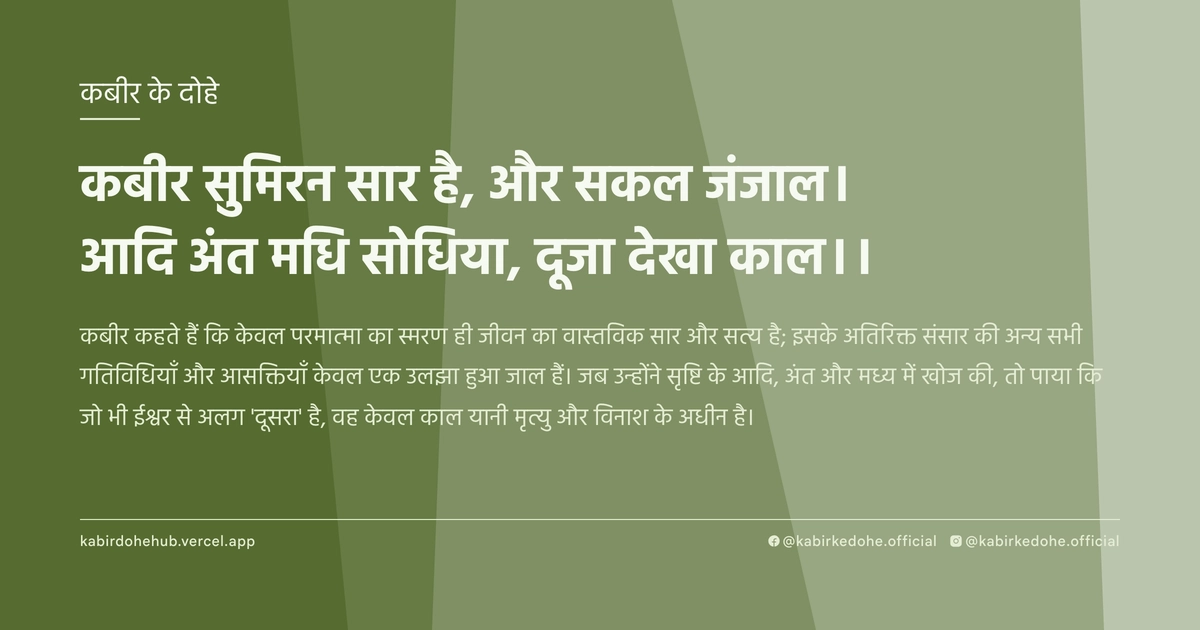
कबीर सुमिरन सार है, और सकल जंजाल।
आदि अंत मधि सोधिया, दूजा देखा काल।।
Kabir sumiran saar hai, aur sakal janjal. Aadi ant madhi sodhiya, dooja dekha kaal.
इस पृष्ठ पर इस कबीर दोहे का अर्थ (meaning), हिंदी व्याख्या और अंग्रेज़ी अनुवाद, दार्शनिक विश्लेषण और व्यावहारिक जीवन सीख दी गई है। यह दोहा भक्ति (Bhakti) विषय से जुड़ा है — Kabir doha meaning and explanation in Hindi and English.
अर्थ (Meaning):
कबीर कहते हैं कि केवल परमात्मा का स्मरण ही जीवन का वास्तविक सार और सत्य है; इसके अतिरिक्त संसार की अन्य सभी गतिविधियाँ और आसक्तियाँ केवल एक उलझा हुआ जाल हैं। जब उन्होंने सृष्टि के आदि, अंत और मध्य में खोज की, तो पाया कि जो भी ईश्वर से अलग 'दूसरा' है, वह केवल काल यानी मृत्यु और विनाश के अधीन है।
Kabir asserts that the remembrance of the Divine is the only true essence of existence, while everything else in the world is merely a complex web of illusions and entanglements. Upon searching through the beginning, the end, and the middle of existence, he realized that whatever is perceived as 'other' or separate from the Divine is ultimately subject to Time and inevitable decay.
व्याख्या (Interpretation):
इस दोहे का शाब्दिक अर्थ है कि सुमिरन ही एकमात्र सत्य है। आध्यात्मिक स्तर पर, 'सुमिरन' केवल शब्दों का जाप नहीं, बल्कि निरंतर जागरूकता है। कबीर यहाँ 'जंजाल' शब्द का प्रयोग माया के लिए करते हैं, जो आत्मा को उसके वास्तविक स्वरूप से अलग करती है। 'आदि अंत मधि' का अर्थ है कि उन्होंने समय और स्थान की सीमाओं से परे सत्य की खोज की। यहाँ 'दूजा' का अर्थ है द्वैत (Duality)—वह भ्रम कि हम ईश्वर से अलग हैं। जब हम स्वयं को अलग मानते हैं, तो हम 'काल' (मृत्यु) के भय में रहते हैं। निर्वाण तब मिलता है जब साधक यह अनुभव करता है कि केवल निर्गुण ब्रह्म ही शाश्वत है और बाकी सब क्षणभंगुर है। यह अद्वैत वेदांत के उस सिद्धांत को दर्शाता है जहाँ केवल एक ही चेतना व्याप्त है।
Literally, the verse claims that remembrance is the only essence. Spiritually, 'Sumiran' is not mere chanting but a state of perpetual consciousness. Kabir uses 'Janjal' to describe Maya, the cosmic illusion that veils the soul's true nature. 'Aadi ant madhi' signifies a search across the dimensions of time and space. The term 'Dooja' refers to duality—the false perception of separation between the self and the Divine. By identifying with the 'other,' one falls under the dominion of 'Kaal' (Time/Death). Liberation occurs when the seeker realizes that only the Nirgun Brahman is eternal. This aligns with Advaita Vedanta, where the realization of non-duality dissolves the fear of mortality, revealing that the Atman and Brahman are one.
दार्शनिक विश्लेषण (Philosophical Analysis):
कबीर का यह दृष्टिकोण उनके युग के कर्मकांडीय धर्म के विरुद्ध एक सशक्त प्रहार था। उस समय समाज बाहरी आडंबरों, तीर्थयात्राओं और कठिन अनुष्ठानों में उलझा था, जिसे कबीर 'जंजाल' कहते हैं। वे तर्क देते हैं कि सत्य किसी मंदिर या मस्जिद में नहीं, बल्कि अंतर्मन के सुमिरन में है। यह विचार सूफी मत के 'फना' (अहंकार का विनाश) और अद्वैत वेदांत के 'अहं ब्रह्मास्मि' का संगम है।
दार्शनिक रूप से, कबीर यहाँ समय (Kaal) की अवधारणा को चुनौती दे रहे हैं। जो कुछ भी आकार में है, वह समय के अधीन है और नष्ट होगा। केवल वह जो निराकार (Nirgun) है, वही समय से परे है। सुमिरन वह सेतु है जो जीव को साकार जगत से निकालकर निराकार सत्य की ओर ले जाता है।
यहाँ 'सुमिरन' का अर्थ मनोवैज्ञानिक रूपांतरण है। यह केवल याद करना नहीं, बल्कि अपनी पहचान को अहंकार (Ego) से हटाकर सार्वभौमिक चेतना में विलीन करना है। जब 'मैं' मिट जाता है, तब केवल 'वह' बचता है।
कबीर जाति और वर्ग के भेदभाव को भी इसी जंजाल का हिस्सा मानते थे। उनके लिए, ईश्वर का स्मरण करने वाला कोई भी व्यक्ति, चाहे वह किसी भी कुल का हो, सत्य के करीब है। यह सामाजिक समानता का एक आध्यात्मिक आधार प्रदान करता है।
अंततः, यह दोहा हमें सिखाता है कि जीवन की सार्थकता बाहरी उपलब्धियों में नहीं, बल्कि आंतरिक शून्यता और पूर्णता के मिलन में है। जो व्यक्ति द्वैत को त्याग कर अद्वैत को अपनाता है, वह मृत्यु के भय से मुक्त हो जाता है क्योंकि वह जान जाता है कि वह स्वयं अविनाशी है।
Kabir’s perspective serves as a potent critique of the ritualistic religion of his era. Society was entangled in external pomps, pilgrimages, and rigid rituals, which Kabir dismisses as 'Janjal' (the web). He argues that truth resides not in temples or mosques, but in the internal remembrance of the Divine. This thought is a synthesis of the Sufi concept of 'Fana' (annihilation of the ego) and the Advaita Vedanta realization of 'Aham Brahmasmi'.
Philosophically, Kabir challenges the concept of Time (Kaal). Everything that possesses form is subject to time and is therefore destined for decay. Only that which is formless (Nirgun) transcends time. Sumiran is the bridge that transports the seeker from the world of forms to the formless truth.
In this context, 'Sumiran' represents a psychological transformation. It is not mere recitation but the shifting of identity from the ego to the universal consciousness. When the 'I' vanishes, only the 'One' remains.
Kabir viewed caste and class distinctions as part of this same illusory web. For him, anyone who remembers the Divine, regardless of their lineage, is close to the truth. This provides a spiritual foundation for social equality and the rejection of hierarchical structures.
Ultimately, this Doha teaches that the meaning of life is not found in external achievements but in the union of internal emptiness and fullness. One who abandons duality for non-duality is liberated from the fear of death, realizing their own indestructible nature.
मूल संदेश (Core Message):
- बाहरी शोर को शांत करें; केवल आंतरिक मौन ही सत्य का द्वार है।
- संसार की आसक्तियाँ एक सुंदर लेकिन घातक जाल हैं।
- समय सब कुछ मिटा देता है, केवल निराकार चेतना ही शाश्वत है।
- द्वैत का त्याग करें; 'मैं' और 'तू' का भेद ही दुख का कारण है।
- सच्ची भक्ति कर्मकांड में नहीं, बल्कि निरंतर जागरूकता में है।
- Silence the external noise; only inner stillness is the gateway to truth.
- Worldly attachments are a beautiful yet lethal web of illusion.
- Time erases everything; only formless consciousness is eternal.
- Abandon duality; the distinction between 'I' and 'Thou' is the root of suffering.
- True devotion lies not in rituals, but in perpetual awareness.
व्यावहारिक उदाहरण (Practical Example):
एक समय की बात है, वाराणसी के घाटों पर रहने वाला एक वृद्ध बुनकर था, जिसका नाम माधव था। माधव दिन भर सूत कातता और कपड़े बुनता, लेकिन उसका मन हमेशा इस बात से परेशान रहता कि उसके बाद उसके परिवार का क्या होगा, उसकी छोटी सी दुकान की साख कैसे बनी रहेगी, और समाज में उसकी क्या स्थिति होगी। वह इन चिंताओं के 'जंजाल' में इतना उलझा था कि उसे नींद नहीं आती थी।
एक दिन माधव की मुलाकात एक घुमंतू साधु से हुई। साधु ने देखा कि माधव कपड़े तो बुन रहा है, लेकिन उसकी आँखें भविष्य के डर से कांप रही हैं। साधु ने उससे पूछा, 'माधव, तुम इस कपड़े को बुन रहे हो, लेकिन क्या तुम उस बुनकर को जानते हो जिसने तुम्हें और इस संसार को बुना है?'
माधव चकित रह गया। उसने कहा, 'महाराज, मैं तो बस अपनी रोजी-रोटी और नाम की चिंता कर रहा हूँ।' साधु ने मुस्कुराते हुए कहा, 'यही जंजाल है। तुम उस धागे को पकड़कर बैठे हो जो कल टूट जाएगा। उस अनंत सत्य का सुमिरन करो जो कभी नहीं टूटता।'
माधव ने पहले तो इसे साधारण बात समझा, लेकिन फिर उसने साधु के बताए अनुसार हर दिन कुछ समय मौन रहकर केवल अपनी सांसों और उस निराकार शक्ति के प्रति जागरूकता का अभ्यास करना शुरू किया। उसने महसूस किया कि उसकी चिंताएं वास्तव में उसके अहंकार की उपज थीं।
धीरे-धीरे माधव का नजरिया बदलने लगा। अब वह कपड़े बुनता था, लेकिन वह परिणाम से नहीं जुड़ा था। उसने महसूस किया कि उसकी दुकान, उसका नाम और उसका डर—सब 'काल' के अधीन हैं और एक दिन मिट जाएंगे। केवल वह शांति, जिसे वह सुमिरन में पा रहा था, वही स्थायी थी।
एक बार शहर में भीषण बाढ़ आई और माधव की दुकान और घर सब बह गए। उसके पड़ोस के लोग विलाप कर रहे थे, लेकिन माधव शांत था। उसने अपनी पत्नी से कहा, 'जो गया, वह जंजाल था। जो बचा है, वह मेरा वास्तविक सार है।'
उसकी इस स्थिरता ने पूरे मोहल्ले को अचंभित कर दिया। लोग उसके पास आने लगे यह पूछने कि इस विनाश के समय में भी वह इतना शांत कैसे है। माधव ने उन्हें बताया कि जब आप 'दूजे' (बाहरी दुनिया) से अपना नाता तोड़कर 'एक' (परमात्मा) से जुड़ जाते हैं, तो खोने का डर समाप्त हो जाता है।
माधव अब केवल एक बुनकर नहीं रहा था; वह एक जीवित उदाहरण बन गया था कि कैसे सुमिरन के माध्यम से व्यक्ति संसार में रहते हुए भी संसार से मुक्त हो सकता है। उसने अपनी शेष आयु दूसरों को इस आंतरिक शांति का मार्ग दिखाने में बिताई।
Once, in the ghats of Varanasi, lived an elderly weaver named Madhav. Madhav spent his days spinning yarn and weaving cloth, but his mind was perpetually plagued by anxiety about his family's future, the reputation of his small shop, and his social standing. He was so entangled in this 'Janjal' of worries that he suffered from insomnia.
One day, Madhav encountered a wandering ascetic. The ascetic noticed that while Madhav was weaving cloth, his eyes were trembling with the fear of the future. The ascetic asked, 'Madhav, you are weaving this fabric, but do you know the Weaver who wove you and this entire universe?'
Madhav was startled. He replied, 'Maharaj, I am merely concerned with my livelihood and my name.' The ascetic smiled and said, 'That is exactly the web. You are clinging to a thread that will break tomorrow. Remember the Eternal Truth that never breaks.'
At first, Madhav dismissed this as simple talk, but he began to practice the ascetic's guidance—spending time each day in silence, focusing on his breath and the awareness of the formless power.
Gradually, Madhav's perspective shifted. He continued to weave, but he was no longer attached to the outcome. He realized that his shop, his reputation, and his fears were all subject to 'Kaal' (Time) and would eventually vanish. Only the peace he found in Sumiran was permanent.
One year, a devastating flood hit the city, sweeping away Madhav's shop and home. While his neighbors wailed in grief, Madhav remained serene. He told his wife, 'What was lost was the web. What remains is my true essence.'
His stability astonished the entire neighborhood. People flocked to him, asking how he could remain so calm amidst such destruction. Madhav explained that when one severs the tie with the 'other' (the external world) and connects with the 'One' (the Divine), the fear of loss disappears.
Madhav was no longer just a weaver; he became a living example of how one can live in the world yet remain free from it through Sumiran. He spent the rest of his life guiding others toward this inner stillness.
अभ्यास मार्गदर्शन (Practice Guidance):
- दैनिक सुमिरन: प्रतिदिन 20 मिनट के लिए शांत बैठें। किसी शब्द का जाप करने के बजाय, केवल इस विचार पर ध्यान केंद्रित करें कि 'मैं इस शरीर और मन से परे एक शुद्ध चेतना हूँ'।
- जंजाल विश्लेषण: एक डायरी रखें। जब भी आप तनाव या चिंता महसूस करें, लिखें कि यह चिंता किस 'जंजाल' (अहंकार, संपत्ति, छवि) से जुड़ी है और फिर पूछें, 'क्या यह समय के साथ नष्ट हो जाएगा?'
- साक्षी भाव: दिन भर में तीन बार रुकें और स्वयं को एक तीसरे व्यक्ति की तरह देखें। निरीक्षण करें कि कैसे आपका मन 'दूजे' (दूसरों की राय, बाहरी वस्तुओं) के पीछे भाग रहा है।
- डायग्नोस्टिक चेकलिस्ट: यदि आप छोटी बातों पर विचलित होते हैं, मृत्यु का भय महसूस करते हैं, या अपनी पहचान केवल अपनी उपलब्धियों से जोड़ते हैं, तो आप अभी भी 'जंजाल' में हैं। यदि आप विपरीत परिस्थितियों में भी आंतरिक स्थिरता महसूस करते हैं, तो आप सुमिरन के सार को जी रहे हैं।
- Daily Sumiran: Sit in silence for 20 minutes daily. Instead of mere chanting, focus on the realization: 'I am pure consciousness beyond this body and mind.'
- Janjal Analysis: Keep a journal. Whenever you feel stress or anxiety, note which 'web' (ego, possessions, image) it is tied to, and then ask, 'Will this eventually be destroyed by time?'
- Witness Consciousness: Three times a day, pause and observe yourself as a third party. Notice how your mind chases the 'other' (others' opinions, external objects).
- Diagnostic Checklist: You are still in the 'web' if you are easily agitated by trivialities, fear death, or tie your identity solely to achievements. You are living the essence of Sumiran if you maintain inner stability despite external chaos.
चिंतन प्रश्न (Reflection Questions):
- मेरी वह कौन सी 'पहचान' है जिसे मैं सबसे ज्यादा बचाने की कोशिश करता हूँ, और यदि वह कल छिन जाए, तो मेरा अस्तित्व क्या बचेगा?
- मैं जिन रिश्तों और वस्तुओं को अपना कहता हूँ, क्या मैं वास्तव में उनसे प्रेम करता हूँ या केवल अपनी असुरक्षा को भरने के लिए उन्हें पकड़ कर बैठा हूँ?
- मेरे जीवन का वह कौन सा हिस्सा है जहाँ मैं अभी भी 'दूजे' (दूसरों की स्वीकृति) की तलाश में अपनी शांति का सौदा कर रहा हूँ?
- क्या मैं वास्तव में ईश्वर को खोज रहा हूँ, या मैं केवल अपनी इच्छाओं की पूर्ति के लिए एक आध्यात्मिक मुखौटा पहन कर घूम रहा हूँ?
- मृत्यु का विचार मुझे भयभीत करता है या यह मुझे वर्तमान क्षण में अधिक गहराई से जीने के लिए प्रेरित करता है?
- Which 'identity' do I strive most to protect, and if it were stripped away tomorrow, what of my existence would remain?
- Do I truly love the people and objects I claim as mine, or am I merely clinging to them to fill a void of insecurity?
- In which area of my life am I still trading my peace for the 'other' (the approval of others)?
- Am I genuinely seeking the Divine, or am I wearing a spiritual mask to satisfy my own egoic desires?
- Does the thought of death terrify me, or does it inspire me to live more deeply in the present moment?