
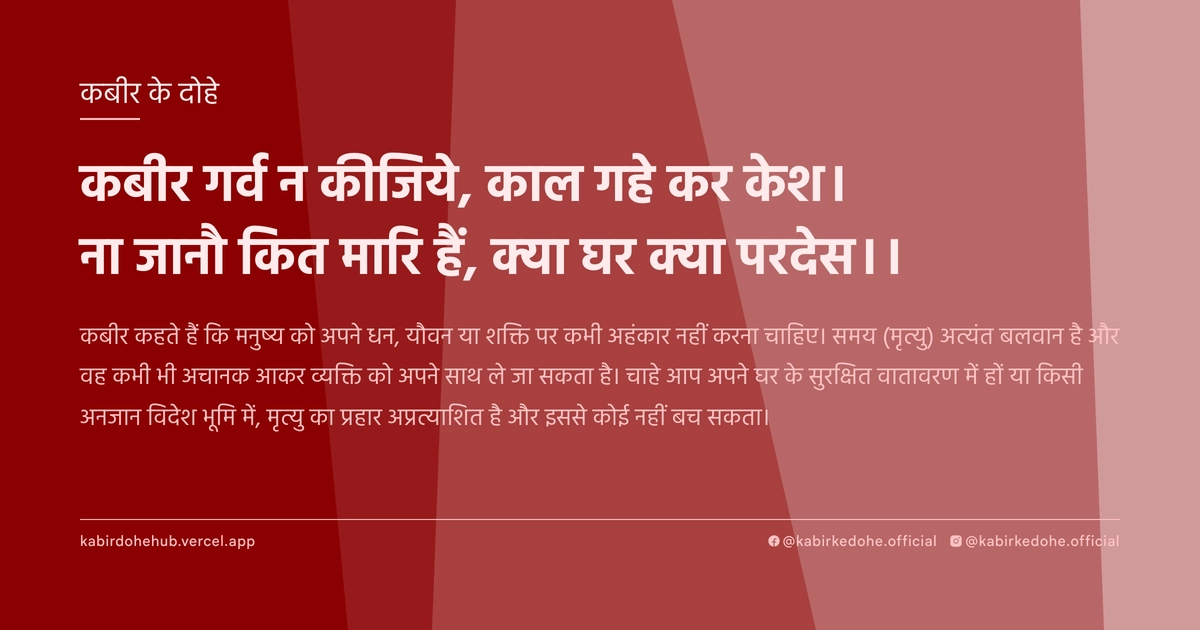
कबीर गर्व न कीजिये, काल गहे कर केश।
ना जानौ कित मारि हैं, क्या घर क्या परदेस।।
Kabir garv na kariye, kaal gahe kar kesh. Na jaanau kit maari hain, kya ghar kya pardes.
इस पृष्ठ पर इस कबीर दोहे का अर्थ (meaning), हिंदी व्याख्या और अंग्रेज़ी अनुवाद, दार्शनिक विश्लेषण और व्यावहारिक जीवन सीख दी गई है। यह दोहा मृतुक्यता (Mortality) विषय से जुड़ा है — Kabir doha meaning and explanation in Hindi and English.
अर्थ (Meaning):
कबीर कहते हैं कि मनुष्य को अपने धन, यौवन या शक्ति पर कभी अहंकार नहीं करना चाहिए। समय (मृत्यु) अत्यंत बलवान है और वह कभी भी अचानक आकर व्यक्ति को अपने साथ ले जा सकता है। चाहे आप अपने घर के सुरक्षित वातावरण में हों या किसी अनजान विदेश भूमि में, मृत्यु का प्रहार अप्रत्याशित है और इससे कोई नहीं बच सकता।
Kabir warns against the folly of pride in one's status, youth, or possessions. He asserts that Time, in the form of Death, holds the hair of every living being, ready to pull them away at any moment. Neither the familiarity of home nor the distance of a foreign land offers sanctuary from the inevitable and unpredictable arrival of the end.
व्याख्या (Interpretation):
इस दोहे का शाब्दिक अर्थ मृत्यु की अनिवार्यता है, लेकिन इसका गहरा आध्यात्मिक अर्थ 'अहंकार के विसर्जन' से है। 'काल' यहाँ केवल समय नहीं, बल्कि उस परम सत्य का प्रतीक है जो माया के पर्दे को हटा देता है। जब कबीर कहते हैं कि काल 'केश' (बालों) को पकड़ता है, तो वे यह दर्शा रहे हैं कि मनुष्य की सारी उपलब्धियाँ और शारीरिक सुंदरता मृत्यु के सामने तुच्छ हैं। यह निर्गुण भक्ति का सार है, जहाँ साधक को यह बोध होता है कि शरीर नश्वर है और केवल आत्मा ही शाश्वत है। अद्वैत वेदांत के अनुसार, जब तक 'मैं' (अहंकार) जीवित है, तब तक मनुष्य माया के भ्रम में है। मृत्यु का भय वास्तव में उस अहंकार की मृत्यु का भय है जो स्वयं को शरीर मानता है। यह विरोधाभास है कि जिसे हम अपना 'घर' (सुरक्षित स्थान) कहते हैं, वह भी काल के प्रभाव से मुक्त नहीं है, क्योंकि वास्तविक घर तो वह शून्य है जहाँ आत्मा परमात्मा में विलीन हो जाती है।
While the literal meaning addresses the inevitability of death, the deeper metaphysical layer concerns the dissolution of the ego. 'Kaal' (Time/Death) is not merely a chronological end but the ultimate truth that strips away the veil of Maya. By stating that Death 'grasps the hair,' Kabir illustrates that all human achievements and physical beauty are trivial in the face of the absolute. This aligns with Nirgun Bhakti, where the seeker realizes the transience of the physical form and the eternity of the soul. In the lens of Advaita Vedanta, as long as the 'I' (ego) persists, the human remains trapped in illusion. The fear of death is, in reality, the fear of the ego's annihilation. The central paradox lies in the concept of 'home'; the physical sanctuary is an illusion, for the only true home is the primordial void where the Atman merges with Brahman, transcending the duality of here and there.
दार्शनिक विश्लेषण (Philosophical Analysis):
कबीर का यह संदेश उस युग की सामाजिक और धार्मिक जड़ता पर प्रहार है जहाँ लोग बाहरी आडंबरों, जातिगत श्रेष्ठता और संचित धन के माध्यम से अपनी अमरता या सुरक्षा खोजने का प्रयास करते थे। कबीर ने स्पष्ट किया कि मृत्यु जाति, धर्म या सामाजिक स्तर का भेद नहीं करती। यह दृष्टिकोण सूफी मत के 'फना' (अहंकार का विनाश) के सिद्धांत से मेल खाता है, जहाँ खुदा को पाने के लिए स्वयं के अस्तित्व को मिटाना आवश्यक है।
दार्शनिक स्तर पर, यह दोहा अद्वैत वेदांत के उस सिद्धांत को पुष्ट करता है कि शरीर केवल एक वस्त्र है। जब मनुष्य गर्व करता है, तो वह इस नश्वर वस्त्र को ही अपनी स्थायी पहचान मान लेता है। कबीर इस 'मिथ्या पहचान' को तोड़ने का आह्वान करते हैं। वे बताते हैं कि गर्व वास्तव में अज्ञानता का परिणाम है। जो व्यक्ति यह समझ लेता है कि वह शरीर नहीं बल्कि चेतना है, वह मृत्यु के भय से मुक्त हो जाता है।
कबीर की अस्वीकृति केवल कर्मकांडों की नहीं थी, बल्कि उस मनोवैज्ञानिक स्थिति की थी जो मनुष्य को श्रेष्ठता का भ्रम देती है। वे तर्क देते हैं कि यदि मृत्यु निश्चित है, तो श्रेष्ठता का दावा करना हास्यास्पद है। यह विचार व्यक्ति को वर्तमान क्षण में जीने और करुणा अपनाने के लिए प्रेरित करता है।
यहाँ 'घर' और 'परदेस' का उल्लेख स्थान नहीं, बल्कि मानसिक अवस्थाओं का प्रतीक है। 'घर' वह मोह है जिसे हम अपना समझते हैं, और 'परदेस' वह अनिश्चितता है जिससे हम डरते हैं। कबीर कहते हैं कि दोनों ही स्थितियों में परिणाम एक ही है। यह बोध मनुष्य को वैराग्य की ओर ले जाता है, जो पलायन नहीं बल्कि सत्य की स्वीकृति है।
अंततः, यह विश्लेषण हमें सिखाता है कि अहंकार का अंत ही वास्तविक जीवन की शुरुआत है। जब हम यह स्वीकार कर लेते हैं कि हम समय के हाथों में केवल एक कठपुतली हैं, तब हम उस परम सत्ता के प्रति समर्पित हो जाते हैं। यही समर्पण हमें उस निर्गुण ईश्वर से जोड़ता है जो रूप, रंग और अहंकार से परे है।
Kabir’s message is a direct assault on the social and religious rigidity of his era, where individuals sought immortality or security through outward rituals, caste superiority, and accumulated wealth. He clarifies that death is the ultimate equalizer, indifferent to caste, creed, or social standing. This perspective mirrors the Sufi concept of 'Fana' (annihilation of the self), where the ego must be extinguished to achieve union with the Divine.
Philosophically, this couplet reinforces the Advaita Vedanta principle that the body is merely a garment. Pride arises when a human mistakenly identifies their eternal consciousness with this perishable vessel. Kabir calls for the dismantling of this 'false identity,' arguing that pride is a symptom of profound ignorance. One who realizes they are not the body but the witness-consciousness transcends the fear of death.
Kabir’s rejection extended beyond ritualism to the psychological state of perceived superiority. He posits that claiming superiority in the face of certain extinction is an absurdity. This realization compels the individual to live authentically in the present and embrace universal compassion, stripping away the layers of social conditioning.
The mention of 'home' and 'foreign lands' symbolizes psychological states rather than geography. 'Home' represents the attachments we cling to for security, while 'foreign lands' represent the uncertainty we dread. Kabir asserts that both are equally vulnerable to Time, urging a shift toward Vairagya (detachment)—not as an escape, but as an acceptance of Truth.
Ultimately, this analysis reveals that the death of the ego is the birth of true spiritual life. By acknowledging our fragility before the cosmic clock, we surrender to the Absolute. This surrender connects the individual to the Nirgun (formless) Divine, which exists beyond form, color, and the delusions of the self.
मूल संदेश (Core Message):
- अहंकार एक ऐसा पर्दा है जो सत्य को देखने नहीं देता।
- मृत्यु केवल शरीर का अंत है, अहंकार का अंत मुक्ति है।
- श्रेष्ठता का भ्रम ही सबसे बड़ा आध्यात्मिक बंधन है।
- समय सबसे बड़ा शिक्षक है, जो अंततः सबको शून्य कर देता है।
- विनम्रता ही वह एकमात्र सेतु है जो आत्मा को परमात्मा से जोड़ता है।
- सच्ची सुरक्षा बाहरी दीवारों में नहीं, आंतरिक विसर्जन में है।
- Pride is the veil that obscures the vision of ultimate Truth.
- Death ends the body; the end of ego initiates liberation.
- The illusion of superiority is the heaviest spiritual chain.
- Time is the ultimate teacher, reducing all complexities to zero.
- Humility is the only bridge connecting the Atman to the Brahman.
- True security lies not in external walls, but in internal dissolution.
व्यावहारिक उदाहरण (Practical Example):
एक समय की बात है, वाराणसी के घाटों पर माधव नाम का एक अत्यंत कुशल और अहंकारी मूर्तिकार रहता था। उसकी बनाई मूर्तियाँ इतनी सजीव होती थीं कि लोग दूर-दूर से उन्हें देखने आते थे। माधव को अपनी कला पर इतना गर्व था कि वह स्वयं को ईश्वर का समकक्ष मानने लगा था। वह अक्सर अन्य शिल्पकारों का उपहास करता और कहता कि उसकी कला उसे अमर बना देगी।
एक दिन, माधव ने शहर के सबसे बड़े मंदिर के लिए एक विशाल प्रतिमा बनाई। जब प्रतिमा का अनावरण हुआ, तो उसकी प्रशंसा में हज़ारों शब्द कहे गए। माधव का अहंकार सातवें आसमान पर था। उसने सोचा कि उसकी यह कृति युगों-युगों तक उसका नाम जीवित रखेगी और वह कभी विस्मृत नहीं होगा।
उसी शाम, जब वह अपनी सफलता का जश्न मना रहा था, अचानक उसे तेज़ बुखार आया। कुछ ही दिनों में वह बिस्तर से लग गया। उसकी वह कला, जिसकी उसने इतनी प्रशंसा की थी, अब उसके किसी काम नहीं आ रही थी। वह अपनी मूर्तियों को देख रहा था, जो अब उसे पत्थर के बेजान टुकड़े लगने लगी थीं।
एक दिन उसके पास एक वृद्ध संन्यासी आया। संन्यासी ने उसकी हालत देखी और शांति से कहा, 'माधव, तुमने पत्थर में जान फूँकने की कोशिश की, लेकिन अपनी नश्वरता को भूल गए। जिस पत्थर पर तुम्हें गर्व था, वह आज भी वहीं खड़ा है, लेकिन तुम ढह रहे हो।'
माधव को पहली बार महसूस हुआ कि उसका गर्व कितना खोखला था। उसने महसूस किया कि वह अपनी कला का स्वामी नहीं था, बल्कि समय का एक छोटा सा हिस्सा था। उसने संन्यासी से पूछा, 'अब मैं क्या करूँ?'
संन्यासी ने उत्तर दिया, 'अपनी कला को अहंकार का माध्यम नहीं, बल्कि सेवा का साधन बनाओ। जब तुम यह जान लोगे कि तुम कुछ भी नहीं हो, तभी तुम वास्तव में सब कुछ बन जाओगे।'
माधव ने अपने जीवन के अंतिम दिनों में अपनी सारी संपत्ति और अपनी कला की शिक्षा उन गरीब बच्चों को देना शुरू किया जो कभी उसके दरबार में आने की हिम्मत नहीं करते थे। उसने अपनी मूर्तियों पर अपना नाम लिखना बंद कर दिया।
जब माधव की मृत्यु हुई, तो उसके चेहरे पर एक अद्भुत शांति थी। वह अब उस 'घर' से विदा हो रहा था जिसे उसने अपना साम्राज्य समझा था, लेकिन इस बार वह डरा हुआ नहीं था क्योंकि उसने अपने अहंकार की मृत्यु पहले ही कर ली थी।
उसकी अंतिम कृति एक साधारण पत्थर पर उकेरी गई एक छोटी सी मुस्कान थी, जिसमें कोई नाम नहीं था, केवल समर्पण था। वह अब वास्तव में अमर हो गया था, क्योंकि उसने स्वयं को मिटा दिया था।
यह 'कबीर ट्विस्ट' था—जहाँ एक कलाकार ने अपनी श्रेष्ठता के भ्रम को तोड़कर शून्य में विलीन होना सीखा, और इसी शून्य में उसे वास्तविक पूर्णता मिली।
Once, on the ghats of Varanasi, lived a master sculptor named Madhav. His sculptures were so lifelike that people traveled from afar to witness them. However, Madhav’s skill bred a towering ego; he began to view himself as an equal to the Divine, often mocking other artisans and claiming his art would grant him immortality.
One day, Madhav completed a colossal statue for the city's grandest temple. As the veil was lifted, thousands praised his genius. Madhav’s pride soared; he believed this creation would ensure his name lived forever, shielding him from the oblivion of time.
That very evening, while celebrating his triumph, a sudden, violent fever seized him. Within days, he was bedridden. The art he had idolized could not offer him a single breath of relief. Looking at his statues, they no longer seemed divine; they looked like cold, lifeless stones.
An elderly monk visited him and observed his suffering. The monk said softly, 'Madhav, you tried to breathe life into stone, but you forgot your own fragility. The stone you were proud of still stands, but you are crumbling.'
For the first time, Madhav realized the hollowness of his pride. He understood he was not the master of his art, but a mere flicker in the vastness of time. He asked the monk, 'What remains for me now?'
The monk replied, 'Stop using your art as a pedestal for your ego and start using it as a vessel for service. Only when you realize you are nothing can you truly become everything.'
In his final days, Madhav began teaching impoverished children who had once been shunned by his arrogance. He stopped signing his works, erasing his identity from the stone.
When death finally arrived, a profound peace rested on Madhav's face. He was leaving the 'home' he once thought was his empire, but he was no longer afraid, for he had already killed his ego.
His final work was a simple, nameless smile carved into a rough stone—a testament to surrender rather than skill. In erasing himself, he finally achieved the immortality he had sought.
This was the 'Kabir Twist'—the artist discovered that true perfection is found not in the height of one's achievement, but in the depth of one's humility.
अभ्यास मार्गदर्शन (Practice Guidance):
- प्रतिदिन 10 मिनट 'मृत्यु चिंतन' (Memento Mori) का अभ्यास करें। विचार करें कि यदि आज अंतिम दिन हो, तो क्या आपका अहंकार आपके साथ जाएगा?
- एक 'अहंकार पत्रिका' (Ego Journal) बनाएँ। उन क्षणों को लिखें जब आपने स्वयं को दूसरों से श्रेष्ठ महसूस किया और विश्लेषण करें कि वह भावना कहाँ से आई।
- व्यवहार परिवर्तन: दिन में कम से कम एक बार किसी ऐसे व्यक्ति की निस्वार्थ सेवा करें जिसे समाज 'निम्न' मानता है, ताकि आपकी श्रेष्ठता का भ्रम टूटे।
- निदान चेकलिस्ट: क्या आप अपनी उपलब्धियों के खोने के विचार से डरते हैं? क्या आप दूसरों की प्रशंसा पर निर्भर हैं? यदि हाँ, तो आप अभी भी 'काल' के भय और अहंकार के जाल में हैं।
- Practice 'Death Contemplation' (Memento Mori) for 10 minutes daily. Ask yourself: If today were my last day, would my pride accompany me into the void?
- Maintain an 'Ego Journal.' Record moments where you felt superior to others and analyze the root of that perceived superiority.
- Behavioral Shift: Perform one act of selfless service daily for someone marginalized by society to actively dismantle the illusion of status.
- Diagnostic Checklist: Do you fear the loss of your achievements? Are you dependent on external validation? If yes, you are still entangled in the web of ego and the fear of Time.
चिंतन प्रश्न (Reflection Questions):
- यदि आपकी सारी उपाधियाँ और संपत्ति आज छीन ली जाएँ, तो 'आप' कौन बचेंगे?
- आपकी सार्वजनिक छवि (Digital/Social Ego) आपके आंतरिक शून्य को कितना ढक रही है?
- क्या आप वास्तव में दूसरों की मदद करते हैं, या मदद करके अपनी 'मददगार' होने की छवि को पुष्ट करते हैं?
- वह कौन सा डर है जिसे आप 'सुरक्षा' के नाम पर पाल रहे हैं?
- क्या आप मृत्यु से डरते हैं, या उस पहचान के खोने से जिसे आपने जीवन भर संजोया है?
- If all your titles and possessions were stripped away today, who would 'you' be?
- To what extent does your public persona (Digital/Social Ego) mask your internal void?
- Do you truly help others, or do you help them to reinforce your image as a 'helper'?
- What is the specific fear you are nurturing under the guise of 'seeking security'?
- Do you fear death itself, or do you fear the loss of the identity you have spent a lifetime constructing?