
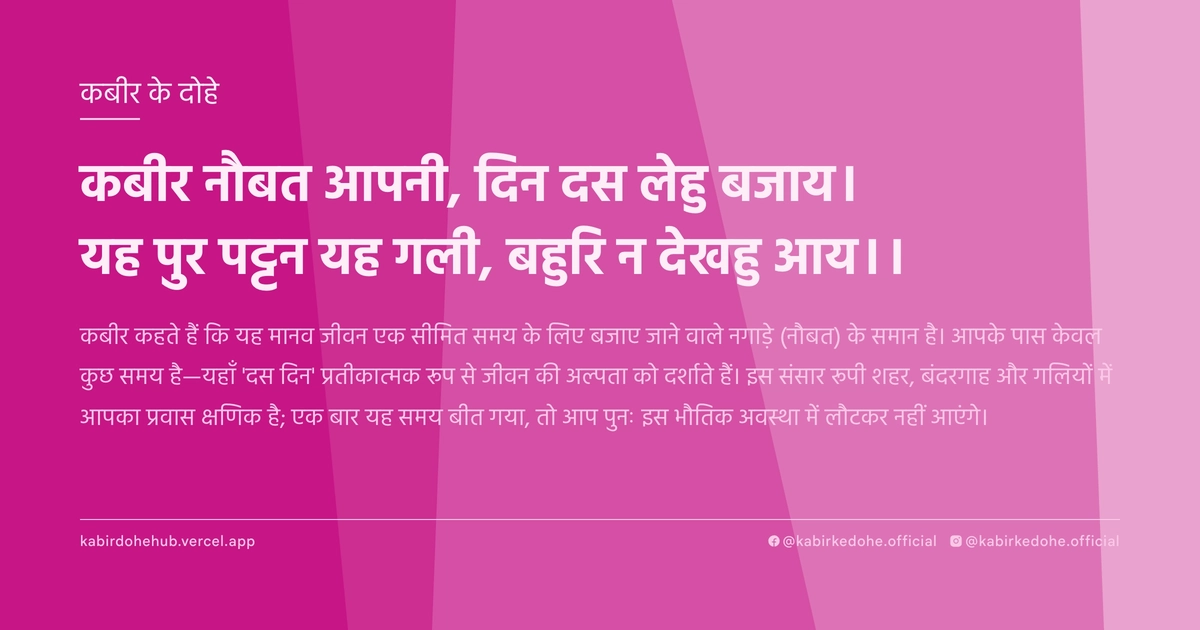
कबीर नौबत आपनी, दिन दस लेहु बजाय।
यह पुर पट्टन यह गली, बहुरि न देखहु आय।।
Kabir naubat aapni, din das lehu bajaay. Yeh pur pattan yeh gali, bahuri na dekhu aay.
इस पृष्ठ पर इस कबीर दोहे का अर्थ (meaning), हिंदी व्याख्या और अंग्रेज़ी अनुवाद, दार्शनिक विश्लेषण और व्यावहारिक जीवन सीख दी गई है। यह दोहा समय का महत्व (The Value of Time) विषय से जुड़ा है — Kabir doha meaning and explanation in Hindi and English.
अर्थ (Meaning):
कबीर कहते हैं कि यह मानव जीवन एक सीमित समय के लिए बजाए जाने वाले नगाड़े (नौबत) के समान है। आपके पास केवल कुछ समय है—यहाँ 'दस दिन' प्रतीकात्मक रूप से जीवन की अल्पता को दर्शाते हैं। इस संसार रूपी शहर, बंदरगाह और गलियों में आपका प्रवास क्षणिक है; एक बार यह समय बीत गया, तो आप पुनः इस भौतिक अवस्था में लौटकर नहीं आएंगे।
Kabir suggests that human life is like a ceremonial drum (naubat) played for a very limited duration. The 'ten days' are symbolic of the brevity of existence. This world, depicted as a city, a port, and a narrow lane, is merely a temporary transit point; once this window of opportunity closes, you shall not return to this physical form or state of being.
व्याख्या (Interpretation):
शाब्दिक रूप से, यह दोहा समय की नश्वरता की चेतावनी देता है। आध्यात्मिक स्तर पर, 'नौबत' वह दिव्य पुकार है जो आत्मा को जगाने के लिए बज रही है। 'दस दिन' का अर्थ वास्तविक दस दिन नहीं, बल्कि वह संक्षिप्त अवधि है जिसमें मनुष्य चेतना विकसित कर सकता है। यह निरगुण भक्ति के उस सिद्धांत को पुष्ट करता है जहाँ संसार को एक 'सराय' या अस्थायी पड़ाव माना गया है। माया यहाँ उस 'पुर' (शहर) की तरह है जो हमें अपनी चकाचौंध में उलझाए रखती है, जिससे हम भूल जाते हैं कि हम केवल यात्री हैं। आत्मा और ब्रह्म की एकता का बोध तभी संभव है जब व्यक्ति इस क्षणभंगुरता को स्वीकार कर अहंकार का त्याग करे। यह विरोधाभास है कि हम अनंत काल के लिए योजनाएं बनाते हैं, जबकि हमारा समय एक ढोल की थाप जितना संक्षिप्त है।
Literally, the couplet warns of the transience of time. Spiritally, the 'naubat' (drum) represents the divine call awakening the soul from its slumber. The 'ten days' do not denote a literal timeframe but symbolize the fleeting window of opportunity for spiritual awakening. This aligns with Nirgun Bhakti, where the world is viewed as a 'sarai' or a temporary inn. Maya is the 'pur' (city) whose distractions blind us to our status as mere travelers. The realization of Atman-Brahman non-duality occurs only when one accepts this fragility and sheds the ego. The central paradox lies in the human tendency to plan for eternity while possessing a lifespan as brief as a single drumbeat.
दार्शनिक विश्लेषण (Philosophical Analysis):
कबीर का यह दोहा उनके युग के सामाजिक और धार्मिक पाखंडों के विरुद्ध एक सशक्त प्रहार है। उस समय, लोग कर्मकांडों और बाहरी आडंबरों में इतने लीन थे कि वे जीवन के वास्तविक उद्देश्य को भूल चुके थे। कबीर ने यहाँ 'समय' को एक शिक्षक के रूप में प्रस्तुत किया है। वे बताते हैं कि मोक्ष किसी मंदिर या मस्जिद में नहीं, बल्कि समय के सही उपयोग और आंतरिक जागरूकता में है।
अद्वैत वेदांत के परिप्रेक्ष्य में, यह दोहा 'विवेक' (discrimination) की बात करता है—नित्य और अनित्य के बीच का अंतर समझना। जब साधक यह जान लेता है कि यह शरीर और यह संसार 'अनित्य' है, तब वह स्वाभाविक रूप से उस 'नित्य' (ब्रह्म) की खोज शुरू करता है। कबीर का दृष्टिकोण यहाँ सूफी मत के 'फना' (अहंकार का विनाश) के करीब है, जहाँ व्यक्ति को अपनी नश्वरता का बोध होते ही ईश्वर में विलीन होने की तड़प जागती है।
कबीर जाति और धर्म की सीमाओं को तोड़ते हुए यह संदेश देते हैं कि मृत्यु और समय सबके लिए समान हैं। एक ब्राह्मण हो या एक चर्मकार, 'नौबत' सबके लिए एक ही समय पर रुकती है। यह समानता ही उन्हें सामाजिक समानता के प्रबल समर्थक बनाती है। वे ritualism को इसलिए नकारते हैं क्योंकि कर्मकांड समय की बर्बादी हैं, जबकि आत्म-साक्षात्कार ही एकमात्र स्थायी उपलब्धि है।
मनोवैज्ञानिक स्तर पर, यह दोहा 'मृत्यु-चेतना' (memento mori) को जागृत करता है। यह डराने के लिए नहीं, बल्कि प्रेरित करने के लिए है। जब मनुष्य को अपनी सीमा का ज्ञान होता है, तो वह अनावश्यक द्वंद्वों, ईर्ष्या और संग्रह की प्रवृत्ति को छोड़ देता है। यह अहंकार के विसर्जन की प्रक्रिया है, जहाँ 'मैं' से 'तत्व' की ओर संक्रमण होता है।
अंततः, कबीर यह स्पष्ट करते हैं कि आध्यात्मिक यात्रा में विलंब करना सबसे बड़ा पाप है। 'बहुरि न देखहु आय' का अर्थ है कि यह अवसर दुर्लभ है। यह बोध साधक को आलस्य से निकालकर 'साधना' की तीव्रता की ओर ले जाता है, जहाँ हर सांस एक प्रार्थना बन जाती है और हर क्षण एक अवसर।
This doha is a powerful strike against the social and religious hypocrisies of Kabir's era. People were so immersed in rituals and outward displays that they forgot the true purpose of existence. Kabir presents 'Time' as the ultimate teacher, asserting that liberation is found not in temples or mosques, but in the conscious utilization of time and internal awakening.
From the lens of Advaita Vedanta, the verse emphasizes 'Viveka' (discrimination)—the ability to distinguish between the Eternal (Nitya) and the Ephemeral (Anitya). Once the seeker realizes that the body and the world are ephemeral, they naturally begin the quest for the Eternal Brahman. Kabir's approach here mirrors the Sufi concept of 'Fana' (annihilation of the self), where the realization of mortality ignites a longing to merge with the Divine.
By highlighting that time and death are universal, Kabir dismantles caste and religious hierarchies. Whether a Brahmin or a tanner, the 'naubat' stops for everyone at the same pace. This universality fuels his advocacy for social equality. He rejects ritualism because rituals are mere distractions—wasteful expenditures of time—whereas self-realization is the only enduring achievement.
Psychologically, the doha invokes 'memento mori'. It is not intended to instill fear, but to catalyze urgency. When a human acknowledges their limitation, they naturally shed unnecessary conflicts, jealousy, and the urge for accumulation. This is the process of ego-dissolution, transitioning from the 'I' to the 'Universal Element'.
Ultimately, Kabir clarifies that procrastination in the spiritual journey is the greatest failure. 'Bahuri na dekhahu aay' implies that this opportunity is rare. This realization shifts the seeker from lethargy to the intensity of 'Sadhana', where every breath becomes a prayer and every moment an opportunity for transcendence.
मूल संदेश (Core Message):
- समय की अल्पता को पहचानना ही वास्तविक बुद्धिमत्ता है।
- बाहरी उपलब्धियां आत्मा की प्यास नहीं बुझा सकतीं।
- संसार एक अस्थायी पड़ाव है, इसे स्थायी घर न समझें।
- अहंकार का त्याग ही मोक्ष का एकमात्र द्वार है।
- वर्तमान क्षण में जागना ही सर्वोच्च साधना है।
- Recognizing the brevity of time is the beginning of true wisdom.
- External achievements cannot quench the thirst of the soul.
- The world is a temporary transit; do not mistake it for a permanent home.
- The dissolution of ego is the only gateway to liberation.
- Awakening in the present moment is the highest spiritual practice.
व्यावहारिक उदाहरण (Practical Example):
वाराणसी के घाटों पर रहने वाले एक वृद्ध बुनकर, माधव, की कहानी है। माधव अपनी पूरी जिंदगी बेहतरीन रेशमी वस्त्र बुनने में बिता चुका था। वह अपनी कला में इतना निपुण था कि लोग दूर-दूर से उसके पास आते थे। लेकिन माधव का अहंकार उसकी कला से भी बड़ा था। वह मानता था कि उसकी प्रसिद्धि अमर है और वह कभी नहीं मरेगा।
वह अपने बेटों और शिष्यों को यह सिखाता था कि केवल तकनीक और बारीकी मायने रखती है, जबकि उसके पड़ोसी, एक साधारण साधु, उसे हमेशा याद दिलाते थे कि समय रेत की तरह फिसल रहा है। माधव उन बातों को हँसकर टाल देता और कहता, 'मेरी कला ही मेरा मोक्ष है।'
एक दिन, माधव ने शहर के सबसे बड़े सेठ के लिए एक अत्यंत जटिल वस्त्र बुनना शुरू किया। उसने सोचा कि इस वस्त्र के पूरा होने के बाद वह दुनिया का सबसे महान बुनकर कहलाएगा। उसने दिन-रात एक कर दिए, नींद त्याग दी और अपने स्वास्थ्य की अनदेखी की। वह इस भ्रम में था कि वह समय को नियंत्रित कर सकता है।
तभी एक शाम, जब वह अंतिम धागा जोड़ने वाला था, उसे अचानक एक तीव्र हृदयघात महसूस हुआ। वह गिर पड़ा। उसकी आँखों के सामने वह अधूरा वस्त्र था और उसके जीवन भर की संचित संपत्ति। उसे अचानक कबीर का वह दोहा याद आया जो उसने बचपन में सुना था—'नौबत आपनी'।
उसे अहसास हुआ कि उसने रेशम के धागों को तो सुलझा लिया, लेकिन अपनी आत्मा के उलझनों को कभी नहीं देखा। उसने अपनी पूरी ऊर्जा बाहरी चमक-धमक और प्रशंसा बटोरने में लगा दी, जबकि उसके भीतर का आध्यात्मिक शून्य गहराता गया।
उस अंतिम क्षण में, माधव ने महसूस किया कि वह 'पुर' (शहर) और 'गली' (प्रसिद्धि की राह) वास्तव में कितनी छोटी थीं। उसकी सारी उपलब्धियां उस एक क्षण के सामने तुच्छ थीं जब उसे अपनी नश्वरता का सामना करना पड़ा।
लेकिन इस बोध ने उसे शांति दी। उसने अपनी आँखें बंद कीं और पहली बार अपनी कला को अहंकार के लिए नहीं, बल्कि उस निराकार ईश्वर के प्रति समर्पण के रूप में देखा। उसने महसूस किया कि वह स्वयं भी एक धागा था जिसे समय के बुनकर ने बुना था और अब उसे वापस उसी में मिल जाना था।
माधव की मृत्यु के बाद, उसके शिष्यों ने देखा कि उसके चेहरे पर एक ऐसी शांति थी जो उसने जीवन भर की प्रसिद्धि में कभी नहीं पाई थी। वह 'दस दिन' की प्रतीकात्मक अवधि के अंतिम क्षण में जाग गया था।
यह कहानी हमें सिखाती है कि बाहरी सफलता और कौशल तब तक व्यर्थ हैं जब तक वे हमें आंतरिक सत्य की ओर नहीं ले जाते। समय का सही उपयोग केवल कार्य पूरा करना नहीं, बल्कि स्वयं को जानना है।
माधव का परिवर्तन यह दर्शाता है कि जब हम अपनी नश्वरता को स्वीकार करते हैं, तो हम वास्तव में जीना शुरू करते हैं।
This is the story of Madhav, an elderly weaver living on the ghats of Varanasi. Madhav had spent his entire life weaving the finest silk fabrics. He was so skilled that people traveled from afar to seek his work. However, Madhav's ego was larger than his art; he believed his fame was immortal and that he would never truly perish.
He taught his sons and disciples that only technique and precision mattered, while a simple monk living next door constantly reminded him that time was slipping away like sand. Madhav would dismiss these warnings with a laugh, claiming, 'My art is my salvation.'
One day, Madhav began weaving an incredibly complex garment for the city's wealthiest merchant. He believed that upon completing this piece, he would be recognized as the greatest weaver in history. He worked day and night, sacrificing sleep and neglecting his health, under the illusion that he could control time.
Then, one evening, just as he was about to tie the final thread, he felt a sudden, sharp pain in his chest. He collapsed. Before his eyes lay the unfinished fabric and the accumulated wealth of a lifetime. Suddenly, he recalled a doha by Kabir he had heard in childhood—the one about the 'naubat' (drum).
He realized that while he had untangled the silk threads, he had never looked at the tangles of his own soul. He had spent all his energy gathering external glitter and praise, while the spiritual void within him only deepened.
In that final moment, Madhav perceived how small the 'pur' (city) and the 'gali' (the path of fame) truly were. All his achievements felt trivial in the face of his own mortality.
Yet, this realization brought him peace. He closed his eyes and, for the first time, viewed his art not as a tool for ego, but as a surrender to the Formless Divine. He felt that he himself was but a thread woven by the Weaver of Time, and now it was time to merge back into the source.
After Madhav's passing, his disciples noticed a serenity on his face that he had never possessed during his years of fame. He had awakened in the final moment of those symbolic 'ten days'.
This story teaches us that external success and skill are futile unless they lead us toward internal truth. The correct use of time is not merely completing tasks, but knowing oneself.
Madhav's transformation demonstrates that when we accept our mortality, we truly begin to live.
अभ्यास मार्गदर्शन (Practice Guidance):
- दैनिक चिंतन: प्रतिदिन 15 मिनट मौन बैठें और विचार करें कि यदि आज जीवन का अंतिम दिन हो, तो आपके कौन से कार्य सार्थक होंगे और कौन से व्यर्थ।
- आत्म-पूछताछ जर्नल: लिखें कि आप अपनी पहचान किन बाहरी चीजों (पद, संपत्ति, छवि) से जोड़ते हैं और वे चीजें समय के साथ कैसे बदल रही हैं।
- व्यवहार परिवर्तन: किसी भी विवाद या क्रोध के क्षण में स्वयं से पूछें—'क्या यह संघर्ष मेरे सीमित समय की कीमत के योग्य है?'
- निदान चेकलिस्ट: यदि आप भविष्य की चिंता में वर्तमान खो रहे हैं या दूसरों से श्रेष्ठ दिखने की होड़ में हैं, तो आप 'माया के पुर' में फंसे हैं। यदि आप वर्तमान क्षण में कृतज्ञता और शांति महसूस करते हैं, तो आप जागृत हैं।
- Daily Contemplation: Spend 15 minutes in silence daily, reflecting on which of your actions would be meaningful and which futile if today were your final day.
- Self-Inquiry Journal: Document the external markers (status, wealth, image) you attach your identity to and observe how these markers shift over time.
- Behavioral Shift: In moments of conflict or anger, ask yourself—'Is this struggle worth the price of my limited time?'
- Diagnostic Checklist: If you are losing the present to future anxieties or competing to appear superior to others, you are trapped in the 'City of Maya'. If you feel gratitude and peace in the present moment, you are awakening.
चिंतन प्रश्न (Reflection Questions):
- यदि आपकी सारी सामाजिक उपलब्धियां छीन ली जाएं, तो आपके पास 'स्वयं' के रूप में क्या बचेगा?
- आप अपने समय का कितना हिस्सा दूसरों को प्रभावित करने में बिताते हैं बनाम स्वयं को जानने में?
- वह कौन सा डर है जो आपको यह स्वीकार करने से रोकता है कि आप इस संसार में केवल एक यात्री हैं?
- क्या आपकी डिजिटल पहचान (सोशल मीडिया) आपके वास्तविक आंतरिक अस्तित्व को ढक रही है?
- आपकी कौन सी आदतें आपको यह विश्वास दिलाती हैं कि आपके पास 'असीमित समय' है?
- If all your social achievements were stripped away, what would remain of 'you' as a self?
- How much of your time is spent influencing others' perceptions versus knowing your own truth?
- What is the fear that prevents you from accepting that you are merely a traveler in this world?
- Is your digital identity masking your actual internal existence?
- Which of your habits trick you into believing that you possess 'unlimited time'?