
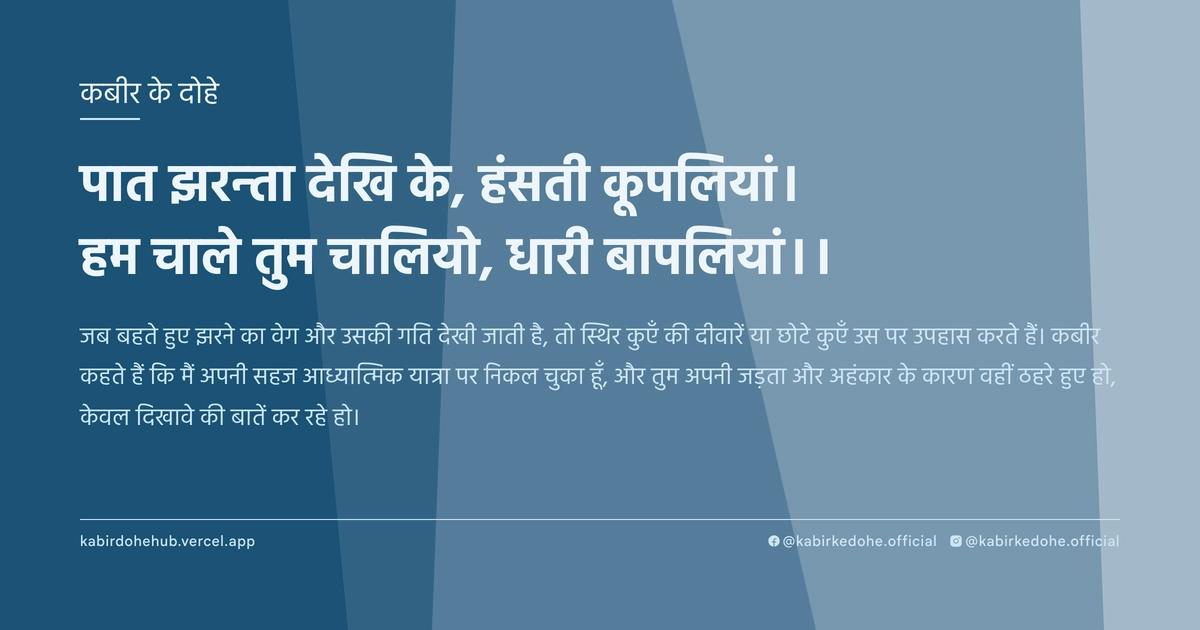
पात झरन्ता देखि के, हंसती कूपलियां।
हम चाले तुम चालियो, धारी बापलियां।।
Paat jharanta dekhi ke, hansti koopliyan. Hum chaale tum chaaliyo, dhaari baapliyan.
इस पृष्ठ पर इस कबीर दोहे का अर्थ (meaning), हिंदी व्याख्या और अंग्रेज़ी अनुवाद, दार्शनिक विश्लेषण और व्यावहारिक जीवन सीख दी गई है। यह दोहा सहज योग (Sahaja Yoga) विषय से जुड़ा है — Kabir doha meaning and explanation in Hindi and English.
अर्थ (Meaning):
जब बहते हुए झरने का वेग और उसकी गति देखी जाती है, तो स्थिर कुएँ की दीवारें या छोटे कुएँ उस पर उपहास करते हैं। कबीर कहते हैं कि मैं अपनी सहज आध्यात्मिक यात्रा पर निकल चुका हूँ, और तुम अपनी जड़ता और अहंकार के कारण वहीं ठहरे हुए हो, केवल दिखावे की बातें कर रहे हो।
Upon seeing the flowing stream, the stagnant wells laugh in mockery. Kabir declares that he has embarked upon the path of spiritual liberation and flow, while those trapped in the rigidity of ritual and ego remain stationary, merely pretending to move or clinging to their outdated, stagnant beliefs.
व्याख्या (Interpretation):
यहाँ 'झरना' उस साधक का प्रतीक है जिसने माया के बंधनों को तोड़कर परमात्मा की ओर प्रवाह शुरू कर दिया है, जबकि 'कूपलियां' (कुएँ) उन लोगों को दर्शाते हैं जो शास्त्रवाद और बाहरी आडंबरों में कैद हैं। यह दोहा निर्गुण भक्ति के उस सार को पकड़ता है जहाँ सत्य अनुभवजन्य है, न कि किताबी। कुएँ की हँसी अज्ञानता का प्रतीक है, जो गतिशीलता को पागलपन समझती है। यह अद्वैत वेदांत के उस सिद्धांत को पुष्ट करता है कि जब तक अहंकार (कुआँ) बना रहता है, तब तक आत्मा का मिलन ब्रह्म (नदी/सागर) से संभव नहीं है। यह विरोधाभास है कि जो स्थिर होने का दावा करते हैं, वे वास्तव में मृतप्राय हैं, और जो बह रहे हैं, वे ही जीवित हैं।
The 'flowing stream' symbolizes the seeker who has shattered the shackles of Maya and entered the current of divine consciousness, whereas the 'wells' represent those imprisoned by dogmatic ritualism and intellectual pride. This verse captures the essence of Nirgun Bhakti, where truth is experiential rather than scriptural. The laughter of the wells is the laughter of ignorance, perceiving spiritual fluidity as instability. It reinforces the Advaita Vedanta principle that as long as the ego (the well's wall) persists, the union of Atman and Brahman (the river and ocean) remains impossible. The central paradox is that those who claim stability are spiritually stagnant, while those in motion are truly alive.
दार्शनिक विश्लेषण (Philosophical Analysis):
कबीर का यह दोहा मध्यकालीन भारत के उस सामाजिक-धार्मिक संघर्ष को दर्शाता है जहाँ कर्मकांड और रूढ़िवादिता ने वास्तविक आध्यात्मिकता का गला घोंट दिया था। कबीर ने यहाँ 'कुएँ' के माध्यम से उन पंडितों और मुल्लाओं पर प्रहार किया है जो केवल शास्त्रों के रटने में विश्वास रखते थे लेकिन उनके जीवन में प्रेम और करुणा का प्रवाह नहीं था।
दार्शनिक स्तर पर, यह सूफीवाद के 'फना' (अहंकार का विनाश) और वेदांत के 'माया' के विलोपन से जुड़ता है। कुआँ एक सीमित पहचान है, एक घेरा है। जब तक मनुष्य अपनी पहचान एक विशिष्ट जाति, धर्म या पद (कुएँ की दीवार) से जोड़कर रखता है, वह सत्य के विराट प्रवाह से वंचित रहता है।
कबीर यहाँ 'सहज मार्ग' की बात कर रहे हैं। उनके लिए भक्ति कोई कठिन तपस्या नहीं, बल्कि एक स्वाभाविक बहाव है। वे ritualism (कर्मकांड) को एक मृत संरचना मानते हैं। उनके अनुसार, ईश्वर मंदिर या मस्जिद में नहीं, बल्कि उस जीवंत प्रवाह में है जो हृदय से निकलता है।
मनोवैज्ञानिक रूप से, यह दोहा 'कम्फर्ट ज़ोन' और 'विकास' के बीच के संघर्ष को दिखाता है। जो लोग बदलाव से डरते हैं, वे अक्सर उन लोगों का मज़ाक उड़ाते हैं जो जोखिम उठाकर सत्य की खोज में निकलते हैं। यह अहंकार की रक्षा प्रणाली है।
अंततः, यह संदेश देता है कि आध्यात्मिक जागृति एक व्यक्तिगत यात्रा है। जब साधक अपनी सीमित पहचान (कुआँ) को तोड़कर अनंतता (झरना) में विलीन होता है, तब वह द्वैत से अद्वैत की ओर बढ़ता है। यह केवल ज्ञान की बात नहीं, बल्कि अस्तित्व के रूपांतरण की बात है।
This couplet reflects the socio-religious conflict of medieval India, where ritualism and orthodoxy had stifled genuine spirituality. Through the metaphor of the 'well,' Kabir attacks the scholars and clerics who relied solely on rote memorization of scriptures, lacking the living flow of love and compassion in their own lives.
Philosophically, this aligns with the Sufi concept of 'Fana' (annihilation of the self) and the Vedantic dissolution of 'Maya.' A well is a limited identity, a boundary. As long as a human identifies with a specific caste, religion, or status (the wall of the well), they remain severed from the vast current of Truth.
Kabir advocates for the 'Sahaj Marg' (the Path of Spontaneity). For him, devotion is not an arduous penance but a natural flow. He views ritualism as a dead structure, asserting that the Divine resides not in temples or mosques, but in the living current emanating from the heart.
Psychologically, the verse highlights the conflict between the 'comfort zone' and 'growth.' Those afraid of transformation often mock those who risk everything to seek the Truth; this is a defense mechanism of the ego to maintain its perceived stability.
Ultimately, the message is that spiritual awakening is a personal journey. When a seeker breaks the walls of their limited identity (the well) and merges into the infinity (the stream), they move from duality to non-duality. It is not merely an intellectual shift, but a total ontological transformation.
मूल संदेश (Core Message):
- जड़ता को स्थिरता समझने की भूल न करें।
- अहंकार की दीवारें सत्य के प्रवाह को रोक देती हैं।
- अनुभवजन्य ज्ञान किताबी ज्ञान से श्रेष्ठ है।
- परिवर्तन ही जीवन का एकमात्र शाश्वत सत्य है।
- अपनी सीमित पहचान को तोड़कर अनंत में विलीन हों।
- Do not mistake stagnation for stability.
- The walls of ego obstruct the flow of Truth.
- Experiential wisdom surpasses scriptural knowledge.
- Change is the only eternal truth of existence.
- Shatter your limited identity to merge with the Infinite.
व्यावहारिक उदाहरण (Practical Example):
एक समय की बात है, वाराणसी के घाटों पर रहने वाला एक वृद्ध बुनकर था जिसका नाम माधव था। माधव अपनी पूरी जिंदगी एक ही तरह की साड़ियाँ बुनने में बिता चुका था, जिसे वह अपनी 'परंपरा' और 'स्थिरता' कहता था। वह उन सभी युवाओं का मज़ाक उड़ाता था जो नए प्रयोग करते थे या शहर जाकर अलग तरह का जीवन जीते थे। माधव का मानना था कि जो अपनी जड़ों से चिपका रहे, वही सच्चा है।
उसी बस्ती में एक युवा लड़का, कबीरन, आया जो दुनिया भर की यात्रा कर रहा था और अलग-अलग संस्कृतियों के धागों को जोड़कर एक नया कपड़ा बुनने की कोशिश कर रहा था। कबीरन का कोई निश्चित घर नहीं था, वह एक झरने की तरह निरंतर बदल रहा था। माधव उसे देखकर हँसता और कहता, 'अरे पागल, तू तो हवा में उड़ रहा है, तुझे स्थिरता का अर्थ नहीं पता। तू कभी यहाँ है, कभी वहाँ, तेरा कोई आधार नहीं है।'
एक दिन शहर में एक बहुत बड़ा मेला लगा जहाँ दुनिया भर के व्यापारी आए। उन्होंने देखा कि माधव की साड़ियाँ सुंदर तो थीं, लेकिन वे पुरानी सोच की थीं और अब कोई उन्हें नहीं खरीदना चाहता था। वहीं कबीरन ने जो कपड़ा बुना था, उसमें पूरी दुनिया के रंगों और अनुभवों का संगम था। लोग उसकी कला की ओर खिंचे चले आए क्योंकि उसमें जीवन का प्रवाह था।
माधव ने देखा कि उसकी 'स्थिरता' वास्तव में एक 'जड़ता' बन गई थी। वह एक कुएँ की तरह था जिसमें पानी तो था, लेकिन वह सड़ रहा था क्योंकि उसमें कोई बहाव नहीं था। कबीरन की चंचलता वास्तव में एक उच्चतर सत्य की खोज थी।
माधव को अपनी गलती का अहसास हुआ। उसने महसूस किया कि वह जिसे 'संस्कार' कह रहा था, वह वास्तव में उसका अहंकार था जो उसे नए अनुभवों से रोक रहा था। उसने अपनी पुरानी करघे की दीवारों को मानसिक रूप से तोड़ दिया।
उसने कबीरन से पूछा, 'क्या मैं भी इस प्रवाह का हिस्सा बन सकता हूँ?' कबीरन ने मुस्कुराते हुए कहा, 'बस अपनी दीवारों को छोड़ दो, और बहना शुरू करो।'
माधव ने अपनी पुरानी तकनीकों को छोड़ा और नए प्रयोग शुरू किए। उसने पाया कि जब वह अपनी पहचान को एक 'परंपरागत बुनकर' से बदलकर एक 'कलाकार' के रूप में देखने लगा, तो उसका तनाव खत्म हो गया।
अब वह घाटों पर बैठकर केवल साड़ियाँ नहीं बुनता था, बल्कि लोगों को यह सिखाता था कि कैसे अपनी जड़ता को छोड़कर जीवन के प्रवाह में शामिल हुआ जाए। उसकी हँसी अब उपहास की नहीं, बल्कि आनंद की थी।
उसका जीवन अब एक स्थिर कुआँ नहीं, बल्कि एक बहता हुआ झरना बन गया था, जो सबको शीतलता प्रदान करता था।
Once, in the ghats of Varanasi, lived an elderly weaver named Madhav. Madhav had spent his entire life weaving the same traditional sarees, which he called his 'tradition' and 'stability.' He mocked all the youth who experimented with new designs or left for the city to lead different lives. Madhav believed that only those who clung to their roots were truly authentic.
Into the same neighborhood came a young man named Kabiran, who traveled the world, attempting to weave a new kind of fabric by blending threads from diverse cultures. Kabiran had no fixed home; he was like a stream, constantly moving and evolving. Madhav would laugh at him, saying, 'You fool, you are floating in the air. You know nothing of stability. You are here today and there tomorrow; you have no foundation.'
One day, a great fair was held in the city, attracting merchants from across the globe. They found that while Madhav's sarees were beautiful, they were products of an old mindset and no longer appealed to the changing world. Conversely, the fabric Kabiran had woven was a confluence of global colors and experiences. People were drawn to his art because it possessed the flow of life.
Madhav realized that his 'stability' had actually become 'stagnation.' He was like a well—containing water, yes, but the water was turning putrid because there was no current. Kabiran's perceived restlessness was, in fact, a quest for a higher truth.
Madhav recognized his error. He saw that what he called 'culture' was actually his ego, preventing him from embracing new experiences.
He asked Kabiran, 'Can I too become part of this flow?' Kabiran smiled and replied, 'Just let go of your walls and start flowing.'
Madhav abandoned his rigid techniques and began to experiment. He discovered that when he shifted his identity from a 'traditional weaver' to an 'artist,' his internal stress vanished.
He no longer spent his days on the ghats merely weaving sarees; he began teaching others how to shed their stagnation and join the current of life.
His laughter was no longer one of mockery, but of pure bliss. His life was no longer a stagnant well, but a flowing stream providing coolness to all who encountered it.
अभ्यास मार्गदर्शन (Practice Guidance):
- दैनिक चिंतन: प्रतिदिन 15 मिनट मौन बैठें और विचार करें कि आपके जीवन में कौन सी 'दीवारें' (पुरानी मान्यताएं, पूर्वाग्रह) आपको आगे बढ़ने से रोक रही हैं।
- आत्म-पूछताछ जर्नल: लिखें कि आप किन लोगों का मज़ाक उड़ाते हैं क्योंकि वे आपसे अलग हैं। क्या यह आपकी अपनी असुरक्षा या जड़ता का प्रतिबिंब है?
- व्यवहारिक परिवर्तन: इस सप्ताह एक ऐसा काम करें जो आपकी सामान्य दिनचर्या या स्वभाव के बिल्कुल विपरीत हो, ताकि आप अपनी मानसिक सीमाओं को तोड़ सकें।
- डायग्नोस्टिक चेकलिस्ट: क्या आप बदलाव से डरते हैं? क्या आप दूसरों की प्रगति पर संदेह करते हैं? क्या आप अपनी पुरानी उपलब्धियों को पकड़कर बैठे हैं? यदि हाँ, तो आप 'कुआँ' बन रहे हैं।
- Daily Contemplation: Sit in silence for 15 minutes daily and identify the 'walls' (outdated beliefs, prejudices) in your life that are preventing your growth.
- Self-Inquiry Journal: Document the instances where you mock others for being different. Ask yourself: Is this a reflection of my own insecurity or stagnation?
- Behavioral Shift: Perform one action this week that is completely contrary to your usual routine or nature to break your mental boundaries.
- Diagnostic Checklist: Do you fear change? Do you doubt the progress of others? Are you clinging to past achievements? If yes, you are operating as the 'well' rather than the 'stream'.
चिंतन प्रश्न (Reflection Questions):
- मेरी कौन सी ऐसी मान्यता है जिसे मैं सत्य मानता हूँ, लेकिन वह वास्तव में केवल एक सामाजिक कंडीशनिंग है?
- जब मैं दूसरों की आध्यात्मिक या मानसिक प्रगति देखता हूँ, तो मेरे भीतर उपहास या ईर्ष्या क्यों पैदा होती है?
- क्या मेरा 'डिजिटल व्यक्तित्व' (Social Media Ego) एक कुएँ की तरह है जो केवल बाहरी प्रशंसा की तलाश में स्थिर है?
- यदि आज मेरी सारी पहचान (पद, नाम, रिश्ता) छीन ली जाए, तो क्या मेरे भीतर कोई प्रवाह बचेगा?
- मैं अपनी सुरक्षा की दीवारों के पीछे छिप रहा हूँ या वास्तव में शांति में हूँ?
- क्या मैं सत्य को खोज रहा हूँ, या केवल उस सत्य की पुष्टि चाहता हूँ जिसे मैं पहले से जानता हूँ?
- Which of my beliefs do I hold as truth, when they are actually just social conditioning?
- Why does mockery or envy arise within me when I witness the spiritual or mental progress of others?
- Is my 'digital persona' like a well, stagnant and merely seeking external validation?
- If all my identities (status, name, relationships) were stripped away today, would any flow remain within me?
- Am I hiding behind walls of security, or am I truly in a state of peace?
- Am I seeking the Truth, or am I merely seeking confirmation of a truth I already believe?