
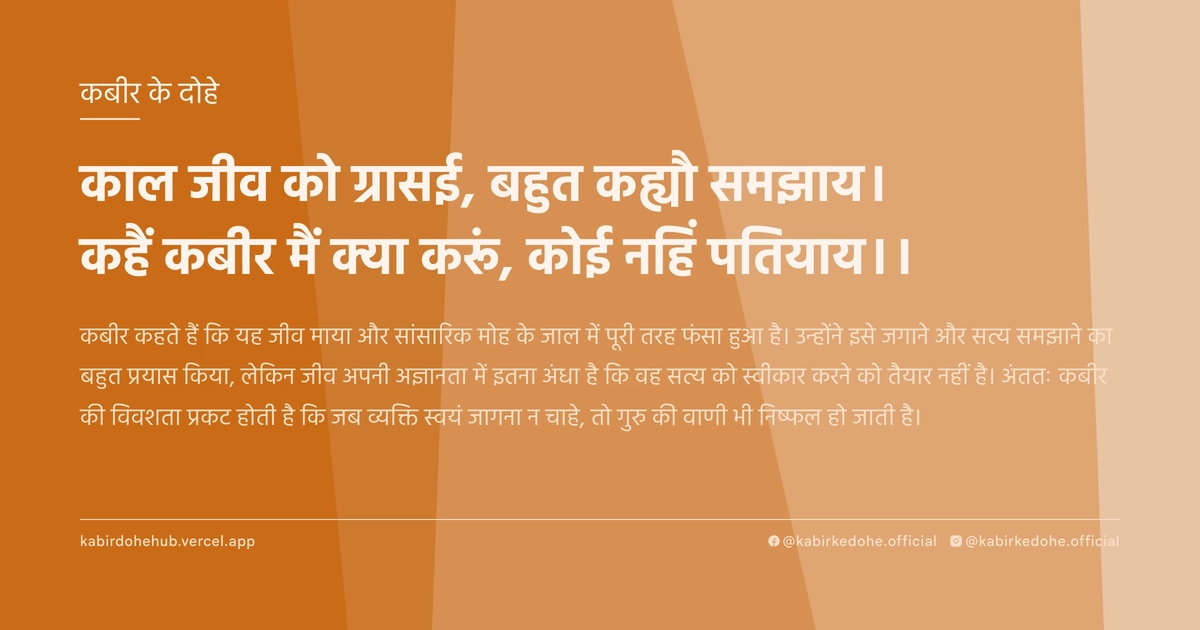
काल जीव को ग्रासई, बहुत कह्यौ समझाय।
कहैं कबीर मैं क्या करूं, कोई नहिं पतियाय।।
Kaal jeev ko grasai, bahut kahyo samjhay. Kahen kabir main kya karun, koi nahin patiyay.
इस पृष्ठ पर इस कबीर दोहे का अर्थ (meaning), हिंदी व्याख्या और अंग्रेज़ी अनुवाद, दार्शनिक विश्लेषण और व्यावहारिक जीवन सीख दी गई है। यह दोहा मृतुक्यता (Mortality) विषय से जुड़ा है — Kabir doha meaning and explanation in Hindi and English.
अर्थ (Meaning):
कबीर कहते हैं कि यह जीव माया और सांसारिक मोह के जाल में पूरी तरह फंसा हुआ है। उन्होंने इसे जगाने और सत्य समझाने का बहुत प्रयास किया, लेकिन जीव अपनी अज्ञानता में इतना अंधा है कि वह सत्य को स्वीकार करने को तैयार नहीं है। अंततः कबीर की विवशता प्रकट होती है कि जब व्यक्ति स्वयं जागना न चाहे, तो गुरु की वाणी भी निष्फल हो जाती है।
Kabir laments that the individual soul is utterly consumed by the illusions of the material world. Despite his repeated efforts to awaken the soul and explain the ultimate truth, the soul remains blinded by ignorance. Kabir expresses a profound sense of helplessness, noting that when a seeker refuses to believe or awaken, even the most potent spiritual guidance remains ineffective.
व्याख्या (Interpretation):
इस दोहे का शाब्दिक अर्थ जीव की जिद्दी अज्ञानता है, लेकिन इसका गहरा आध्यात्मिक अर्थ 'माया' की शक्ति को दर्शाता है। यहाँ 'ग्रासई' शब्द केवल खाने को नहीं, बल्कि उस मानसिक निगलने की प्रक्रिया को दर्शाता है जहाँ अहंकार सत्य को निगल जाता है। यह निरगुण भक्ति का वह पहलू है जहाँ ईश्वर किसी बाहरी कर्मकांड में नहीं, बल्कि आंतरिक जागरूकता में है। अद्वैत वेदांत के अनुसार, जीव स्वयं को शरीर और मन समझकर ब्रह्म से अलग मानता है, और यही वह 'पर्दा' है जिसे कबीर हटाने की कोशिश कर रहे हैं। यह विरोधाभास है कि सत्य सबके सामने है, फिर भी वह अदृश्य है क्योंकि देखने वाली आँखें मोह से ढकी हैं। यह आत्मा की उस गहरी नींद का वर्णन है जिसे केवल तीव्र आत्म-साक्षात्कार ही तोड़ सकता है।
While the literal meaning addresses the stubbornness of the soul, the metaphorical depth explores the crushing power of 'Maya'. The term 'graasai' (to consume) signifies how the ego devours the truth, leaving the individual in a state of spiritual starvation. In the context of Nirgun Bhakti, the divine is not a distant entity but an immanent presence, yet the soul's identification with the transient body creates a perceived separation. This aligns with Advaita Vedanta's concept of Avidya (ignorance), where the Atman forgets its identity as Brahman. The central paradox presented is that the truth is omnipresent, yet invisible to those blinded by desire. Kabir highlights the tragedy of the human condition: the guide is present, the path is open, but the traveler is asleep in a dream of their own making.
दार्शनिक विश्लेषण (Philosophical Analysis):
कबीर का यह दोहा उनके युग के धार्मिक पाखंड और बौद्धिक अहंकार पर एक तीखा प्रहार है। वह उस समय में लिख रहे थे जब लोग बाहरी अनुष्ठानों, तीर्थयात्राओं और जातिगत श्रेष्ठता को ही मोक्ष का मार्ग मानते थे। कबीर ने इस 'संस्थागत धर्म' को खारिज कर दिया और सीधे अनुभवजन्य सत्य (Anubhav) पर जोर दिया। उनके लिए सत्य कोई ऐसी चीज नहीं थी जिसे किताबों से सीखा जा सके, बल्कि वह एक आंतरिक अनुभूति थी।
दार्शनिक रूप से, यह सूफीवाद के 'फना' (अहंकार का विनाश) और वेदांत के 'माया' के सिद्धांत का संगम है। कबीर यह समझाते हैं कि जब तक 'मैं' (अहंकार) जीवित है, तब तक सत्य का अनुभव असंभव है। जीव का 'ग्रासई' होना वास्तव में उसकी अपनी पहचान के प्रति झूठी आसक्ति है। वह स्वयं को एक सीमित इकाई मानता है, जबकि वह अनंत है।
कबीर की हताशा वास्तव में एक आध्यात्मिक चुनौती है। वह यह स्पष्ट करते हैं कि ज्ञान का हस्तांतरण केवल तभी संभव है जब प्राप्तकर्ता के भीतर 'जिज्ञासा' और 'विनम्रता' हो। बिना पात्रता के, शब्द केवल शोर होते हैं। यह मनोवैज्ञानिक परिवर्तन की प्रक्रिया है जहाँ व्यक्ति को पहले अपनी अज्ञानता को स्वीकार करना पड़ता है।
वह जाति और धर्म की सीमाओं को तोड़कर यह बताते हैं कि अज्ञानता किसी विशेष वर्ग की नहीं, बल्कि संपूर्ण मानवता की साझा समस्या है। चाहे वह पंडित हो या मुल्ला, यदि वह अहंकार के वशीभूत है, तो वह उसी 'ग्रास' का हिस्सा है।
अंततः, यह दोहा हमें सिखाता है कि आध्यात्मिक जागृति कोई बाहरी थोपी गई प्रक्रिया नहीं है। यह एक आंतरिक विस्फोट है। कबीर का 'मैं क्या करूं' यह दर्शाता है कि गुरु केवल एक इशारा कर सकता है; चलना स्वयं जीव को ही पड़ता है।
This couplet is a searing critique of the religious hypocrisy and intellectual arrogance prevalent during Kabir's era. He operated in a societal landscape where salvation was sought through external rituals, pilgrimages, and caste hierarchies. Kabir rejected this 'institutionalized religion,' advocating instead for 'Anubhav'—direct, experiential truth. For him, spirituality was not a scholarly pursuit but a visceral realization of the self.
Philosophically, this work represents a synthesis of the Sufi concept of 'Fana' (annihilation of the ego) and the Vedantic doctrine of 'Maya'. Kabir posits that as long as the 'I' (the ego) persists, the realization of the Absolute is impossible. The soul being 'consumed' is a metaphor for the false identification with the transient self. The individual perceives themselves as a fragmented entity, oblivious to their inherent unity with the Infinite.
Kabir's expressed frustration serves as a spiritual provocation. He clarifies that the transmission of wisdom is contingent upon the seeker's 'Jigyasa' (curiosity) and humility. Without these, the most profound words remain mere noise. This is a psychological transition: one must first acknowledge their own blindness before they can seek the light.
By transcending caste and creed, Kabir demonstrates that ignorance is a universal human affliction. Whether a Brahmin or a Mullah, anyone enslaved by the ego is equally consumed by the illusion. The spiritual struggle is not against an external enemy, but against the internal veil of perception.
Ultimately, this Doha teaches that spiritual awakening cannot be imposed from the outside. It is an internal eruption. Kabir's lament, 'What can I do?', emphasizes that the Guru is merely a pointer; the actual journey of walking the path must be undertaken by the soul itself.
मूल संदेश (Core Message):
- अहंकार सत्य के मार्ग में सबसे बड़ी बाधा है।
- बाहरी ज्ञान तब तक व्यर्थ है जब तक आंतरिक पात्रता न हो।
- माया केवल भ्रम नहीं, बल्कि एक मानसिक कैद है।
- सत्य को सुनने के लिए पहले पुराने विश्वासों को मिटाना होगा।
- गुरु केवल मार्ग दिखाता है, चलना स्वयं को पड़ता है।
- प्रेम और करुणा ही अज्ञानता के अंधेरे को मिटा सकते हैं।
- The ego is the primary obstacle on the path to Truth.
- External knowledge is futile without internal receptivity.
- Maya is not just an illusion, but a psychological imprisonment.
- To hear the Truth, one must first unlearn false beliefs.
- The Guru provides the map, but the seeker must walk the path.
- Only love and compassion can dissolve the darkness of ignorance.
व्यावहारिक उदाहरण (Practical Example):
वाराणसी के घाटों पर रहने वाले एक वृद्ध विधवा, जानकी, का जीवन केवल परंपराओं और शोक के इर्द-गिर्द घूमता था। वह मानती थीं कि सफेद वस्त्र पहनना और दिन भर माला जपना ही उनकी मुक्ति का एकमात्र मार्ग है। उनके मन में यह गहरा विश्वास था कि उनके दुख का कारण उनका दुर्भाग्य है और केवल कठोर नियमों का पालन ही उन्हें शांति दिला सकता है।
उसी घाट पर एक घुमक्कड़ साधु आया, जिसने जानकी को समझाया कि ईश्वर किसी वस्त्र या माला में नहीं, बल्कि उनके भीतर की करुणा और शांति में है। साधु ने उनसे कहा कि वे दूसरों के दुखों को अपना समझें और स्वयं को इस शोक के बंधन से मुक्त करें।
लेकिन जानकी ने उनकी बातों को अनसुना कर दिया। उन्हें लगा कि यह साधु उनकी परंपराओं का अपमान कर रहा है। वह अपनी मान्यताओं के 'ग्रास' में इतनी फंसी थीं कि उन्हें सत्य का प्रकाश दिखाई ही नहीं दिया।
समय बीता, और एक दिन उन्होंने देखा कि एक छोटा बच्चा, जो बहुत गरीब था, अपनी आधी रोटी एक घायल कुत्ते को खिला रहा था। उस बच्चे के चेहरे पर जो निस्वार्थ आनंद था, उसने जानकी को झकझोर दिया।
उन्हें अचानक याद आया कि साधु ने यही कहा था—कि प्रेम और करुणा ही वास्तविक पूजा है। उन्हें महसूस हुआ कि उन्होंने वर्षों तक केवल 'दिखावे' की भक्ति की, जबकि असली भक्ति उनके सामने एक बच्चे के रूप में खड़ी थी।
यह वह 'कबीर ट्विस्ट' था जिसने उनकी चेतना को बदल दिया। उन्होंने महसूस किया कि उनकी माला और सफेद वस्त्र केवल एक ढाल थे, जिन्होंने उन्हें वास्तविक जीवन के अनुभवों से दूर रखा था।
जानकी ने अपनी कठोरता को त्याग दिया। उन्होंने घाट पर आने वाले अन्य असहाय लोगों की मदद करना शुरू किया। अब उनकी शांति बाहरी नियमों में नहीं, बल्कि आंतरिक सेवा में थी।
उन्होंने समझा कि जब तक हम अपनी पुरानी पहचान और अहंकार से चिपके रहते हैं, हम सत्य को सुनने के बावजूद उसे समझ नहीं पाते।
उनका जीवन अब शोक का नहीं, बल्कि उत्सव का था, क्योंकि उन्होंने 'जीव' के उस ग्रास से खुद को मुक्त कर लिया था।
अंततः, जानकी ने जाना कि मुक्ति किसी नियम में नहीं, बल्कि उस प्रेम में है जो बिना किसी शर्त के बहता है।
Janaki, an elderly widow living on the ghats of Varanasi, spent her life confined by rigid traditions and perpetual mourning. She believed that wearing white robes and incessantly chanting beads was the only path to salvation. She was convinced that her suffering was a result of fate and that strict adherence to ritual was her only sanctuary.
One day, a wandering ascetic arrived at the ghat and told Janaki that the Divine does not reside in cloth or beads, but in the compassion and peace within her. He urged her to see the suffering of others as her own and to break free from the shackles of grief.
However, Janaki dismissed his words. She felt the ascetic was insulting her traditions. She was so consumed by the 'graas' of her beliefs that the light of truth remained invisible to her.
Months passed, and one afternoon, she witnessed a young, impoverished boy sharing half of his meager piece of bread with a wounded dog. The expression of selfless joy on the child's face struck a chord deep within Janaki.
Suddenly, the ascetic's words echoed in her mind—that love and compassion are the only true forms of worship. She realized she had spent years practicing a 'performative' faith, while the living truth stood before her in the form of a child.
This was the 'Kabir Twist' that shattered her perception. She realized her white robes and prayer beads had become a shield, isolating her from the actual experience of humanity.
Janaki abandoned her rigidity. She began helping other destitute souls who frequented the ghats. Her peace no longer came from following rules, but from the act of selfless service.
She understood that as long as one clings to a fixed identity and ego, they remain deaf to the truth, even when it is spoken clearly.
Her life transitioned from a state of mourning to a state of celebration, having liberated herself from the 'consumption' of the ego.
Ultimately, Janaki discovered that liberation is not found in the precision of a ritual, but in the flow of unconditional love.
अभ्यास मार्गदर्शन (Practice Guidance):
- प्रतिदिन 20 मिनट मौन बैठें और विचार करें कि आपकी कौन सी मान्यताएं आपको सत्य देखने से रोक रही हैं।
- एक डायरी लिखें जिसमें उन क्षणों का वर्णन करें जब आपने अपनी गलती होने के बावजूद अपनी बात पर अड़े रहने की कोशिश की (अहंकार की पहचान)।
- व्यवहार परिवर्तन: दिन में एक बार किसी ऐसे व्यक्ति की बात सुनें जिससे आप असहमत हैं, बिना उसे सही या गलत ठहराए।
- डायग्नोस्टिक चेकलिस्ट: क्या मैं अपनी पहचान (जाति, पद, धर्म) को अपनी योग्यता से ऊपर मानता हूँ? क्या मैं दूसरों की सलाह को 'अहंकार' के कारण खारिज करता हूँ? यदि हाँ, तो आप अभी भी 'ग्रासई' अवस्था में हैं।
- Practice 20 minutes of daily silence, contemplating which of your deeply held beliefs act as barriers to perceiving the ultimate truth.
- Maintain a journal documenting moments where you clung to your opinion despite evidence of being wrong (identifying the ego's grip).
- Behavioral Shift: Once a day, listen intently to someone you fundamentally disagree with, without attempting to correct or judge them.
- Diagnostic Checklist: Do I prioritize my identity (caste, status, religion) over my spiritual growth? Do I dismiss guidance due to a sense of superiority? If yes, you are still in the state of being 'consumed' by Maya.
चिंतन प्रश्न (Reflection Questions):
- मेरी कौन सी ऐसी 'पवित्र' मान्यता है जो वास्तव में मुझे दूसरों से अलग करती है और मेरे भीतर घृणा पैदा करती है?
- यदि आज मेरा सामाजिक पद और प्रतिष्ठा छीन ली जाए, तो मेरे पास 'मैं' के रूप में क्या बचेगा?
- मैं सत्य को खोजने का दावा करता हूँ, लेकिन क्या मैं वास्तव में उस सत्य को स्वीकार करने के लिए तैयार हूँ जो मेरी वर्तमान जीवनशैली को गलत ठहराए?
- मेरे डिजिटल व्यक्तित्व (Social Media Ego) और मेरे वास्तविक आंतरिक शून्य के बीच कितना बड़ा अंतर है?
- क्या मैं वास्तव में दूसरों की मदद करता हूँ, या मैं केवल अपनी 'मदद करने वाले' की छवि को पुष्ट कर रहा हूँ?
- Which of my 'sacred' beliefs actually serve to separate me from others and foster hidden prejudices?
- If my social status and professional identity were stripped away today, what would remain of 'I'?
- I claim to seek the truth, but am I truly prepared to accept a truth that invalidates my current lifestyle?
- How wide is the chasm between my curated digital persona and my actual internal void?
- Do I truly act out of compassion for others, or am I merely reinforcing my image as a 'benevolent' person?