
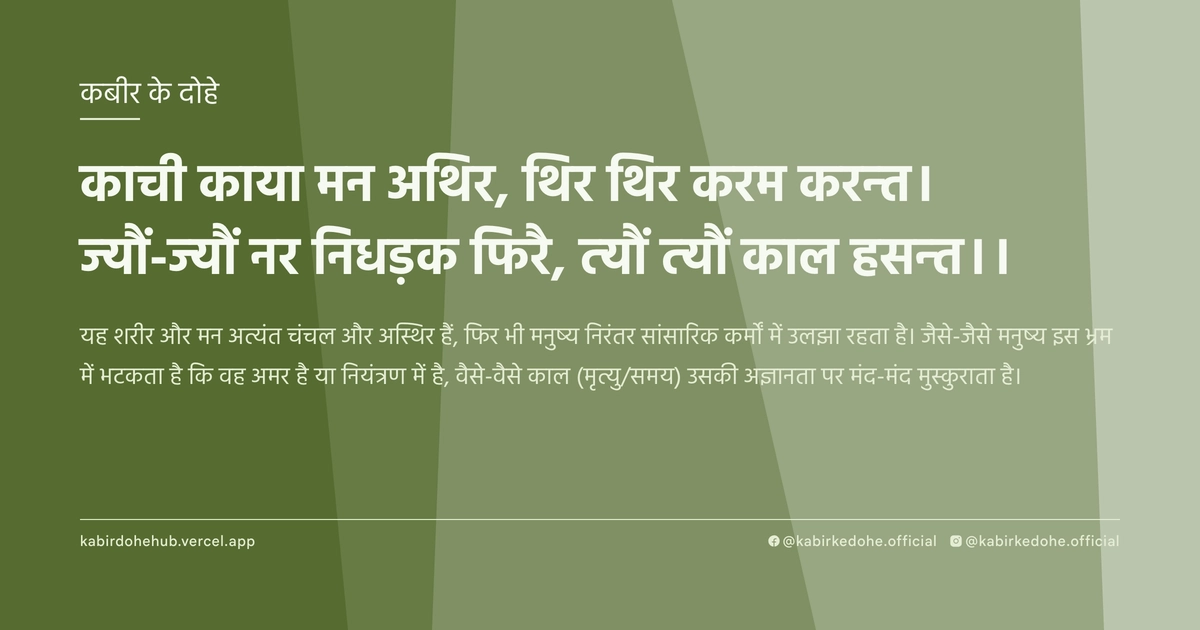
काची काया मन अथिर, थिर थिर करम करन्त।
ज्यौं-ज्यौं नर निधड़क फिरै, त्यौं त्यौं काल हसन्त।।
Kaachi kaya man athir, thir thir karam karant. Jyun-jyun nar nidhdark phire, tyun tyun kaal hasant.
इस पृष्ठ पर इस कबीर दोहे का अर्थ (meaning), हिंदी व्याख्या और अंग्रेज़ी अनुवाद, दार्शनिक विश्लेषण और व्यावहारिक जीवन सीख दी गई है। यह दोहा मृतुक्यता (Mortality) विषय से जुड़ा है — Kabir doha meaning and explanation in Hindi and English.
अर्थ (Meaning):
यह शरीर और मन अत्यंत चंचल और अस्थिर हैं, फिर भी मनुष्य निरंतर सांसारिक कर्मों में उलझा रहता है। जैसे-जैसे मनुष्य इस भ्रम में भटकता है कि वह अमर है या नियंत्रण में है, वैसे-वैसे काल (मृत्यु/समय) उसकी अज्ञानता पर मंद-मंद मुस्कुराता है।
The physical body and the mind are inherently unstable and fleeting, yet man persists in performing restless worldly actions. As the human wanders aimlessly in the delusion of permanence and ego, Time (Death) smiles mockingly at this profound ignorance.
व्याख्या (Interpretation):
कबीर यहाँ शरीर की नश्वरता और मन की चंचलता के विरोधाभास को दर्शाते हैं। 'अथिर' शब्द उस अस्थिरता को इंगित करता है जो न केवल शारीरिक क्षय है, बल्कि मानसिक भटकाव भी है। यह दोहा निर्गुण भक्ति के उस सिद्धांत से जुड़ा है जहाँ माया को एक ऐसा पर्दा माना गया है जो आत्मा को उसके वास्तविक स्वरूप (ब्रह्म) से अलग करता है। जब मनुष्य स्वयं को इस नश्वर शरीर के साथ जोड़ लेता है, तो वह 'अहंकार' के जाल में फंस जाता है। काल का हँसना इस बात का प्रतीक है कि समय की गति अटल है और मानवीय अहंकार उसके सामने तुच्छ है। यह अद्वैत वेदांत के उस सत्य की ओर संकेत है कि केवल साक्षी भाव (Witness Consciousness) ही इस अस्थिरता से मुक्ति दिला सकता है।
Kabir highlights the paradox between the fragility of the body and the restlessness of the mind. The term 'Athir' signifies not just physical decay but a profound psychological instability. This connects to the Nirgun Bhakti principle where Maya is viewed as a veil separating the Atman from the formless Brahman. When a human identifies solely with the perishable body, they fall into the trap of the ego. The 'smiling of Time' is a potent metaphor for the inevitability of death and the futility of human arrogance. It echoes Advaita Vedanta, suggesting that only by shifting from the 'doer' to the 'witness' can one escape the cycle of restlessness and the mockery of temporal existence.
दार्शनिक विश्लेषण (Philosophical Analysis):
कबीर का यह दोहा मध्यकालीन भारत के उस सामाजिक-धार्मिक परिवेश में रचा गया था जहाँ कर्मकांड और बाहरी आडंबरों का बोलबाला था। कबीर ने स्पष्ट किया कि मोक्ष किसी मंदिर, मस्जिद या कठिन अनुष्ठान से नहीं, बल्कि आंतरिक जागरूकता से मिलता है। यहाँ 'काल' केवल मृत्यु नहीं है, बल्कि वह ब्रह्मांडीय समय है जो हर उस चीज़ को नष्ट कर देता है जो सत्य नहीं है।
दार्शनिक स्तर पर, यह सूफी मत के 'फना' (अहंकार का विनाश) और वेदांत के 'माया' के सिद्धांत का संगम है। कबीर तर्क देते हैं कि मनुष्य का दुख उसकी अस्थिरता में नहीं, बल्कि इस भ्रम में है कि वह इस अस्थिरता को नियंत्रित कर सकता है। वह कर्मों को 'थिर थिर' (कांपते हुए या अनिश्चित) कहते हैं, क्योंकि बिना आत्म-ज्ञान के किए गए कर्म केवल बंधन बढ़ाते हैं।
जाति और वर्ण व्यवस्था के प्रति कबीर का विद्रोह यहाँ भी झलकता है; काल सबके लिए समान है, चाहे वह ब्राह्मण हो या अछूत। यह समानता ही मनुष्य को विनम्रता की ओर ले जानी चाहिए।
मनोवैज्ञानिक रूप से, यह दोहा 'एंग्जायटी' या अस्तित्वगत भय का विश्लेषण करता है। जब हम अपनी पहचान बाहरी उपलब्धियों से जोड़ते हैं, तो हम समय के हाथों खिलौना बन जाते हैं।
अंततः, कबीर का संदेश यह है कि जब तक मन 'अथिर' (अस्थिर) है, तब तक कर्म केवल बोझ हैं। शांति केवल तब आती है जब व्यक्ति अपनी पहचान शरीर से हटाकर उस अविनाशी तत्व (निर्गुण ब्रह्म) में विलीन कर देता है।
This couplet was composed during a period of intense ritualism in medieval India. Kabir dismantles the notion that salvation is achieved through external rites, asserting instead that it stems from internal awakening. Here, 'Kaal' (Time/Death) is not merely a biological end but a cosmic force that dissolves everything devoid of ultimate truth.
Philosophically, this is a synthesis of the Sufi concept of 'Fana' (annihilation of the self) and the Vedantic doctrine of 'Maya'. Kabir argues that human suffering arises not from instability itself, but from the delusion that one can control this instability. He describes actions as 'thir thir' (trembling/uncertain), implying that deeds performed without self-realization only tighten the shackles of bondage.
Kabir's rebellion against the caste hierarchy is implicit here; Time is the great equalizer, treating the priest and the outcast with the same indifference. This realization should ideally lead to profound humility.
Psychologically, the verse analyzes existential anxiety. By anchoring identity in external achievements or the physical form, humans become puppets of temporal decay.
Ultimately, Kabir suggests that as long as the mind remains 'Athir' (unstable), actions are merely burdens. Peace is attained only when the individual shifts their identity from the perishable body to the imperishable, formless essence (Nirgun Brahman).
मूल संदेश (Core Message):
- शरीर और मन की अस्थिरता को स्वीकार करना ही शांति का पहला कदम है।
- अहंकार समय की मुस्कुराहट के सामने सबसे कमजोर ढाल है।
- बाहरी कर्मों की भागदौड़ आंतरिक शून्यता को कभी नहीं भर सकती।
- नश्वरता का बोध ही मनुष्य को वास्तविक प्रेम और करुणा की ओर ले जाता है।
- सत्य वह है जो समय के परिवर्तन से अप्रभावित रहता है।
- Accepting the instability of body and mind is the first step toward peace.
- Ego is the weakest shield against the mocking smile of Time.
- The hustle of external actions can never fill an internal void.
- The awareness of impermanence leads one toward authentic love and compassion.
- Truth is that which remains unaffected by the fluctuations of time.
व्यावहारिक उदाहरण (Practical Example):
वाराणसी के घाटों पर रहने वाले एक वृद्ध बुनकर, माधव, की कहानी है। माधव अपनी पूरी जिंदगी बेहतरीन रेशमी साड़ियाँ बुनने में बिता चुका था। उसे अपनी कला पर इतना गर्व था कि वह खुद को शहर का सबसे श्रेष्ठ कलाकार मानता था। वह अक्सर नए बुनकरों को नीचा दिखाता और अपनी श्रेष्ठता का दावा करता।
एक दिन माधव को एक गंभीर बीमारी ने घेर लिया। उसके हाथ कांपने लगे और वह अब वह बारीकी नहीं ला पा रहा था जिसके लिए वह प्रसिद्ध था। उसकी साड़ियाँ अब उतनी सुंदर नहीं रहीं, और धीरे-धीरे उसके ग्राहक कम होने लगे।
वह अपनी इस लाचारी पर क्रोधित था। वह भगवान से लड़ता कि उसने उसकी कला छीन ली। वह जितना अधिक प्रयास करता, उसके हाथ उतने ही ज्यादा कांपते। वह अपनी पहचान अपनी कला और शरीर की कुशलता से जोड़ चुका था।
एक शाम, वह घाट पर बैठा एक फकीर को यह दोहा सुनते हुए पाया: 'ची काया मन अथिर...'। फकीर ने माधव की ओर देखा और मुस्कुराते हुए कहा, 'माधव, तुम उस धागे को पकड़ने की कोशिश कर रहे हो जो टूट चुका है। तुम अपनी कला से नहीं, अपने अहंकार से चिपके हो।'
माधव को पहली बार महसूस हुआ कि उसका पूरा जीवन एक भ्रम था। उसने सोचा कि वह जिसे अपनी 'शक्ति' समझता था, वह वास्तव में समय की एक छोटी सी लहर थी।
उसने महसूस किया कि उसकी असली पहचान वह 'बुनकर' नहीं है जो कपड़ा बनाता है, बल्कि वह 'चेतना' है जो इस पूरे खेल को देख रही है।
उसने अपनी श्रेष्ठता का मोह छोड़ दिया। अब वह नए बुनकरों को सिखाने लगा, न कि उन्हें नीचा दिखाने के लिए, बल्कि इस खुशी के लिए कि ज्ञान साझा करना ही एकमात्र स्थायी कर्म है।
उसकी बेचैनी समाप्त हो गई। हालांकि उसके हाथ अब भी कांपते थे, लेकिन उसका मन अब 'थिर' (स्थिर) हो गया था।
उसने पाया कि जब उसने खुद को 'सर्वश्रेष्ठ' होने के बोझ से मुक्त किया, तो उसे एक ऐसी शांति मिली जो उसकी सबसे महंगी साड़ी से भी अधिक सुंदर थी।
समय अब उसके लिए डराने वाला 'काल' नहीं था, बल्कि एक मित्र था जिसने उसे उसकी असलियत से मिलवाया था।
Consider the story of Madhav, an elderly weaver living on the ghats of Varanasi. Madhav had spent his entire life weaving the finest silk sarees. He was so proud of his craft that he considered himself the greatest artist in the city, often belittling novice weavers to assert his dominance.
One day, a severe illness struck Madhav. His hands began to tremble, and he could no longer achieve the precision for which he was renowned. His sarees lost their luster, and his clientele dwindled.
Madhav was consumed by rage and frustration. He fought with God, questioning why his skill was being taken away. The more he struggled to regain control, the more his hands shook. He had anchored his entire identity to his physical dexterity and professional prestige.
One evening, while sitting on the ghats, he overheard a wandering fakir reciting the doha: 'Chi kaya man athir...'. The fakir looked at Madhav and smiled, saying, 'Madhav, you are trying to hold onto a thread that has already snapped. You are not clinging to your art, but to your ego.'
For the first time, Madhav realized his life had been a delusion. He understood that what he perceived as his 'power' was merely a fleeting ripple in the ocean of time.
He realized that his true identity was not the 'weaver' who creates fabric, but the 'consciousness' that observes the entire play of existence.
He let go of the need to be the best. He began mentoring young weavers—not to showcase his superiority, but out of the joy that sharing knowledge is the only enduring action.
His restlessness vanished. Although his hands continued to shake, his mind became 'Thir' (stable).
He discovered that by liberating himself from the burden of being 'the greatest,' he found a peace more exquisite than his most expensive saree.
Time was no longer a terrifying 'Kaal' to him, but a friend who had finally introduced him to his true self.
अभ्यास मार्गदर्शन (Practice Guidance):
- प्रतिदिन 20 मिनट 'साक्षी भाव' का अभ्यास करें: अपने शरीर की संवेदनाओं और मन के विचारों को बिना किसी निर्णय के केवल देखें, जैसे आप किसी और को देख रहे हों।
- आत्म-पूछताछ जर्नल: हर रात लिखें कि आज आपने किन चीजों को 'स्थायी' मानकर उनसे चिपके रहने की कोशिश की और समय ने उन्हें कैसे चुनौती दी।
- व्यवहारिक परिवर्तन: जब भी क्रोध या अहंकार महसूस हो, स्वयं से पूछें—'क्या यह भावना मेरे नश्वर शरीर की है या मेरी शाश्वत आत्मा की?'
- निदान चेकलिस्ट: यदि आप छोटी विफलताओं पर अत्यधिक विचलित होते हैं या अपनी पहचान केवल पद/संपत्ति से जोड़ते हैं, तो आप 'अथिर' अवस्था में हैं। यदि आप परिवर्तन को सहजता से स्वीकार करते हैं, तो आप स्थिरता की ओर बढ़ रहे हैं।
- Practice 'Witness Consciousness' for 20 minutes daily: Observe your bodily sensations and mental fluctuations without judgment, as if watching a stranger.
- Self-Inquiry Journaling: Every night, record the things you treated as 'permanent' and how Time challenged those assumptions during the day.
- Behavioral Shift: Whenever ego or anger arises, ask yourself—'Does this emotion belong to my perishable body or my eternal soul?'
- Diagnostic Checklist: If you are excessively distressed by minor failures or tie your identity solely to status/wealth, you are in the 'Athir' state. If you accept change with equanimity, you are moving toward stability.
चिंतन प्रश्न (Reflection Questions):
- यदि आज आपकी सारी सामाजिक पहचान (पद, नाम, संपत्ति) छीन ली जाए, तो आपके भीतर क्या बचेगा?
- आप अपने जीवन के किन हिस्सों को 'स्थायी' बनाने की कोशिश कर रहे हैं, जबकि वे स्वभाव से ही नश्वर हैं?
- क्या आपका डिजिटल व्यक्तित्व (Social Media Ego) आपकी वास्तविक आंतरिक शांति को निगल रहा है?
- जब आप दूसरों की सफलता से ईर्ष्या करते हैं, तो क्या आप वास्तव में उस व्यक्ति से लड़ रहे होते हैं या अपनी नश्वरता के डर से?
- क्या आप समय के साथ बह रहे हैं, या समय के विरुद्ध लड़कर खुद को थका रहे हैं?
- If all your social identities (status, name, wealth) were stripped away today, what would remain within you?
- Which parts of your life are you trying to make 'permanent' despite their inherent impermanence?
- Is your digital persona (Social Media Ego) consuming your actual inner peace?
- When you feel envy toward others' success, are you fighting that person or your own fear of insignificance?
- Are you flowing with the current of Time, or are you exhausting yourself by fighting against it?