
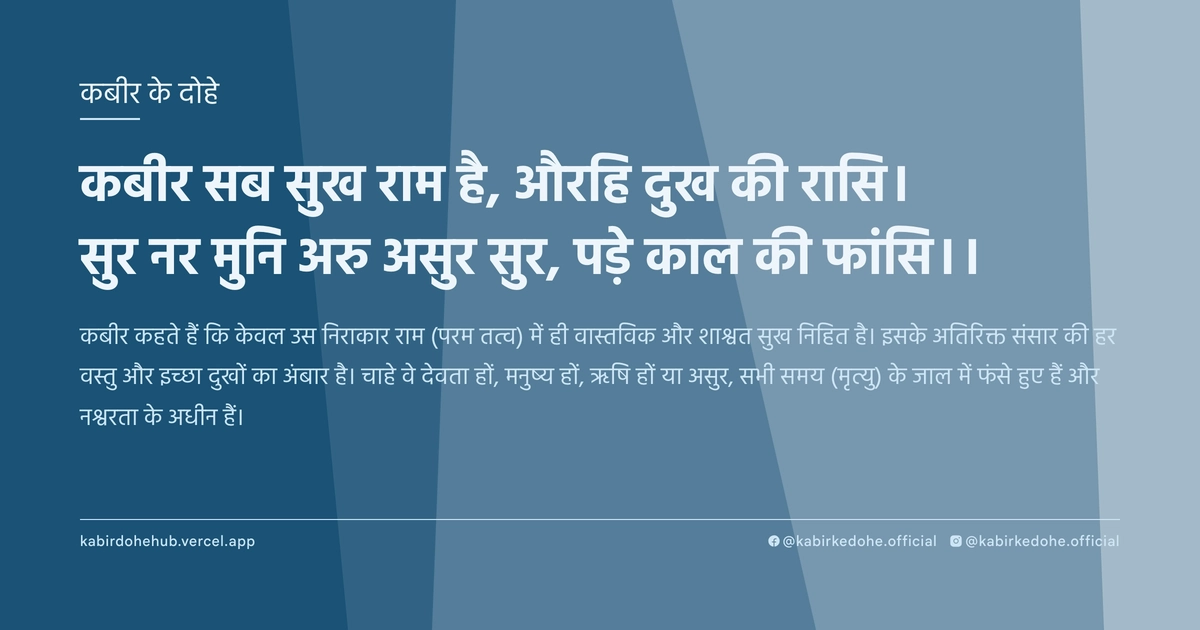
कबीर सब सुख राम है, औरहि दुख की रासि।
सुर नर मुनि अरु असुर सुर, पड़े काल की फांसि।।
Kabir sab sukh ram hai, aurahi dukh ki raasi. Sur nar muni aru asur sur, pade kaal ki phaansi.
इस पृष्ठ पर इस कबीर दोहे का अर्थ (meaning), हिंदी व्याख्या और अंग्रेज़ी अनुवाद, दार्शनिक विश्लेषण और व्यावहारिक जीवन सीख दी गई है। यह दोहा मृतुक्यता (Mortality) विषय से जुड़ा है — Kabir doha meaning and explanation in Hindi and English.
अर्थ (Meaning):
कबीर कहते हैं कि केवल उस निराकार राम (परम तत्व) में ही वास्तविक और शाश्वत सुख निहित है। इसके अतिरिक्त संसार की हर वस्तु और इच्छा दुखों का अंबार है। चाहे वे देवता हों, मनुष्य हों, ऋषि हों या असुर, सभी समय (मृत्यु) के जाल में फंसे हुए हैं और नश्वरता के अधीन हैं।
Kabir asserts that true and eternal bliss resides solely in the formless Ram (the Supreme Reality). Everything else in this material existence is merely a heap of sorrows. Whether they be celestial deities, mortal humans, enlightened sages, or demonic forces, all are ensnared by the noose of Time and subject to inevitable decay.
व्याख्या (Interpretation):
यहाँ 'राम' दशरथ के पुत्र नहीं, बल्कि निर्गुण ब्रह्म हैं जो कण-कण में व्याप्त हैं। कबीर एक गहरे विरोधाभास को उजागर करते हैं: जिसे हम सुख समझते हैं, वह वास्तव में दुख का बीज है क्योंकि वह क्षणभंगुर है। 'काल की फांसि' समय की उस अपरिवर्तनीय गति का प्रतीक है जो अहंकार और शरीर के मोह में बंधे हर जीव को खींचती है। जब तक साधक अपनी पहचान शरीर या सामाजिक स्थिति (सुर, नर, मुनि) से जोड़ता है, वह माया के जाल में रहता है। मुक्ति केवल तब संभव है जब व्यक्ति द्वैत को त्यागकर उस एक सत्य में विलीन हो जाए। यह अद्वैत वेदांत का सार है जहाँ आत्मा और परमात्मा का भेद मिट जाता है।
Here, 'Ram' does not refer to the historical prince of Ayodhya, but to the Nirgun Brahman—the formless, attributeless Absolute pervading every atom. Kabir highlights a profound paradox: what we perceive as pleasure is actually the seed of sorrow because it is transient. The 'noose of Time' symbolizes the inexorable force of mortality that drags down every being clinging to ego and bodily identification. As long as the seeker identifies as a deity, human, or sage, they remain trapped in the illusion of Maya. Liberation occurs only when the duality of 'I' and 'Thou' dissolves into the singular Truth. This mirrors the essence of Advaita Vedanta, where the distinction between Atman and Brahman vanishes.
दार्शनिक विश्लेषण (Philosophical Analysis):
कबीर का यह दोहा उनके युग के धार्मिक पाखंड और कर्मकांडों पर एक प्रहार है। उस समय समाज जाति और धार्मिक पदक्रम (Hierarchy) में बंटा था, जहाँ मुनि और सुर को श्रेष्ठ माना जाता था। कबीर इस सामाजिक ढांचे को ध्वस्त करते हुए कहते हैं कि मृत्यु और समय के सामने सब समान हैं। यह विचार सूफी मत के 'फना' (अहंकार का विनाश) और अद्वैत के 'अहं ब्रह्मास्मि' का संगम है।
वे बताते हैं कि दुख का मूल कारण 'इच्छा' और 'आसक्ति' है। जब हम बाहरी दुनिया में सुख खोजते हैं, तो हम वास्तव में एक ऐसे मृगतृष्णा के पीछे भाग रहे होते हैं जो अंततः हमें समय के जाल में फंसा देती है। यह मनोवैज्ञानिक विश्लेषण है कि कैसे मनुष्य अपनी पहचान को बाहरी उपाधियों से जोड़कर अपनी वास्तविक प्रकृति को भूल जाता है।
निर्गुण भक्ति का मार्ग यहाँ स्पष्ट है: ईश्वर किसी मंदिर या मस्जिद में नहीं, बल्कि स्वयं के भीतर की जागरूकता में है। कबीर का 'राम' वह चेतना है जो जन्म और मृत्यु के चक्र से परे है। वे तर्क देते हैं कि यदि कोई मुनि होने के अहंकार में है, तो वह भी उतना ही बंधन में है जितना कि एक असुर।
यह दर्शन हमें सिखाता है कि आध्यात्मिक प्रगति का पैमाना बाहरी अनुष्ठान नहीं, बल्कि आंतरिक वैराग्य है। जब साधक यह जान लेता है कि संसार एक स्वप्न है और केवल वह निराकार तत्व ही सत्य है, तब वह 'काल की फांसि' से मुक्त हो जाता है।
अंततः, कबीर का संदेश यह है कि मुक्ति का मार्ग केवल आत्म-साक्षात्कार (Self-realization) है। जब व्यक्ति अपनी सीमित पहचान को मिटाकर अनंत में विलीन होता है, तब वह उस सुख को प्राप्त करता है जो समय की सीमाओं से परे है।
This couplet is a direct assault on the religious hypocrisy and ritualism of Kabir's era. Society was fragmented by caste and spiritual hierarchies, where sages (munis) and deities (surs) were viewed as superior. Kabir dismantles this structure by asserting that before the absolute force of Time and Death, all are equal. This thought converges with the Sufi concept of 'Fana' (annihilation of the ego) and the Advaitic realization of 'Aham Brahmasmi'.
He posits that the root of all suffering is 'desire' and 'attachment'. When we seek happiness in the external world, we are chasing a mirage that eventually tightens the noose of temporal existence. This is a psychological critique of how humans mistake their social labels and titles for their true essence, thereby forgetting their primordial nature.
The path of Nirgun Bhakti is evident here: the Divine is not housed in temples or mosques but resides within the stillness of one's own awareness. Kabir's 'Ram' is the consciousness that transcends the cycle of birth and death. He argues that a sage blinded by the pride of his status is as trapped as a demon in the depths of ignorance.
This philosophy teaches that the metric of spiritual progress is not external ritual, but internal detachment (Vairagya). Once the seeker recognizes the world as a transient dream and the formless Absolute as the only Truth, the 'noose of Time' loses its grip.
Ultimately, Kabir suggests that liberation is achieved solely through Self-realization. When the individual dissolves the limited 'I' into the Infinite, they attain a bliss that is independent of time and circumstance.
मूल संदेश (Core Message):
- बाहरी सुख केवल एक भ्रम है जो अंततः दुख लाता है।
- अहंकार ही वह रस्सी है जो हमें समय के बंधन में जकड़ती है।
- सच्चा आनंद केवल निराकार आत्म-साक्षात्कार में निहित है।
- मृत्यु और समय सबके लिए समान हैं, इसलिए पद का अहंकार व्यर्थ है।
- जब 'मैं' मिटता है, तब केवल 'राम' (परम सत्य) शेष रहता है।
- External pleasures are mere illusions that inevitably lead to sorrow.
- The ego is the very rope that binds us to the constraints of time.
- True bliss resides solely in the realization of the formless Self.
- Death and Time are impartial; thus, pride in status is futile.
- When the 'I' dissolves, only 'Ram' (the Absolute Truth) remains.
व्यावहारिक उदाहरण (Practical Example):
वाराणसी के घाटों पर रहने वाले एक वृद्ध बुनकर, माधव की कहानी है। माधव अपने जीवन के साठ साल बेहतरीन रेशमी साड़ियाँ बुनने में बिता चुका था। उसे अपनी कला पर बहुत गर्व था और वह मानता था कि उसकी श्रेष्ठता उसकी कला की बारीकियों में है। वह अक्सर अन्य बुनकरों को तुच्छ समझता था।
एक दिन माधव ने देखा कि उसका सबसे पुराना और प्रिय करघा, जिसे उसने अपनी पूरी संपत्ति माना था, दीमकों द्वारा खा लिया गया है। उसी शाम उसे खबर मिली कि उसका सबसे योग्य शिष्य, जिसे वह अपना उत्तराधिकारी मानता था, एक आकस्मिक दुर्घटना में मारा गया।
माधव गहरे शोक और क्रोध में डूब गया। उसने ईश्वर से पूछा, 'मैंने जीवन भर धर्म का पालन किया, श्रेष्ठ कला सीखी, फिर भी मेरा सब कुछ क्यों छिन रहा है?'
तभी उसकी मुलाकात एक फकीर से हुई जिसने उसे कबीर का यह दोहा सुनाया। फकीर ने कहा, 'माधव, तूने रेशम के धागों में सुख खोजा, लेकिन धागे तो समय की धूल हैं। तूने अपनी पहचान एक 'श्रेष्ठ बुनकर' के रूप में बनाई, और अब जब वह पहचान टूट रही है, तुझे दुख हो रहा है।'
माधव को समझ आया कि उसका दुख उसकी कला के खोने से नहीं, बल्कि उस 'अहंकार' के टूटने से था जिसने उसे दूसरों से अलग किया था। उसने महसूस किया कि वह जिसे अपना 'सफल जीवन' कह रहा था, वह वास्तव में समय के जाल में एक छोटा सा खेल था।
उसने अपनी शेष आयु केवल बुनने में नहीं, बल्कि दूसरों को सिखाने और निस्वार्थ सेवा में बिताने का निर्णय लिया। उसने अपनी श्रेष्ठता का मुखौटा उतार फेंका।
अब वह घाट पर बैठकर केवल धागे नहीं बुनता था, बल्कि लोगों के बीच प्रेम और समानता का सेतु बनाता था।
उसने पाया कि जब उसने 'मैं श्रेष्ठ हूँ' का विचार छोड़ा, तो उसे एक ऐसा आंतरिक सुकून मिला जो किसी भी रेशमी कपड़े से अधिक कोमल और स्थायी था।
माधव अब मृत्यु से नहीं डरता था, क्योंकि उसने जान लिया था कि वह शरीर या पेशा नहीं, बल्कि उस निराकार राम का एक अंश है।
यह 'कबीर ट्विस्ट' था—एक महान कलाकार का अपनी कला के मोह से मुक्त होकर वास्तविक कलाकार (परमात्मा) से जुड़ना।
Consider the story of Madhav, an elderly weaver living on the ghats of Varanasi. Madhav had spent sixty years of his life weaving the finest silk sarees. He took immense pride in his craft, believing his superiority lay in the intricate details of his work. He often looked down upon other weavers as inferior.
One day, Madhav discovered that his oldest and most cherished loom, which he considered his greatest asset, had been eaten away by termites. That same evening, he received news that his most talented apprentice, whom he viewed as his successor, had died in a sudden accident.
Madhav sank into a pit of grief and rage. He questioned the Divine, 'I followed the path of righteousness, mastered the highest art, yet why is everything being stripped away from me?'
During this turmoil, he met a wandering fakir who recited Kabir's doha to him. The fakir said, 'Madhav, you sought happiness in silk threads, but threads are merely the dust of time. You built your identity as a "superior weaver," and now that this identity is crumbling, you suffer.'
Madhav realized that his pain did not stem from the loss of his craft, but from the shattering of the 'ego' that had separated him from others. He understood that what he called a 'successful life' was merely a brief play within the noose of time.
He decided to spend the remainder of his years not just weaving fabric, but weaving bonds of selfless service and teaching others without pride.
He cast off the mask of superiority. He no longer sat on the ghats merely to produce cloth, but to build bridges of love and equality among the people.
He discovered that once he abandoned the thought 'I am superior,' he attained an inner peace more delicate and enduring than any silk fabric he had ever woven.
Madhav no longer feared death, for he realized he was not a body or a profession, but a spark of that formless Ram.
This was the 'Kabir Twist'—a master artist liberating himself from the attachment to his art to unite with the Ultimate Artist.
अभ्यास मार्गदर्शन (Practice Guidance):
- प्रतिदिन 20 मिनट मौन ध्यान करें, जहाँ आप अपने विचारों को केवल एक दर्शक की तरह देखें, बिना किसी निर्णय के।
- एक 'अहंकार डायरी' लिखें: दिन भर में उन क्षणों को नोट करें जब आपने खुद को दूसरों से श्रेष्ठ या निम्न महसूस किया, और विश्लेषण करें कि वह भावना कहाँ से आई।
- व्यवहार परिवर्तन: सप्ताह में एक बार ऐसा कार्य करें जिसमें आपकी सामाजिक स्थिति या पहचान पूरी तरह से गौण हो (जैसे किसी अनजान की निस्वार्थ सेवा)।
- निदान चेकलिस्ट: क्या आप अपनी उपलब्धियों के खोने के डर से घबराते हैं? क्या आप दूसरों की सफलता से ईर्ष्या करते हैं? यदि हाँ, तो आप अभी भी 'काल की फांसि' (अहंकार के जाल) में हैं।
- Practice 20 minutes of silent meditation daily, observing your thoughts as a detached witness without judgment.
- Maintain an 'Ego Diary': Note moments throughout the day when you felt superior or inferior to others, and analyze the root of that emotion.
- Behavioral Shift: Once a week, perform an act of service where your social status or identity is completely irrelevant (e.g., anonymous helping).
- Diagnostic Checklist: Do you panic at the thought of losing your achievements? Do you feel envy toward others' success? If yes, you are still ensnared in the 'noose of Time' (the ego's trap).
चिंतन प्रश्न (Reflection Questions):
- यदि आपकी सभी उपाधियाँ, संपत्ति और सामाजिक पहचान आज छीन ली जाएँ, तो आपके पास क्या बचेगा?
- आप अपनी डिजिटल पहचान (सोशल मीडिया) को कितना सच मानते हैं, और वह आपके वास्तविक स्वरूप से कितना अलग है?
- क्या आप वास्तव में दूसरों की मदद करते हैं, या आपकी मदद करने की इच्छा आपके अपने 'परोपकारी' होने के अहंकार को संतुष्ट करती है?
- वह कौन सा डर है जो आपको यह मानने से रोकता है कि आप और आपका शत्रु वास्तव में एक ही चेतना के हिस्से हैं?
- आप समय को नियंत्रित करने की कोशिश करते हैं या समय के प्रवाह के साथ लयबद्ध होना सीख रहे हैं?
- If all your titles, possessions, and social identities were stripped away today, what would remain of you?
- How much of your digital identity (social media) do you perceive as real, and how far does it deviate from your true essence?
- Do you truly help others, or does your desire to help merely satisfy the ego of being a 'philanthropist'?
- What is the specific fear that prevents you from accepting that you and your enemy are parts of the same consciousness?
- Are you attempting to control time, or are you learning to flow in harmony with its inevitable current?