
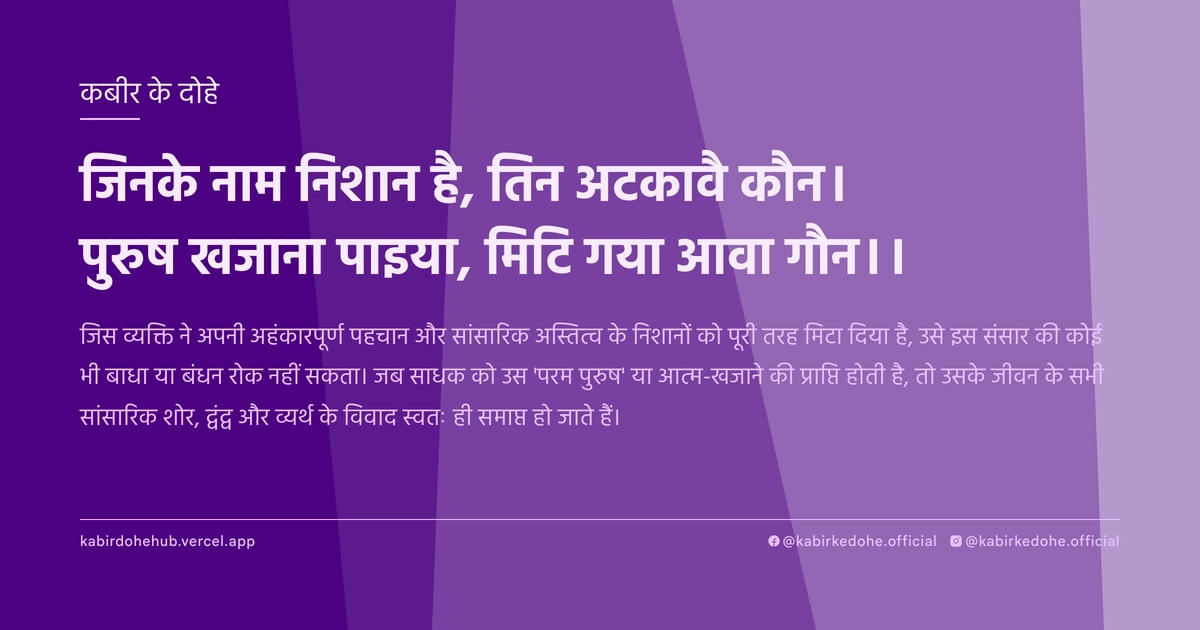
जिनके नाम निशान है, तिन अटकावै कौन।
पुरुष खजाना पाइया, मिटि गया आवा गौन।।
Jinke naam nishaan hai, tin atkavai kaun. Purush khazana paiya, miti gaya aava gaun.
इस पृष्ठ पर इस कबीर दोहे का अर्थ (meaning), हिंदी व्याख्या और अंग्रेज़ी अनुवाद, दार्शनिक विश्लेषण और व्यावहारिक जीवन सीख दी गई है। यह दोहा मुक्ति (Liberation) विषय से जुड़ा है — Kabir doha meaning and explanation in Hindi and English.
अर्थ (Meaning):
जिस व्यक्ति ने अपनी अहंकारपूर्ण पहचान और सांसारिक अस्तित्व के निशानों को पूरी तरह मिटा दिया है, उसे इस संसार की कोई भी बाधा या बंधन रोक नहीं सकता। जब साधक को उस 'परम पुरुष' या आत्म-खजाने की प्राप्ति होती है, तो उसके जीवन के सभी सांसारिक शोर, द्वंद्व और व्यर्थ के विवाद स्वतः ही समाप्त हो जाते हैं।
One who has erased all traces of their egoic identity and worldly markers cannot be hindered or bound by any worldly obstacle. Upon discovering the 'Supreme Treasure'—the realization of the Pure Consciousness or the Divine Self—all the mundane noise, conflicts, and trivialities of existence vanish into nothingness.
व्याख्या (Interpretation):
यह दोहा शून्य और पूर्णता के बीच के विरोधाभास को दर्शाता है। 'नाम निशान' का मिटना केवल भौतिक मृत्यु नहीं, बल्कि 'अहंकार' की मृत्यु है, जिसे निर्गुण भक्ति में 'जीव' का 'शिव' में विलीन होना कहा गया है। जब व्यक्ति अपनी सामाजिक पहचान, जाति और पद के मोह को त्याग देता है, तो वह माया के जाल से मुक्त हो जाता है। 'पुरुष खजाना' यहाँ उस अविनाशी आत्मा (Atman) का प्रतीक है जो ब्रह्म के साथ एक है। अद्वैत वेदांत के अनुसार, जब तक 'मैं' का भाव है, तब तक बंधन है; जैसे ही यह भाव मिटता है, साधक उस अनंत शांति को प्राप्त करता है जहाँ कोई द्वंद्व नहीं बचता। यह अवस्था उस बिंदु की है जहाँ साधक स्वयं वह सत्य बन जाता है जिसे वह खोज रहा था।
This couplet illustrates the paradox between emptiness and wholeness. The erasure of 'name and mark' refers not to physical death, but to the death of the ego, which in Nirgun Bhakti is the merging of the individual soul (Jiva) into the Universal Consciousness (Shiva). When a seeker relinquishes attachment to social identity, caste, and status, they break the shackles of Maya. The 'Purush Khazaana' (Divine Treasure) symbolizes the indestructible Atman, which is non-different from Brahman. According to Advaita Vedanta, as long as the sense of 'I' persists, bondage remains; the moment this illusion dissolves, the seeker attains an infinite peace where all duality ceases. It is the state where the seeker becomes the very Truth they were searching for.
दार्शनिक विश्लेषण (Philosophical Analysis):
कबीर का यह दर्शन मध्यकालीन भारत के उस दौर का है जब धर्म कर्मकांडों और बाहरी दिखावे में सिमट गया था। कबीर ने पुरजोर तरीके से उन सभी प्रतीकों को नकारा जो मनुष्य को मनुष्य से अलग करते हैं। उनका 'नाम निशान' मिटाने का आह्वान वास्तव में सामाजिक और आध्यात्मिक स्तरीकरण के विरुद्ध एक विद्रोह है। वे कहते हैं कि जब तक आप खुद को किसी विशेष धर्म, जाति या कुल का हिस्सा मानते हैं, आप सीमित हैं। यह विचार सूफी मत के 'फना' (Fana) के करीब है, जहाँ साधक ईश्वर की इच्छा में खुद को पूरी तरह मिटा देता है।
दार्शनिक स्तर पर, यह दोहा अद्वैत वेदांत के 'अहं ब्रह्मास्मि' के सिद्धांत को पुष्ट करता है। कबीर यहाँ यह समझा रहे हैं कि संसार की सारी बाधाएं केवल हमारी पहचान के साथ जुड़ी होती हैं। यदि कोई व्यक्ति यह दावा करता है कि वह 'अमुक' है, तो उसे उस पहचान की रक्षा करनी पड़ती है, जिससे संघर्ष पैदा होता है। लेकिन जो 'कोई नहीं' (Nobody) बन जाता है, उसे कोई चोट नहीं पहुँचा सकता और न ही कोई रोक सकता है।
यहाँ 'पुरुष खजाना' शब्द का प्रयोग अत्यंत गहरा है। यह केवल भौतिक धन नहीं, बल्कि 'चेतना' का विस्तार है। कबीर के अनुसार, वास्तविक खजाना बाहर नहीं, बल्कि भीतर है। जब आंतरिक खोज पूरी होती है, तो बाहरी दुनिया का शोर 'आवा गौन' यानी तुच्छ और अर्थहीन लगने लगता है। यह मनोवैज्ञानिक रूपांतरण है जहाँ व्यक्ति बाहरी प्रशंसा और आलोचना से ऊपर उठकर तटस्थ हो जाता है।
कबीर ritualism (कर्मकांड) का विरोध करते हुए यह स्पष्ट करते हैं कि मोक्ष किसी तीर्थ या मंदिर में नहीं, बल्कि अहंकार के विसर्जन में है। वे एक ऐसी आध्यात्मिक लोकतंत्र की बात करते हैं जहाँ केवल सत्य की प्रधानता हो। यह मार्ग कठिन है क्योंकि यह मनुष्य से उसकी सबसे प्रिय वस्तु—उसकी पहचान—को छीन लेता है।
अंततः, यह दोहा हमें सिखाता है कि मुक्ति का मार्ग 'जोड़ने' में नहीं, बल्कि 'छोड़ने' में है। जब हम अपनी कृत्रिम पहचानों को हटा देते हैं, तो जो बचता है वह शुद्ध चैतन्य है। यही वह अवस्था है जहाँ मनुष्य और ईश्वर के बीच का अंतर समाप्त हो जाता है और केवल एक अखंड सत्य शेष रहता है।
Kabir's philosophy emerged during a medieval Indian era where religion had shrunk into rigid rituals and outward displays. His call to erase 'name and mark' is a potent rebellion against social and spiritual stratification. He asserts that as long as one identifies as a member of a specific religion, caste, or lineage, they remain limited. This concept closely mirrors the Sufi notion of 'Fana' (annihilation), where the seeker completely dissolves their ego into the Divine Will.
On a philosophical level, this couplet reinforces the Advaita Vedanta principle of 'Aham Brahmasmi' (I am Brahman). Kabir explains that all worldly obstacles are tied to our identities. If a person claims to be 'someone,' they must defend and protect that identity, which inevitably leads to conflict. However, the one who becomes 'nobody' cannot be harmed, hindered, or trapped, for there is no target left for the world to strike.
The use of the term 'Purush Khazaana' (Divine Treasure) is profoundly significant. It does not refer to material wealth, but to the expansion of consciousness. According to Kabir, the true treasure is not external but internal. Once the inner quest is fulfilled, the noise of the external world—the 'aava gaun'—becomes trivial and meaningless. This is a psychological transformation where the individual transcends the need for external validation or fear of criticism.
By opposing ritualism, Kabir clarifies that liberation is not found in pilgrimages or temples, but in the dissolution of the ego. He advocates for a spiritual democracy where only Truth prevails. This path is arduous because it demands the surrender of the thing humans cherish most: their identity.
Ultimately, this couplet teaches us that the path to liberation is not about 'acquisition' but about 'relinquishment.' When we strip away our artificial identities, what remains is Pure Consciousness. This is the state where the distinction between the human and the Divine vanishes, leaving only one undivided Truth.
मूल संदेश (Core Message):
- अहंकार की पहचान ही सभी मानसिक बंधनों का मूल कारण है।
- जब 'मैं' मिटता है, तब ब्रह्मांडीय चेतना का उदय होता है।
- सच्चा खजाना बाहरी उपलब्धियों में नहीं, आंतरिक शून्यता में है।
- सांसारिक विवाद केवल तब तक हैं जब तक पहचान जीवित है।
- पूर्णता की प्राप्ति केवल पूर्ण विसर्जन के बाद ही संभव है।
- The egoic identity is the root cause of all mental bondage.
- When the 'I' vanishes, universal consciousness awakens.
- The true treasure lies not in external gains, but in internal emptiness.
- Worldly conflicts exist only as long as the identity persists.
- Attaining wholeness is possible only after complete dissolution.
व्यावहारिक उदाहरण (Practical Example):
एक समय की बात है, वाराणसी के घाटों पर माधव नाम का एक वृद्ध बुनकर रहता था। माधव अपनी कला में निपुण था, लेकिन उसका अहंकार उससे भी बड़ा था। वह पूरे शहर में अपनी श्रेष्ठता के लिए जाना जाता था और अक्सर अन्य बुनकरों को नीचा दिखाता था। वह अपनी पहचान को अपनी श्रेष्ठता का आधार मानता था।
एक दिन माधव की मुलाकात एक घुमक्कड़ फकीर से हुई। फकीर ने माधव की बारीकी से बुनी हुई चादर देखी और मुस्कुराकर पूछा, 'इस सुंदर कपड़े में बुनकर कहाँ है?' माधव ने गर्व से कहा, 'मैं हूँ, मैंने इसे बनाया है!' फकीर ने शांति से उत्तर दिया, 'यदि तुम इसमें हो, तो यह कपड़ा तुम्हारा अहंकार है। यदि तुम इसमें नहीं हो, तो यह केवल एक सुंदर रचना है।'
माधव को यह बात समझ नहीं आई, लेकिन फकीर ने उसे एक चुनौती दी। उसने कहा, 'एक ऐसा कपड़ा बुनो जिसमें तुम्हारी कोई पहचान न हो, न तुम्हारा नाम, न तुम्हारी शैली की छाप, बस शुद्धता हो।'
माधव ने हफ्तों तक प्रयास किया। वह जितना अधिक कोशिश करता, उतना ही उसकी 'विशेष शैली' उभर कर आती। उसे एहसास हुआ कि वह अपनी पहचान से इतना चिपका हुआ है कि वह उससे अलग कुछ भी नहीं बना सकता। वह अपनी 'महारत' के पिंजरे में कैद था।
एक रात, गहरे ध्यान और हताशा के बीच, माधव का अहंकार टूट गया। उसने महसूस किया कि वह 'महान बुनकर' नहीं है, बल्कि वह केवल एक माध्यम है जिसके जरिए प्रकृति अपनी कला दिखा रही है। उसने अपनी सारी उपलब्धियों, अपने नाम और अपनी प्रतिष्ठा के मोह को त्याग दिया।
उस क्षण, उसने एक ऐसी चादर बुनी जो इतनी सरल और शुद्ध थी कि देखने वाले को उसमें कोई 'कलाकार' नहीं, बल्कि केवल 'शांति' दिखाई दी। माधव अब अपनी श्रेष्ठता के लिए नहीं लड़ता था।
जब अन्य बुनकर उससे उसकी सफलता का राज पूछते, तो वह केवल मुस्कुरा देता। अब उसे किसी की प्रशंसा की भूख नहीं थी और न ही किसी की आलोचना का डर।
उसका जीवन अब विवादों से मुक्त था। वह अब केवल एक बुनकर नहीं था, बल्कि वह उस 'परम खजाने' को पा चुका था जहाँ 'मैं' और 'मेरा' का अस्तित्व समाप्त हो गया था।
Once, on the ghats of Varanasi, lived an elderly weaver named Madhav. Madhav was a master of his craft, but his ego was even greater than his skill. He was renowned throughout the city for his superiority and often looked down upon other weavers, using his identity as a benchmark of his greatness.
One day, Madhav met a wandering fakir. The fakir looked at a finely woven shawl and asked with a smile, 'Where is the weaver in this beautiful cloth?' Madhav replied proudly, 'I am here; I created it!' The fakir calmly answered, 'If you are in it, then this cloth is your ego. If you are not in it, then it is merely a beautiful creation.'
Madhav did not understand, but the fakir gave him a challenge: 'Weave a cloth in which there is no trace of your identity—no name, no signature style, only purity.'
Madhav struggled for weeks. The more he tried, the more his 'unique style' emerged. He realized he was so clung to his identity that he could create nothing separate from it. He was imprisoned in the cage of his own 'mastery.'
One night, amidst deep contemplation and desperation, Madhav's ego shattered. He realized he was not the 'Great Weaver,' but merely a medium through which nature expressed its art. He let go of all his achievements, his name, and the craving for prestige.
In that moment, he wove a shawl so simple and pure that anyone who saw it perceived not an 'artist,' but only 'peace.' Madhav no longer fought for superiority.
When other weavers asked the secret of his success, he would only smile. He no longer hungered for praise, nor did he fear criticism.
His life became free of conflict. He was no longer just a weaver; he had found that 'Supreme Treasure' where the existence of 'I' and 'Mine' had completely vanished.
अभ्यास मार्गदर्शन (Practice Guidance):
- दैनिक आत्म-निरीक्षण: प्रतिदिन 20 मिनट मौन बैठें और अपने भीतर उठने वाली 'मैं' की भावनाओं (जैसे- मैं सही हूँ, मैं श्रेष्ठ हूँ, मैं पीड़ित हूँ) को केवल एक साक्षी की तरह देखें।
- पहचान का विसर्जन: दिन में कम से कम एक ऐसा कार्य करें जिसमें आप अपनी प्रशंसा की इच्छा को पूरी तरह त्याग दें और गुमनाम रहकर दूसरों की सहायता करें।
- जर्नलिंग प्रॉम्प्ट: लिखें—'यदि मेरी जाति, मेरा पेशा, मेरा नाम और मेरी उपलब्धियाँ मुझसे छीन ली जाएँ, तो वास्तव में मैं कौन हूँ?'
- डायग्नोस्टिक चेकलिस्ट: क्या मैं अभी भी दूसरों की आलोचना से विचलित होता हूँ? क्या मैं अपनी पहचान को लेकर रक्षात्मक (defensive) महसूस करता हूँ? यदि हाँ, तो अहंकार अभी जीवित है।
- Daily Self-Observation: Sit in silence for 20 minutes daily and observe the emerging feelings of 'I' (e.g., 'I am right,' 'I am superior,' 'I am the victim') as a detached witness.
- Dissolution of Identity: Perform at least one act of service daily where you completely renounce the desire for recognition and remain anonymous.
- Journaling Prompt: Write—'If my caste, profession, name, and achievements were stripped away from me, who would I actually be?'
- Diagnostic Checklist: Do I still feel disturbed by others' criticism? Do I feel defensive about my identity? If yes, the ego is still active.
चिंतन प्रश्न (Reflection Questions):
- मेरी वह कौन सी पहचान है जिसे खोने के डर से मैं सबसे अधिक संघर्ष करता हूँ?
- क्या मेरा 'आध्यात्मिक' या 'धार्मिक' होना भी मेरे अहंकार का एक सूक्ष्म रूप है?
- यदि दुनिया मुझे पूरी तरह भूल जाए, तो क्या मेरी आंतरिक शांति बनी रहेगी?
- मैं अपनी डिजिटल पहचान (सोशल मीडिया) को बनाए रखने के लिए कितनी ऊर्जा व्यर्थ करता हूँ?
- मेरे जीवन के कौन से विवाद वास्तव में सत्य की खोज में नहीं, बल्कि केवल 'सही साबित होने' की इच्छा में हैं?
- Which identity do I fear losing the most, and how does that fear drive my struggles?
- Is my identity as a 'spiritual' or 'religious' person actually a subtle form of ego?
- If the world completely forgot me, would my inner peace remain intact?
- How much energy do I waste maintaining my digital identity on social media?
- Which conflicts in my life are not about seeking Truth, but merely about the desire to be 'proven right'?