
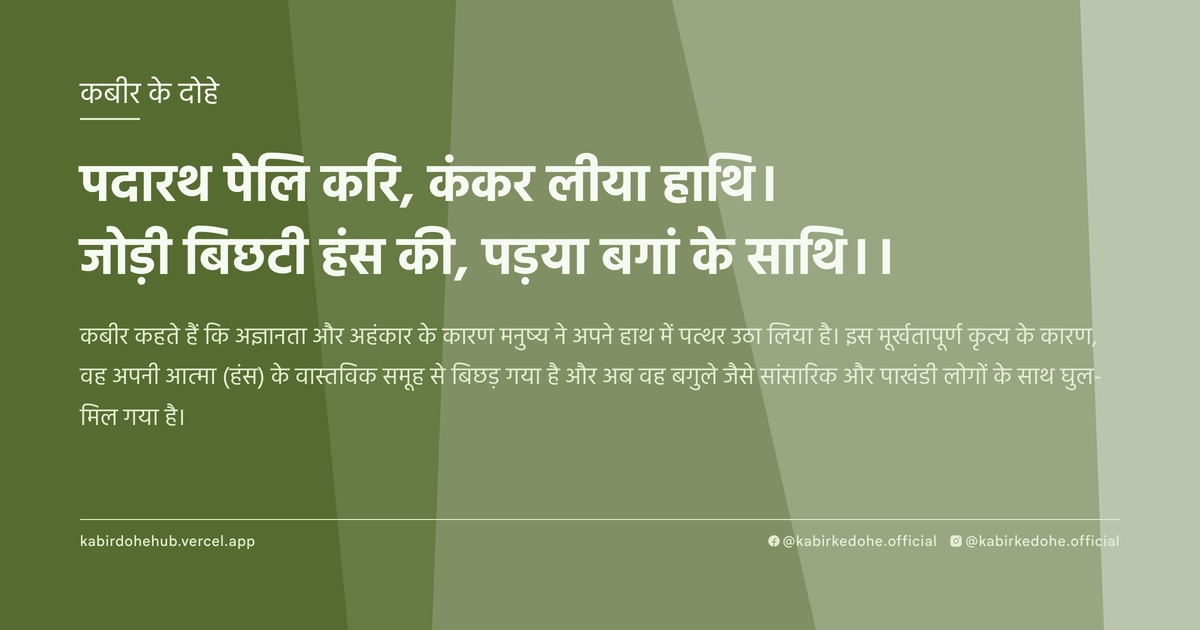
पदारथ पेलि करि, कंकर लीया हाथि।
जोड़ी बिछटी हंस की, पड़या बगां के साथि।।
Padarath peli kari, kankar liya haathi. Jodi bichhati hans ki, padya bagan ke saathi.
इस पृष्ठ पर इस कबीर दोहे का अर्थ (meaning), हिंदी व्याख्या और अंग्रेज़ी अनुवाद, दार्शनिक विश्लेषण और व्यावहारिक जीवन सीख दी गई है। यह दोहा सत्संग (Satsang) विषय से जुड़ा है — Kabir doha meaning and explanation in Hindi and English.
अर्थ (Meaning):
कबीर कहते हैं कि अज्ञानता और अहंकार के कारण मनुष्य ने अपने हाथ में पत्थर उठा लिया है। इस मूर्खतापूर्ण कृत्य के कारण, वह अपनी आत्मा (हंस) के वास्तविक समूह से बिछड़ गया है और अब वह बगुले जैसे सांसारिक और पाखंडी लोगों के साथ घुल-मिल गया है।
Kabir explains that driven by ignorance and ego, man has picked up a stone of attachment and pride. Because of this misguided action, he has been severed from the company of the 'Hans' (the pure, liberated souls) and has instead fallen into the company of 'Bagas' (the hypocrites and worldly pretenders).
व्याख्या (Interpretation):
इस दोहे का शाब्दिक अर्थ है कि एक पत्थर मारने से हंसों का झुंड बिखर गया और हंस बगुले के साथ रह गया। आध्यात्मिक स्तर पर, 'कंकर' माया और अहंकार का प्रतीक है। 'हंस' उस शुद्ध आत्मा का प्रतिनिधित्व करता है जो ब्रह्म में लीन होना चाहती है, जबकि 'बगुला' उस व्यक्ति का प्रतीक है जो बाहर से शांत दिखता है लेकिन भीतर छल और पाखंड रखता है। यह विस्थापन आत्मा की त्रासदी है—जब मनुष्य अपनी दिव्य प्रकृति को भूलकर सांसारिक दिखावे और सामाजिक मुखौटों को अपना लेता है, तो वह अपनी मूल चेतना से दूर हो जाता है। यह निर्गुण भक्ति का सार है, जहाँ बाहरी आडंबरों को त्यागकर आंतरिक सत्य की खोज की जाती है।
Literally, the verse describes how a stone thrown caused a flock of swans to scatter, leaving a swan stranded among herons. Metaphorically, the 'stone' represents the heavy burden of Maya (illusion) and the ego. The 'Hans' (Swan) symbolizes the pure Atman, the divine spark seeking union with the formless Brahman, while the 'Baga' (Heron) symbolizes the hypocrite—one who mimics spirituality for social gain. This displacement is the central tragedy of the human condition: when the soul forgets its divine origin and identifies with the superficial masks of society. It aligns with Nirgun Bhakti, emphasizing that true spirituality is not found in outward imitation but in the dissolution of the ego that separates the individual from the Universal Truth.
दार्शनिक विश्लेषण (Philosophical Analysis):
कबीर का यह दोहा मध्यकालीन भारत के उस सामाजिक परिवेश पर प्रहार करता है जहाँ धर्म केवल कर्मकांड और बाहरी दिखावे तक सीमित था। यहाँ 'बगुला' उन धर्मगुरुओं और पाखंडियों का प्रतीक है जो शास्त्र तो पढ़ते हैं लेकिन उनके आचरण में सत्य नहीं है। कबीर का दर्शन अद्वैत वेदांत से गहराई से जुड़ा है, जहाँ वे बताते हैं कि आत्मा और परमात्मा एक ही हैं, लेकिन अहंकार (कंकर) इस एकता में बाधा डालता है।
सूफीवाद के प्रभाव में, कबीर 'इश्क-ए-हकीकी' या ईश्वर के प्रति सच्चे प्रेम की बात करते हैं। उनके लिए, किसी भी प्रकार का धार्मिक भेदभाव या जातिगत श्रेष्ठता वह 'पत्थर' है जो मनुष्य को उसकी वास्तविक आध्यात्मिक मंडली से अलग करता है। वे तर्क देते हैं कि जब तक मनुष्य अपनी पहचान को सामाजिक पद या धार्मिक लेबल से जोड़ता रहेगा, वह बगुले जैसी भीड़ में खोया रहेगा।
मनोवैज्ञानिक स्तर पर, यह दोहा 'पहचान के संकट' को दर्शाता है। जब हम दूसरों की नकल करते हैं या समाज द्वारा थोपे गए मानकों के अनुसार जीते हैं, तो हम अपनी सहज बुद्धि (Intuition) को खो देते हैं। यह आत्म-विस्मृति ही दुःख का मूल कारण है।
कबीर का प्रहार केवल बाहरी पाखंड पर नहीं, बल्कि उस आंतरिक अंधापन पर है जो हमें यह विश्वास दिलाता है कि हम दूसरों से अलग या श्रेष्ठ हैं। यह 'श्रेष्ठता का बोध' ही वह पत्थर है जो आत्मा की शांति को भंग करता है।
अंततः, यह दोहा हमें चेतावनी देता है कि सत्य की खोज के लिए सबसे पहले उन भ्रमों को तोड़ना होगा जिन्हें हमने अपनी पहचान मान लिया है। जब अहंकार का पत्थर गिर जाता है, तभी आत्मा पुनः अपने मूल स्वरूप 'हंस' में लौट पाती है और उस अनंत शून्य में विलीन हो जाती है जहाँ कोई द्वैत नहीं रहता।
This couplet is a sharp critique of the socio-religious landscape of Kabir's era, where spirituality had devolved into mere ritualism and outward performance. The 'Heron' serves as a potent symbol for the religious elites and hypocrites who possess scriptural knowledge but lack authentic realization. Kabir's philosophy deeply resonates with Advaita Vedanta, asserting that the Atman and Brahman are one, yet the 'stone' of ego creates a perceived separation.
Influenced by Sufism, Kabir emphasizes 'Ishq-Haqiqi' (Divine Love). For him, any form of religious bigotry or caste-based superiority is the very 'stone' that severs the soul from its spiritual kinship. He argues that as long as a person identifies with social labels or religious masks, they remain trapped in the company of the superficial, losing sight of the formless Truth.
Psychologically, the verse addresses the 'crisis of identity.' When we mimic others or adhere to societal expectations, we suppress our innate intuition. This self-alienation is the root of human suffering, as we trade our authentic divine nature for a curated social persona.
Kabir's attack is not merely on external hypocrisy but on the internal blindness that convinces us of our own superiority. The belief in being 'better' or 'holier' than another is the precise stone that shatters the peace of the soul.
Ultimately, the Doha warns that the path to truth requires the dismantling of the illusions we mistake for our identity. Only when the stone of ego is dropped can the soul reclaim its nature as the 'Hans' and merge back into the infinite void where all duality ceases to exist.
मूल संदेश (Core Message):
- अहंकार वह पत्थर है जो हमें हमारी अपनी दिव्यता से अलग करता है।
- दिखावा और पाखंड आत्मा की वास्तविक उड़ान को रोक देते हैं।
- सत्य बाहरी कर्मकांडों में नहीं, बल्कि आंतरिक शुद्धि में निहित है।
- जब 'मैं' मिटता है, तभी 'वह' (परमात्मा) प्रकट होता है।
- सांसारिक पहचान एक भ्रम है; वास्तविक पहचान केवल शुद्ध चेतना है।
- Ego is the stone that severs us from our own inherent divinity.
- Pretense and hypocrisy stifle the soul's authentic spiritual flight.
- Truth resides not in external rituals, but in internal purification.
- Only when the 'I' dissolves does the 'Divine' manifest.
- Worldly identity is an illusion; the only true identity is pure consciousness.
व्यावहारिक उदाहरण (Practical Example):
एक समय की बात है, वाराणसी के घाटों पर रहने वाले एक वृद्ध बुनकर थे, जिनका नाम माधव था। माधव अपने काम में निपुण थे, लेकिन उनके मन में एक गहरा अहंकार था कि उनकी बुनाई पूरे शहर में सबसे श्रेष्ठ है। वे अन्य बुनकरों को तुच्छ समझते थे और खुद को एक 'दिव्य कलाकार' मानते थे।
एक दिन, एक साधारण सा दिखने वाला साधु उनके पास आया और उनकी कला की प्रशंसा की। माधव ने गर्व से कहा, 'यह कला केवल मुझे प्राप्त है, क्योंकि मैं शुद्धता और परंपरा का पालन करता हूँ, जबकि बाकी सब केवल कपड़ा बुनते हैं।'
साधु ने मुस्कुराते हुए माधव को एक सफेद सूती कपड़ा दिखाया जिसमें एक छोटा सा काला धागा फंसा था। साधु ने पूछा, 'क्या यह कपड़ा अब भी श्रेष्ठ है?' माधव ने झल्लाकर कहा, 'एक छोटे से धागे ने पूरी सुंदरता बिगाड़ दी!'
साधु ने शांति से कहा, 'ठीक वैसे ही, माधव, तुम्हारा अहंकार वह काला धागा है। तुम खुद को हंस समझते हो, लेकिन अपने अहंकार के पत्थर ने तुम्हें उन बगुले जैसे लोगों की श्रेणी में खड़ा कर दिया है जो केवल अपनी प्रशंसा सुनना चाहते हैं।'
माधव को पहली बार महसूस हुआ कि उनकी श्रेष्ठता की भावना वास्तव में उनकी सबसे बड़ी कमजोरी थी। उन्होंने देखा कि वे अपने साथी बुनकरों से नफरत करते थे, जबकि वे सब एक ही कला के साधक थे।
अगले कुछ महीनों में, माधव ने अपना व्यवहार बदला। उन्होंने अपनी कला को दूसरों को सिखाना शुरू किया और अपनी श्रेष्ठता के दावे छोड़ दिए। उन्होंने पाया कि जब उन्होंने 'मैं श्रेष्ठ हूँ' का पत्थर फेंक दिया, तो उनका मन हल्का हो गया।
अब वे केवल कपड़ा नहीं बुन रहे थे, बल्कि प्रेम और विनम्रता का ताना-बाना बुन रहे थे। उनके जीवन में एक ऐसी शांति आई जो उन्हें उनकी तकनीकी निपुणता से कभी नहीं मिली थी।
माधव अब बगुले की तरह दिखावा नहीं करते थे, बल्कि वास्तव में एक हंस की तरह शांत और सहज हो गए थे। उन्होंने जान लिया कि असली कला वह है जो अहंकार को मिटाकर आत्मा को परमात्मा से जोड़ दे।
Once, in the ghats of Varanasi, lived an elderly weaver named Madhav. Madhav was an absolute master of his craft, but he harbored a deep-seated arrogance, believing his weaving was the finest in the entire city. He looked down upon other weavers, viewing himself as a 'divine artist' while dismissing others as mere laborers.
One day, a simple-looking monk visited his loom and praised his work. Madhav replied with pride, 'This art is mine alone, for I follow purity and tradition, while others merely weave cloth.'
The monk smiled and showed Madhav a piece of white cotton cloth with a single, tiny black thread caught in the weave. The monk asked, 'Is this cloth still superior?' Madhav snapped, 'That one tiny thread has ruined the entire beauty!'
The monk calmly replied, 'Exactly, Madhav. Your ego is that black thread. You believe yourself to be a swan, but the stone of your pride has cast you into the company of herons—those who crave only praise and validation.'
For the first time, Madhav realized that his sense of superiority was actually his greatest flaw. He saw that he had spent years despising his fellow weavers, even though they were all seekers of the same art.
Over the following months, Madhav transformed his behavior. He began teaching his techniques to others and abandoned his claims of exclusivity. He discovered that once he dropped the stone of 'I am the best,' his heart became light.
He was no longer just weaving fabric; he was weaving a tapestry of love and humility. He experienced a profound peace that his technical mastery had never provided.
Madhav stopped pretending like a heron and truly became like a swan—serene and effortless. He understood that true art is that which dissolves the ego to unite the soul with the Divine.
अभ्यास मार्गदर्शन (Practice Guidance):
- प्रतिदिन 20 मिनट मौन साधना करें, जहाँ आप अपने भीतर उठने वाले 'श्रेष्ठता' के भावों को केवल एक साक्षी की तरह देखें।
- एक डायरी लिखें जिसमें उन क्षणों को दर्ज करें जब आपने किसी को छोटा महसूस कराया या जब आपने अपनी पहचान को किसी बाहरी लेबल (पद, जाति, धर्म) से जोड़ा।
- सचेत व्यवहार: दिन में कम से कम एक बार किसी ऐसे व्यक्ति की मदद करें या उसकी प्रशंसा करें जिसे समाज 'तुच्छ' समझता है, ताकि आपका अहंकार टूटे।
- निदान चेकलिस्ट: क्या मैं दूसरों की आलोचना करते समय गुप्त रूप से अपनी श्रेष्ठता महसूस कर रहा हूँ? क्या मेरी शांति बाहरी प्रशंसा पर निर्भर है? यदि हाँ, तो आप 'बगुले' की स्थिति में हैं।
- Practice 20 minutes of silent meditation daily, observing the arising feelings of 'superiority' or 'specialness' as a detached witness.
- Maintain a self-inquiry journal, documenting moments where you made someone feel inferior or clung to an external label (status, caste, religion) for identity.
- Conscious Action: At least once a day, genuinely help or appreciate someone whom society deems 'insignificant' to actively dismantle the ego's walls.
- Diagnostic Checklist: Am I secretly feeling superior while criticizing others? Is my inner peace dependent on external validation? If yes, you are currently identifying with the 'Heron'.
चिंतन प्रश्न (Reflection Questions):
- मेरे जीवन में वह 'पत्थर' क्या है जिसे मैंने पकड़ रखा है और जो मुझे दूसरों से अलग करता है?
- क्या मेरी आध्यात्मिक या नैतिक छवि केवल एक 'बगुले' की तरह बाहरी दिखावा है?
- मैं अपनी डिजिटल पहचान (सोशल मीडिया) के माध्यम से किस प्रकार के अहंकार को पोषित कर रहा हूँ?
- यदि मेरी सारी उपलब्धियाँ और पद छीन लिए जाएँ, तो मेरे भीतर क्या बचेगा?
- मैं किन लोगों को 'बगुला' मानता हूँ, और क्या वह निर्णय मेरे अपने अहंकार का प्रतिबिंब है?
- What is the 'stone' in my life that I am clinging to, which creates a wall between me and others?
- Is my spiritual or moral persona merely a 'heron-like' external mask for social acceptance?
- How am I nourishing my ego through my digital identity and curated online presence?
- If all my achievements, titles, and status were stripped away, what would remain of 'me'?
- Who do I label as 'hypocrites' (herons), and is that judgment merely a reflection of my own hidden ego?