
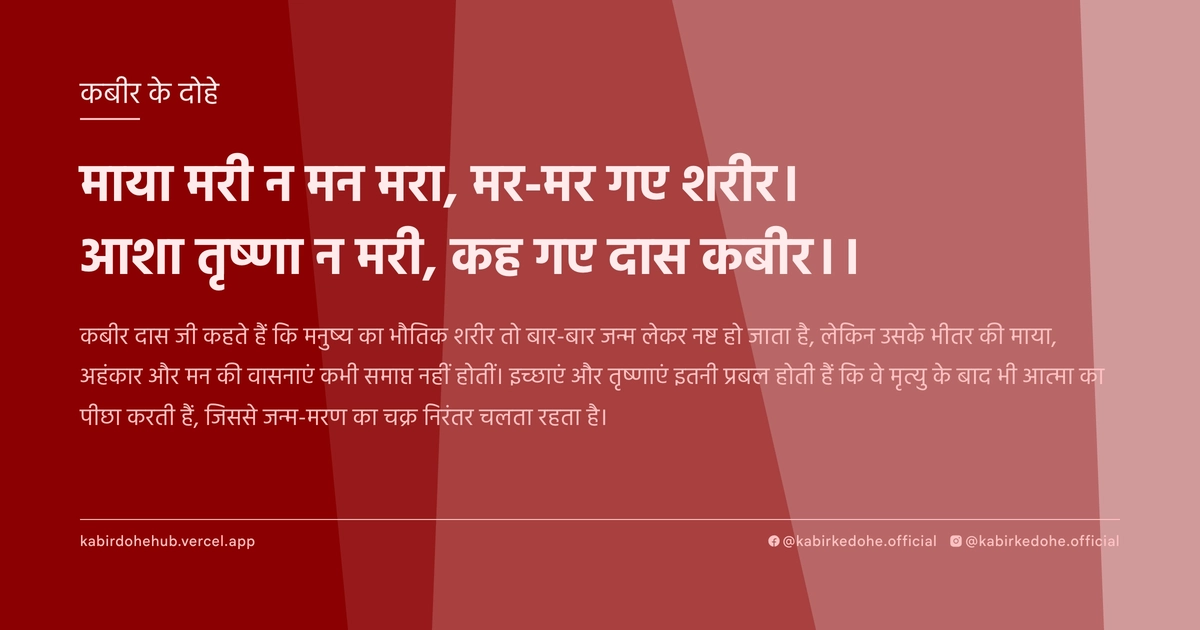
माया मरी न मन मरा, मर-मर गए शरीर।
आशा तृष्णा न मरी, कह गए दास कबीर।।
Maya mari na man mara, mar-mar gaye shareer. Asha trishna na mari, keh gaye das Kabir.
इस पृष्ठ पर इस कबीर दोहे का अर्थ (meaning), हिंदी व्याख्या और अंग्रेज़ी अनुवाद, दार्शनिक विश्लेषण और व्यावहारिक जीवन सीख दी गई है। यह दोहा माया (Maya) विषय से जुड़ा है — Kabir doha meaning and explanation in Hindi and English.
अर्थ (Meaning):
कबीर दास जी कहते हैं कि मनुष्य का भौतिक शरीर तो बार-बार जन्म लेकर नष्ट हो जाता है, लेकिन उसके भीतर की माया, अहंकार और मन की वासनाएं कभी समाप्त नहीं होतीं। इच्छाएं और तृष्णाएं इतनी प्रबल होती हैं कि वे मृत्यु के बाद भी आत्मा का पीछा करती हैं, जिससे जन्म-मरण का चक्र निरंतर चलता रहता है।
Kabir asserts that while the physical body perishes and decomposes repeatedly through cycles of birth and death, the underlying illusions of Maya and the cravings of the mind remain untouched. The insatiable nature of human desire and longing persists beyond the grave, trapping the soul in an endless loop of reincarnation.
व्याख्या (Interpretation):
इस दोहे का शाब्दिक अर्थ है कि शरीर मर जाता है पर इच्छाएं नहीं मरतीं। गहरे स्तर पर, कबीर 'माया' को उस मानसिक पर्दे के रूप में देखते हैं जो आत्मा को उसके वास्तविक स्वरूप (ब्रह्म) से अलग करता है। यहाँ 'मन' वह केंद्र है जहाँ वासनाएं जन्म लेती हैं। निर्गुण भक्ति के अनुसार, जब तक साधक अपने भीतर के 'अहंकार' और 'तृष्णा' का विसर्जन नहीं करता, तब तक वह केवल शारीरिक मृत्यु का अनुभव करता है, आध्यात्मिक मुक्ति का नहीं। यह द्वैतवाद की स्थिति है जहाँ मनुष्य स्वयं को शरीर मानता है, जबकि वह वास्तव में अविनाशी चेतना है। मुक्ति तब होती है जब 'मैं' का भाव समाप्त हो जाए और केवल वह निराकार सत्य शेष रहे।
Literally, the verse speaks of the persistence of desire over the fragility of the flesh. Metaphorically, Kabir identifies 'Maya' as the cosmic illusion that veils the Atman from its non-dual identity with Brahman. The 'mind' is portrayed as the engine of attachment, creating a false sense of separation. In the context of Nirgun Bhakti, the death of the body is a mere biological event; the true 'death' required is the annihilation of the ego (Ahamkara). This paradox highlights that the human condition is a struggle between the transient physical form and the eternal, yet clouded, consciousness. Only when the thirst for external validation and material possession (Trishna) is extinguished does the soul transcend the cycle of Samsara.
दार्शनिक विश्लेषण (Philosophical Analysis):
कबीर का यह दोहा मध्यकालीन भारत के उस सामाजिक और धार्मिक परिवेश की प्रतिक्रिया है जहाँ कर्मकांड और बाहरी आडंबरों को मोक्ष का मार्ग माना जाता था। कबीर ने स्पष्ट किया कि तिलक, माला या तीर्थयात्रा से मन की गंदगी नहीं धुलती। उनका दर्शन अद्वैत वेदांत के करीब है, जहाँ वे आत्मा और परमात्मा की एकता पर बल देते हैं, लेकिन उनका दृष्टिकोण अधिक व्यावहारिक और विद्रोही है।
वे सूफी मत के 'फना' (अहंकार का विनाश) के विचार को समाहित करते हैं। उनके अनुसार, माया केवल बाहरी दुनिया नहीं है, बल्कि मन की वह प्रवृत्ति है जो 'मेरे' और 'तेरे' का भेद पैदा करती है। जब तक यह भेद जीवित है, मनुष्य वास्तव में जीवित नहीं बल्कि अपनी इच्छाओं का गुलाम है।
यहाँ 'तृष्णा' का अर्थ केवल भौतिक वस्तुओं की चाह नहीं, बल्कि पहचान की भूख है। जाति और धर्म के नाम पर जो श्रेष्ठता का भाव है, वह भी इसी माया का हिस्सा है। कबीर इस सामाजिक संरचना को चुनौती देते हुए कहते हैं कि वास्तविक पवित्रता आंतरिक शुद्धि में है, न कि बाहरी पहचान में।
मनोवैज्ञानिक स्तर पर, कबीर यह समझा रहे हैं कि हमारी आदतें और संस्कार (Samskaras) शरीर के नष्ट होने के बाद भी सूक्ष्म शरीर (Linga Sharira) के साथ यात्रा करते हैं। यही कारण है कि मनुष्य बार-बार उन्हीं त्रुटियों और दुखों को दोहराता है।
अंततः, यह दोहा एक चेतावनी है कि समय का सदुपयोग केवल शरीर को पालने में नहीं, बल्कि मन को जीतने में करना चाहिए। जब मन मरता है (अर्थात शांत होता है), तभी मनुष्य वास्तव में जागता है और उस निराकार ईश्वर का साक्षात्कार करता है जो उसके भीतर ही व्याप्त है।
This couplet emerges from the socio-religious turbulence of medieval India, where ritualism and caste hierarchies were presented as paths to salvation. Kabir dismantles these notions, arguing that external symbols—be it the sacred thread or the pilgrimage—cannot cleanse the internal residue of desire. His philosophy aligns with Advaita Vedanta's non-duality, yet it is stripped of scholarly elitism and infused with the raw energy of the Bhakti movement.
He integrates the Sufi concept of 'Fana' (the annihilation of the self). For Kabir, Maya is not just the material world, but the cognitive distortion that creates the illusion of 'I' and 'Mine.' As long as this duality persists, the individual remains a prisoner of their own perceptions, regardless of their religious affiliation.
'Trishna' (thirst) here represents more than material greed; it is the hunger for identity and status. The rigid caste system of his era was a manifestation of this collective Maya, where people clung to social labels to feel superior. Kabir asserts that true liberation is the shedding of these labels in favor of a universal, formless truth.
Psychologically, Kabir addresses the persistence of 'Samskaras' or latent impressions. He suggests that while the biological vessel is replaced, the psychic patterns of craving and aversion migrate with the soul, ensuring that the same spiritual errors are repeated across lifetimes.
Ultimately, the verse serves as a critique of the human tendency to prioritize the maintenance of the body over the liberation of the mind. He posits that the 'death' of the ego is the only meaningful death, as it is the prerequisite for awakening to the Nirgun (formless) reality that permeates all existence.
मूल संदेश (Core Message):
- शरीर नश्वर है, लेकिन मानसिक संस्कार स्थायी होते हैं।
- माया बाहरी दुनिया नहीं, बल्कि मन का भ्रम है।
- इच्छाओं की पूर्ति ही दुख का मूल कारण है।
- अहंकार का विसर्जन ही वास्तविक मृत्यु और पुनर्जन्म है।
- शांति बाहर नहीं, बल्कि तृष्णा के अंत में है।
- निराकार सत्य को पाने के लिए साकार मोह छोड़ना होगा।
- The body is transient, but mental impressions are enduring.
- Maya is not the world, but the mind's distortion of it.
- The pursuit of desire is the primary source of suffering.
- The dissolution of ego is the only true death and rebirth.
- Peace is found not in acquisition, but in the end of craving.
- To realize the Formless, one must relinquish attachment to form.
व्यावहारिक उदाहरण (Practical Example):
वाराणसी के एक पुराने घाट पर रहने वाले माधव नाम के एक वृद्ध बुनकर थे। माधव अपनी कला में निपुण थे, लेकिन उनका मन हमेशा इस बात की टीस से भरा रहता था कि उनके बेटे ने शहर जाकर उन्हें भुला दिया है। वे दिन भर कपड़े बुनते, लेकिन उनका ध्यान इस बात पर रहता कि उनका बेटा वापस आए और उनकी संपत्ति की प्रशंसा करे।
माधव की यह 'तृष्णा' उन्हें चैन से जीने नहीं देती थी। वे अक्सर अन्य बुनकरों से अपनी श्रेष्ठता सिद्ध करने की कोशिश करते और अपने बेटे की उपलब्धियों के झूठे किस्से सुनाते। शरीर बूढ़ा हो रहा था, हाथ कांप रहे थे, लेकिन मन की वह भूख और अधिक बढ़ रही थी।
एक दिन, एक घुमक्कड़ संत उनके पास आए। उन्होंने माधव के चेहरे पर छाई उदासी और अहंकार को देखा। संत ने उनसे पूछा, 'माधव, तुम क्या बुन रहे हो—कपड़ा या अपनी पुरानी यादों की जंजीरें?'
माधव को पहले तो गुस्सा आया, लेकिन संत की आंखों में एक अजीब सी शांति थी। संत ने कहा, 'तुम शरीर से तो यहाँ हो, लेकिन तुम्हारा मन उस बेटे के पास है जो तुम्हें नहीं चाहता। तुम उस चीज़ को पकड़कर बैठे हो जो मर चुकी है, और इस जीवन को खो रहे हो जो अभी तुम्हारे पास है।'
यह बात माधव के हृदय में गहरे तक उतर गई। उन्होंने महसूस किया कि जिस 'बेटे' के लिए वे तड़प रहे थे, वह वास्तव में उनका बेटा नहीं, बल्कि उनकी अपनी 'अहंकारपूर्ण पहचान' थी जिसे वे जीवित रखना चाहते थे।
अगले कुछ महीनों में, माधव ने एक बदलाव का अनुभव किया। उन्होंने अपने बेटे की प्रतीक्षा करना छोड़ दिया और अपनी कला को ईश्वर की सेवा मानकर बुनना शुरू किया। उन्होंने अपने हुनर से गरीब बच्चों को मुफ्त में बुनना सिखाना शुरू किया।
अब उनके चेहरे पर एक ऐसी मुस्कान थी जो पहले कभी नहीं देखी गई। उन्होंने पाया कि जब उन्होंने 'पाने' की इच्छा को मार दिया, तो उन्हें वह शांति मिली जिसे वे जीवन भर खोज रहे थे।
उनकी तृष्णा समाप्त हो गई थी। अब वे केवल एक बुनकर नहीं थे, बल्कि एक मुक्त आत्मा थे जो वर्तमान क्षण में पूरी तरह जीवित थे।
जब माधव की मृत्यु हुई, तो उनके चेहरे पर कोई पछतावा नहीं था। उन्होंने शरीर को तो खो दिया, लेकिन उन्होंने उस 'मन' को जीत लिया था जिसने उन्हें दशकों तक कैद कर रखा था।
In the ancient ghats of Varanasi lived an elderly weaver named Madhav. Madhav was a master of his craft, yet his heart was perpetually heavy with the resentment that his son, having moved to the city, had forgotten him. He spent his days weaving exquisite fabrics, but his mind was always weaving fantasies of his son's return and the validation of his wealth.
This 'Trishna' or thirst consumed Madhav. He would often boast to other weavers about his son's supposed success, using these stories to establish a false sense of superiority. While his body grew frail and his hands trembled with age, the hunger for recognition in his mind only intensified.
One afternoon, a wandering ascetic visited his loom. Observing the turmoil in Madhav's eyes, the ascetic asked, 'Madhav, what are you truly weaving—a piece of cloth, or the chains of your own memories?'
Initially, Madhav felt insulted, but the profound stillness in the ascetic's gaze compelled him to listen. The saint continued, 'You are physically present here, but your mind resides with a son who does not seek you. You are clinging to a ghost of the past, and in doing so, you are killing the life that is actually present.'
These words struck a chord deep within Madhav. He realized that the 'son' he longed for was not a person, but a projection of his own ego—a desire to be seen as a successful father and a man of status.
Over the following months, a transformation occurred. Madhav stopped waiting for the phone to ring or the door to open. He began to view his weaving not as a means to an end, but as a meditative offering to the formless Divine.
He started teaching the art of weaving to orphaned children in the neighborhood for free, finding joy in the act of giving rather than the hope of receiving.
A serenity settled over him that no material wealth could have provided. He discovered that by killing the desire for external validation, he had finally accessed the internal peace he had sought for a lifetime.
He was no longer just a weaver of cloth; he had become a weaver of consciousness, living fully in the present moment.
When Madhav eventually passed away, there was no trace of longing or regret on his face. He had lost his physical body, but he had successfully slain the 'mind' that had imprisoned him for decades.
अभ्यास मार्गदर्शन (Practice Guidance):
- साक्षी भाव का अभ्यास: दिन में तीन बार 10 मिनट के लिए बैठें और अपने विचारों को केवल देखें। यह न कहें कि 'मैं दुखी हूँ', बल्कि कहें 'मैं देख रहा हूँ कि मन में दुख का विचार उठ रहा है'।
- इच्छा-विश्लेषण जर्नल: अपनी तीन सबसे बड़ी इच्छाओं को लिखें। फिर खुद से पूछें, 'यदि यह इच्छा पूरी नहीं हुई, तो क्या मेरा अस्तित्व समाप्त हो जाएगा?' इस प्रक्रिया से तृष्णा की जड़ को पहचानें।
- अनासक्ति का प्रयोग: किसी ऐसी वस्तु या विचार का त्याग करें जिससे आप बहुत अधिक जुड़े हुए हैं, और देखें कि आपके भीतर कैसी बेचैनी उठती है। उस बेचैनी को बिना प्रतिक्रिया दिए महसूस करें।
- निदान चेकलिस्ट: (1) क्या मैं दूसरों की प्रशंसा के बिना अधूरा महसूस करता हूँ? (2) क्या मेरी खुशी बाहरी परिस्थितियों पर निर्भर है? (3) क्या मैं अतीत की यादों में वर्तमान को खो रहा हूँ? यदि उत्तर 'हाँ' है, तो माया अभी प्रभावी है।
- Practice of the Witness (Sakshi): Sit for 10 minutes three times a day and observe your thoughts. Instead of saying 'I am sad,' say 'I observe a thought of sadness arising in the mind.'
- Desire-Analysis Journaling: List your three strongest desires. Ask yourself, 'If this desire remains unfulfilled, does my essential existence cease to be?' Use this to identify the root of Trishna.
- Experiment with Non-attachment: Consciously let go of a belief or a material object you are overly attached to. Observe the anxiety that arises and feel it without reacting to it.
- Diagnostic Checklist: (1) Do I feel incomplete without external validation? (2) Is my happiness dependent on external circumstances? (3) Am I losing the present to memories of the past? If 'Yes,' Maya is still dominant.
चिंतन प्रश्न (Reflection Questions):
- मेरा वह कौन सा 'डिजिटल अहंकार' है जिसे मैं सोशल मीडिया पर जीवित रखने के लिए संघर्ष कर रहा हूँ?
- यदि आज मेरी सारी सामाजिक पहचान (पद, प्रतिष्ठा, रिश्ता) छीन ली जाए, तो मेरे भीतर क्या बचेगा?
- मैं किन ऐसी इच्छाओं को 'ज़रूरत' का नाम दे रहा हूँ, जो वास्तव में केवल मेरी तृष्णा हैं?
- क्या मैं वास्तव में स्वतंत्र हूँ, या मैं अपनी पुरानी आदतों और संस्कारों का एक गुलाम हूँ?
- मेरे जीवन का वह कौन सा हिस्सा है जहाँ मैं 'सही' होने के अहंकार में सत्य को अनदेखा कर रहा हूँ?
- क्या मैं मृत्यु से डरता हूँ, या उस सत्य से जिसे स्वीकार करने के लिए मुझे अपने 'मन' को मारना होगा?
- What is the 'digital ego' I struggle to maintain on social media, and why does it define me?
- If all my social identities—rank, status, relationships—were stripped away today, what would remain of me?
- Which of my 'needs' are actually just cravings disguised as necessities?
- Am I truly free, or am I merely a puppet of my own ingrained habits and Samskaras?
- In which area of my life am I ignoring the truth simply to maintain the ego's need to be 'right'?
- Do I fear death, or do I fear the truth that requires the annihilation of my conditioned mind?