
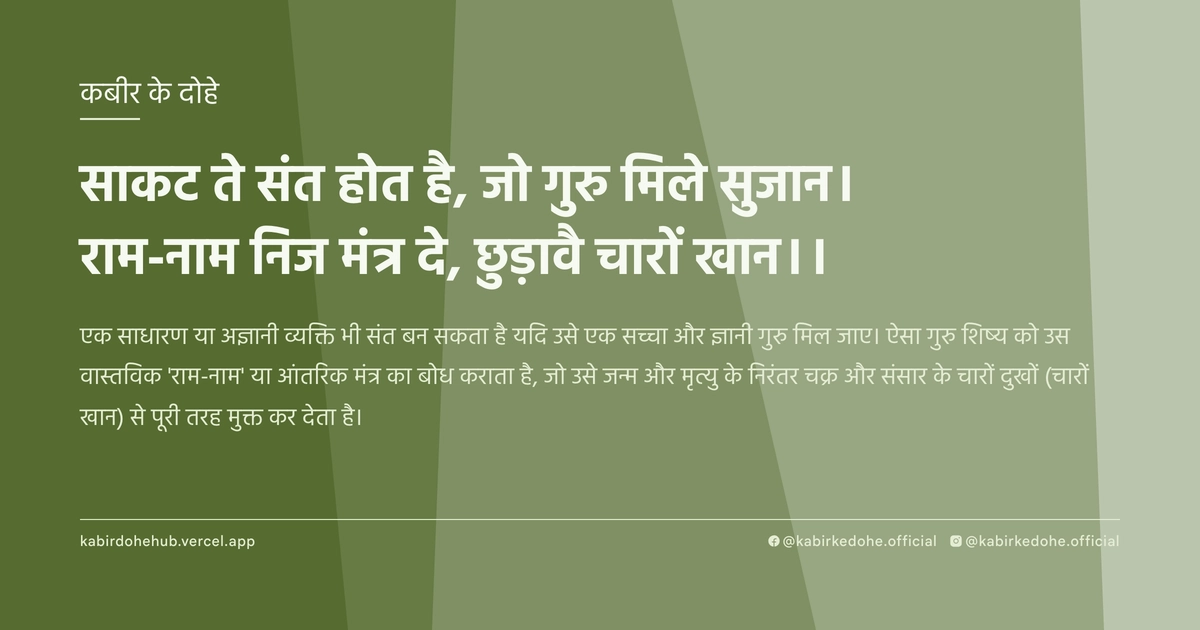
साकट ते संत होत है, जो गुरु मिले सुजान।
राम-नाम निज मंत्र दे, छुड़ावै चारों खान।।
Saakat te sant hot hai, jo guru mile sujaan. Ram-naam nij mantra de, chhudaave chaaron khan.
इस पृष्ठ पर इस कबीर दोहे का अर्थ (meaning), हिंदी व्याख्या और अंग्रेज़ी अनुवाद, दार्शनिक विश्लेषण और व्यावहारिक जीवन सीख दी गई है। यह दोहा मुक्ति (Liberation) विषय से जुड़ा है — Kabir doha meaning and explanation in Hindi and English.
अर्थ (Meaning):
एक साधारण या अज्ञानी व्यक्ति भी संत बन सकता है यदि उसे एक सच्चा और ज्ञानी गुरु मिल जाए। ऐसा गुरु शिष्य को उस वास्तविक 'राम-नाम' या आंतरिक मंत्र का बोध कराता है, जो उसे जन्म और मृत्यु के निरंतर चक्र और संसार के चारों दुखों (चारों खान) से पूरी तरह मुक्त कर देता है।
An ordinary or ignorant person can be transformed into a saint if they encounter a truly wise and enlightened teacher. Such a guru imparts the authentic 'Ram-naam'—the internal mantra of cosmic consciousness—which liberates the seeker from the grueling cycle of birth and death and the four realms of worldly suffering.
व्याख्या (Interpretation):
शाब्दिक अर्थ में यह दोहा गुरु की महत्ता बताता है, लेकिन आध्यात्मिक स्तर पर यह 'अंधकार से प्रकाश' की यात्रा है। 'साकट' यहाँ उस व्यक्ति का प्रतीक है जो माया के मोह में फंसा है और अपनी वास्तविक प्रकृति से अनभिज्ञ है। 'सुजान' गुरु वह है जो केवल किताबी ज्ञान नहीं, बल्कि अनुभवजन्य सत्य (Anubhava) प्रदान करता है। 'राम-नाम' यहाँ किसी व्यक्ति विशेष का नाम नहीं, बल्कि उस निर्गुण ब्रह्म की ध्वनि है जो हर कण में व्याप्त है। 'चारों खान' का अर्थ है चौरासी लाख योनियों का वह चक्र जिसमें आत्मा भटकती रहती है। यह दोहा इस विरोधाभास को दर्शाता है कि मुक्ति बाहरी प्रयास से नहीं, बल्कि एक आंतरिक कुंजी (मंत्र) के माध्यम से आती है जिसे केवल एक जागृत गुरु ही दे सकता है।
Literally, this couplet emphasizes the necessity of a teacher, but metaphorically, it describes the transition from darkness to illumination. 'Sakat' represents the individual trapped in Maya, oblivious to their inherent divinity. The 'Sujaan' guru is not a mere academic instructor but one who possesses experiential realization (Anubhava). 'Ram-naam' here does not refer to a deity in a temple, but to the primordial vibration of the Nirgun Brahman permeating every atom. The 'four realms' (charon khaan) symbolize the endless cycle of transmigration across eighty-four lakh species. The central paradox presented is that liberation is not achieved through strenuous external effort, but through an internal key—the mantra—which can only be unlocked by a realized master, bridging the gap between the finite ego and the infinite Atman.
दार्शनिक विश्लेषण (Philosophical Analysis):
कबीर का यह दर्शन निर्गुण भक्ति और अद्वैत वेदांत के संगम पर स्थित है। उनके समय में धर्म केवल कर्मकांडों और जातिगत श्रेष्ठता तक सीमित था। कबीर ने इस व्यवस्था को चुनौती देते हुए यह स्थापित किया कि आध्यात्मिकता किसी विशेष जाति या कुल की बपौती नहीं है; एक साधारण व्यक्ति भी 'संत' बन सकता है। यह विचार सामाजिक समानता का एक क्रांतिकारी घोषणापत्र है।
दार्शनिक रूप से, कबीर यहाँ 'गुरु' को एक माध्यम के रूप में देखते हैं जो शिष्य के भीतर के 'अहंकार' को नष्ट करता है। सूफीवाद में इसे 'पीर' की भूमिका के समान माना जा सकता है, जहाँ गुरु शिष्य के हृदय के पर्दे को हटाता है। यहाँ 'राम-नाम' का अर्थ है वह सत्य जो शब्दों से परे है, जिसे केवल अनुभव किया जा सकता है। यह अद्वैत वेदांत के उस सिद्धांत से मेल खाता है जहाँ जीव और ब्रह्म की एकता को पहचाना जाता है।
कबीर ritualism (कर्मकांड) का विरोध करते हैं क्योंकि उनका मानना था कि बाहरी पूजा केवल अहंकार को बढ़ाती है। वास्तविक मुक्ति 'शब्द' या 'नाद' के माध्यम से आती है, जो आत्मा को उसके मूल स्रोत से जोड़ता है। यह मनोवैज्ञानिक रूपांतरण की प्रक्रिया है जहाँ साधक अपनी पहचान को 'शरीर' से हटाकर 'चेतना' पर केंद्रित करता है।
इस दोहे में 'चारों खान' से मुक्ति का अर्थ केवल मृत्यु के बाद मोक्ष नहीं, बल्कि जीवित रहते हुए वासनाओं और मानसिक द्वंद्वों से मुक्ति है। यह 'जीवन्मुक्ति' की अवस्था है। कबीर यह स्पष्ट करते हैं कि बिना मार्गदर्शन के, व्यक्ति माया के जाल में उलझा रहता है, क्योंकि मन स्वयं को धोखा देने में माहिर है।
अंततः, यह विश्लेषण दर्शाता है कि कबीर के लिए गुरु वह दर्पण है जिसमें शिष्य अपनी वास्तविक छवि (ब्रह्मरूप) देख पाता है। यह प्रक्रिया अहंकार के पूर्ण विसर्जन की मांग करती है, क्योंकि जब तक 'मैं' मौजूद है, तब तक 'राम' (परम सत्य) का अनुभव असंभव है।
Kabir's philosophy here resides at the intersection of Nirgun Bhakti and Advaita Vedanta. During his era, religion was largely confined to rigid rituals and caste hierarchies. Kabir challenged this by asserting that spirituality is not the birthright of any specific caste or lineage; even the most ordinary person can become a 'saint.' This is a revolutionary manifesto for social and spiritual equality.
Philosophically, Kabir views the 'Guru' as the catalyst who annihilates the disciple's ego. This mirrors the role of the 'Pir' in Sufism, where the master removes the veils of illusion from the seeker's heart. The 'Ram-naam' mentioned is not a name for a mythological figure, but the primordial vibration of the formless Absolute, which can only be realized through direct experience (Anubhava).
Kabir vehemently rejects ritualism, arguing that external ceremonies only inflate the ego. True liberation comes through the 'Shabd' or 'Naad' (the inner sound), which reconnects the soul with its cosmic source. This aligns with the Advaita Vedanta principle of non-duality, where the perceived separation between the individual self (Jiva) and the universal consciousness (Brahman) is revealed as an illusion.
The liberation from the 'four realms' (charon khaan) does not merely refer to post-mortem salvation, but to 'Jivanmukti'—liberation while alive. It is the cessation of cravings and mental conflicts. Kabir emphasizes that without a guide, the individual remains trapped in Maya, as the mind is an expert at self-deception.
Ultimately, the Guru serves as a mirror in which the disciple recognizes their true nature as divine. This process demands the total dissolution of the 'I'. As long as the ego persists, the experience of the Absolute remains elusive. The transformation is psychological and ontological, shifting the identity from the transient body to the eternal consciousness.
मूल संदेश (Core Message):
- अज्ञानता कोई स्थायी स्थिति नहीं, बल्कि एक पर्दा है।
- सच्चा गुरु वह है जो आपको आपसे मिला दे।
- मुक्ति बाहरी कर्मकांडों में नहीं, आंतरिक बोध में है।
- अहंकार का विसर्जन ही वास्तविक संतत्व की शुरुआत है।
- परम सत्य (राम) हर जीव के भीतर एक गूँज है।
- Ignorance is not a permanent state, but a veil to be lifted.
- A true Guru is one who introduces you to your own essence.
- Liberation lies in internal realization, not external rituals.
- The dissolution of ego is the true beginning of sainthood.
- The Ultimate Truth (Ram) is a resonance within every living being.
व्यावहारिक उदाहरण (Practical Example):
वाराणसी के एक घाट पर रहने वाला एक वृद्ध नाविक था, जिसका नाम माधव था। माधव का पूरा जीवन केवल नाव चलाने और पर्यटकों को घुमाने में बीता था। वह खुद को अनपढ़ और आध्यात्मिक रूप से शून्य मानता था। वह अक्सर देखता कि बड़े-बड़े विद्वान पंडित घाटों पर शास्त्र चर्चा करते, लेकिन उसके मन में हमेशा एक टीस रहती कि क्या उसके जैसा साधारण व्यक्ति कभी ईश्वर को पा सकेगा?
एक दिन उसकी नाव में एक शांत स्वभाव का संन्यासी सवार हुआ। संन्यासी ने माधव की आंखों में छिपी उस तड़प को पहचान लिया। जब माधव ने अपनी अयोग्यता का जिक्र किया, तो संन्यासी ने मुस्कुराकर कहा, 'माधव, जिस तरह नाव को किनारे लगाने के लिए पतवार की जरूरत होती है, वैसे ही आत्मा को किनारे लगाने के लिए केवल एक सही शब्द की जरूरत होती है।'
संन्यासी ने उसे कोई कठिन ग्रंथ नहीं दिया, बल्कि उसे 'सांसों की लय' और 'भीतर की गूँज' पर ध्यान केंद्रित करना सिखाया। उसने माधव को बताया कि जिसे वह बाहर खोज रहा है, वह उसके अपने हृदय की धड़कन में छिपा है। यह वह 'राम-नाम' था जिसे कबीर ने निर्गुण कहा था।
शुरुआत में माधव को लगा कि यह सब व्यर्थ है। वह सोचता था कि बिना मंत्रोच्चार और पूजा-पाठ के क्या होगा? लेकिन संन्यासी के निरंतर मार्गदर्शन और सरल अभ्यास से, माधव के भीतर एक बदलाव आने लगा। वह अब केवल नाव नहीं चला रहा था, बल्कि वह हर लहर में एक संगीत सुनने लगा था।
उसका क्रोध कम होने लगा और उसके मन में सबके प्रति करुणा जाग गई। एक दिन एक अमीर यात्री ने उसे बहुत अधिक पैसे दिए, लेकिन माधव ने महसूस किया कि उसकी असली संपत्ति तो वह आंतरिक शांति है जो उसे मिल चुकी थी। उसने उन पैसों का उपयोग घाट पर भूखे लोगों को भोजन कराने के लिए किया।
गाँव के लोग हैरान थे कि वह 'अज्ञानी' नाविक अब एक संत की तरह व्यवहार कर रहा था। उसकी वाणी में एक ऐसी गहराई आ गई थी कि लोग अपनी समस्याएं लेकर उसके पास आने लगे। माधव अब किसी मंदिर या मस्जिद का मोहताज नहीं था; उसकी नाव ही उसका मंदिर बन गई थी।
एक बार एक अहंकारी विद्वान ने उससे पूछा कि उसने कौन सा शास्त्र पढ़ा है। माधव ने विनम्रता से उत्तर दिया, 'मैंने केवल उस गुरु की बात सुनी जिसने मुझे खुद से मिला दिया।' विद्वान निरुत्तर रह गया क्योंकि माधव के चेहरे पर वह तेज था जो शास्त्रों के रटने से नहीं आता।
माधव की कहानी यह सिद्ध करती है कि 'साकट' (साधारण) व्यक्ति भी 'संत' बन सकता है। उसकी मुक्ति किसी बाहरी अनुष्ठान से नहीं, बल्कि एक सुजान गुरु द्वारा दिए गए उस आंतरिक बोध से हुई, जिसने उसे जन्म-मृत्यु के मानसिक चक्र और लालच की 'खान' से मुक्त कर दिया।
On the ghats of Varanasi lived an elderly boatman named Madhav. His entire life had been spent rowing boats and guiding tourists. He considered himself uneducated and spiritually void, often watching learned pundits engage in scholarly debates on the riverbanks. A persistent ache remained in his heart: could a simple man like him ever attain the Divine?
One day, a serene monk boarded his boat. The monk recognized the latent longing in Madhav's eyes. When Madhav spoke of his inadequacy, the monk smiled and said, 'Madhav, just as a boat needs a rudder to reach the shore, the soul needs a single right word to reach its destination.'
The monk did not hand him a complex scripture; instead, he taught him to focus on the rhythm of his breath and the inner resonance of his being. He told Madhav that what he sought externally was hidden within the very beat of his own heart. This was the 'Ram-naam' that Kabir described as formless.
Initially, Madhav felt this was futile. He wondered how liberation could occur without ritual chants or elaborate worship. However, under the monk's steady guidance and simple practice, a transformation began. He was no longer just rowing a boat; he began to hear a cosmic music in every ripple of the Ganges.
His anger subsided, and a profound compassion for all living beings awakened within him. Once, a wealthy traveler offered him an exorbitant sum of money, but Madhav realized his true wealth was the inner peace he had attained. He used that money to feed the hungry on the ghats.
The villagers were astonished that the 'ignorant' boatman was now behaving like a saint. His words acquired a depth that drew people to him for solace. Madhav was no longer dependent on temples or mosques; his boat had become his sanctuary.
One day, an arrogant scholar asked him which scriptures he had studied. Madhav replied humbly, 'I have only listened to the Guru who introduced me to myself.' The scholar was left speechless, for Madhav's face radiated a luminosity that cannot be gained by rote learning.
Madhav's story proves that a 'Sakat' (ordinary) person can indeed become a 'Sant'. His liberation did not come from external rituals, but from the internal awakening triggered by a wise Guru, freeing him from the mental cycle of craving and the 'realms' of suffering.
अभ्यास मार्गदर्शन (Practice Guidance):
- प्रतिदिन 20 मिनट 'शून्य ध्यान' का अभ्यास करें, जहाँ आप किसी विचार को पकड़ने के बजाय केवल अपनी सांसों की प्राकृतिक गति को देखें।
- स्व-अन्वेषण जर्नल: प्रतिदिन लिखें कि आज आपके भीतर किस 'अहंकार' (जैसे- सही होने का दावा, श्रेष्ठता की भावना) ने आपको सत्य से दूर किया।
- व्यवहार परिवर्तन: किसी ऐसे व्यक्ति की मदद करें जिससे आप घृणा करते हैं, यह महसूस करते हुए कि उसमें भी वही 'राम-नाम' (चेतना) है जो आपमें है।
- निदान चेकलिस्ट: क्या मैं अभी भी बाहरी पहचान (पद, जाति, ज्ञान) से अपनी कीमत आंक रहा हूँ? क्या मेरी शांति बाहरी परिस्थितियों पर निर्भर है? यदि हाँ, तो आप अभी भी 'साकट' अवस्था में हैं।
- Practice 20 minutes of 'Shunya Meditation' daily, observing the natural flow of breath without attempting to grasp any specific thought.
- Self-Inquiry Journaling: Record daily instances where your 'ego' (e.g., the need to be right, feelings of superiority) distanced you from the truth.
- Behavioral Shift: Perform an act of selfless service for someone you dislike, recognizing that the same 'Ram-naam' (universal consciousness) resides in them as in you.
- Diagnostic Checklist: Am I still measuring my worth by external identities (status, caste, knowledge)? Is my peace dependent on external circumstances? If yes, you are still in the 'Sakat' state.
चिंतन प्रश्न (Reflection Questions):
- क्या मैं वास्तव में एक गुरु की तलाश में हूँ, या मैं केवल अपनी मान्यताओं की पुष्टि करने वाला व्यक्ति चाहता हूँ?
- मेरे जीवन में 'साकट' (अज्ञानी) कौन है—वह जिसे ज्ञान नहीं है, या वह जो यह मानता है कि वह सब जानता है?
- यदि मेरी सारी सामाजिक पहचान (नाम, पेशा, प्रतिष्ठा) छीन ली जाए, तो मेरे भीतर क्या बचेगा?
- क्या मेरा 'धर्म' मुझे दूसरों से जोड़ रहा है या मुझे श्रेष्ठता का भ्रम देकर अलग कर रहा है?
- मैं किन मानसिक 'खानों' (दुखद चक्रों) में बार-बार गिरता हूँ और उनसे निकलने के लिए किस आंतरिक मंत्र की आवश्यकता है?
- Am I truly seeking a Guru, or am I merely looking for someone to validate my existing beliefs?
- Who is the 'Sakat' (ignorant) in my life—the one who lacks knowledge, or the one who believes they know everything?
- If all my social identities (name, profession, status) were stripped away, what would remain within me?
- Is my 'religion' connecting me to others, or is it isolating me through an illusion of superiority?
- Which mental 'realms' (cycles of suffering) do I repeatedly fall into, and what internal mantra is needed to break them?