
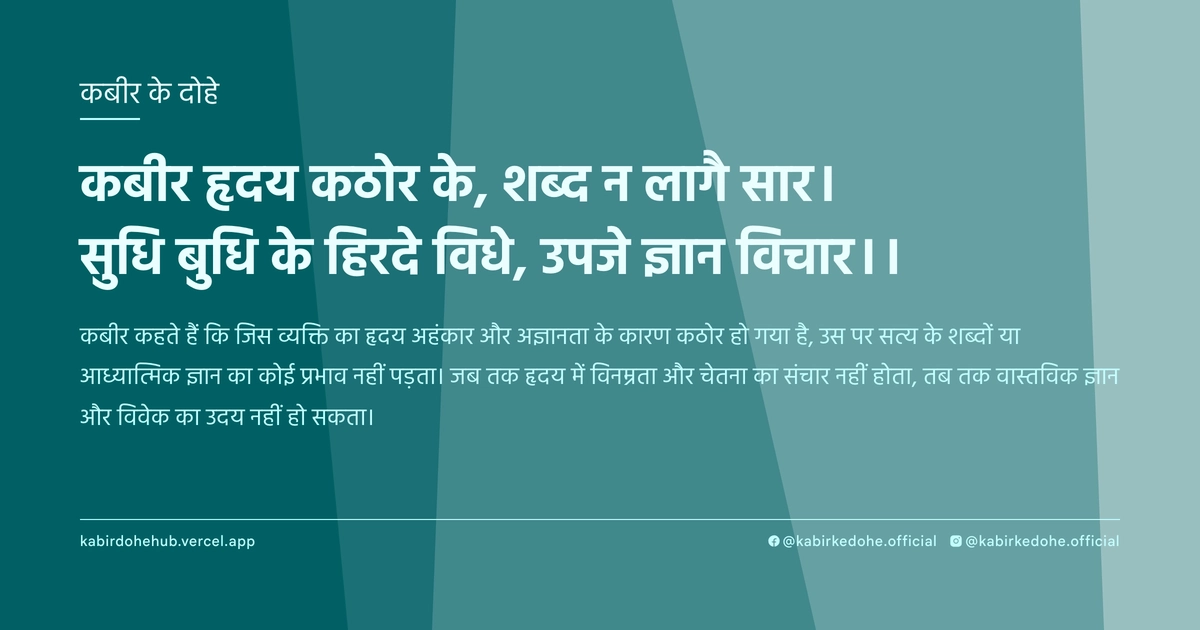
कबीर हृदय कठोर के, शब्द न लागै सार।
सुधि बुधि के हिरदे विधे, उपजे ज्ञान विचार।।
Kabir hriday kathor ke, shabd na laagai saar. Sudh budhi ke hirde vidhe, upje gyan vichaar.
इस पृष्ठ पर इस कबीर दोहे का अर्थ (meaning), हिंदी व्याख्या और अंग्रेज़ी अनुवाद, दार्शनिक विश्लेषण और व्यावहारिक जीवन सीख दी गई है। यह दोहा आत्मनिरीक्षण (Self-introspection) विषय से जुड़ा है — Kabir doha meaning and explanation in Hindi and English.
अर्थ (Meaning):
कबीर कहते हैं कि जिस व्यक्ति का हृदय अहंकार और अज्ञानता के कारण कठोर हो गया है, उस पर सत्य के शब्दों या आध्यात्मिक ज्ञान का कोई प्रभाव नहीं पड़ता। जब तक हृदय में विनम्रता और चेतना का संचार नहीं होता, तब तक वास्तविक ज्ञान और विवेक का उदय नहीं हो सकता।
Kabir asserts that for one whose heart has become hardened by ego and ignorance, the essence of spiritual words remains ineffective. Only when the heart is softened through mindfulness and openness can true wisdom and contemplative thought actually take root and flourish.
व्याख्या (Interpretation):
यहाँ 'कठोर हृदय' का अर्थ केवल भावनाशून्यता नहीं, बल्कि अहंकार (Maya) की वह परत है जो आत्मा को परमात्मा से अलग करती है। जब व्यक्ति स्वयं को पूर्ण मानता है, तो वह बाहरी सत्य के प्रति बहरा हो जाता है। यह स्थिति अद्वैत वेदांत के उस भ्रम के समान है जहाँ जीव स्वयं को ब्रह्म से अलग और सीमित मानता है। 'सुधि बुधि' का अर्थ है वह जागृति जो हृदय के बंद द्वारों को खोलती है। जब यह आंतरिक शुद्धि होती है, तब ज्ञान केवल सूचना नहीं रहता, बल्कि एक जीवंत अनुभव बन जाता है। यह विरोधाभास है कि ज्ञान पाने के लिए पहले यह स्वीकार करना पड़ता है कि हम अज्ञानी हैं।
The 'hardened heart' here refers not merely to a lack of emotion, but to the dense layer of ego (Maya) that severs the connection between the Atman and Brahman. When an individual believes they are already complete or superior, they become deaf to the resonance of Truth. This mirrors the Advaita Vedanta concept of Avidya, where the illusion of separation creates a spiritual rigidity. 'Sudhi Budhi' represents the awakening of consciousness that pierces through this calcified ego. Once the heart is softened, knowledge transcends intellectual data and becomes a lived experience. The central paradox is that the prerequisite for receiving wisdom is the humble admission of one's own ignorance.
दार्शनिक विश्लेषण (Philosophical Analysis):
कबीर का यह दोहा उनके युग के धार्मिक पाखंड और कट्टरता पर एक गहरा प्रहार है। उस समय समाज कर्मकांडों और बाहरी दिखावे में इतना उलझा था कि आंतरिक रूपांतरण की बात गौण हो गई थी। कबीर ने स्पष्ट किया कि चाहे कोई कितने भी मंत्र पढ़े या तीर्थ करे, यदि हृदय कठोर है, तो वह सब व्यर्थ है। यह दृष्टिकोण सूफी मत के 'इश्क' और 'दिल' की अवधारणा से मिलता-जुलता है, जहाँ हृदय को ईश्वर का निवास स्थान माना गया है।
दार्शनिक स्तर पर, यह दोहा 'अहंकार' के विनाश की बात करता है। जब तक 'मैं' (Ego) मौजूद है, तब तक 'वह' (Divine) प्रकट नहीं हो सकता। यह निर्गुण भक्ति का सार है—ईश्वर किसी मूर्ति या मंदिर में नहीं, बल्कि एक निर्मल और कोमल हृदय में बसता है। कबीर यहाँ तर्क देते हैं कि ज्ञान कोई ऐसी वस्तु नहीं है जिसे बाहर से आरोपित किया जा सके; यह तो भीतर से प्रस्फुटित होता है जब बाधाएं हट जाती हैं।
यह विश्लेषण हमें यह समझने में मदद करता है कि आध्यात्मिक प्रगति का पैमाना किताबी ज्ञान नहीं, बल्कि हृदय की संवेदनशीलता है। जो व्यक्ति दूसरों के दुख को महसूस नहीं कर सकता या अपनी गलतियों को स्वीकार नहीं कर सकता, वह आध्यात्मिक रूप से 'कठोर' है। कबीर के अनुसार, यह कठोरता ही मोक्ष के मार्ग में सबसे बड़ी बाधा है।
वेदांत के परिप्रेक्ष्य में, यह हृदय की शुद्धि 'चित्त शुद्धि' के समान है। जब चित्त शांत और कोमल होता है, तभी उसमें ब्रह्म का प्रतिबिंब स्पष्ट दिखाई देता है। यदि दर्पण (हृदय) पर धूल (अहंकार) जमी हो, तो सत्य का प्रकाश परावर्तित नहीं हो पाता।
अंततः, कबीर यह संदेश देते हैं कि ज्ञान का उदय एक जैविक प्रक्रिया की तरह है—जैसे बीज को अंकुरित होने के लिए नरम मिट्टी की आवश्यकता होती है, वैसे ही ज्ञान के लिए विनम्र हृदय अनिवार्य है। बिना विनम्रता के, सबसे महान उपदेश भी केवल शोर बनकर रह जाते हैं।
This couplet is a profound critique of the religious hypocrisy and dogmatism prevalent during Kabir's era. Society was so entangled in ritualism and external displays of piety that internal transformation became an afterthought. Kabir clarifies that regardless of how many mantras one recites or pilgrimages one undertakes, if the heart remains hardened, these efforts are futile. This perspective aligns closely with the Sufi concepts of 'Ishq' (divine love) and the 'Heart' as the true sanctuary of the Divine.
On a philosophical level, the verse addresses the annihilation of the ego. As long as the 'I' (the false ego) persists, the 'Thou' (the Divine) cannot manifest. This is the essence of Nirgun Bhakti—the belief that the formless God resides not in idols or temples, but within a pure and receptive heart. Kabir argues that wisdom is not an external commodity to be acquired, but an internal flowering that occurs once the obstructions are removed.
This analysis reveals that the metric of spiritual progress is not scholarly erudition, but emotional and spiritual sensitivity. One who cannot empathize with others or acknowledge their own flaws is 'hardened.' According to Kabir, this rigidity is the primary obstacle to liberation (Moksha).
In the context of Vedanta, this softening of the heart is akin to 'Chitta Shuddhi' (purification of the mind-stuff). Only when the mind is calm and receptive can the reflection of Brahman be clearly seen. If the mirror of the heart is covered in the dust of arrogance, the light of Truth cannot be reflected.
Ultimately, Kabir suggests that the emergence of knowledge is like a biological process—just as a seed requires soft soil to germinate, wisdom requires a humble heart. Without humility, even the most sublime teachings remain mere noise.
मूल संदेश (Core Message):
- अहंकार सत्य के मार्ग में सबसे बड़ी दीवार है।
- विनम्रता वह कुंजी है जो ज्ञान के द्वार खोलती है।
- शब्द केवल सूचना हैं, अनुभव ही वास्तविक ज्ञान है।
- हृदय की कोमलता ही आध्यात्मिक जागृति की पहली शर्त है।
- जब 'मैं' मिटता है, तभी 'परम सत्य' प्रकट होता है।
- Ego is the greatest wall standing between the seeker and the Truth.
- Humility is the key that unlocks the doors of genuine wisdom.
- Words are mere information; only lived experience is true knowledge.
- Softness of heart is the primary prerequisite for spiritual awakening.
- Only when the 'I' vanishes does the 'Ultimate Truth' reveal itself.
व्यावहारिक उदाहरण (Practical Example):
वाराणसी के एक पुराने घाट पर रहने वाली एक वृद्ध विधवा, जानकी, का जीवन अत्यंत कठिन था। वर्षों के शोक और समाज की उपेक्षा ने उनके हृदय को एक पत्थर की तरह कठोर बना दिया था। वे किसी की मदद नहीं लेती थीं और न ही किसी की बातों पर विश्वास करती थीं। उनके लिए धर्म का अर्थ केवल कठोर नियमों का पालन करना था।
एक दिन, एक युवा संन्यासी उनके पास आया और उन्हें करुणा और क्षमा के बारे में बताने लगा। जानकी ने उसे झिड़क दिया और कहा, 'तुम जैसे हज़ारों आए और गए, मुझे तुम्हारी किताबी बातों से कोई मतलब नहीं।' संन्यासी चुप रहा और मुस्कुराया।
अगले कुछ दिनों तक, संन्यासी ने उन्हें कोई उपदेश नहीं दिया। इसके बजाय, वह चुपचाप जानकी के घर के बाहर बिखरे कचरे को साफ करने लगा और उनके लिए ताजे फूल लाने लगा। उसने बिना कुछ कहे उनकी छोटी-छोटी जरूरतों का ख्याल रखा।
एक शाम, जानकी ने देखा कि एक छोटा कुत्ता ठंड से कांप रहा था। उन्होंने हमेशा ऐसे जानवरों को दुत्कारा था। लेकिन संन्यासी ने उस कुत्ते को अपनी चादर में लपेटकर गर्माहट दी और उसे प्यार से सहलाया।
उस छोटे से दृश्य ने जानकी के भीतर कुछ तोड़ दिया। उन्हें महसूस हुआ कि जिस 'प्रेम' की बात संन्यासी कर रहा था, वह शब्दों में नहीं, बल्कि कर्मों में था। उनकी आँखों से आंसू बहने लगे और वर्षों की जमी बर्फ पिघल गई।
उस क्षण, जानकी का हृदय 'कोमल' हो गया। अब जब संन्यासी ने उनसे कहा कि 'सब एक हैं', तो वह बात उनके हृदय में गहराई तक उतर गई। पहले जो शब्द उन्हें शोर लगते थे, अब वे संगीत बन गए।
उन्होंने अपने जीवन के पुराने द्वेष और कड़वाहट को त्याग दिया। उन्होंने मोहल्ले के अन्य उपेक्षित लोगों की मदद करना शुरू किया, जिन्हें वे पहले तुच्छ समझती थीं।
यह 'कबीर ट्विस्ट' था—जब बाहरी उपदेश विफल रहे, तो निस्वार्थ प्रेम ने हृदय की कठोरता को नष्ट किया। जानकी को समझ आया कि ज्ञान मस्तिष्क से नहीं, बल्कि हृदय के खुलने से आता है।
Janaki, an elderly widow living on an ancient ghat in Varanasi, had a life marked by extreme hardship. Years of grief and social neglect had turned her heart into a stone. She refused help from anyone and trusted no one, viewing religion solely as a set of rigid, joyless rules.
One day, a young monk approached her and began speaking about compassion and forgiveness. Janaki snapped at him, saying, 'Thousands like you have come and gone; I have no use for your bookish words.' The monk remained silent and simply smiled.
For the next few days, the monk offered no sermons. Instead, he quietly began cleaning the debris outside Janaki's small dwelling and brought her fresh wildflowers. He attended to her small needs without a single word of instruction.
One evening, Janaki noticed a small stray dog shivering violently in the cold. She had always shunned such animals. However, the monk wrapped the dog in his own shawl, providing warmth and stroking it with genuine tenderness.
That simple act broke something inside Janaki. She realized that the 'love' the monk had been talking about was not found in words, but in actions. Tears streamed down her face, and the ice that had frozen her heart for decades finally melted.
In that moment, Janaki's heart became 'soft.' Now, when the monk told her that 'all are one,' the words penetrated the depths of her being. What had previously sounded like noise now sounded like divine music.
She abandoned the old grudges and bitterness of her life. She began helping other neglected people in her neighborhood, whom she had previously dismissed as insignificant.
This was the 'Kabir Twist'—where external preaching failed, selfless love dissolved the rigidity of the heart. Janaki understood that true knowledge does not enter through the intellect, but through the opening of the heart.
अभ्यास मार्गदर्शन (Practice Guidance):
- प्रतिदिन 15 मिनट 'मौन अवलोकन' का अभ्यास करें, जहाँ आप बिना किसी निर्णय के केवल अपनी सांसों और आसपास की आवाजों को सुनें।
- एक 'अहंकार पत्रिका' (Ego Journal) लिखें: दिन भर में उन क्षणों को दर्ज करें जब आपने किसी की बात को केवल इसलिए ठुकराया क्योंकि आपको लगा कि आप अधिक जानते हैं।
- सचेत विनम्रता का अभ्यास: दिन में कम से कम एक बार किसी ऐसे व्यक्ति से मदद मांगें या उनकी सलाह लें जिन्हें आप सामाजिक रूप से अपने से छोटा समझते हैं।
- निदान चेकलिस्ट: क्या आप दूसरों की आलोचना सुनकर तुरंत रक्षात्मक (defensive) हो जाते हैं? क्या आप मानते हैं कि सत्य केवल आपके पास है? यदि हाँ, तो हृदय अभी भी 'कठोर' है।
- Practice 15 minutes of 'Silent Observation' daily, listening to your breath and surrounding sounds without passing any judgment.
- Maintain an 'Ego Journal': Record moments during the day when you dismissed someone's perspective simply because you felt you knew more.
- Practice Conscious Humility: At least once a day, ask for help or seek advice from someone you perceive as socially inferior to yourself.
- Diagnostic Checklist: Do you become instantly defensive when criticized? Do you believe you possess the absolute truth? If yes, the heart remains 'hardened'.
चिंतन प्रश्न (Reflection Questions):
- मेरे जीवन का वह कौन सा हिस्सा है जिसे मैं 'सही' मानकर किसी भी बदलाव के लिए बंद कर चुका हूँ?
- क्या मेरी धार्मिक या वैचारिक पहचान मुझे दूसरों के प्रति संवेदनशील बनाती है या अधिक कठोर?
- जब मैं किसी की गलती सुधारता हूँ, तो क्या मेरा उद्देश्य सुधारना होता है या अपनी श्रेष्ठता सिद्ध करना?
- मेरे भीतर का वह कौन सा डर है जो मुझे विनम्र होने से रोकता है?
- यदि आज मेरा सारा सामाजिक पद और ज्ञान छीन लिया जाए, तो क्या मेरे पास कोई ऐसा गुण बचेगा जिससे मैं दूसरों से जुड़ सकूँ?
- Which part of my life have I labeled as 'correct,' thereby closing myself off to any further growth?
- Does my religious or ideological identity make me more empathetic or more rigid toward others?
- When I correct someone, is my true intention to help them improve or to establish my own superiority?
- What is the underlying fear within me that prevents me from being truly humble?
- If all my social status and intellectual achievements were stripped away, would I have any quality left that allows me to connect with others?