
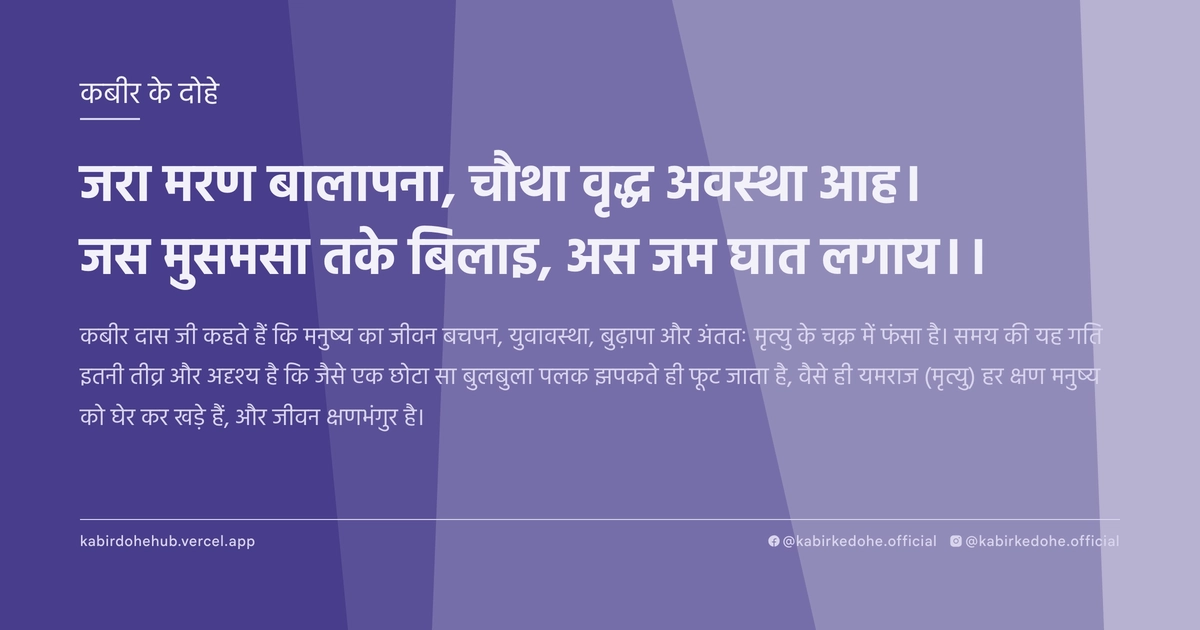
जरा मरण बालापना, चौथा वृद्ध अवस्था आह।
जस मुसमसा तके बिलाइ, अस जम घात लगाय।।
Jara maran balapana, chautha vriddh avastha aah. Jas musamsa take bilai, as jam ghat lagay.
इस पृष्ठ पर इस कबीर दोहे का अर्थ (meaning), हिंदी व्याख्या और अंग्रेज़ी अनुवाद, दार्शनिक विश्लेषण और व्यावहारिक जीवन सीख दी गई है। यह दोहा मृतुक्यता (Mortality) विषय से जुड़ा है — Kabir doha meaning and explanation in Hindi and English.
अर्थ (Meaning):
कबीर दास जी कहते हैं कि मनुष्य का जीवन बचपन, युवावस्था, बुढ़ापा और अंततः मृत्यु के चक्र में फंसा है। समय की यह गति इतनी तीव्र और अदृश्य है कि जैसे एक छोटा सा बुलबुला पलक झपकते ही फूट जाता है, वैसे ही यमराज (मृत्यु) हर क्षण मनुष्य को घेर कर खड़े हैं, और जीवन क्षणभंगुर है।
Kabir explains that human existence is a relentless cycle of childhood, youth, old age, and inevitable death. The passage of time is so swift and subtle that life vanishes like a tiny bubble bursting in an instant; death (Yama) is an ever-present shadow, waiting to claim the soul at any moment.
व्याख्या (Interpretation):
यह दोहा जीवन की नश्वरता का एक गहरा विश्लेषण है। कबीर यहाँ चार अवस्थाओं का वर्णन करते हैं, लेकिन उनका वास्तविक उद्देश्य समय की क्रूरता को दिखाना है। 'मुसमसा' या बुलबुले का उदाहरण माया के भ्रम को दर्शाता है—जिस तरह बुलबुला अस्तित्व में होते हुए भी शून्य है, वैसे ही हमारा अहंकार और भौतिक पहचान क्षणिक है। यह निर्गुण भक्ति का आह्वान है, जहाँ साधक को यह समझना होता है कि शरीर केवल एक वस्त्र है। जब हम इस अनित्यता को पहचान लेते हैं, तब हम 'अहं' से मुक्त होकर उस अविनाशी ब्रह्म (Atman-Brahman) की ओर बढ़ते हैं। यहाँ विरोधाभास यह है कि मृत्यु का भय ही वास्तव में जीवन की सार्थकता और आध्यात्मिक जागृति का द्वार खोलता है।
This couplet serves as a profound meditation on the transience of existence. By delineating the four stages of life, Kabir emphasizes the relentless momentum of time. The metaphor of the 'musamsa' (bubble) represents the illusion of Maya—just as a bubble appears substantial yet is essentially void, our ego and material identity are fleeting. This is a call toward Nirgun Bhakti, urging the seeker to realize that the physical body is merely a garment. Once this impermanence is internalized, one transcends the 'I' to merge with the eternal Brahman. The central paradox lies in the fact that the acute awareness of death is the only catalyst capable of triggering true spiritual awakening.
दार्शनिक विश्लेषण (Philosophical Analysis):
कबीर का यह दर्शन उनके समय के कर्मकांडीय धर्म के विरुद्ध एक प्रहार था। जहाँ लोग मोक्ष के लिए कठिन तीर्थयात्राओं और बाहरी अनुष्ठानों में विश्वास करते थे, कबीर ने 'क्षणभंगुरता' के मनोविज्ञान पर जोर दिया। उन्होंने तर्क दिया कि यदि मृत्यु हर पल करीब है, तो बाहरी दिखावे का कोई अर्थ नहीं रह जाता।
यह विचार अद्वैत वेदांत के करीब है, जहाँ संसार को 'मिथ्या' माना गया है। कबीर कहते हैं कि हम जिस शरीर और सामाजिक पहचान (जाति, पद) को सत्य मानते हैं, वह वास्तव में एक सपना है। जब साधक इस सत्य को स्वीकार करता है, तो वह द्वैत (दो होने का भाव) से मुक्त हो जाता है और स्वयं को उस अनंत चेतना का हिस्सा मानने लगता है।
सूफी मत के 'फना' (अहंकार का विनाश) के सिद्धांत से भी यह जुड़ा है। कबीर के अनुसार, जब तक मनुष्य यह नहीं मानता कि वह 'मिटने' वाला है, वह 'अमर' सत्य को प्राप्त नहीं कर सकता। यह मृत्यु का भय नहीं, बल्कि मृत्यु की वास्तविकता का उत्सव है, जो हमें वर्तमान क्षण में पूरी तरह जीने और ईश्वर से जुड़ने के लिए प्रेरित करता है।
ऐतिहासिक रूप से, कबीर ने समाज के सबसे निचले तबके को यह सिखाया कि मृत्यु सबको समान बनाती है। न कोई राजा है, न कोई रंक; न कोई ब्राह्मण, न कोई अछूत। यह समानता का दर्शन उन्हें सामाजिक बंधनों से मुक्त करता है और उन्हें सीधे परमात्मा से जोड़ता है।
अंततः, यह दोहा एक मनोवैज्ञानिक रूपांतरण की मांग करता है। यह हमें सिखाता है कि आध्यात्मिक प्रगति बाहरी ज्ञान से नहीं, बल्कि इस अहसास से आती है कि समय हमारे हाथ से रेत की तरह फिसल रहा है। यही वह 'घात' है जिसे यमराज ने लगाया है—समय का निरंतर क्षय।
Kabir's philosophy here is a direct critique of the ritualistic religion of his era. While contemporaries sought salvation through arduous pilgrimages and external rites, Kabir emphasized the psychology of impermanence. He argued that if death is an ever-present reality, external displays of piety become meaningless.
This perspective aligns closely with Advaita Vedanta, which posits the world as 'Mithya' (illusory). Kabir suggests that the body and social identities—caste, status, wealth—are mere projections. When the seeker accepts this transience, the sense of duality vanishes, and they recognize themselves as a fragment of the infinite consciousness.
Furthermore, this resonates with the Sufi concept of 'Fana' (the annihilation of the self). Kabir posits that until a human accepts their own 'vanishing' nature, they cannot attain the 'Immortal' Truth. This is not a morbid obsession with death, but a celebration of reality that compels the individual to live fully in the present and connect with the Divine.
Historically, Kabir used this truth to empower the marginalized. By highlighting that death is the ultimate equalizer, he dismantled the hierarchy of caste and class. In the eyes of Yama, there is no king or beggar, no priest or outcast. This radical equality liberated the masses from social shackles and pointed them toward a direct, unmediated relationship with God.
Ultimately, the couplet demands a psychological transformation. It teaches that spiritual evolution does not come from scholarly knowledge, but from the visceral realization that time is slipping away like sand. This is the 'trap' set by Yama—the constant, invisible erosion of our existence.
मूल संदेश (Core Message):
- अहंकार एक बुलबुला है जो सत्य के स्पर्श से फूट जाता है।
- समय की गति को पहचानना ही वास्तविक जागृति है।
- शरीर की नश्वरता को स्वीकार करना ही मुक्ति का पहला कदम है।
- बाहरी अनुष्ठानों से ऊपर उठकर आंतरिक सत्य को खोजें।
- वर्तमान क्षण ही एकमात्र सत्य है, बाकी सब माया है।
- मृत्यु अंत नहीं, बल्कि शाश्वत यात्रा का प्रारंभ है।
- The ego is a bubble that bursts upon the touch of Truth.
- Recognizing the velocity of time is the essence of awakening.
- Accepting bodily transience is the first step toward liberation.
- Rise above external rituals to discover the internal Truth.
- The present moment is the only reality; all else is Maya.
- Death is not an end, but the beginning of the eternal journey.
व्यावहारिक उदाहरण (Practical Example):
वाराणसी के एक पुराने घाट पर रहने वाले एक वृद्ध बुनकर थे, जिनका नाम माधव था। माधव अपनी कला में निपुण थे और उन्हें अपनी बनाई रेशमी साड़ियों पर बहुत गर्व था। वे मानते थे कि उनकी कला उन्हें अमर बना देगी और लोग सदियों तक उनके काम की प्रशंसा करेंगे।
माधव का अहंकार इतना बढ़ गया था कि वे अपने छोटे शिष्यों को तुच्छ समझते थे और उन्हें सिखाने में आनाकानी करते थे। वे सोचते थे कि उनकी श्रेष्ठता उनके कौशल में है, जो कभी खत्म नहीं होगा।
एक दिन, माधव ने देखा कि उनके सबसे प्रिय शिष्य का एक छोटा बच्चा खेलते हुए अचानक एक बुलबुले को देख रहा था। बच्चा खुश था, लेकिन जैसे ही उसने बुलबुले को छूना चाहा, वह फूट गया। बच्चा रोने लगा, लेकिन माधव को अचानक एक गहरा झटका लगा।
उन्हें याद आया कि उनका अपना जीवन भी उसी बुलबुले की तरह है। उन्होंने अपनी उंगलियों को देखा, जो अब कांप रही थीं। उन्हें अहसास हुआ कि जिस 'अमरता' का वे सपना देख रहे थे, वह केवल एक भ्रम था।
उसी शाम, माधव ने अपनी सारी गुप्त तकनीकें अपने शिष्यों को सिखाना शुरू कर दिया। उन्होंने महसूस किया कि यदि वे केवल अपने लिए संचित करेंगे, तो उनकी मृत्यु के साथ सब कुछ समाप्त हो जाएगा।
उन्होंने अपने अहंकार को त्याग दिया और यह समझ लिया कि असली विरासत वह नहीं है जो कपड़ों में बची रहे, बल्कि वह है जो दूसरों के जीवन में ज्ञान बनकर बहे।
माधव का व्यवहार पूरी तरह बदल गया। वे अब विनम्र थे और हर व्यक्ति में उसी ईश्वर का अंश देखते थे।
उन्होंने अपनी साड़ियों पर अपना नाम लिखना बंद कर दिया और उन्हें 'परमात्मा की भेंट' कहना शुरू किया।
जब माधव की मृत्यु हुई, तो पूरा शहर उनके लिए रोया, इसलिए नहीं कि वे एक महान बुनकर थे, बल्कि इसलिए क्योंकि वे एक महान इंसान बन चुके थे।
यह 'कबीर ट्विस्ट' था—मृत्यु की अनिवार्यता को स्वीकार करने से माधव का जीवन वास्तव में सार्थक और अमर हो गया।
In the ancient ghats of Varanasi lived an elderly weaver named Madhav. Madhav was a master of his craft, possessing an immense pride in the silk sarees he created. He believed his artistry would make him immortal and that people would praise his work for centuries.
Madhav's ego grew so large that he began to look down upon his young apprentices, hesitating to share the secrets of his trade. He believed his superiority lay in a skill that would never fade.
One afternoon, Madhav observed a small child, the son of one of his students, watching a soap bubble floating in the air. The child was mesmerized, but the moment he reached out to touch it, the bubble burst. The child cried, but Madhav felt a sudden, profound shock.
He realized that his own life was exactly like that bubble. He looked at his fingers, which had begun to tremble with age. He understood that the 'immortality' he sought through his art was a mere illusion.
That very evening, Madhav began teaching all his secret techniques to his students. He realized that if he hoarded his knowledge, it would perish with him.
He surrendered his ego and understood that a true legacy is not something woven into fabric, but something that flows as wisdom into the lives of others.
Madhav's behavior transformed completely. He became humble and began to see a spark of the Divine in every person he encountered.
He stopped signing his name on his sarees and instead began calling them 'Offerings to the Eternal'.
When Madhav eventually passed away, the entire city mourned him—not because he was a great weaver, but because he had become a great human being.
This was the 'Kabir Twist'—by accepting the inevitability of death, Madhav's life finally attained a meaningful and lasting immortality.
अभ्यास मार्गदर्शन (Practice Guidance):
- प्रतिदिन 10 मिनट 'मृत्यु-चिंतन' (Memento Mori) का अभ्यास करें, यह सोचकर कि यह शरीर क्षणिक है और केवल चेतना शाश्वत है।
- एक जर्नल लिखें जिसमें आप उन तीन चीजों की सूची बनाएं जिन पर आप सबसे अधिक गर्व करते हैं, और फिर विश्लेषण करें कि 100 साल बाद उनका क्या मूल्य होगा।
- व्यवहार परिवर्तन: जब भी क्रोध या अहंकार महसूस हो, तो स्वयं से पूछें—'क्या यह भावना मेरी मृत्यु के क्षण में भी महत्वपूर्ण होगी?'
- डायग्नोस्टिक चेकलिस्ट: यदि आप छोटी बातों पर अत्यधिक तनाव लेते हैं या भविष्य की सुरक्षा के लिए वर्तमान का त्याग कर रहे हैं, तो आप इस ज्ञान को जीने में विफल हो रहे हैं।
- Practice 10 minutes of 'Death Contemplation' (Memento Mori) daily, reflecting on the fact that the body is transient and only consciousness is eternal.
- Maintain a journal listing three things you are most proud of, then analyze their value from the perspective of 100 years into the future.
- Behavioral Shift: Whenever ego or anger arises, ask yourself—'Will this emotion hold any significance at the moment of my death?'
- Diagnostic Checklist: If you are overly stressed by trivialities or sacrificing the present for future security, you are failing to live this wisdom.
चिंतन प्रश्न (Reflection Questions):
- यदि आज आपका अंतिम दिन हो, तो आपकी कौन सी उपलब्धियां वास्तव में मायने रखेंगी और कौन सी व्यर्थ लगेंगी?
- आप अपनी सामाजिक पहचान (पद, प्रतिष्ठा) को बचाने के लिए अपनी आंतरिक शांति का कितना बलिदान करते हैं?
- क्या आपका 'डिजिटल व्यक्तित्व' आपके वास्तविक अस्तित्व को ढक रहा है?
- आप मृत्यु से डरते हैं या उस सत्य से जिसे मृत्यु उजागर करती है?
- यदि आप इस शरीर के बिना हैं, तो आप वास्तव में कौन हैं?
- If today were your final day, which of your achievements would truly matter and which would seem futile?
- How much of your inner peace do you sacrifice to maintain your social identity (status, reputation)?
- Is your 'digital persona' obscuring your authentic existence?
- Do you fear death, or do you fear the Truth that death reveals?
- If you are stripped of this body, who are you, really?