
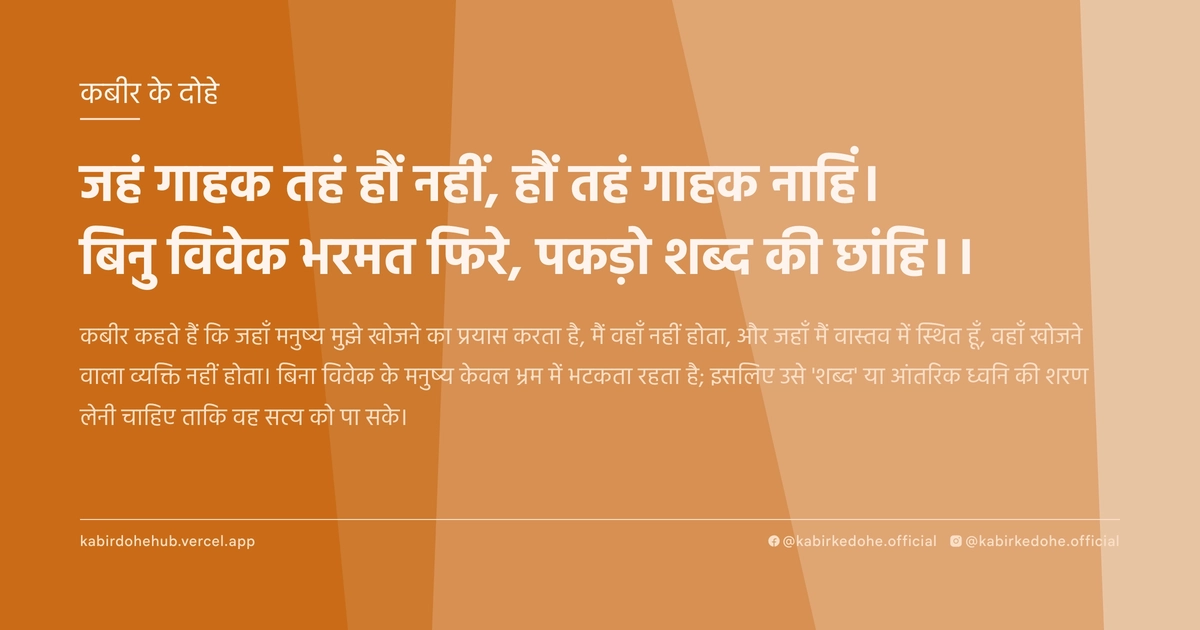
जहं गाहक तहं हौं नहीं, हौं तहं गाहक नाहिं।
बिनु विवेक भरमत फिरे, पकड़ो शब्द की छांहि।।
Jahan gahak tahan haun nahi, haun tahan gahak nahin. Binu vivek bharmat phire, pakdo shabd ki chhanhi.
इस पृष्ठ पर इस कबीर दोहे का अर्थ (meaning), हिंदी व्याख्या और अंग्रेज़ी अनुवाद, दार्शनिक विश्लेषण और व्यावहारिक जीवन सीख दी गई है। यह दोहा निर्गुण ब्रह्म (Nirguna Brahman) विषय से जुड़ा है — Kabir doha meaning and explanation in Hindi and English.
अर्थ (Meaning):
कबीर कहते हैं कि जहाँ मनुष्य मुझे खोजने का प्रयास करता है, मैं वहाँ नहीं होता, और जहाँ मैं वास्तव में स्थित हूँ, वहाँ खोजने वाला व्यक्ति नहीं होता। बिना विवेक के मनुष्य केवल भ्रम में भटकता रहता है; इसलिए उसे 'शब्द' या आंतरिक ध्वनि की शरण लेनी चाहिए ताकि वह सत्य को पा सके।
Kabir asserts that where the seeker looks for the Divine, the Divine is absent, and where the Divine truly resides, the seeker is not present. Without spiritual discernment, a person wanders in illusion; therefore, one must seek refuge in the 'Shabd' (the Eternal Sound/Word) to find the ultimate truth.
व्याख्या (Interpretation):
इस दोहे का शाब्दिक अर्थ है कि ईश्वर और साधक के बीच एक विरोधाभास है। जब तक साधक अपनी बाहरी इंद्रियों और अहंकार के माध्यम से खोजता है, वह ईश्वर से दूर रहता है क्योंकि वह 'बाहर' खोज रहा है। जैसे ही वह स्वयं के भीतर विलीन होता है, 'खोजने वाला' (अहंकार) समाप्त हो जाता है और केवल 'खोजा जाने वाला' (परमात्मा) शेष रहता है। यह निर्गुण भक्ति का सार है, जहाँ ईश्वर किसी मूर्ति या स्थान में नहीं, बल्कि चेतना के शुद्धतम रूप में है। माया वह पर्दा है जो हमें यह विश्वास दिलाता है कि हम और ईश्वर अलग हैं। यह अद्वैत वेदांत के उस सिद्धांत को दर्शाता है जहाँ आत्मा और ब्रह्म एक ही हैं, लेकिन अज्ञानता के कारण द्वैत का भ्रम बना रहता है। 'शब्द' यहाँ केवल वाणी नहीं, बल्कि वह अनाहत नाद है जो ब्रह्मांड की मूल कंपन है।
The literal meaning suggests a paradox between the seeker and the Divine. As long as the seeker searches through external senses and the ego, they remain distant from God because they are looking 'outside.' The moment the seeker dissolves into their own essence, the 'seeker' (the ego) ceases to exist, and only the 'Sought' (the Divine) remains. This is the essence of Nirgun Bhakti, where God is not found in idols or locations but in the purest form of consciousness. Maya is the veil that convinces us of a separation between the self and the Divine. This aligns with Advaita Vedanta, where Atman and Brahman are one, yet the illusion of duality persists due to ignorance. The 'Shabd' here refers not to spoken words, but to the Anahata Nada—the unstruck sound, the primordial vibration of the universe.
दार्शनिक विश्लेषण (Philosophical Analysis):
कबीर का यह दोहा मध्यकालीन भारत के उस सामाजिक और धार्मिक परिवेश में रचा गया था जहाँ कर्मकांड और बाहरी आडंबर चरम पर थे। कबीर ने पुरोहितवाद और मंदिर-मस्जिद की दीवारों को चुनौती देते हुए यह स्पष्ट किया कि सत्य किसी भौगोलिक स्थान या धार्मिक अनुष्ठान का मोहताज नहीं है। उनका दृष्टिकोण पूरी तरह से आंतरिक रूपांतरण पर केंद्रित था।
दार्शनिक रूप से, यह दोहा 'नेति-नेति' (यह नहीं, वह नहीं) की प्रक्रिया को दर्शाता है। जब कबीर कहते हैं कि 'जहाँ गाहक तहं हौं नहीं', तो वे उस मानसिक अवस्था की बात कर रहे हैं जहाँ अहंकार सक्रिय है। अहंकार की उपस्थिति में परमात्मा का अनुभव असंभव है क्योंकि अहंकार 'मैं' की भावना पैदा करता है, जबकि परमात्मा 'सर्व' है। यह सूफी मत के 'फना' (अहंकार का विनाश) के सिद्धांत के समान है, जहाँ साधक अपनी व्यक्तिगत पहचान को ईश्वर की इच्छा में विलीन कर देता है।
अद्वैत वेदांत के संदर्भ में, यह दोहा माया के प्रभाव को उजागर करता है। माया हमें यह विश्वास दिलाती है कि हम एक सीमित शरीर हैं जो किसी बाहरी शक्ति की खोज कर रहे हैं। कबीर इस भ्रम को तोड़ने के लिए 'विवेक' की बात करते हैं। विवेक वह क्षमता है जो नित्य (शाश्वत) और अनित्य (क्षणिक) के बीच अंतर कर सके।
कबीर का 'शब्द' योग यहाँ महत्वपूर्ण है। वे बताते हैं कि जब बाहरी शोर शांत हो जाता है और मन स्थिर होता है, तब आंतरिक ध्वनि सुनाई देती है। यह ध्वनि ही वह सेतु है जो जीव को शिव से जोड़ती है। यह किसी मंत्र का जाप नहीं, बल्कि अस्तित्व की मौन गूँज है जिसे केवल शून्य में अनुभव किया जा सकता है।
अंततः, यह शिक्षण हमें सिखाता है कि आध्यात्मिक यात्रा 'प्राप्ति' की नहीं, बल्कि 'त्याग' की है। हमें कुछ पाना नहीं है, बल्कि उस भ्रम को त्यागना है कि हम अलग हैं। जब खोजने वाला मिट जाता है, तो जो बचता है वही सत्य है। यह अहंकार के पूर्ण विलोपन की प्रक्रिया है, जिसके बाद केवल शुद्ध चेतना शेष रहती है।
This couplet was composed during a period in medieval India when ritualism and external displays of piety were dominant. Kabir challenged the priesthood and the confines of temples and mosques, clarifying that Truth is not dependent on geographical locations or religious rituals. His approach was centered entirely on internal transformation.
Philosophically, this doha illustrates the process of 'Neti-Neti' (not this, not that). When Kabir says, 'Where the seeker is, I am not,' he refers to the mental state where the ego is active. In the presence of ego, the experience of the Divine is impossible because the ego creates the sense of 'I,' whereas the Divine is 'All.' This mirrors the Sufi concept of 'Fana' (annihilation), where the seeker dissolves their individual identity into the Divine Will.
In the context of Advaita Vedanta, this doha highlights the influence of Maya. Maya convinces us that we are limited physical beings searching for an external power. Kabir advocates for 'Viveka' (discernment) to break this illusion. Viveka is the capacity to distinguish between the Eternal (Nitya) and the ephemeral (Anitya).
Kabir's 'Shabd Yoga' is pivotal here. He explains that when external noise subsides and the mind becomes still, the internal sound is heard. This sound is the bridge connecting the individual soul (Jiva) to the Universal Soul (Shiva). It is not the chanting of a mantra, but the silent resonance of existence, audible only in the void.
Ultimately, this teaching suggests that the spiritual journey is not one of 'acquisition' but of 'relinquishment.' We are not meant to find something new, but to discard the illusion of separation. When the seeker vanishes, what remains is the Truth. This is the process of total ego-effacement, leaving behind only pure consciousness.
मूल संदेश (Core Message):
- बाहरी खोज केवल भ्रम और मानसिक थकान पैदा करती है।
- अहंकार की उपस्थिति परमात्मा के अनुभव की सबसे बड़ी बाधा है।
- सत्य को पाने के लिए पहले 'पाने वाले' को मिटाना होगा।
- आंतरिक मौन ही वह द्वार है जहाँ शब्द और शून्य मिलते हैं।
- विवेक ही वह उपकरण है जो माया के पर्दे को हटाता है।
- परमात्मा कोई गंतव्य नहीं, बल्कि हमारी अपनी शुद्ध चेतना है।
- External searching only produces illusion and mental exhaustion.
- The presence of ego is the greatest obstacle to experiencing the Divine.
- To attain the Truth, the 'attainer' must first be annihilated.
- Inner silence is the gateway where the Word and the Void meet.
- Discernment is the only tool that can lift the veil of Maya.
- The Divine is not a destination, but our own pure consciousness.
व्यावहारिक उदाहरण (Practical Example):
वाराणसी के घाटों पर रहने वाला एक वृद्ध विधवा, जिसे लोग 'माई' कहते थे, अपना पूरा जीवन गंगा किनारे पूजा-पाठ और कठिन उपवासों में बिता चुकी थी। वह मानती थी कि यदि वह और अधिक तपस्या करेगी, तो ईश्वर उसे दर्शन देंगे। वह घंटों मूर्तियों के सामने रोती और प्रार्थना करती, लेकिन उसे भीतर एक खालीपन महसूस होता था।
एक दिन उसकी मुलाकात एक घुमंतू साधु से हुई जिसने उसे कबीर का यह दोहा सुनाया। माई ने पूछा, 'मैं इतनी खोज कर रही हूँ, फिर भी ईश्वर नहीं मिले। क्यों?' साधु ने मुस्कुराकर कहा, 'माई, तुम ईश्वर को वहाँ खोज रही हो जहाँ तुम खुद खड़ी हो। जब तक तुम 'मैं खोज रही हूँ' के भाव में हो, तब तक तुम एक दीवार बन गई हो। ईश्वर उस दीवार के पीछे है, लेकिन दीवार खुद को देखने की कोशिश कर रही है।'
माई को यह बात समझ नहीं आई, लेकिन उसने साधु के कहने पर एक प्रयोग किया। उसने अपनी सारी प्रार्थनाएँ, अपनी माँगों की सूची और अपनी 'भक्त' होने की पहचान को त्याग दिया। उसने तय किया कि वह अब ईश्वर को 'पाने' की कोशिश नहीं करेगी, बल्कि बस चुपचाप बैठेगी।
शुरुआत में उसे बहुत बेचैनी हुई। उसका मन चिल्लाता था, 'क्या मैं सही कर रही हूँ? क्या मैं अब भी भक्त हूँ?' यह उसका अहंकार था जो अपनी पहचान खोने से डर रहा था। उसने महसूस किया कि उसकी पूरी भक्ति वास्तव में उसके अहंकार को संतुष्ट करने का एक तरीका थी—यह विचार कि 'मैं एक महान तपस्विनी हूँ।'
धीरे-धीरे, वह 'खोजने वाली' माई गायब होने लगी। एक शाम, जब वह गंगा की लहरों को देख रही थी, उसने अचानक महसूस किया कि वह लहरों को देख नहीं रही है, बल्कि वह स्वयं वह लहर है। वह जो खोजने निकली थी, वह उसके भीतर ही था, लेकिन वह उसे बाहर ढूंढ रही थी।
उस पल में, 'खोजने वाला' मिट गया। कोई प्रार्थना नहीं थी, कोई माँग नहीं थी, कोई पहचान नहीं थी। केवल एक गहरा, अनंत मौन था। उसने महसूस किया कि जिस ईश्वर को वह पत्थरों और मंत्रों में ढूंढ रही थी, वह वास्तव में उसकी अपनी सांसों की लय में छिपा था।
माई का व्यवहार पूरी तरह बदल गया। अब वह घंटों मंदिर में नहीं बैठती थी, बल्कि वह हर छोटे जीव में उसी 'शब्द' को सुनने लगी। वह अब दूसरों को उपदेश नहीं देती थी, बल्कि उनकी सेवा मौन रहकर करती थी।
उसका जीवन अब एक निरंतर ध्यान बन गया था। उसने जान लिया था कि जब तक 'मैं' रहता हूँ, तब तक 'वह' नहीं मिलता, और जब 'वह' मिलता है, तो 'मैं' बचता ही नहीं। यही कबीर का वह 'ट्विस्ट' था जिसने एक धार्मिक महिला को एक मुक्त आत्मा में बदल दिया।
In the ghats of Varanasi lived an elderly widow known as 'Mai,' who had spent her entire life in rigorous rituals and fasting by the Ganges. She believed that if she intensified her penance, God would finally grant her a vision. She wept for hours before idols, yet felt a persistent void within.
One day, she met a wandering monk who recited this doha of Kabir. Mai asked, 'I search so fervently, yet God remains elusive. Why?' The monk smiled and replied, 'Mai, you are searching for God where you yourself are standing. As long as you hold the feeling of "I am searching," you have become a wall. God is behind that wall, but the wall is trying to see itself.'
Mai did not immediately understand, but following the monk's advice, she attempted an experiment. She discarded all her prayers, her list of demands, and her identity as a 'devotee.' She decided she would no longer try to 'find' God; she would simply sit in silence.
Initially, she felt immense restlessness. Her mind screamed, 'Am I doing this right? Am I still a devotee?' This was her ego, terrified of losing its identity. She realized that her entire devotion had actually been a way to satisfy her ego—the notion that 'I am a great ascetic.'
Slowly, the 'seeking' Mai began to vanish. One evening, while watching the ripples of the Ganges, she suddenly felt that she was not observing the waves, but that she *was* the wave. That which she had set out to find was within her all along, but she had been looking outward.
In that moment, the 'seeker' dissolved. There was no prayer, no demand, no identity. There was only a deep, infinite silence. She realized that the God she sought in stones and mantras was actually hidden in the rhythm of her own breath.
Mai's behavior transformed completely. She no longer spent hours in the temple; instead, she began to hear that same 'Shabd' in every small creature. She stopped preaching to others and began serving them in absolute silence.
Her life became a continuous meditation. She understood that as long as the 'I' exists, 'He' is not found, and when 'He' is found, the 'I' no longer remains. This was the 'Kabir Twist' that transformed a religious woman into a liberated soul.
अभ्यास मार्गदर्शन (Practice Guidance):
- प्रतिदिन 20 मिनट 'शून्य ध्यान' का अभ्यास करें, जहाँ आप किसी मंत्र या विचार के पीछे नहीं भागेंगे, बल्कि केवल अपनी स्वाभाविक सांसों की ध्वनि को सुनेंगे।
- स्व-पूछताछ जर्नल: प्रतिदिन लिखें कि आज आपने कितनी बार 'मैं' (अहंकार) का उपयोग किया और कहाँ आप यह महसूस कर पाए कि आप केवल एक माध्यम हैं, कर्ता नहीं।
- व्यवहारिक परिवर्तन: किसी ऐसे व्यक्ति की निस्वार्थ सेवा करें जिससे आप घृणा करते हों, यह महसूस करते हुए कि आप उनकी सेवा नहीं कर रहे, बल्कि स्वयं के ही एक अंश की सेवा कर रहे हैं।
- नैदानिक चेकलिस्ट: यदि आप अभी भी आध्यात्मिक प्रगति के लिए 'पुरस्कार' या 'पहचान' की इच्छा रखते हैं, तो आप अभी भी 'गाहक' (खोजने वाले) की अवस्था में हैं। यदि आप मौन में सहज हैं, तो आप 'शब्द' के करीब हैं।
- Practice 20 minutes of 'Sunya Dhyana' (Void Meditation) daily, where you do not chase a mantra or thought, but simply listen to the natural sound of your breath.
- Self-Inquiry Journal: Record daily how many times you operated from the 'I' (ego) and where you felt you were merely a medium, not the doer.
- Behavioral Shift: Perform selfless service for someone you dislike, realizing that you are not serving another, but a different fragment of your own self.
- Diagnostic Checklist: If you still desire 'rewards' or 'recognition' for your spiritual progress, you are still in the state of the 'Gahak' (seeker). If you are comfortable in absolute silence, you are nearing the 'Shabd'.
चिंतन प्रश्न (Reflection Questions):
- क्या मेरी आध्यात्मिक खोज वास्तव में सत्य की प्यास है, या यह केवल मेरे अहंकार को एक 'पवित्र' पहचान देने का तरीका है?
- यदि मेरी सभी धार्मिक और सामाजिक पहचानें छीन ली जाएं, तो उस शून्य में कौन बचेगा?
- मैं किन बाहरी प्रतीकों (कपड़े, भाषा, रीति-रिवाज) के पीछे छिपकर खुद को दूसरों से श्रेष्ठ महसूस करता हूँ?
- क्या मैं मौन से डरता हूँ क्योंकि मौन में मेरा 'अहंकार' अपनी आवाज खो देता है?
- मेरे जीवन का वह कौन सा हिस्सा है जहाँ मैं अभी भी 'कर्ता' होने का दावा करता हूँ, जबकि सब कुछ नियति है?
- क्या मैं ईश्वर को इसलिए खोज रहा हूँ क्योंकि मैं उनसे प्यार करता हूँ, या इसलिए क्योंकि मैं उनसे कुछ चाहता हूँ?
- Is my spiritual quest truly a thirst for Truth, or is it just a way to give my ego a 'holy' identity?
- If all my religious and social identities were stripped away, who would remain in that void?
- Behind which external symbols (clothing, language, rituals) do I hide to feel superior to others?
- Do I fear silence because in silence, my 'ego' loses its voice?
- In which part of my life do I still claim to be the 'doer,' while everything is actually destiny?
- Am I searching for God because I love Him, or because I want something from Him?