
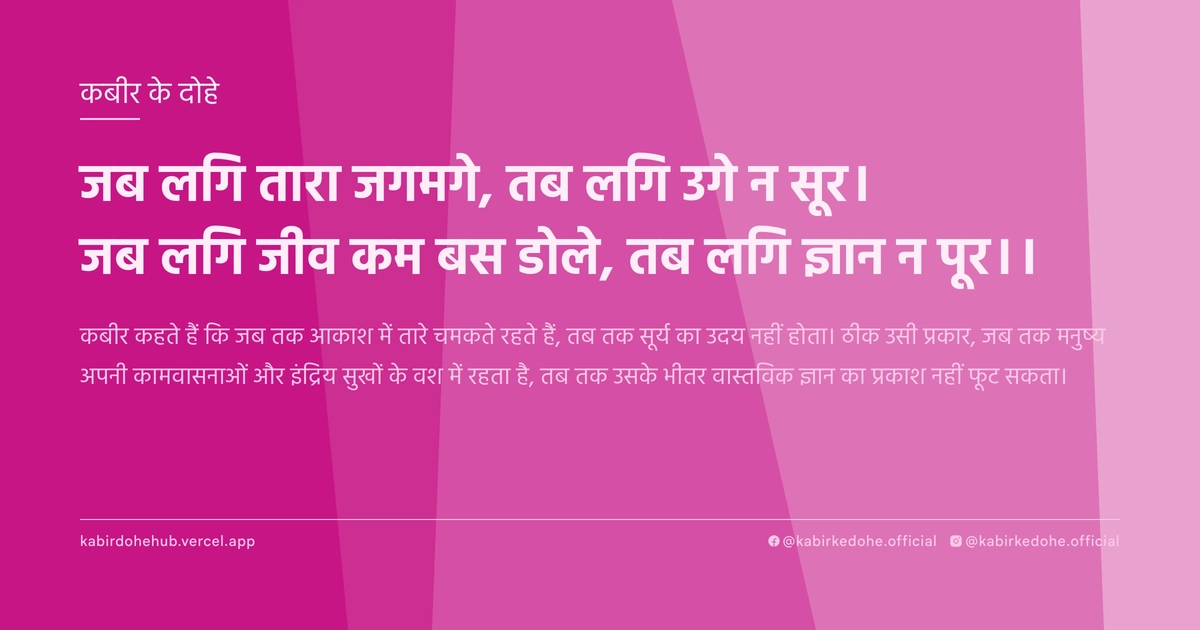
जब लगि तारा जगमगे, तब लगि उगे न सूर।
जब लगि जीव कम बस डोले, तब लगि ज्ञान न पूर।।
Jab lagi tara jagmage, tab lagi uge na sur. Jab lagi jeev kam bas dole, tab lagi gyan na pur.
इस पृष्ठ पर इस कबीर दोहे का अर्थ (meaning), हिंदी व्याख्या और अंग्रेज़ी अनुवाद, दार्शनिक विश्लेषण और व्यावहारिक जीवन सीख दी गई है। यह दोहा जागृति (The Wake-up Call) विषय से जुड़ा है — Kabir doha meaning and explanation in Hindi and English.
अर्थ (Meaning):
कबीर कहते हैं कि जब तक आकाश में तारे चमकते रहते हैं, तब तक सूर्य का उदय नहीं होता। ठीक उसी प्रकार, जब तक मनुष्य अपनी कामवासनाओं और इंद्रिय सुखों के वश में रहता है, तब तक उसके भीतर वास्तविक ज्ञान का प्रकाश नहीं फूट सकता।
Kabir explains that as long as the stars continue to twinkle in the sky, the sun does not rise. Similarly, as long as a human being remains enslaved by lust and sensory desires, the light of true spiritual knowledge cannot dawn within the soul.
व्याख्या (Interpretation):
इस दोहे में कबीर ने खगोलीय घटना का उपयोग आध्यात्मिक सत्य को समझाने के लिए किया है। तारे 'माया' और 'अल्प-सुख' के प्रतीक हैं, जो रात के अंधेरे में चमकते तो हैं लेकिन सूर्य जैसी पूर्णता नहीं रखते। 'सूर' या सूर्य यहाँ आत्म-ज्ञान (Self-realization) का प्रतीक है। जब जीव अपनी वासनाओं (काम) के अधीन होता है, तो वह केवल बाहरी चमक-धमक में उलझा रहता है। यह स्थिति अद्वैत वेदांत के उस विचार से मेल खाती है जहाँ अविद्या (अज्ञान) के कारण हम स्वयं को शरीर और मन समझते हैं। जब तक वासनाओं का अंधकार बना रहता है, तब तक ब्रह्म-साक्षात्कार संभव नहीं है। यह एक विरोधाभास है कि हम जिसे प्रकाश समझते हैं, वह वास्तव में सूर्य के आने में बाधा डालने वाले छोटे तारे मात्र हैं।
In this couplet, Kabir employs a celestial metaphor to illustrate a profound spiritual truth. The stars symbolize 'Maya' and transient pleasures—they glitter in the dark but lack the absolute brilliance of the sun. The 'Sun' represents the dawn of Self-realization. As long as the soul is driven by 'Kama' (desire/lust), it remains trapped in the superficial glimmer of the material world. This aligns with Advaita Vedanta, where 'Avidya' (ignorance) obscures the realization of the Atman. The central paradox is that the very things we chase for fulfillment (the stars) are the obstacles preventing the sunrise of true wisdom. Only when the agitation of desire ceases does the singular, all-pervading light of consciousness emerge.
दार्शनिक विश्लेषण (Philosophical Analysis):
कबीर का यह दर्शन निर्गुण भक्ति और सूफी मत के संगम पर स्थित है। उन्होंने अपने समय के उन पाखंडों पर प्रहार किया जो केवल बाहरी कर्मकांडों से मोक्ष की बात करते थे। कबीर का तर्क है कि मोक्ष किसी मंदिर या मस्जिद में नहीं, बल्कि वासनाओं के विसर्जन में है।
यहाँ 'काम' केवल यौन इच्छा नहीं, बल्कि किसी भी प्रकार का आसक्ति (Attachment) है। यह अद्वैत वेदांत के 'माया' सिद्धांत को पुष्ट करता है, जहाँ संसार की विविधता एक भ्रम है जो सत्य को ढंक लेती है। जब तक जीव 'मैं' और 'मेरा' के अहंकार में डूबा है, वह वास्तव में अंधकार में है।
सूफीवाद के 'फना' (अहंकार का विनाश) के सिद्धांत की तरह, कबीर भी कहते हैं कि ज्ञान की प्राप्ति के लिए पहले पुराने व्यक्तित्व का अंत होना आवश्यक है। जैसे सूर्य के आने पर तारे स्वतः लुप्त हो जाते हैं, वैसे ही ज्ञान के उदय होने पर वासनाएं समाप्त हो जाती हैं।
कबीर जाति और धर्म के बंधनों को नकारते हुए यह बताते हैं कि आध्यात्मिक यात्रा आंतरिक शुद्धिकरण की यात्रा है। वे चेतावनी देते हैं कि जो लोग केवल शास्त्रों को पढ़ते हैं लेकिन अपनी इंद्रियों पर नियंत्रण नहीं रखते, वे केवल अंधेरे में तारों को गिन रहे हैं।
मनोवैज्ञानिक स्तर पर, यह दोहा इच्छाओं के निरंतर चक्र (Hedonic Treadmill) की बात करता है। जब तक हम बाहरी उत्तेजनाओं से अपनी खुशी ढूंढते हैं, हम आंतरिक शांति से दूर रहते हैं। वास्तविक ज्ञान वह है जो हमें बाहरी निर्भरता से मुक्त कर आंतरिक पूर्णता की ओर ले जाए।
Kabir's philosophy here stands at the intersection of Nirgun Bhakti and Sufism. He critiques the ritualistic hypocrisy of his era, asserting that liberation is not found in temples or mosques, but in the dissolution of desire.
'Kama' in this context is not merely sexual lust, but any form of clinging or attachment. This reinforces the Advaita Vedanta concept of 'Maya,' where the perceived multiplicity of the world is an illusion obscuring the singular Truth. As long as the individual is immersed in the ego of 'I' and 'Mine,' they remain in spiritual darkness.
Mirroring the Sufi concept of 'Fana' (annihilation of the self), Kabir suggests that for the light of knowledge to dawn, the old, desire-driven identity must perish. Just as stars vanish upon the arrival of the sun, desires dissolve in the presence of true Gnosis.
By rejecting caste and creed, Kabir emphasizes that the spiritual journey is one of internal purification. He warns that those who merely study scriptures without mastering their senses are like people counting stars in the dark, mistaking a glimmer for the sun.
Psychologically, this verse addresses the 'Hedonic Treadmill'—the endless cycle of craving. When we seek fulfillment through external stimuli, we distance ourselves from inner peace. True knowledge is that which liberates us from external dependency and leads us toward an inherent, unshakable wholeness.
मूल संदेश (Core Message):
- इच्छाएं आध्यात्मिक जागृति के मार्ग में सबसे बड़ी बाधा हैं।
- बाहरी चमक-धमक अक्सर आंतरिक अंधकार को छिपाने का तरीका होती है।
- इंद्रियों पर विजय ही वास्तविक ज्ञान की पहली सीढ़ी है।
- जब 'मैं' की वासना मिटती है, तब 'ब्रह्म' का प्रकाश प्रकट होता है।
- शांति पाने के लिए वस्तुओं को जोड़ना नहीं, बल्कि मोह को छोड़ना आवश्यक है।
- Desires are the primary obstacles on the path to spiritual awakening.
- External glimmers often serve as masks for internal darkness.
- Mastery over the senses is the first step toward true gnosis.
- When the craving of the 'I' dissolves, the light of the Absolute emerges.
- Peace is achieved not by accumulating objects, but by releasing attachments.
व्यावहारिक उदाहरण (Practical Example):
वाराणसी के एक पुराने घाट पर रामदीन नाम का एक वृद्ध नाविक रहता था। वह अपनी नाव चलाने में निपुण था, लेकिन उसका मन हमेशा इस बात की लालसा में रहता था कि वह शहर के सबसे अमीर सेठ की नाव बन जाए। वह हर दिन नए-नए गहनों, रेशमी कपड़ों और विलासिता की वस्तुओं के सपने देखता था।
रामदीन का पूरा जीवन 'और अधिक' पाने की इच्छा में बीता। वह अपनी वर्तमान शांति को भूलकर उन 'तारों' के पीछे भाग रहा था जो उसे दूर से चमकते हुए दिखते थे। वह जितना अधिक धन कमाने की कोशिश करता, उसकी बेचैनी उतनी ही बढ़ती जाती।
एक दिन, उसकी मुलाकात एक मौन साधु से हुई। साधु ने रामदीन को गंगा की लहरों को देखने को कहा और पूछा, 'क्या तुम लहरों को पकड़ने की कोशिश कर रहे हो या बस उन्हें बहते हुए देख रहे हो?'
रामदीन ने महसूस किया कि वह अपनी पूरी जिंदगी उन इच्छाओं को पकड़ने की कोशिश कर रहा था जो कभी पूरी नहीं होती थीं। उसने देखा कि उसकी लालसा ही वह अंधकार था जिसने उसे उसके भीतर की शांति (सूर्य) को देखने से रोका था।
उस रात, रामदीन ने पहली बार अपनी नाव को किनारे लगाकर शांति से बैठा। उसने अपनी इच्छाओं को केवल देखा, उनसे जुड़ा नहीं। जैसे ही उसने 'पाने' की जिद छोड़ी, उसे एक अद्भुत संतोष का अनुभव हुआ।
उसने महसूस किया कि वह अब तक केवल बाहरी चमक-धमक के पीछे भाग रहा था, जबकि असली आनंद उसके भीतर ही था। उसकी बेचैनी खत्म हो गई और उसका मन शांत हो गया।
अब रामदीन अपनी नाव चलाता था, लेकिन अब वह धन के लिए नहीं, बल्कि सेवा और संतोष के लिए चलाता था। उसकी आँखों में अब एक अलग चमक थी—लालच की नहीं, बल्कि ज्ञान की।
उसने जान लिया था कि जब तक वह अपनी वासनाओं के वश में था, वह अंधकार में था। जैसे ही उसने वासनाओं का त्याग किया, उसके जीवन में ज्ञान का सूर्य उदय हो गया।
On an ancient ghat in Varanasi lived an elderly boatman named Ramdeen. He was skilled in his craft, but his mind was perpetually consumed by a longing to become the boatman for the city's wealthiest merchant. He spent his days dreaming of gold ornaments, silk robes, and luxuries.
Ramdeen's entire life passed in the pursuit of 'more.' He was chasing 'stars'—distant glimmers of luxury that seemed bright but provided no real warmth. The more he strove for wealth, the deeper his restlessness grew.
One day, he encountered a silent monk. The monk asked him to observe the ripples of the Ganges and questioned, 'Are you trying to catch the waves, or are you simply watching them flow?'
Ramdeen realized he had spent his life trying to grasp desires that were inherently fleeting. He saw that his craving was the very darkness preventing the 'sun' of inner peace from rising within him.
That night, for the first time, Ramdeen moored his boat and sat in stillness. He observed his desires without attaching himself to them. The moment he surrendered the grip of 'wanting,' a profound sense of contentment washed over him.
He understood that he had been chasing external reflections while the true light resided within. His agitation ceased, and his mind became a mirror of stillness.
Ramdeen continued to row his boat, but no longer for the sake of accumulation; he rowed for service and serenity. There was a new light in his eyes—not the glitter of greed, but the glow of wisdom.
He realized that as long as he was enslaved by his cravings, he was in the dark. Once he let go, the sun of knowledge dawned in his life.
अभ्यास मार्गदर्शन (Practice Guidance):
- दैनिक अवलोकन: दिन भर में जब भी कोई तीव्र इच्छा (लालच, क्रोध, वासना) जागे, तो उसे 'तारा' मानकर केवल देखें, उसमें बहें नहीं।
- आत्म-पूछताछ जर्नल: हर रात लिखें—'आज किस इच्छा ने मुझे मेरी आंतरिक शांति से दूर किया?' और विश्लेषण करें कि वह इच्छा वास्तविक थी या केवल एक भ्रम।
- सांस-केंद्रित ध्यान: 20 मिनट के लिए केवल अपनी सांसों पर ध्यान दें। जब मन भटककर किसी इच्छा की ओर जाए, तो धीरे से उसे वापस लाएं और कहें, 'मैं सूर्य हूँ, ये केवल तारे हैं।'
- निदान चेकलिस्ट: क्या मैं वर्तमान क्षण में संतुष्ट हूँ? क्या मेरी खुशी बाहरी वस्तुओं पर निर्भर है? क्या मैं दूसरों की सफलता से ईर्ष्या कर रहा हूँ? (यदि हाँ, तो ज्ञान का सूर्य अभी उदय नहीं हुआ है)।
- Daily Observation: Whenever an intense desire (greed, anger, lust) arises during the day, view it as a 'star'—observe it objectively without becoming entangled in it.
- Self-Inquiry Journal: Every night, record: 'Which desire pulled me away from my inner peace today?' Analyze whether that desire was a genuine need or a mere illusion.
- Breath-Centered Meditation: For 20 minutes, focus solely on your breath. When the mind drifts toward a craving, gently bring it back and affirm, 'I am the Sun; these are merely stars.'
- Diagnostic Checklist: Am I content in the present moment? Is my happiness dependent on external objects? Am I envious of others' success? (If yes, the sun of knowledge has not yet risen).
चिंतन प्रश्न (Reflection Questions):
- मेरे जीवन के वे कौन से 'तारे' हैं जिन्हें मैं सूर्य समझकर उनका पीछा कर रहा हूँ?
- क्या मेरी डिजिटल पहचान (सोशल मीडिया) मेरी वास्तविक आंतरिक स्थिति को छिपाने का एक मुखौटा है?
- यदि मेरी सभी भौतिक इच्छाएं आज पूरी हो जाएं, तो क्या मेरा अहंकार समाप्त होगा या और बढ़ जाएगा?
- मैं अपनी वासनाओं को दबाता हूँ या उन्हें साक्षी भाव से देखता हूँ?
- मेरे भीतर का वह कौन सा डर है जो मुझे पूर्ण समर्पण और आत्म-ज्ञान से रोकता है?
- Which 'stars' in my life am I mistakenly pursuing, believing them to be the sun?
- Is my digital identity a mask used to conceal my actual internal state of void or unrest?
- If all my material desires were fulfilled today, would my ego dissolve or expand further?
- Do I suppress my cravings, or do I observe them with the detachment of a witness?
- What is the hidden fear within me that prevents total surrender and self-realization?