
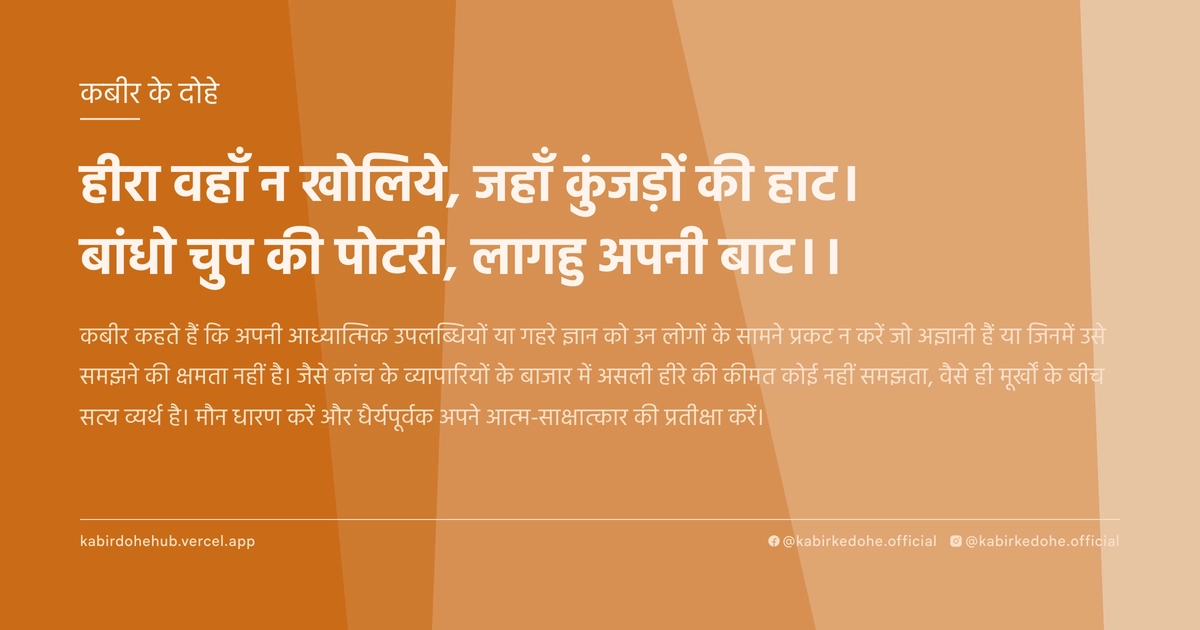
हीरा वहाँ न खोलिये, जहाँ कुंजड़ों की हाट।
बांधो चुप की पोटरी, लागहु अपनी बाट।।
Heera wahan na kholiye, jahan kunjdon ki haat. Bandho chup ki potari, laaghu apni baat.
इस पृष्ठ पर इस कबीर दोहे का अर्थ (meaning), हिंदी व्याख्या और अंग्रेज़ी अनुवाद, दार्शनिक विश्लेषण और व्यावहारिक जीवन सीख दी गई है। यह दोहा सत्संग (Satsang) विषय से जुड़ा है — Kabir doha meaning and explanation in Hindi and English.
अर्थ (Meaning):
कबीर कहते हैं कि अपनी आध्यात्मिक उपलब्धियों या गहरे ज्ञान को उन लोगों के सामने प्रकट न करें जो अज्ञानी हैं या जिनमें उसे समझने की क्षमता नहीं है। जैसे कांच के व्यापारियों के बाजार में असली हीरे की कीमत कोई नहीं समझता, वैसे ही मूर्खों के बीच सत्य व्यर्थ है। मौन धारण करें और धैर्यपूर्वक अपने आत्म-साक्षात्कार की प्रतीक्षा करें।
Kabir advises against revealing one's spiritual realizations or profound inner truths to those who lack the capacity to comprehend them. Just as a diamond's true value is ignored in a market of glass-bead sellers, spiritual truth is wasted on the ignorant. One should embrace silence and patiently await the arrival of a true seeker or the fruition of their own inner journey.
व्याख्या (Interpretation):
यह दोहा प्रतीकों के माध्यम से आंतरिक पवित्रता और बाहरी अज्ञान के द्वंद्व को दर्शाता है। 'हीरा' यहाँ आत्मा के ज्ञान, बोध या ईश्वर के साथ मिलन का प्रतीक है, जबकि 'कुंजड़' (कांच के टुकड़े) उन लोगों को दर्शाते हैं जो केवल बाहरी आडंबरों और भौतिकता में फंसे हैं। यह निरगुण भक्ति का एक सूक्ष्म पहलू है, जहाँ साधक को यह समझना होता है कि सत्य सार्वभौमिक है, लेकिन उसकी ग्राह्यता व्यक्तिगत पात्रता पर निर्भर करती है। माया यहाँ एक पर्दे की तरह है जो अज्ञानी को सत्य देखने से रोकती है। कबीर यहाँ 'मौन' को एक सुरक्षा कवच के रूप में प्रस्तुत करते हैं, जो साधक को अहंकार से बचाता है। यह अद्वैत वेदांत के उस सिद्धांत से जुड़ा है जहाँ ब्रह्म की चर्चा केवल योग्य शिष्यों के सामने की जाती है। अंततः, यह दोहा सिखाता है कि सत्य का प्रदर्शन अहंकार की तुष्टि है, जबकि सत्य का संरक्षण साधना है।
This couplet employs potent metaphors to illustrate the conflict between inner purity and external ignorance. The 'diamond' symbolizes the realization of the Atman, spiritual awakening, or the experience of the Divine, while the 'glass-beads' represent those trapped in superficiality and material delusions. It highlights a subtle aspect of Nirgun Bhakti: while Truth is universal, its receptivity depends on individual readiness. Maya acts as a veil, blinding the ignorant to the brilliance of the diamond. Kabir presents 'silence' not as a void, but as a protective sanctuary that shields the seeker from the pitfalls of spiritual pride. This aligns with the Advaita Vedanta tradition of sharing sacred knowledge only with those who possess the necessary 'Adhikara' (qualification). Ultimately, the verse teaches that displaying truth is an act of ego, whereas preserving it in silence is an act of devotion.
दार्शनिक विश्लेषण (Philosophical Analysis):
कबीर का यह दृष्टिकोण उनके युग के सामाजिक और धार्मिक पाखंड के विरुद्ध एक प्रतिक्रिया था। उस समय धर्म केवल कर्मकांडों और बाहरी पहचानों (जाति, वस्त्र, तिलक) तक सीमित था। कबीर ने देखा कि लोग सत्य की खोज करने के बजाय सत्य का 'दिखावा' करने में अधिक रुचि रखते थे। उन्होंने ritualism का विरोध करते हुए यह स्पष्ट किया कि ईश्वर किसी मंदिर या मस्जिद में नहीं, बल्कि भीतर के मौन में है।
दार्शनिक स्तर पर, यह दोहा 'गुह्य' (secret) ज्ञान की परंपरा को दर्शाता है, जो सूफीवाद के 'सिर्र' (secret) के समान है। सूफी संतों का मानना था कि ईश्वरीय प्रेम का अनुभव इतना गहरा होता है कि शब्दों में व्यक्त करने पर वह अपनी पवित्रता खो देता है। कबीर यहाँ साधक को चेतावनी दे रहे हैं कि जब आप अपने अनुभव को अज्ञानियों के सामने रखते हैं, तो आप अनजाने में अपने अहंकार को पोषण देते हैं, जिससे आध्यात्मिक प्रगति रुक जाती है।
अद्वैत वेदांत के अनुसार, जब व्यक्ति को यह अनुभव होता है कि वह और ब्रह्म एक ही हैं, तो वह द्वैत से ऊपर उठ जाता है। लेकिन समाज अभी भी द्वैत (मैं और तुम, सही और गलत) में जी रहा है। इस विरोधाभास के कारण, एक प्रबुद्ध व्यक्ति और एक अज्ञानी व्यक्ति के बीच संवाद अक्सर व्यर्थ होता है। कबीर इस मानसिक अंतराल को पाटने के बजाय मौन रहने की सलाह देते हैं।
मनोवैज्ञानिक रूप से, यह 'पुष्टि पूर्वाग्रह' (Confirmation Bias) की बात करता है। लोग वही देखते हैं जो वे देखना चाहते हैं। एक व्यक्ति जो केवल कांच की कीमत जानता है, वह हीरे को भी कांच ही समझेगा। इसलिए, सत्य को उन लोगों के सामने लाना जो उसे नकारने के लिए तैयार हैं, केवल मानसिक क्लेश को जन्म देता है।
अंततः, कबीर का संदेश यह है कि वास्तविक आध्यात्मिक उपलब्धि बाहरी प्रशंसा की मोहताज नहीं होती। जब साधक 'चुप की पोटरी' बांधता है, तो वह अपनी ऊर्जा को बाहर बिखेरने के बजाय भीतर केंद्रित करता है। यह ऊर्जा का संरक्षण ही उसे पूर्णता की ओर ले जाता है, जहाँ वह स्वयं ही हीरा और स्वयं ही जौहरी बन जाता है।
Kabir's perspective is a direct reaction to the social and religious hypocrisy of his era, where spirituality was reduced to mere rituals and external markers of identity such as caste, attire, or sectarian marks. He observed that people were more interested in the 'performance' of truth than the actual realization of it. By rejecting ritualism, Kabir emphasizes that the Divine resides not in structures, but in the profound silence of the interior.
Philosophically, this verse reflects the tradition of 'hidden knowledge,' mirroring the Sufi concept of 'Sirr' (the secret). Sufi mystics believed that the experience of Divine Love is so intimate and profound that attempting to articulate it in common language often strips it of its sanctity. Kabir warns that by presenting one's realizations to the ignorant, the seeker inadvertently feeds the ego, which becomes a barrier to further spiritual ascent.
According to Advaita Vedanta, once a seeker realizes the non-duality of Atman and Brahman, they transcend the world of opposites. However, the masses remain entrenched in duality (I vs. Thou). Because of this fundamental cognitive gap, dialogue between the enlightened and the ignorant often becomes a futile exercise. Kabir suggests silence as the only rational response to this discrepancy.
Psychologically, this addresses the phenomenon of 'Confirmation Bias.' People perceive reality through the lens of their own limitations. One who only knows the value of glass will perceive a diamond as merely a piece of glass. Thus, exposing truth to those predisposed to deny it only generates mental agitation and frustration for the seeker.
Ultimately, Kabir asserts that genuine spiritual achievement requires no external validation. By 'binding the bundle of silence,' the seeker stops leaking their spiritual energy into the void of public approval and instead redirects it inward. This conservation of energy is what leads to ultimate liberation, where the seeker becomes both the diamond and the jeweler.
मूल संदेश (Core Message):
- अहंकार की भूख सत्य के अनुभव को नष्ट कर देती है।
- मौन केवल शब्दहीनता नहीं, बल्कि आंतरिक सुरक्षा है।
- सत्य की कीमत केवल वही जानता है जो उसे खोजने के योग्य है।
- बाहरी प्रशंसा आध्यात्मिक पतन का पहला संकेत है।
- अपनी ऊर्जा को प्रदर्शन के बजाय संरक्षण में लगाएं।
- धैर्यपूर्वक सही समय और सही पात्र की प्रतीक्षा करें।
- The hunger for ego-validation destroys the experience of Truth.
- Silence is not just wordlessness, but an internal sanctuary.
- The value of Truth is known only to those qualified to seek it.
- External praise is often the first sign of spiritual decline.
- Invest your energy in preservation rather than performance.
- Wait patiently for the right moment and the right recipient.
व्यावहारिक उदाहरण (Practical Example):
वाराणसी के एक पुराने मोहल्ले में माधव नाम का एक वृद्ध बुनकर रहता था। माधव ने जीवन के अंतिम तीस वर्ष मौन साधना और आत्म-चिंतन में बिताए थे। उसने अनुभव किया था कि शांति केवल बाहरी शोर के थमने से नहीं, बल्कि भीतर के शोर के शांत होने से आती है।
उसकी इस शांति को देखकर मोहल्ले के कुछ लोग उसे 'पागल' या 'अक्षम' समझने लगे। वे अक्सर उसके पास बैठकर अपनी राजनीतिक शिकायतों और सांसारिक दुखों का रोना रोते थे। माधव बस मुस्कुराता और चुप रहता।
एक दिन, शहर का एक बड़ा विद्वान वहां आया। उसने माधव की ख्याति सुनी थी और उससे 'मोक्ष' के गुप्त मार्ग के बारे में पूछने लगा। विद्वान ने अपनी लंबी उपाधियों और शास्त्रों के ज्ञान का बखान किया और माधव को चुनौती दी कि वह अपनी 'उपलब्धि' साबित करे।
माधव ने देखा कि विद्वान केवल अपनी श्रेष्ठता सिद्ध करना चाहता था, वह वास्तव में सत्य को जानने का इच्छुक नहीं था। माधव ने महसूस किया कि यह व्यक्ति उस 'कुंजड़ों की हाट' की तरह है जहाँ ज्ञान केवल एक वस्तु है, अनुभव नहीं।
माधव ने एक शब्द भी नहीं बोला। उसने बस अपनी करघे की मशीन चालू की और लयबद्ध तरीके से कपड़े बुनने लगा। विद्वान को लगा कि माधव वास्तव में अज्ञानी है और वह झुंझलाकर वहां से चला गया।
लेकिन उसी शाम, एक छोटा बच्चा माधव के पास आया और बिना कुछ पूछे बस उसके पास बैठ गया। उस बच्चे की आंखों में एक सहज जिज्ञासा और सरलता थी।
माधव ने उस बच्चे को एक छोटा सा पत्थर दिया और कहा, 'इसे अपनी आंखें बंद करके महसूस करो, यह पत्थर नहीं, तुम्हारी अपनी धड़कन है।' वह बच्चा उस एक वाक्य से गहरे चिंतन में डूब गया।
माधव ने समझ लिया था कि हीरा कहाँ खोलना है। उसने विद्वान के अहंकार के सामने अपना मौन बनाए रखा और बच्चे की सरलता में अपना ज्ञान साझा किया।
इस 'कबीर ट्विस्ट' ने माधव को यह सिखाया कि मौन केवल शब्दों का अभाव नहीं है, बल्कि यह सही समय और सही पात्र की प्रतीक्षा करने का विवेक है।
अंततः, माधव की शांति उसके लिए एक ढाल बन गई, जिसने उसे बाहरी आलोचनाओं से बचाकर उसकी आंतरिक ज्योति को और अधिक प्रज्ज्वलित किया।
In an old lane of Varanasi lived an elderly weaver named Madhav. Madhav had spent the last thirty years of his life in silent meditation and deep self-inquiry. He had realized that peace does not come from the cessation of external noise, but from the silencing of the inner turmoil.
Observing his stillness, some neighbors began to perceive him as 'mad' or 'incapable.' They would often sit near him, venting their political grievances and worldly sorrows. Madhav would simply smile and remain silent.
One day, a renowned scholar from the city arrived. Having heard of Madhav's reputation, he began questioning him about the 'secret paths to liberation.' The scholar boasted of his numerous degrees and scriptural knowledge, challenging Madhav to 'prove' his spiritual attainment.
Madhav observed that the scholar was merely seeking to validate his own superiority; he had no genuine thirst for Truth. Madhav realized this man was like the 'market of glass-beads,' where knowledge is treated as a commodity, not an experience.
Madhav did not utter a single word. He simply started his loom and began weaving cloth in a rhythmic, meditative flow. The scholar, perceiving this as a sign of ignorance, left in a fit of frustration.
However, that same evening, a small child approached Madhav and sat beside him without asking anything. In the child's eyes was a natural curiosity and a profound simplicity.
Madhav handed the child a small pebble and whispered, 'Close your eyes and feel this; it is not a stone, but the echo of your own heartbeat.' That single sentence plunged the child into a state of deep contemplation.
Madhav knew exactly where to 'open the diamond.' He maintained his silence before the scholar's ego and shared his wisdom with the child's innocence.
This 'Kabir Twist' taught Madhav that silence is not merely the absence of speech, but the wisdom of waiting for the right moment and the right recipient.
Ultimately, Madhav's silence became a shield, protecting him from external judgment and allowing his inner light to burn more brightly.
अभ्यास मार्गदर्शन (Practice Guidance):
- दैनिक मौन अभ्यास: प्रतिदिन 30 मिनट के लिए 'पूर्ण मौन' (मौन व्रत) का पालन करें, जिसमें मानसिक संवाद को भी रोकने का प्रयास करें।
- आत्म-पूछताछ जर्नल: जब भी आपको अपनी उपलब्धियों को दूसरों को बताने की तीव्र इच्छा हो, तो लिखें: 'मैं यह प्रशंसा क्यों चाहता हूँ? क्या यह मेरी आत्मा की पुकार है या मेरे अहंकार की भूख?'
- व्यवहार परिवर्तन: किसी भी चर्चा में अपनी श्रेष्ठता सिद्ध करने के बजाय, सामने वाले की बात को बिना निर्णय के सुनने का अभ्यास करें।
- निदान चेकलिस्ट: यदि आप दूसरों की प्रतिक्रिया से विचलित हो रहे हैं या अपनी आध्यात्मिक यात्रा के लिए बाहरी मान्यता खोज रहे हैं, तो समझें कि आप अभी भी 'कांच के बाजार' में हैं।
- Daily Silence Practice: Observe 'Absolute Silence' (Mauna Vrata) for 30 minutes daily, attempting to still not only the tongue but also the internal mental chatter.
- Self-Inquiry Journaling: Whenever you feel a strong urge to broadcast your achievements or insights, write: 'Why do I seek this validation? Is this a call from my soul or a hunger of my ego?'
- Behavioral Shift: Instead of attempting to prove your superiority in a conversation, practice listening to the other person without judgment or the intent to correct.
- Diagnostic Checklist: If you find yourself agitated by others' opinions or searching for external validation for your spiritual progress, recognize that you are still operating within the 'market of glass-beads'.
चिंतन प्रश्न (Reflection Questions):
- मेरे जीवन में 'कांच के बाजार' कौन हैं—वे लोग जिनके सामने मैं अपनी छवि को बेहतर दिखाने की कोशिश करता हूँ?
- क्या मेरी आध्यात्मिक या बौद्धिक चर्चाएं वास्तव में दूसरों की मदद के लिए हैं, या वे मेरे 'डिजिटल ईगो' को पोषण दे रही हैं?
- जब कोई मेरे गहरे विश्वासों को गलत समझता है, तो मुझे क्रोध क्यों आता है? क्या वह क्रोध सत्य के लिए है या मेरी छवि के लिए?
- मैं अपने जीवन के किन रहस्यों को इतना पवित्र मानता हूँ कि उन्हें शब्दों में ढालना उनका अपमान होगा?
- यदि दुनिया मेरी सारी उपलब्धियों को भुला दे, तो क्या मेरे भीतर का 'हीरा' अभी भी चमकता रहेगा?
- Who are the 'glass-bead sellers' in my life—the people before whom I constantly try to project a superior image?
- Are my spiritual or intellectual discussions truly for the benefit of others, or are they feeding my 'digital ego'?
- Why do I feel anger when someone misunderstands my deep beliefs? Is that anger for the Truth, or for my bruised image?
- Which secrets of my life do I hold so sacred that translating them into words would feel like a desecration?
- If the world forgot all my achievements, would the 'diamond' within me still shine with the same intensity?